
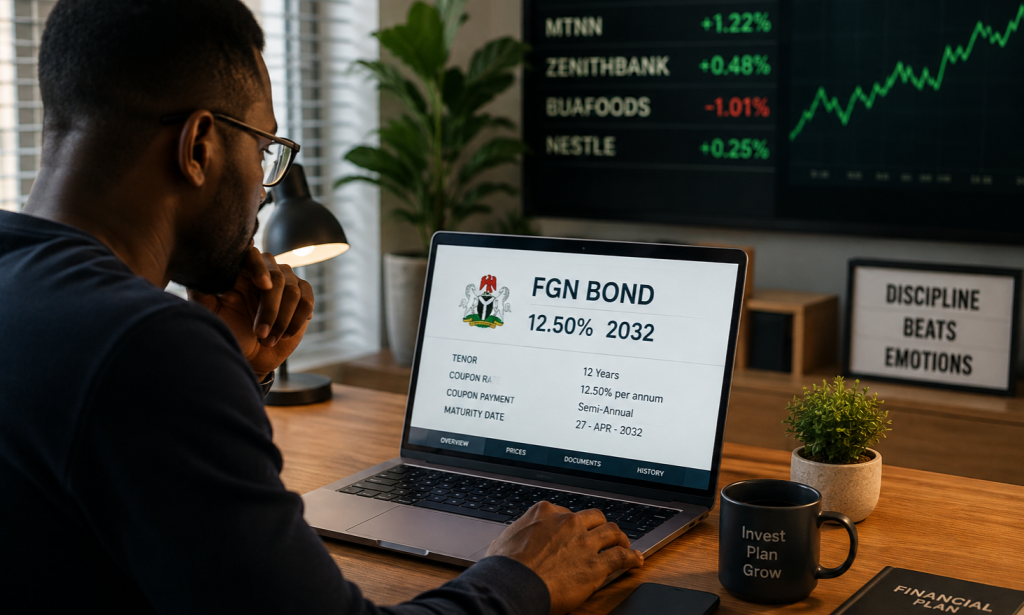
When you hear that someone invested in a bond, it can sound complicated.
In simple terms, a bond is a way of lending money to an issuer in exchange for interest and the repayment of your principal under the terms of the bond.
The issuer could be the Federal Government, a state government, a company or another eligible organisation.
For example, imagine a company wants to raise ₦1 billion to expand its business. Instead of borrowing all the money from a bank, it could raise money from investors by issuing bonds.
If you buy ₦100,000 worth of that bond, you are lending money to the issuer.
In return, the issuer agrees to pay you interest according to the bond's terms and repay the principal at maturity.
That is the basic idea behind bonds.
But bonds are more than just "invest and collect interest." Their prices can change, different bonds carry different levels of risk, and selling a bond before maturity can produce a gain or loss.
This guide explains how bonds work in Nigeria, the different types you may encounter, how investors make money from them and what you should understand before buying one.
Nigeria has different types of bonds, including Federal Government of Nigeria bonds, state bonds and corporate bonds. They can differ significantly in maturity, return, credit risk and liquidity.
Bonds can provide income and diversification, but they are not completely risk-free. Interest rates can affect bond prices, and corporate or state bonds can carry greater credit risk than government securities.
What Is a Bond?
A bond is essentially a loan that can be structured as a tradable security.
When an organisation needs to raise money, it can issue bonds to investors.
The investor provides the money.
The issuer promises to make payments according to the bond's terms.
At maturity, the issuer is expected to repay the principal.
The Securities and Exchange Commission (SEC) describes bonds as debt issued by corporations, states and the Federal Government, with investors receiving interest and repayment of principal according to the bond's terms.
This is why a bond is very different from a stock.
When you buy shares, you become an owner of part of the company.
When you buy a bond issued by that company, you are a lender, not an owner.
A Simple Example of How a Bond Works

Suppose a company issues a bond with these hypothetical terms:
- Face value: ₦100,000
- Coupon rate: 12% per year
- Maturity: 5 years
- Coupon payment: twice a year
If you buy the bond at its face value and the terms remain unchanged, the annual coupon would be:
₦100,000 × 12% = ₦12,000
If the coupon is paid twice a year, that would be:
₦6,000 every six months
At maturity, the issuer would repay the ₦100,000 principal, assuming it meets its obligations.
This is only an illustration. Actual bonds have their own coupon rates, prices, payment schedules, maturity dates and conditions.
The important thing to understand is:
Coupon payments are based on the bond's terms, while the market price of a bond can change after it is issued.
What Is the Principal of a Bond?
The principal is the amount on which the bond's coupon is generally calculated and the amount the issuer agrees to repay at maturity, subject to the bond's terms.
It may also be called:
- Face value
- Par value
- Nominal value
For example, if a bond has a face value of ₦100,000 and a 10% coupon rate, the annual coupon would be ₦10,000.
The price you actually pay to acquire the bond can be different from its face value if you purchase it in the secondary market.
That distinction becomes important when calculating your actual return.
What Is a Coupon?
The coupon is the interest payment associated with a bond.
Suppose a bond has:
- Face value: ₦500,000
- Coupon rate: 10%
The annual coupon based on the face value would be:
₦500,000 × 10% = ₦50,000
If the bond pays interest twice a year, the payment would be approximately ₦25,000 every six months.
The actual payment schedule depends on the specific bond.
The SEC notes that coupon payments can be made quarterly, semi-annually or annually depending on the bond's terms.
What Is the Maturity Date?
The maturity date is when the bond reaches the end of its agreed term and the issuer is expected to repay the principal.
For example, if you buy a five-year bond issued in 2026, it could mature in 2031.
This is one reason bonds can be useful for financial planning.
If you have a financial goal several years away, a bond with a suitable maturity can potentially provide income while giving you a known date for principal repayment.
However, maturity does not mean the investment is completely risk-free.
The issuer still has to be capable of meeting its obligations.
What Types of Bonds Are Available in Nigeria?

There are several types of bonds you may encounter in Nigeria.
1. Federal Government Bonds
These are issued by the Federal Government of Nigeria.
The Debt Management Office (DMO) explains that FGN bonds are debt contracts under which investors lend money to the Federal Government in exchange for coupon payments and repayment of the face value at maturity.
2. State Government Bonds
State governments can also raise money through bond issues.
The risk associated with a state bond is not necessarily identical to that of an FGN bond, so investors should examine the specific issue and its credit characteristics.
3. Corporate Bonds
Companies can issue bonds to raise money.
For example, a company might issue bonds to finance:
- New equipment
- Expansion
- Infrastructure
- Refinancing existing debt
- Other business projects
The investor earns the return specified by the bond's terms.
However, corporate bonds introduce credit risk.
If the company experiences serious financial difficulties, it may struggle to make its interest or principal payments.
4. Sukuk
Sukuk is a different form of investment structured according to Islamic finance principles.
It is often described as an Islamic alternative to conventional bonds, but it should not simply be treated as an identical product.
The SEC explains that Sukuk differs from conventional bonds in its structure, including its relationship with underlying assets and returns.
Government Bonds vs Corporate Bonds
This is one of the most important distinctions for beginners.
Suppose you have two bonds:
Bond A: issued by the Federal Government.
Bond B: issued by a company.
If the company has a greater chance of experiencing financial difficulties than the government issuer, investors may demand a higher return from the corporate bond to compensate for taking additional risk.
This is one reason corporate bonds can offer higher returns than some government bonds.
But:
Higher return usually comes with higher risk.
The SEC specifically identifies credit risk as the risk that an issuer may not make interest or principal payments when due.
So don't look at the highest coupon and immediately conclude that it is the best bond.
How Do Investors Make Money From Bonds?
There are two main ways a bond investor can potentially make money.
1. Coupon income
You receive interest according to the bond's terms.
For example, a ₦1 million bond with a hypothetical 10% coupon could provide ₦100,000 in annual coupon payments.
2. Capital gain
If you sell the bond for more than you paid for it, you can potentially make a capital gain.
For example:
You buy a bond for ₦950,000.
Later, you sell it for ₦980,000.
Your gross gain would be:
₦980,000 − ₦950,000 = ₦30,000
But the reverse can also happen.
If you buy it for ₦1 million and later sell it for ₦930,000, you would have a ₦70,000 capital loss before considering any applicable costs.
This is why a bond's coupon rate should not be confused with its total investment return.
Why Do Bond Prices Change?
This is one of the most confusing parts of bonds.
Bond prices can move when market interest rates change.
In general, existing bond prices and market interest rates move in opposite directions.
The SEC explains that when interest rates rise, prices of existing bonds tend to fall, while falling interest rates can push existing bond prices higher.
Here's a simplified example.
Imagine you own an existing bond paying a 10% coupon.
Later, newly issued bonds become available with similar risk but pay 14%.
Your old 10% bond is now less attractive to someone looking to buy a bond.
Its market price may therefore fall to compensate the new buyer.
The reverse can happen when market interest rates fall.
This relationship becomes especially important if you plan to sell a bond before maturity.
What If You Hold the Bond Until Maturity?
If you hold a bond until maturity and the issuer meets its obligations, you generally receive the principal according to the bond's terms.
That means temporary market price movements may matter less to you than they would to someone planning to sell before maturity.
However, this does not eliminate every risk.
The issuer still has to repay you.
Inflation can also reduce the purchasing power of your money.
And if the bond is callable or has other special provisions, its actual behaviour can differ from a simple hold-to-maturity example.
What Is Credit Risk?
Credit risk is the possibility that the issuer cannot meet its financial obligations.
Imagine you lend ₦1 million to a company through a corporate bond.
The company is expected to pay your coupons and eventually return your ₦1 million.
If the company's financial condition deteriorates badly, it may fail to make those payments.
That is a default.
This is why investors should investigate the issuer before buying a corporate bond.
A bond's credit rating can provide useful information, but it should not replace your own due diligence.
The SEC notes that credit-rating agencies assess an issuer's ability to meet its obligations and that investors should still perform appropriate due diligence.
What Is Interest Rate Risk?
Interest rate risk is the possibility that changes in market interest rates will affect the value of your bond.
Suppose you bought a bond when market rates were 10%.
Later, similar new bonds offer 15%.
Your existing bond may become less valuable in the secondary market.
If you need to sell it, you could receive less than you originally paid.
This matters particularly for investors who may need their money before maturity.
What Is Liquidity Risk?
Liquidity means how easily you can sell an investment without significantly affecting the price.
A bond may technically be tradable, but that does not guarantee that you will always find a buyer at the price you want.
The SEC identifies liquidity and market risk among the risks investors should consider when investing in bonds.
This is particularly important with some corporate or less actively traded bonds.
Before buying a bond, don't just ask:
"How much interest does it pay?"
Also ask:
"If I need to sell this before maturity, how easy will it be?"
Bonds vs Treasury Bills
Treasury bills and bonds are both debt instruments, but they are not identical.
Treasury bills are short-term government securities.
Bonds generally have longer maturities, although exact terms vary.
For example, Nigerian Treasury bills commonly have maturities such as 91, 182 and 364 days.
Bonds can run for several years.
The CBN describes Treasury bills as short-term government securities, while the SEC and DMO describe bonds as debt instruments with defined terms and maturity dates.
This means Treasury bills may be more appropriate for some short-term goals, while bonds can be useful for investors looking further ahead.
Read:
What Is a Treasury Bill and How Does It Work in Nigeria?
Bonds vs Fixed Deposits
A fixed deposit is a deposit product.
A bond is a debt security.
They can both generate income, but the structure and risks are different.
With a fixed deposit, you place money with a financial institution under agreed deposit terms.
With a bond, you are lending to the bond issuer.
This distinction matters because a bond can trade at a price above or below its face value, while a fixed deposit is not normally priced like a tradable security.
You can learn more about fixed deposits here:
What Is a Fixed Deposit and How Does It Work in Nigeria?
Bonds vs Money Market Funds
A money market fund pools money from investors and invests in a portfolio of eligible short-term instruments.
A bond, on the other hand, is a specific debt security issued by a particular issuer.
This means buying an individual corporate bond exposes you directly to that issuer's creditworthiness.
A money market fund can provide diversification across its underlying investments, depending on the fund's mandate and portfolio.
Neither structure is automatically better.
They simply work differently.
Read:
What Is a Money Market Fund and How Does It Work in Nigeria?
And:
Money Market Fund vs Treasury Bills: Which Is Better in Nigeria?
Example: Investing ₦100,000 in a Bond
Suppose you have ₦100,000 and find a hypothetical bond with:
- Face value: ₦100,000
- Coupon: 10%
- Maturity: 3 years
The annual coupon based on the face value would be:
₦100,000 × 10% = ₦10,000
If paid annually, you could receive ₦10,000 each year under the bond's terms.
At maturity, you would expect the ₦100,000 principal to be repaid if the issuer meets its obligation.
But there is an important detail.
If you buy or sell the bond in the secondary market at a price different from ₦100,000, your actual investment return can differ from the coupon rate.
Example: Investing ₦1 Million
Now suppose you have ₦1 million available.
You find a hypothetical bond with a 12% coupon.
The annual coupon based on the face value would be:
₦1,000,000 × 12% = ₦120,000
If paid semi-annually, that could be ₦60,000 every six months.
Again, this does not mean you will necessarily earn exactly 12% as your total investment return.
The price you pay matters.
The timing of your purchase matters.
Fees and taxes where applicable matter.
And if you sell before maturity, the market price matters.
Can You Lose Money in Bonds?
Yes.
This is important because bonds are sometimes described as if they cannot lose money.
They can.
You can lose money if:
- The issuer defaults.
- You sell a bond for less than you paid.
- Interest rates rise and push the bond's market price down.
- The bond is difficult to sell when you need cash.
- Inflation significantly reduces your purchasing power.
The level of risk depends heavily on the type of bond and the issuer.
A government bond and a speculative corporate bond should not be treated as identical investments.
Are Bonds Good for Beginners?
They can be, but beginners should understand what they are buying.
A beginner does not need to become a bond-market expert before investing.
But you should understand at least:
- Who issued the bond?
- What is the maturity date?
- What is the coupon rate?
- How frequently is interest paid?
- What is the purchase price?
- What is the face value?
- What happens if you sell before maturity?
- What are the risks?
- What fees apply?
- Is the offer properly regulated where applicable?
If you cannot explain how the investment works in your own words, don't rush into it.
How Can You Buy Bonds in Nigeria?
The process depends on the particular bond.
For some publicly available bonds, investors may participate through authorised market channels and registered capital-market operators.
The SEC explains that bonds can be bought through the appropriate market channels, including exchanges or over-the-counter markets depending on the security.
For government securities, the relevant issuing and distribution arrangements can differ from those used for corporate bonds.
The important principle is:
Use authorised and properly regulated channels.
Do not transfer money to an individual simply because they claim to be selling a high-yield bond.
What Should You Check Before Buying a Corporate Bond?
Corporate bonds require more investigation than simply looking at the coupon.
Consider:
The issuer
Who is borrowing your money?
The issuer's financial position
Can the company realistically meet its obligations?
The credit rating
What does the available rating tell you about credit risk?
The maturity
How long will your money be committed?
The coupon
How much and how often will you receive interest?
The security
Is the bond secured or unsecured?
The liquidity
Can you realistically sell it if you need your money early?
The offer documents
Read the prospectus or relevant documentation.
The SEC notes that a prospectus explains important details about an investment, including how the issuer intends to use the money and the terms of the investment. Registration of a prospectus does not mean the SEC has endorsed or guaranteed the investment.
Don't Confuse Coupon Rate With Yield
This is a common mistake.
A bond's coupon rate is the interest rate applied to its face value according to the bond's terms.
Its yield considers the price you pay for the bond and the income you expect to receive.
For example, suppose a bond has a face value of ₦100,000 and a 10% coupon.
It pays ₦10,000 per year.
If you buy that bond for ₦90,000, your effective return based solely on the annual coupon relative to your purchase price is different from 10%.
If you buy it for ₦110,000, the relationship changes again.
This is why investors should not compare bonds using coupon rates alone.
How Bonds Fit Into a Portfolio
Bonds can play different roles in an investment portfolio.
They may provide:
- Income
- Diversification
- Exposure to fixed-income assets
- A potential way to match investments with future financial needs
But how much you allocate to bonds depends on your circumstances.
Someone in their 20s investing for retirement may have a very different asset allocation from someone approaching retirement.
This is where risk tolerance, risk capacity and time horizon matter.
You can read:
What Is Risk Tolerance and How Do You Know How Much Investment Risk You Can Take?
And:
What Is Asset Allocation and How Should You Divide Your Investments?
What About Bond Funds?
You do not necessarily have to buy individual bonds.
There are also bond-focused collective investment schemes and funds.
Instead of selecting individual bonds yourself, you invest in a fund that holds a portfolio of bonds according to its investment mandate.
This can provide diversification and professional management.
However, a bond fund is still an investment product and carries its own risks, fees and terms.
Its value can also change.
Therefore, don't assume that "bond fund" means guaranteed return.
Should You Invest All Your Money in Bonds?
Probably not simply because bonds seem safer than stocks.
A diversified portfolio can contain different asset classes because different investments respond differently to economic conditions.
For example, an investor might have:
- Cash for immediate needs
- Fixed-income investments for certain goals
- Equities for long-term growth
- Other investments appropriate to their circumstances
The appropriate combination depends on the investor.
This is the principle behind asset allocation and diversification.
Read:
What Is Investment Diversification and How Does It Work?
When Might Bonds Make Sense?
Bonds may be worth considering if you:
- Want exposure to fixed-income investments.
- Want potential periodic income.
- Have a financial goal several years away.
- Want to diversify away from equities.
- Understand the issuer and associated risks.
- Can tolerate the liquidity and interest-rate risks involved.
They may be less appropriate if you:
- Need the money immediately.
- Do not understand the bond's terms.
- Are investing money needed for essential expenses.
- Are attracted only by a high coupon.
- Have not investigated the issuer.
Bottom Line
A bond is essentially a loan packaged as a financial security.
You lend money to an issuer, and the issuer agrees to pay interest according to the bond's terms and repay the principal at maturity.
In Nigeria, you may encounter FGN bonds, state government bonds, corporate bonds and other debt instruments.
But bonds are not simply "safe investments."
They carry different risks, including credit risk, interest-rate risk, market risk and liquidity risk.
Before buying a bond, understand who issued it, how much interest it pays, when the principal is due, what you are paying for it, whether you can sell it easily and what could cause you to lose money.
The best bond is not necessarily the one with the highest coupon.
It is the one whose risk, return, maturity and liquidity fit your financial goals.
MoneyTrut provides general educational information and is not a substitute for personalised financial, investment, tax or legal advice.

You must be logged in to post a comment.