

This guide explains how to manage multiple income streams without losing control of your money.
Why Multiple Income Sources Can Make Money Management Harder
Suppose someone earns:
- ₦300,000 salary
- ₦100,000 from freelancing
- ₦150,000 from a small business
- ₦50,000 in occasional commissions
On paper, that person made ₦600,000 that month.
But there is an important problem.
The ₦300,000 salary may arrive every month.
The ₦100,000 freelance income may happen only occasionally.
The ₦150,000 from the business may be revenue rather than profit.
And the ₦50,000 commission may not happen again next month.
If the person starts budgeting as though ₦600,000 is guaranteed every month, they could quickly create a spending problem.
This is one of the biggest mistakes people make when they begin earning money from multiple sources.
Start With Your Most Reliable Income
The safest way to build your basic monthly budget is to start with the income you can reasonably expect.
For someone earning a regular ₦300,000 salary plus irregular side income, the basic monthly expenses should ideally be planned around the ₦300,000 rather than assuming another ₦200,000 will arrive every month.
Your regular income can cover predictable expenses such as:
- Rent
- Food
- Transportation
- Utilities
- School expenses
- Insurance
- Debt payments
- Regular savings
Additional income can then be assigned to specific goals.
This makes your finances less dependent on unpredictable earnings.
Don't Treat Business Revenue as Personal Income
This is especially important for anyone who runs a small business.
Imagine your business receives ₦500,000 from customers in one month.
That does not mean you personally earned ₦500,000.
The business may still need to pay:
- Suppliers
- Staff
- Delivery costs
- Rent
- Electricity
- Advertising
- Packaging
- Taxes and other obligations
- Other operating expenses
If only ₦120,000 remains after the relevant business costs, your personal income from that business is not ₦500,000.
It is closer to the amount you can legitimately take out after accounting for the business's needs and obligations.
Confusing business revenue with personal income is one of the fastest ways to make a profitable-looking business financially unstable.
Keep Business Money Separate From Personal Money
If you operate a business alongside your job, consider using a separate account for the business.
For example:
Personal account
- Salary
- Freelance income
- Personal expenses
- Personal savings
- Investments
Business account
- Customer payments
- Supplier payments
- Business expenses
- Business reserves
- Business operating costs
You don't necessarily have to create a complicated accounting system when you're starting.
But you should be able to answer a simple question:
"How much money does my business actually have available?"
If personal withdrawals and business expenses are mixed together, that becomes difficult.
Recent small-business guidance also highlights the importance of separating personal and business finances and tracking cash coming in and going out.
Create One Personal Income Number
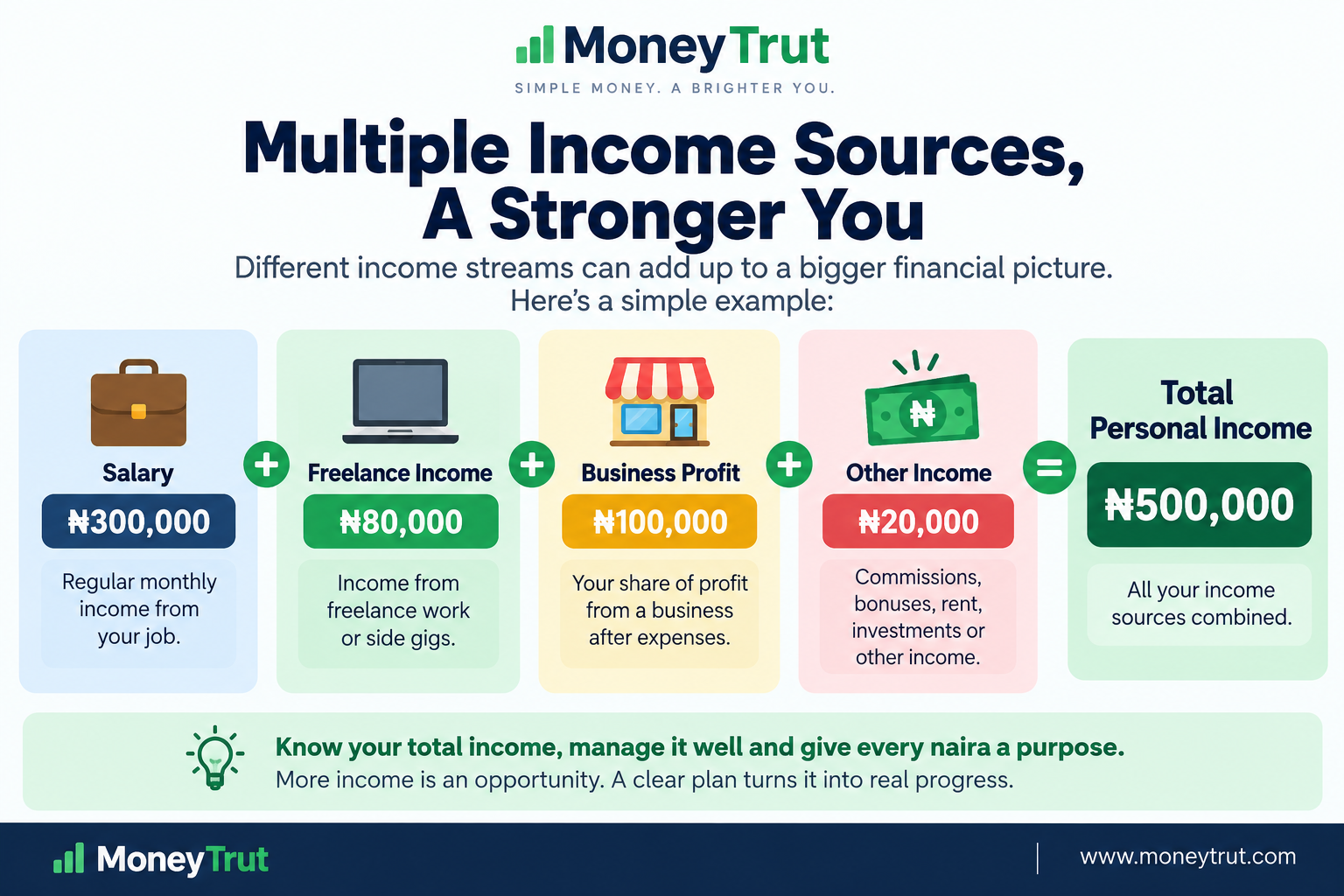
You can have several sources of income without creating several separate personal budgets.
For example:
| Income source | Monthly amount |
|---|---|
| Salary | ₦300,000 |
| Freelancing | ₦80,000 |
| Side business profit | ₦100,000 |
| Other income | ₦20,000 |
| Total | ₦500,000 |
You can record all of these sources, but don't assume the ₦500,000 will necessarily repeat next month.
Instead, classify each income source as either:
Reliable income — likely to arrive regularly.
Variable income — changes from month to month.
Occasional income — may happen only a few times a year.
This makes budgeting much more realistic.
Use a "Base Budget" and an "Extra Income" Plan

A useful system is to create two budgets.
Budget 1: Your Base Budget
This covers the expenses that must be paid regardless of how much extra income you earn.
For example, if your salary is ₦300,000:
- Housing: ₦80,000
- Food: ₦60,000
- Transport: ₦35,000
- Utilities: ₦20,000
- Family commitments: ₦25,000
- Savings: ₦30,000
- Other essential expenses: ₦30,000
- Buffer: ₦20,000
Total:
₦300,000
The numbers are only an illustration. Your actual budget should reflect your own circumstances.
Budget 2: Your Additional Income
Then decide what happens when additional money arrives.
For example:
Additional income → debt → emergency fund → investing → planned spending
The important part is deciding this before the money arrives.
Otherwise, additional income can disappear into everyday spending.
Give Every Extra Naira a Job
Suppose your salary is ₦300,000 and you receive an additional ₦150,000 from freelance work.
Instead of thinking:
"I now have ₦150,000 extra."
give it specific jobs.
For example:
- ₦50,000 → emergency fund
- ₦40,000 → investment
- ₦30,000 → debt repayment
- ₦20,000 → business/equipment
- ₦10,000 → personal spending
The percentages do not have to be exactly this way.
The principle is what matters:
Additional income should improve your financial position instead of automatically increasing your lifestyle.
What If Your Side Income Is Different Every Month?
This is where many people struggle.
Suppose your freelance income looks like this:
- January: ₦40,000
- February: ₦150,000
- March: ₦70,000
- April: ₦0
- May: ₦200,000
If you spend as though you will receive ₦150,000 every month, April becomes a problem.
Instead, treat variable income differently.
You can build a variable-income reserve.
For example, if you receive ₦200,000 in a strong month, you might keep part of it available for months when your side income is low.
This smooths out your finances.
Build an Emergency Fund Before Depending on Irregular Income
If part of your income is unpredictable, an emergency fund becomes even more important.
Our guide on how much you should have in an emergency fund explains how to think about emergency savings.
You can also read how to build an emergency fund with a low income.
The key idea is that an emergency fund is not the same as money you intend to spend on a normal monthly expense.
It is there to protect you when something unexpected happens.
Don't Count the Same Money Twice
This sounds obvious, but it happens frequently.
Suppose you receive ₦100,000 from a side business.
You decide that the money will:
- Pay your rent
- Fund your business
- Increase your savings
- Pay school fees
It cannot do all four.
Money can only be assigned once.
This is why a simple written budget is so useful.
When you assign every naira on paper, conflicting plans become easier to spot.
Watch Out for Lifestyle Inflation
Multiple income streams can make you feel richer very quickly.
Someone earning ₦300,000 may begin earning ₦500,000.
Instead of saving the additional ₦200,000, they might:
- Move into a more expensive apartment
- Buy a more expensive car
- Eat out more often
- Increase subscriptions
- Take more expensive trips
- Increase financial support for other people
- Take on additional loans
The problem is that some of these expenses become permanent.
If the additional income disappears, the higher expenses remain.
This is one reason a temporary increase in income can turn into a permanent increase in financial obligations.
You can read our article on why you still feel broke even when your salary increases.
Don't Use Irregular Income to Justify Permanent Expenses
This is one of the simplest rules for managing multiple income streams.
If you make ₦200,000 from freelancing this month, don't immediately commit yourself to a new ₦150,000 monthly expense.
Why?
Because next month you might make ₦30,000.
Or nothing.
Variable income should generally be used more cautiously than stable income when deciding what recurring obligations you can afford.
Decide What Your Side Income Is For
One of the easiest ways to control additional income is to give each income stream a purpose.
For example:
Salary: living expenses
Freelance income: investing and savings
Business profit: business growth
Commission income: debt repayment
This isn't mandatory.
You can combine everything.
But assigning a purpose can make it easier to avoid spending everything simply because the money arrived.
Use a Separate Account for Savings Goals
Suppose you are saving for:
- Emergency fund
- Land
- School fees
- Car
- Business equipment
- Vacation
Don't keep all of this mentally in one pile.
You can use separate savings accounts or clearly labelled savings categories where your bank or financial institution allows it.
This reduces the chance of accidentally spending money intended for another goal.
What Should You Do With a Large One-Off Payment?
Imagine you suddenly receive ₦1 million.
It could come from:
- A large freelance contract
- Business profit
- Commission
- Bonus
- Asset sale
- Other legitimate income
Don't immediately spend it.
Pause first.
A useful order is:
1. Check Your Immediate Financial Needs
Are there overdue essential expenses?
2. Deal With Expensive Debt
If you have costly debt, paying it down can provide a predictable financial benefit.
See our guide on how to pay off debt faster without ruining your finances.
3. Strengthen Your Emergency Fund
If your emergency savings are inadequate, this may be an important use for some of the money.
4. Fund Important Near-Term Goals
Set aside money for expenses you know are coming.
5. Invest What Is Appropriate for Long-Term Goals
Once your immediate financial needs are covered, some money may be suitable for long-term investing depending on your circumstances and risk tolerance.
6. Spend Some If You Want
You don't have to save every naira.
Enjoying a reasonable portion of your money can be part of a sustainable financial plan.
The important thing is to make the spending intentional.
Don't Automatically Invest Every Extra Naira
Additional income can create excitement about investing.
But don't invest money simply because you have extra cash.
First consider:
- Emergency savings
- Debt
- Time horizon
- Risk tolerance
- When you need the money
- Investment fees
- Potential losses
Our guide on how much you should invest from your salary each month explains why there isn't one percentage that works for everyone.
You can also read what is risk tolerance and how do you know how much investment risk you can take?.
Keep Track of Your Total Income
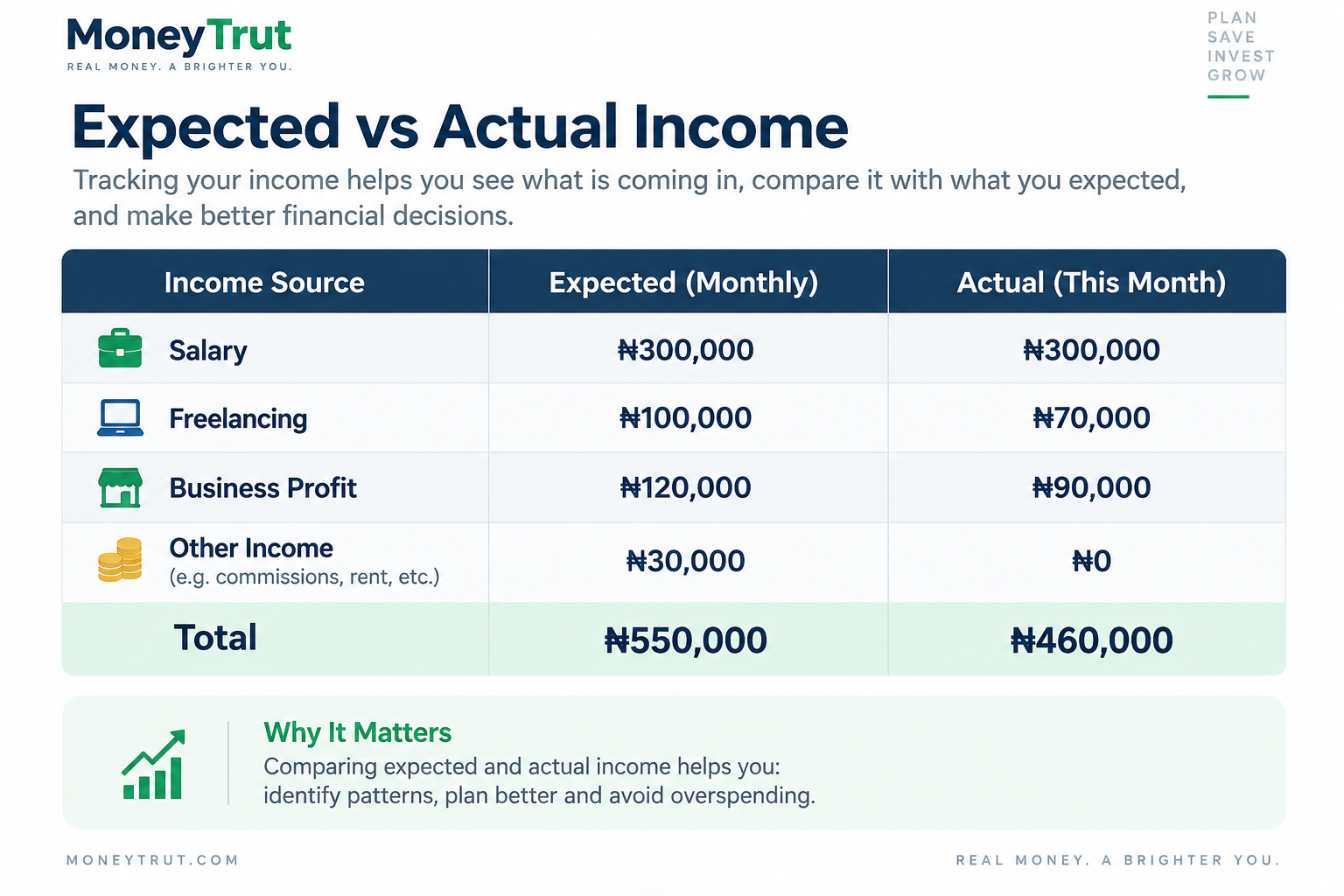
Once you have several income sources, don't rely on memory.
A simple monthly table can help:
| Income source | Expected | Actual |
|---|---|---|
| Salary | ₦300,000 | ₦300,000 |
| Freelancing | ₦100,000 | ₦70,000 |
| Business profit | ₦120,000 | ₦90,000 |
| Other | ₦30,000 | ₦0 |
| Total | ₦550,000 | ₦460,000 |
Now you can immediately see the difference between what you expected and what actually happened.
Over several months, this can also reveal which income sources are genuinely reliable.
Track Income, Not Just Sales
If you have a business, don't record only the amount customers pay you.
Track the actual amount that belongs to you after business costs.
For example:
Business sales: ₦800,000
Business expenses: ₦600,000
Remaining amount: ₦200,000
The ₦800,000 is revenue.
The ₦200,000 is much closer to the amount you can consider when assessing business profit, subject to your full accounting and other expenses.
This distinction is especially important when you have both employment income and business income.
Build Your Budget Around Reality, Not Your Best Month
Suppose your total income over six months was:
- ₦400,000
- ₦550,000
- ₦480,000
- ₦700,000
- ₦450,000
- ₦500,000
Your average is about ₦513,000.
But that doesn't necessarily mean you should build a ₦513,000 monthly lifestyle.
A more conservative approach is to build your essential expenses around your reliable income and treat the variable component separately.
If you have no reliable salary and most of your income fluctuates, using a conservative average or a low-month income figure can make the budget more resilient.
Create a "Good Month" Rule
You can create a simple rule for months when income is unusually high.
For example:
"Any income above my normal monthly budget will be divided between savings, debt repayment, investing and planned spending."
Suppose your normal personal budget is ₦350,000.
You receive ₦600,000.
The extra ₦250,000 doesn't automatically become lifestyle money.
You already have a plan for it.
This prevents good months from creating bad months later.
Avoid Taking Loans Based on Expected Side Income
Be careful with statements such as:
"I know I can pay it because my business usually gives me another ₦200,000."
Usually is not guaranteed.
If your side income falls, the loan payment remains.
Debt should be evaluated against your ability to repay it under less favourable circumstances, not only your best months.
What If You Have Three or Four Income Sources?
The number itself isn't the problem.
The system is.
You can simplify your finances into three levels:
Level 1: Income
Record everything that comes in.
Level 2: Obligations
Pay essential expenses and required commitments.
Level 3: Goals
Direct the remaining money toward:
- Emergency savings
- Debt reduction
- Investing
- Business growth
- Other financial goals
- Controlled personal spending
You don't need a separate complicated budget for every income stream.
You need one clear personal financial system.
Review Your Income Sources Every Few Months
Not every income stream deserves equal effort.
After several months, ask:
- How much did this source actually generate?
- How much time did it require?
- What expenses did it create?
- Is the income reliable?
- Can I increase the income?
- Is it distracting me from a more profitable opportunity?
For example, a side business generating ₦50,000 after 30 hours of work may be less attractive than freelance work generating ₦100,000 in 15 hours.
Income alone doesn't tell the whole story.
Consider income relative to time, risk and cost.
Don't Let Multiple Income Streams Destroy Your Time
There is another hidden cost.
You can have:
- A full-time job
- Freelance work
- A business
- Investment management
- Family responsibilities
and eventually become exhausted.
More income is useful only if the system remains sustainable.
If your side income consistently damages your health, job performance, relationships or ability to manage your primary responsibilities, you may need to reconsider how much you are trying to do.
A Practical Example: Someone Earning ₦500,000 From Multiple Sources
Imagine Ada earns:
- ₦300,000 salary
- ₦100,000 freelance income
- ₦100,000 average monthly business profit
Her total average income is:
₦500,000
She could create a base lifestyle around the ₦300,000 salary.
Then she could decide in advance what happens to the additional ₦200,000.
For example:
- ₦70,000 → emergency savings/investment
- ₦50,000 → business reinvestment
- ₦30,000 → debt repayment
- ₦30,000 → long-term goal
- ₦20,000 → personal spending
The exact allocation isn't a recommendation for everyone.
The point is that the additional income has a plan.
If the business makes only ₦50,000 next month, she doesn't need to completely redesign her lifestyle because she wasn't depending on all ₦200,000 for basic expenses.
A Simple System You Can Start This Month
If you're currently receiving money from several sources, try this:
Step 1: List Every Income Source
Write down salary, freelance work, business profit, commissions, rent and other income.
Step 2: Classify Each Source
Mark each as:
- Reliable
- Variable
- Occasional
Step 3: Calculate Your Real Income
For businesses, use profit rather than simply sales.
Step 4: Build Your Essential Budget
Base recurring expenses primarily on reliable income.
Step 5: Create Rules for Variable Income
Decide what percentage or amount goes toward savings, debt, investing, business growth and spending.
Step 6: Separate Business Money
Don't treat business revenue as personal spending money.
Step 7: Review Every Month
Compare expected income with actual income.
Then adjust.
Bottom Line
Multiple income sources can make your finances stronger, but only if you manage them deliberately.
The goal isn't simply to have money coming from five different places.
The goal is to know:
How much is coming in, how reliable it is, what belongs to the business, what you can safely spend and what each extra naira should accomplish.
Build your basic lifestyle around reliable income.
Treat irregular income cautiously.
Separate business and personal money.
Build an emergency fund.
Avoid permanent expenses based on temporary income.
And give additional money a purpose before you spend it.
More income creates an opportunity.
A good money-management system is what turns that opportunity into financial progress.

You must be logged in to post a comment.