

The challenge is that freelancing is often presented as easy money. It is not. Getting clients, building trust, pricing your services, delivering quality work and getting paid safely all require effort.
This guide explains how freelancing works, the skills you can sell, where to find clients, how much you can realistically charge, how to build your first portfolio and the mistakes beginners should avoid.
What Is Freelancing?
Freelancing means working independently for clients instead of being permanently employed by one employer.
A client might hire you to:
- Write an article
- Design a logo
- Edit videos
- Manage social media
- Build a website
- Create graphics
- Analyse data
- Provide virtual assistance
- Handle customer support
- Translate documents
- Edit documents
- Manage email
- Create presentations
- Provide technical or professional services
You can work with Nigerian clients, international clients or both.
The important part is this: you are selling a service, not simply looking for someone to give you money online.
That distinction matters.
If you approach freelancing as "How can I make money online?", you may jump from one opportunity to another.
If you approach it as "What problem can I solve for someone, and what can I charge for solving it?", you have a much better foundation.
Can You Really Make Money Freelancing in Nigeria?
Yes, but freelancing is not a guaranteed source of quick income.
Your potential income depends on your skill, experience, the type of clients you attract, your ability to communicate, the quality of your work and how effectively you find clients.
For example, someone offering basic data entry may compete with thousands of other freelancers.
Someone who can build a professional website, automate a business process or provide specialised engineering or financial analysis may have fewer competitors and be able to charge considerably more.
This is why the skill you choose matters more than simply joining a freelance platform.
The Best Freelance Skills to Start With
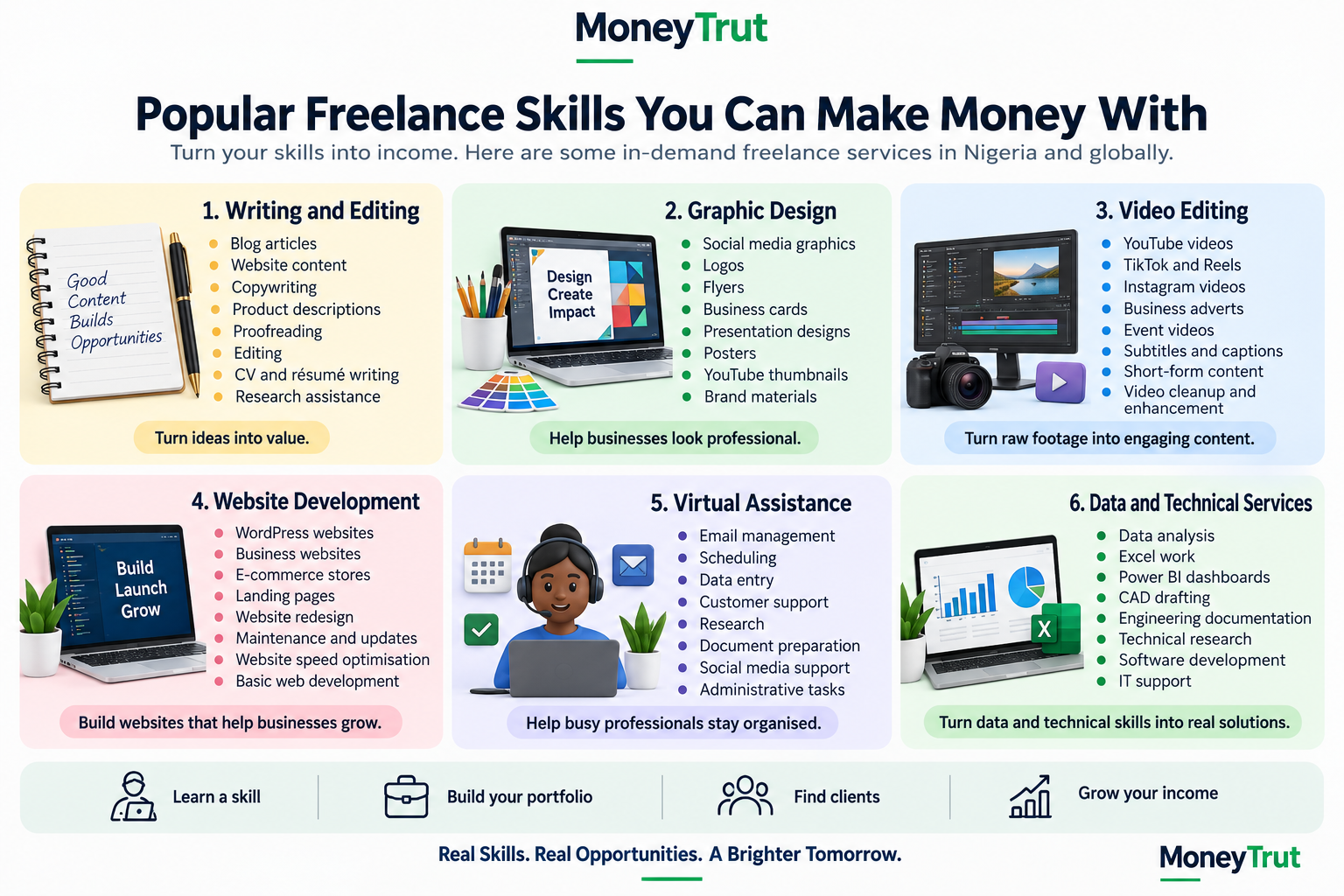
You do not necessarily need to learn programming before you can freelance.
Some services require advanced technical skills, while others can be learned with practice.
1. Writing and Editing
If you are good at writing, you can offer:
- Blog articles
- Website content
- Product descriptions
- Copywriting
- Proofreading
- Editing
- CV and résumé writing
- Research assistance
Businesses constantly need written content, although competition can be high.
2. Graphic Design
You can offer:
- Social media graphics
- Flyers
- Business cards
- Presentation designs
- Logos
- Posters
- YouTube thumbnails
- Simple brand materials
Tools such as Canva can make it easier for beginners to start, while professional designers can move into more advanced software and higher-value work.
3. Video Editing
Short-form video has created demand for editors who can turn raw footage into content for:
- TikTok
- YouTube
- Business advertisements
You can start with relatively simple editing and gradually develop more advanced skills.
4. Social Media Management
Small businesses often need someone to:
- Create posts
- Schedule content
- Respond to messages
- Manage comments
- Create content calendars
- Track basic performance
Instead of charging for individual posts, an experienced freelancer can eventually package these services into monthly retainers.
5. Website Development
If you learn WordPress, web development or related technologies, you can build websites for:
- Small businesses
- Professionals
- Churches and organisations
- Restaurants
- Schools
- E-commerce businesses
- Startups
Website development can become a higher-value freelance skill because the client is paying for a business outcome rather than simply a few hours of work.
6. Virtual Assistance
A virtual assistant can help clients with:
- Email management
- Scheduling
- Research
- Data entry
- Customer support
- Document preparation
- Administrative tasks
It can be a reasonable entry point for someone who is organised and comfortable using computers.
7. Data and Technical Services
People with technical backgrounds can offer services such as:
- Data analysis
- Excel work
- Power BI dashboards
- CAD drafting
- Engineering documentation
- Technical research
- Software development
- IT support
Specialised skills can be particularly valuable because clients are often willing to pay more for expertise that is difficult to find.
You Don't Need Ten Skills
One of the biggest mistakes beginners make is trying to become a writer, designer, programmer, marketer and virtual assistant at the same time.
You don't need to.
Start with one commercially useful skill.
For example:
"I help small businesses create professional social media graphics."
is much stronger than:
"I can do anything online."
The first statement tells a potential client exactly what you do.
How to Start Freelancing With Little or No Money
You can begin with a phone for some services, but a laptop will make many types of freelance work significantly easier.
Your first investment should usually be in skill development and your ability to deliver the service, rather than expensive equipment.
A simple starting process is:
Step 1: Choose One Skill
Look at:
- What you already know
- What you can learn reasonably quickly
- What businesses actually need
- What type of work you can tolerate doing repeatedly
Don't choose a skill simply because somebody on social media claims it makes $10,000 a month.
Step 2: Learn the Skill
Use free or affordable resources to learn.
Then practise.
Watching tutorials for three months without producing anything does not make you a freelancer.
You need actual work samples.
Step 3: Create 3–5 Portfolio Samples
You don't necessarily need paying clients to create your first portfolio.
Suppose you want to become a social media designer.
Create five sample designs for imaginary businesses.
If you want to become a writer, create three strong articles covering subjects you understand.
If you want to become a website designer, build two or three sample websites.
Make it obvious what you can do.
Step 4: Create a Simple Professional Profile
Your profile should explain:
- What you do
- Who you help
- What result you provide
- What evidence you have
- How clients can contact or hire you
Avoid writing a long biography that says nothing about the client's problem.
Instead of:
"I am a hardworking and passionate individual who loves technology..."
try:
"I help small businesses create fast, mobile-friendly websites that make it easier for customers to find and contact them."
That is more useful to a potential client.
Where Can Nigerians Find Freelance Clients?

There are several routes.
Freelance Marketplaces
Platforms such as Upwork and Fiverr connect freelancers with clients looking for specific services.
Upwork uses job proposals and contracts, while Fiverr allows freelancers to package services into listings that clients can purchase.
Upwork's official help documentation confirms that freelancers can receive payments through several methods, including bank transfers and Payoneer, although the options available can depend on location and account eligibility.
Because platform fees, payment options and eligibility can change, check the platform's current terms before relying on a particular payment method.
LinkedIn is often overlooked by beginners.
You can use it to:
- Display your expertise
- Publish useful content
- Connect with business owners
- Contact potential clients
- Find contract opportunities
You don't have to wait for someone to post "freelance job."
You can identify a business with a problem and offer a useful solution.
Direct Outreach
You can contact Nigerian businesses directly.
For example, imagine you are a website designer and find a small business with an outdated website.
Instead of sending:
"Hello sir, I need a job."
You could send:
"I noticed your website is difficult to use on mobile. I design simple mobile-friendly websites for small businesses. I made a quick example of how your homepage could look. If you're interested, I can send it to you."
That is a business proposition rather than a request for charity.
Your Existing Network
Your first client may be closer than you think.
Tell people you already know what service you provide.
Friends, former colleagues, business owners, professional contacts and community networks can become sources of referrals.
Just make sure you maintain professional standards even when the client is someone you know.
How Much Can a Nigerian Freelancer Make?
There is no reliable universal figure.
A beginner might make little or nothing during the first few weeks while building a portfolio and searching for clients.
Another freelancer with an established skill and international clients could earn considerably more.
For example, imagine someone starts offering graphic design.
If they complete:
- 4 jobs at ₦15,000 = ₦60,000
- 4 jobs at ₦25,000 = ₦100,000
- 4 jobs at ₦40,000 = ₦160,000
The difference is not simply the number of jobs.
It can come from the quality of the service, client type, portfolio, reputation and value delivered.
This is why you should not build your freelance strategy around a promise such as "make ₦500,000 in 30 days."
Focus instead on building a repeatable system for finding and serving clients.
Don't Automatically Charge the Lowest Price
Beginners often think:
"I have no experience, so I must be the cheapest."
That can attract the wrong clients.
If you charge ₦5,000 for something that takes six hours, you may eventually become frustrated.
Instead, calculate what you need to make the work worthwhile.
For example, suppose you want to earn ₦150,000 from freelance work each month.
If you can realistically work 60 billable hours per month, that gives you a target of:
₦150,000 ÷ 60 = ₦2,500 per billable hour
That does not mean you must literally quote every client an hourly rate. You can package your service as a project.
But the calculation helps you understand whether your prices make sense.
Also remember that not every hour spent freelancing is billable.
You may spend time:
- Searching for clients
- Writing proposals
- Attending meetings
- Revising work
- Sending invoices
- Learning
- Managing your portfolio
Your pricing needs to account for that.
How to Get Your First Freelance Client
Your first client is often the hardest.
A practical approach is:
1. Start With People Who Already Know You
Tell your professional network what you offer.
2. Build Specific Samples
Don't simply say you're good.
Show people.
3. Apply for Small Jobs
Your first objective may be experience and a strong review rather than maximum income.
That does not mean working for free indefinitely.
4. Make Your Proposal About the Client
Instead of writing five paragraphs about yourself, explain:
- You understand the problem
- You can solve it
- How you would approach it
- What the client will receive
5. Ask Satisfied Clients for Referrals
One good client can potentially become several more.
Don't Depend on Freelance Platforms Forever
Freelance marketplaces can be useful, but they should not necessarily become your only source of clients.
Eventually, you can build direct relationships with businesses.
For example:
Marketplace → first clients → portfolio → referrals → direct clients → repeat contracts
This can reduce your dependence on constantly competing for every new job.
How to Turn Freelancing Into a Monthly Income
One-off jobs can make income unpredictable.
A better long-term strategy is to create recurring services.
For example, instead of:
"I design one flyer for ₦15,000."
you might eventually offer:
"I manage your monthly social media graphics for ₦100,000."
Instead of:
"I build one website."
you might offer:
"I maintain and update your business website for ₦50,000 per month."
Recurring work can make income more predictable.
It also means you don't have to find a completely new client every week.
Keep Your Freelance Money Separate
Once you start earning, don't treat every payment as spending money.
A freelance payment may need to cover:
- Business expenses
- Internet/data
- Software subscriptions
- Equipment
- Taxes
- Savings
- Emergency funds
- Personal spending
Keeping separate records makes it easier to know whether freelancing is actually profitable.
This also connects to the broader personal-finance principle of knowing where your money goes. The CBN's financial-literacy framework emphasises budgeting, prioritising spending and developing the ability to generate and save income.
You can also read our guide on how to create a monthly budget that actually works.
What About Getting Paid by International Clients?
International freelancing can open access to clients who pay in foreign currencies, but payment arrangements vary by platform and country.
Do not assume that a particular payment service will always be available to Nigerian users.
Before accepting work, check:
- The platform's current withdrawal options
- Currency conversion costs
- Withdrawal fees
- Minimum withdrawal requirements
- Processing times
- Whether your account is eligible
Also keep records of what you earn and what you spend.
A freelancer who earns ₦300,000 but spends ₦100,000 acquiring clients and delivering the work has not made ₦300,000 in profit.
Watch Out for Freelance Scams
The search for online income attracts scammers.
Be careful when someone:
- Promises guaranteed freelance income
- Asks you to pay a large "registration fee" before giving you work
- Offers unrealistic payment for extremely simple tasks
- Asks for your banking PIN or OTP
- Wants you to receive and forward suspicious funds
- Sends fake payment confirmations
- Pressures you to move a protected transaction outside a platform
- Asks you to download suspicious software
- Wants you to pay before releasing a supposed job
A genuine client may ask for information needed to complete a legitimate transaction, but you should never give anyone your PIN, password or one-time authentication code.
The CBN also advises bank customers to protect account information such as PINs, passwords and codes.
Don't Pay Someone Because They Promised You a Client
This is one of the most important rules for beginners.
There is a difference between paying for a legitimate service—such as a course, software or professional tool—and paying someone because they claim they have a guaranteed client waiting for you.
If someone says:
"Pay me ₦100,000 and I will give you five international clients every month."
be extremely cautious.
Freelancing is a business. Nobody can legitimately guarantee that clients will keep buying your service simply because you paid an upfront fee.
Freelancing vs a Side Business
Freelancing and running a business are related but different.
With freelancing, you usually sell your skill and time.
With a business, you can eventually build systems, products, employees or processes that allow the business to serve customers beyond your personal working hours.
For someone starting with little capital, freelancing can therefore be a useful way to generate income before building a larger business.
If you are interested in starting a business with limited capital, see our guide on how to start a small business in Nigeria with little money once that article is live.
What If You Already Have a Full-Time Job?
You don't necessarily have to quit your job.
You can start freelancing in your spare time.
For example, someone earning ₦300,000 from employment might initially make an additional ₦50,000–₦100,000 from freelance work.
Instead of immediately increasing lifestyle spending, that additional income could be used to:
- Build an emergency fund
- Pay down expensive debt
- Buy better equipment
- Develop a valuable skill
- Invest
- Build a small business
Our article on how to make extra money without quitting your job explores this idea in more detail.
A Simple 30-Day Freelancing Plan
If you want to start, don't spend the next six months planning.
Try this:
Week 1: Choose Your Skill
Pick one service and identify the type of client you want to serve.
Week 2: Build Your Portfolio
Create three to five strong examples.
Week 3: Set Up Your Profiles
Create a professional freelance profile and make your service clear.
Also prepare a simple portfolio that you can send directly to potential clients.
Week 4: Start Finding Clients
Every working day, contact or apply to a small number of relevant prospects.
Don't measure success only by how much money you make immediately.
Track:
- Applications sent
- Responses
- Calls
- Proposals
- Jobs won
- Revenue
- Expenses
- Repeat clients
The numbers will show you where the problem is.
If you're getting no responses, improve your offer or proposal.
If people respond but don't hire you, improve your portfolio, pricing or sales conversation.
If you get clients but they don't return, improve the quality of your service.
The Biggest Mistakes New Freelancers Make
Trying to Learn Everything
Choose one valuable skill first.
Copying Other People's Prices
Your costs, skill level and clients are different.
Having No Portfolio
Clients need evidence that you can deliver.
Working Without Clear Requirements
Before starting a project, agree on what will be delivered, the deadline, price and number of revisions.
Accepting Every Client
A difficult client can consume far more time than the money is worth.
Spending Your First Earnings Immediately
Your first ₦100,000 of freelance income is not necessarily ₦100,000 of disposable income.
Depending on One Client
A single client can disappear, reduce their budget or stop needing your service.
Build a broader client base over time.
Is Freelancing Worth It in Nigeria?
It can be.
But freelancing should be viewed as a business skill, not a shortcut to free money.
You need something people are willing to pay for.
Then you need to find those people, convince them that you can help, deliver good work and build enough trust that they return or recommend you.
For someone starting with limited capital, this can be attractive because the primary investment is often your skill and time rather than inventory or a physical shop.
And if your freelance income grows, you can use it as a foundation for broader financial goals. Our guides on building wealth from a small income and how much you should invest from your salary each month cover the next stage.
Bottom Line
Freelancing can provide an additional source of income for Nigerians, but the opportunity is often misunderstood.
You don't make money simply because you open an Upwork or Fiverr account.
You make money when you have a useful skill, find someone who needs it, deliver the promised result and build a reputation that makes future work easier to obtain.
Start with one skill.
Build a portfolio.
Find your first clients.
Deliver excellent work.
Track your income and expenses.
Then gradually increase your prices, improve your skills and move toward better clients and recurring work.
The goal should not be to chase every "make money online" opportunity.
The goal is to build a skill that the market is willing to pay for.

You must be logged in to post a comment.