
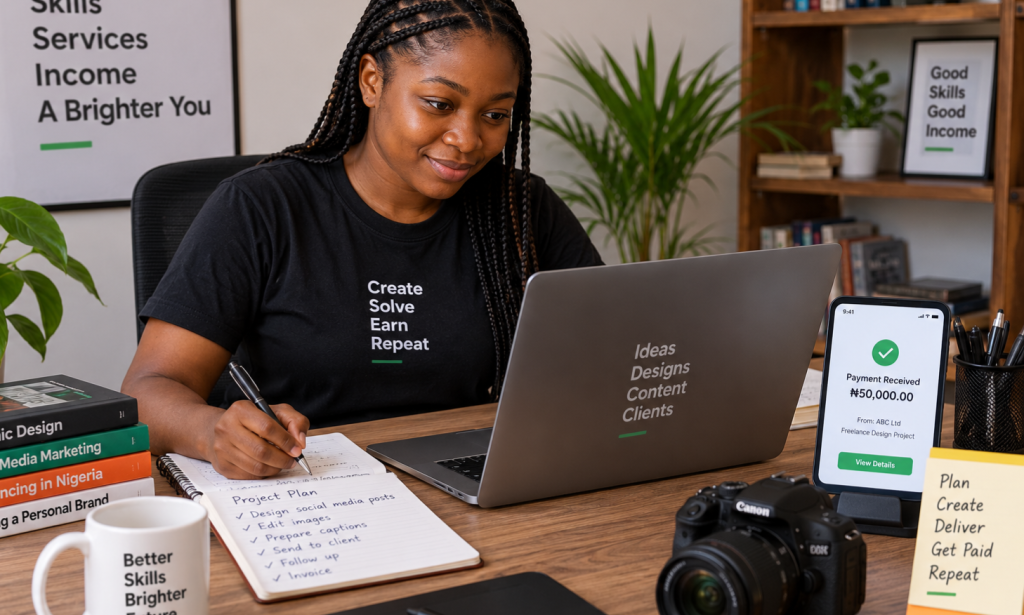
You may already have something people are willing to pay for.
You just may not be thinking about it as a money-making skill.
Maybe you can:
- Repair equipment
- Design graphics
- Write
- Teach
- Cook
- Take photographs
- Edit videos
- Build websites
- Fix computers
- Install electrical equipment
- Manage social media
- Analyse data
- Sew clothes
- Style hair
- Repair phones
- Prepare accounts
- Sell products
- Train people
- Build or maintain technical systems
The problem is that having a skill and making money from that skill are two different things.
You can be very good at something and still struggle to find paying customers.
That is because customers generally don't pay simply because you are talented.
They pay because your skill solves a problem that matters to them.
The good news is that you don't necessarily need a large amount of capital to start monetising a skill.
You need to understand what you can offer, who needs it, what they are willing to pay and how to consistently reach those people.
What Does It Mean to Monetise a Skill?
Monetising a skill simply means turning something you know or can do into something people pay you for.
For example:
Skill: Graphic design
Service: Designing social-media advertisements for small businesses
Customer: Restaurants, fashion businesses and retailers
Payment: Customer pays for each design or a monthly package
Another example:
Skill: Teaching mathematics
Service: Weekend mathematics tutoring
Customer: Secondary-school students and their parents
Payment: Monthly or per-session fee
The skill itself is not necessarily the product.
The solution you provide with the skill is what the customer buys.
You Don't Have to Be the Best
A common reason people never start is:
"There are already too many people doing this."
There may be.
But that doesn't mean there is no opportunity.
You don't necessarily have to be the best graphic designer in Nigeria.
You may simply need to be good enough to solve a specific customer's problem reliably.
For example, instead of competing with thousands of graphic designers for every possible type of project, you could focus on:
Social-media designs for restaurants.
Or:
Business flyers for small shops.
Or:
Wedding invitation designs.
The narrower your initial offer, the easier it can be for potential customers to understand what you do.
Start With Skills You Already Have
Before looking for a new skill to learn, make a list of what you can already do.
Think about:
Professional skills
Skills you use at work.
For example:
- Engineering
- Accounting
- Administration
- Data analysis
- Project management
- Writing
- Sales
- Human resources
- Marketing
- Technical support
Practical skills
Things you can physically do.
For example:
- Repairs
- Installation
- Catering
- Sewing
- Hair styling
- Photography
- Cleaning
- Furniture work
- Electrical work
- Plumbing
Digital skills
For example:
- Graphic design
- Video editing
- Website development
- Social media management
- Digital marketing
- Content writing
- Search engine optimisation
- Data analysis
Knowledge-based skills
You may also be able to make money from knowledge.
For example:
- Tutoring
- Training
- Coaching
- Consulting
- Exam preparation
- Professional workshops
Your first opportunity may be closer than you think.
Your Job May Already Have Given You a Marketable Skill
Consider someone working as an accountant.
Their salary may be ₦500,000.
But outside working hours, they could potentially provide bookkeeping services to small businesses.
Someone working in IT may provide website or technical support services.
A teacher may provide private tutoring.
A photographer may take weekend events.
An engineer may provide specialised technical services where their employment contract and professional requirements allow it.
The important point is to avoid assuming that your salary is the only way your professional knowledge can generate income.
At the same time, check your employment contract and employer policies before using a professional skill outside your job, especially where conflicts of interest, confidential information or competing activities could be involved.
Don't Sell a Skill. Sell a Result.
This is one of the most important changes you can make.
Instead of saying:
"I do graphic design."
Say:
"I create promotional designs that small restaurants can use on WhatsApp and Instagram to advertise their weekly offers."
Instead of:
"I am a web developer."
Say:
"I build simple websites for small businesses that need an online presence and a way for customers to contact them."
Instead of:
"I teach English."
Say:
"I help secondary-school students improve their English and prepare for examinations through weekend lessons."
The second version makes the benefit clearer.
Identify a Problem People Already Have
Don't start by asking:
"What can I sell?"
Ask:
"What problem do people around me already have?"
For example:
Small businesses may struggle with:
- Bookkeeping
- Social-media content
- Product photography
- Website setup
- Customer follow-up
- Advertising
- Inventory records
Students may struggle with:
- Mathematics
- English
- Science
- Exam preparation
Homeowners may need:
- Repairs
- Cleaning
- Installation
- Maintenance
Professionals may need:
- CV editing
- Presentation design
- Data analysis
- Technical support
- Training
Once you identify the problem, your skill becomes easier to package.
The Three Questions You Should Answer
Before trying to sell a skill, answer:
1. Who is the customer?
Be specific.
"Everybody" is not a useful customer definition.
2. What problem do they have?
What are they struggling to do?
3. What exactly will you do for them?
Turn your skill into a clear deliverable.
For example:
Customer: Small restaurants
Problem: They need attractive weekly promotional materials.
Offer: Four promotional social-media designs every month.
Now you have a business offer.
You Can Start With One Customer
You don't need 100 customers before you begin.
You need one person willing to pay.
Suppose you want to offer bookkeeping services.
Your first target could be one small business owner.
You help them organise their records.
They pay you ₦30,000.
Now you have something much more valuable than a theory.
You have a paying customer.
You can use the experience to improve your process and look for your next customer.
Your First Customer Is Also a Test
Your first customer can help you answer important questions.
Was the service useful?
Did the customer understand the offer?
Was the price acceptable?
How long did the work take?
Did you make enough profit?
Would the customer recommend you?
Would they pay you again?
If the answer to several of these questions is no, you have information you can use to improve.
That is much better than spending ₦500,000 building a business before discovering that nobody wants the service.
Don't Work for Free Forever
Offering a free sample can sometimes help you demonstrate your ability.
But there is a difference between:
Doing one small demonstration to prove your skill
and
Doing repeated work for free because you are afraid to charge.
If someone genuinely benefits from your work, you should eventually establish a price.
You can start with an introductory price if necessary.
But don't build your business around free labour.
How to Set Your First Price
Pricing a skill can feel uncomfortable.
You may think:
"What if they say it's too expensive?"
That can happen.
But your price should not be based only on what feels comfortable to you.
Consider:
- Time required
- Materials
- Transportation
- Equipment
- Software
- Communication
- Taxes where applicable
- Business overhead
- Your experience
- Value to the customer
- Profit margin
Suppose you provide a service that takes five hours.
You spend:
₦5,000 on transport
₦3,000 on materials
₦2,000 on other costs
Your direct costs are already:
₦10,000
If you charge ₦12,000, you have only ₦2,000 left before considering the value of your five hours of work and other overhead.
That may not be sustainable.
Don't Copy Someone Else's Price Blindly
You may see another person charging:
₦100,000
for a service.
You charge:
₦20,000
because you think being cheaper will attract customers.
It might.
But you may also discover that your costs make the business unprofitable.
Alternatively, you may see someone charging ₦20,000 and assume you cannot charge ₦50,000.
But if you provide a different level of service to a different customer, the comparison may not be useful.
Understand your own economics.
MoneyTrut discusses pricing in greater detail here:
How to Price Your Products and Services in Nigeria Without Losing Money
Charge for the Value You Provide, Not Just Your Time
Some services can be priced by the hour.
Others are better priced by the project or result.
For example, suppose you are a photographer.
You could charge:
₦20,000 per hour
or create a package:
Birthday photography package — ₦100,000
The second option may be easier for the customer to understand.
Similarly, a website developer may charge by project rather than saying:
"I charge ₦10,000 per hour."
Neither approach is automatically better.
The appropriate pricing method depends on the service.
Build a Portfolio Before You Have Many Customers
If you want someone to pay you, they may ask:
"What have you done before?"
You need something to show.
If you have previous work, organise it.
If you don't, create a few sample projects.
For example, a graphic designer could create:
- Restaurant flyer
- Fashion advertisement
- Real-estate flyer
- Event design
A website developer could build:
- Sample restaurant website
- Sample business website
- Sample portfolio site
A writer could create:
- Sample article
- Product description
- Business profile
The examples don't have to be for real customers.
Just make it clear that they are samples.
Your Portfolio Doesn't Need to Be Fancy
You don't necessarily need an expensive website.
Depending on your service, your portfolio could start with:
- A simple website
- Google Drive
- Instagram page
- LinkedIn profile
- WhatsApp Business catalogue
- Before-and-after examples
The goal is simple:
Let potential customers see what you can do.
Use WhatsApp as a Business Tool
WhatsApp is already part of everyday communication for many Nigerian businesses.
You can use it to:
- Display your services
- Share examples
- Answer customer questions
- Send quotations
- Follow up with prospects
- Receive referrals
- Communicate with existing customers
But don't turn every WhatsApp status into:
"Please patronise me."
Instead, show useful evidence.
For example:
Before: Poor product photograph
After: Improved product photograph
Then explain:
"I help small businesses create better product images for WhatsApp and social media."
You are demonstrating the service rather than simply announcing that you need customers.
Ask for Referrals
If you do good work, ask satisfied customers whether they know someone who needs the same service.
For example:
"If you know another business that needs this service, I'd appreciate an introduction."
A referral from a satisfied customer can be much more powerful than a random advertisement.
Don't Depend Only on Friends and Family
Your friends may be your first audience.
But they are not necessarily your market.
If you provide bookkeeping services, your ideal customer may be a small business owner you have never met.
If you provide technical maintenance, your customers may be property managers.
If you teach mathematics, your customers may be parents.
Build a system for reaching the people who actually need the service.
How to Find Potential Customers
Depending on the skill, you can find prospects through:
- Google search
- Local business directories
- Professional associations
- Referrals
- Existing networks
- Community groups
- Direct outreach
- Partnerships
You don't need to use every platform.
Choose the places where your potential customers actually spend time.
Direct Outreach Can Work
Suppose you provide social-media design services for restaurants.
Instead of waiting for customers to discover you, identify 20 restaurants whose online marketing could be improved.
Send a short, professional message.
For example:
"Hello, I noticed your restaurant's weekly offers are mainly being shared as text. I create promotional graphics that restaurants can use on WhatsApp and Instagram. I prepared a sample concept for your business. If you're interested, I can send it and my pricing."
That is much better than:
"Hello, I am a graphic designer. Do you need a designer?"
The first message demonstrates that you understand their business.
Don't Spam People
There is a difference between outreach and spam.
Don't send the same message to hundreds of people without understanding who they are.
Don't repeatedly message people who have said no.
Don't make false claims.
Don't pretend to have worked for companies you haven't worked for.
Professionalism matters.
Your reputation can become one of your most valuable business assets.
Use Your Existing Workplace Carefully
Your colleagues may know people who need your service.
For example, someone in your office may need:
- Tutoring for their child
- Photography
- Graphic design
- Website development
- Home repairs
- Event services
But be careful not to turn your workplace into an aggressive sales environment.
And never use employer databases, confidential information or paid working time for your private business without permission.
Learn to Explain Your Offer in One Sentence
If someone asks:
"What do you do?"
you should be able to answer clearly.
For example:
"I help small businesses keep their financial records organised."
Or:
"I create social-media designs for restaurants and retail businesses."
Or:
"I provide weekend mathematics tutoring for secondary-school students."
Or:
"I help small businesses build simple websites that make it easier for customers to find and contact them."
If you need five minutes to explain your service, the offer may not be clear enough yet.
Turn a Skill Into a Package
Packaging can make selling easier.
Instead of:
"I offer photography."
You could offer:
Basic Package
- 1-hour session
- 20 edited photos
- Digital delivery
Standard Package
- 2-hour session
- 50 edited photos
- Short video clips
Premium Package
- Extended session
- More edited images
- Video coverage
- Faster delivery
The actual prices depend on your market and costs.
But packages make the customer's decision easier.
You Can Also Sell Your Knowledge
Not every skill has to be sold as a service.
You can potentially turn knowledge into:
- Classes
- Workshops
- Training sessions
- Guides
- Templates
- Courses
- Paid consultations
- Educational content
For example, someone who is highly skilled in Excel could teach small-business owners how to manage their records.
Someone experienced in photography could teach beginners.
Someone with professional experience in a technical field could create training material within appropriate professional and employment boundaries.
The key is again to solve a problem.
Don't Create a Course Before You Have an Audience
This is a common mistake.
Someone knows how to use Excel and immediately spends ₦300,000 creating a sophisticated online course.
Then nobody buys it.
A better approach is to test demand.
Offer:
A two-hour live Excel class for 10 people.
If people pay and find it useful, you have evidence.
You can then improve and scale the product.
A Skill Can Become a Business
At the beginning, you may be the person doing everything.
You find the customer.
You perform the work.
You collect payment.
You handle complaints.
You keep records.
But if demand grows, you can gradually build a business around the skill.
For example:
Stage 1: You design graphics yourself.
Stage 2: You get more customers.
Stage 3: You bring in another designer.
Stage 4: You focus more on sales and customer relationships.
Stage 5: You develop packages and processes.
Now you are no longer simply selling your time.
You are building a service business.
Don't Scale Too Early
If you have one customer, you don't necessarily need:
- An expensive office
- Five employees
- ₦2 million of equipment
- A large website
- Complex software
First prove that customers want what you offer.
Then increase your investment as the business justifies it.
MoneyTrut's guide on starting a small business discusses this broader principle:
How to Start a Small Business in Nigeria With Little Money
Keep Your Income and Business Money Organised
Suppose you earn:
Salary: ₦400,000
Skill-based income: ₦150,000
Don't automatically assume the entire ₦150,000 is profit.
If you spent:
₦30,000 on transport
₦20,000 on software
₦10,000 on materials
your business costs are:
₦60,000
Your remaining amount is:
₦90,000
That is much closer to your actual earnings from the activity before considering other applicable costs or taxes.
This is why record keeping matters.
Keep Track of Every Job
A simple record can include:
| Customer | Service | Revenue | Costs | Profit |
|---|---|---|---|---|
| Customer A | Design | ₦30,000 | ₦5,000 | ₦25,000 |
| Customer B | Design | ₦50,000 | ₦10,000 | ₦40,000 |
| Customer C | Design | ₦20,000 | ₦4,000 | ₦16,000 |
After several months, you can see:
- Which services make the most money
- Which customers return
- Which jobs consume too much time
- Which expenses are too high
- What you should charge
Your records become a decision-making tool.
What If Nobody Is Buying?
Don't immediately conclude:
"There is no market."
Investigate.
Maybe:
Your offer is unclear.
Maybe:
Your price is wrong.
Maybe:
You're targeting the wrong customer.
Maybe:
Customers don't trust you yet.
Maybe:
Your work isn't good enough.
Maybe:
You're marketing in the wrong place.
Maybe:
The problem isn't important enough for people to pay to solve.
These are very different problems.
You need to identify which one you actually have.
What If You Are Not Good Enough Yet?
Then improve the skill.
You can:
- Practise
- Take structured courses
- Study other professionals
- Work on sample projects
- Ask for feedback
- Volunteer selectively for experience
- Build a portfolio
But don't spend years "preparing" without ever testing whether people will pay.
You can improve while gradually entering the market.
What If Your Skill Is Common?
Common skills can still make money.
Writing is common.
Cooking is common.
Graphic design is common.
Hairdressing is common.
Photography is common.
Accounting is common.
What matters is how you position and deliver the skill.
A photographer who specialises in professional headshots for corporate employees is different from a photographer who focuses on weddings.
A writer who specialises in financial content is different from someone who writes everything.
A designer who focuses on restaurant marketing is different from a general designer.
Specialisation can make it easier to explain why a customer should choose you.
You Can Combine Two Ordinary Skills
You don't always need one extraordinary skill.
Sometimes two ordinary skills can create a useful combination.
For example:
Accounting + Excel
could become a financial-record service for small businesses.
Writing + Finance knowledge
could become financial content writing.
Photography + Social media
could become content creation for businesses.
Engineering + Technical writing
could become technical documentation.
Teaching + Video editing
could become educational content.
Think about combinations.
Your unique advantage may come from the combination rather than one skill by itself.
What About AI?
AI can help you perform certain tasks faster.
It can help with:
- Brainstorming
- Research
- Drafting
- Data organisation
- Basic design assistance
- Content ideas
- Administrative work
- Customer-service workflows
But AI does not automatically create a valuable business.
If everyone can generate the same output with a free tool, simply offering that output may not be a strong competitive advantage.
The valuable part may be your:
- Expertise
- Judgement
- Industry knowledge
- Quality control
- Communication
- Ability to understand the customer's problem
- Ability to deliver the final result
Use technology to increase your productivity rather than assuming the technology itself is the business.
Don't Spend Your First Earnings Immediately
Suppose your first month produces:
₦100,000
You may want to spend it all because it feels like extra money.
But consider dividing it.
For example:
₦40,000 — business reinvestment
₦30,000 — savings
₦20,000 — investment
₦10,000 — personal spending
The percentages are only an example.
The important idea is to avoid allowing every additional naira to disappear into lifestyle spending.
If the skill-based income continues growing, it can become a meaningful part of your financial plan.
What If You Already Have a Full-Time Job?
You don't necessarily need to quit.
In fact, keeping your job while testing a skill-based income stream can reduce financial pressure.
Suppose you earn:
Salary: ₦500,000
and your skill-based income starts at:
₦50,000
Then:
₦100,000
Then:
₦180,000
You now have evidence that the skill can generate money.
You can decide whether to continue as a side income or eventually build it into a larger business.
MoneyTrut previously explored this approach:
How to Start a Side Hustle in Nigeria While Working Full-Time
A Simple 30-Day Plan
If you want to start monetising a skill, don't make the process unnecessarily complicated.
Days 1–3: List Your Skills
Write down everything you can reasonably do.
Don't judge the list yet.
Days 4–7: Choose One
Select the skill that:
- You are reasonably good at
- People actually need
- You can deliver reliably
- You can perform without excessive startup capital
Week 2: Define Your Customer
Choose a specific group.
For example:
Restaurants
Small retailers
Students
Parents
Professionals
Property owners
Small businesses
Week 3: Create Your Offer
Define:
- What you do
- Who you do it for
- What the customer receives
- How long it takes
- How much it costs
Week 4: Find Your First Customers
Contact potential customers.
Ask for referrals.
Show your work.
Post useful examples.
Try to make your first sale.
The objective of the first month is not to become rich.
It is to prove that someone will pay for your skill.
What If You Make Only ₦20,000?
Don't automatically dismiss it.
Suppose your first month produces ₦20,000.
If the process taught you:
- Who your customers are
- What they want
- What they will pay
- How much your work costs
- How long the work takes
you have learned something valuable.
The next month you might make ₦50,000.
Then ₦100,000.
Or you may discover that the idea is not worth pursuing and move on.
Either way, you now have evidence instead of assumptions.
What If You Start Making ₦200,000 or More?
At that point, start thinking more seriously about the business.
Track:
- Revenue
- Costs
- Profit
- Repeat customers
- Customer acquisition
- Time spent
- Cash flow
Consider whether you need:
- Better equipment
- A separate business account
- Formal registration
- Additional staff
- Better marketing
- A clearer pricing system
- Professional accounting support
The exact requirements depend on the business.
When Should You Register the Business?
There is no universal rule that every person must register immediately on the first day they earn money from a skill.
Your obligations depend on the nature and scale of the activity and applicable regulations.
But as the activity becomes a genuine ongoing business, formalisation can become increasingly important.
MoneyTrut explains the distinction between a business name and a company here:
Business Name vs Company in Nigeria: Which Should You Register?
Also remember that certain industries have additional regulatory or licensing requirements beyond CAC registration.
Don't Confuse Revenue With Success
Suppose you generate:
₦500,000 revenue
but spend:
₦450,000
to produce that revenue.
Your business is not generating ₦500,000 of profit.
You have only:
₦50,000
remaining before other applicable expenses and taxes.
Similarly, someone generating ₦100,000 from a service with ₦10,000 of costs may have a more attractive business model.
Always look beyond the headline revenue.
Your Skill Can Eventually Become an Asset
At first, you are selling your time.
Eventually, you may build:
- A customer base
- A reputation
- Repeat contracts
- Systems
- Employees
- Training materials
- Digital products
- A brand
- A registered business
Now the business has value beyond the individual jobs you perform.
That is when a skill can begin to turn into a more scalable business.
The Most Important Question
Don't ask:
"What skill can make me rich?"
Ask:
"What useful problem can I solve well enough that someone will pay me repeatedly?"
That question leads to better opportunities.
Because sustainable income generally comes from creating value, not simply finding a clever way to collect money.
Bottom Line
You may not need a large amount of money to start increasing your income.
You may already possess something valuable:
A skill.
The challenge is turning that skill into an offer that solves a real problem.
Start with what you know.
Choose a specific customer.
Define the problem.
Create a clear offer.
Set a price that accounts for your costs and time.
Find one paying customer.
Deliver excellent work.
Ask for referrals.
Track your numbers.
Then improve and scale gradually.
You don't need thousands of customers on day one.
You don't need an expensive office.
You don't need to quit your job immediately.
You need evidence that someone is willing to pay for what you can do.
A skill becomes an income source when you stop thinking only about what you can do and start thinking about the problem you can solve for someone else.
Related MoneyTrut Articles
- How to Make Money as a Freelancer in Nigeria: A Practical Beginner's Guide
- How to Start a Side Hustle in Nigeria While Working Full-Time
- How to Make Extra Money Without Quitting Your Job
- How to Price Your Products and Services in Nigeria Without Losing Money
- How to Start a Small Business in Nigeria With Little Money
- How to Manage Your Money When You Have Multiple Sources of Income

You must be logged in to post a comment.