
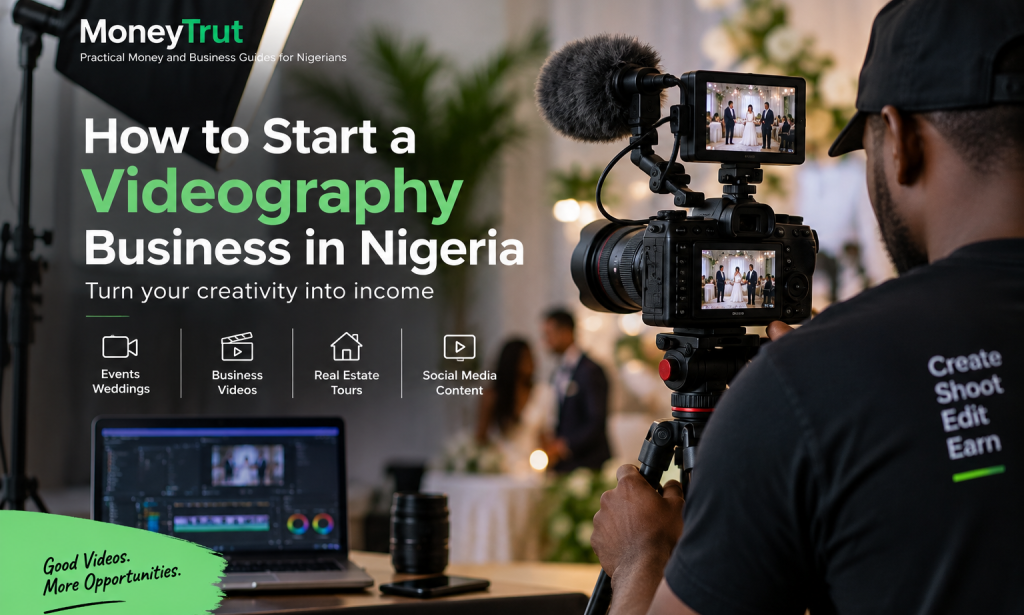
Starting a videography business in Nigeria can be done without immediately buying an expensive cinema camera, renting a studio or employing a large production team.
You can start by filming small events, creating social media videos for businesses, producing real estate walkthroughs, covering weddings, editing videos for clients or working as a second shooter for established videographers.
But owning a camera does not automatically make a videography business profitable.
You need to understand what type of video service you want to sell, who will pay for it, what it costs to produce, how to price it and how to consistently find customers.
The equipment matters, but the business model matters just as much.
What Is a Videography Business?
A videography business creates video content for paying clients.
Unlike a traditional film production company, a small videography business may operate with one person or a small team.
A client might hire you to:
- Record a wedding
- Cover a birthday
- Produce an event highlight video
- Create Instagram or TikTok content
- Film a property
- Produce a company profile
- Record interviews
- Create product demonstrations
- Shoot promotional videos
- Edit existing footage
The type of customer you target will determine the equipment, skills and pricing structure you need.
For example, a person producing short social-media videos for restaurants does not necessarily need the same setup as someone filming an eight-hour wedding.
Choose Your Videography Niche
One of the first decisions you should make is what type of videography you want to sell.
You can eventually offer several services, but starting with a clear niche makes it easier to build a portfolio and market yourself.
Wedding and Event Videography
You record:
- Weddings
- Birthdays
- Burials
- Conferences
- Religious events
- Anniversaries
- Parties
- Corporate events
The advantage is that a single event can generate a relatively large project fee.
The challenge is that event work requires reliability.
If you arrive without sufficient batteries, storage, audio equipment or backup plans, you cannot simply ask the client to repeat the event.
Social Media Videography
Businesses increasingly need short videos for platforms such as Instagram, TikTok, YouTube Shorts and other social platforms.
You could create:
- Product videos
- Restaurant videos
- Talking-head videos
- Promotional clips
- Short advertisements
- Behind-the-scenes content
- Customer testimonials
This model can potentially create recurring customers rather than one-off projects.
Real Estate Videography
Property agents, developers and landlords can use video to showcase:
- Houses
- Apartments
- Hotels
- Offices
- Estates
- Commercial properties
You can offer walkthrough videos, short social-media clips and promotional property videos.
Corporate Videography
Businesses may need:
- Interviews
- Training videos
- Company profiles
- Conferences
- Product launches
- Promotional videos
- Internal communications
Corporate work can require stronger production standards, contracts and professional delivery.
Product Videography
Online sellers and businesses may need videos showing how their products look and work.
Examples include:
- Fashion
- Electronics
- Food
- Cosmetics
- Furniture
- Household products
This can be particularly useful for businesses that sell through social media and e-commerce platforms.
Creator and YouTube Videography
You can also work with:
- YouTubers
- Influencers
- Coaches
- Consultants
- Musicians
- Podcasters
- Personal brands
Some clients may need regular filming rather than a single project.
That creates the possibility of monthly service packages.
Do Not Buy Equipment Before Choosing Your Market
A common mistake is starting with a camera shopping list.
Someone decides to become a videographer and immediately starts looking for:
- Camera
- Lenses
- Gimbal
- Drone
- Lights
- Microphones
- Tripods
- Monitor
- Memory cards
- Batteries
- Computer
- Studio
The equipment can easily become more expensive than the business itself.
Instead, start with the question:
What type of customer am I trying to serve?
Then determine what equipment is actually necessary.
A social-media videographer may need a completely different setup from a wedding videographer.
Can You Start Videography With a Smartphone?
Yes.
A modern smartphone can be enough to start learning video production and, for some types of commercial content, can also be used to deliver paid work.
This is particularly relevant for:
- Social-media videos
- Short promotional clips
- Restaurant content
- Behind-the-scenes videos
- Personal-brand content
- Simple product videos
The phone is only one part of the result.
You still need to understand:
- Lighting
- Composition
- Camera movement
- Audio
- Storytelling
- Framing
- Editing
- Colour
- Delivery
A professionally produced smartphone video can be more useful to a customer than poorly produced footage from an expensive camera.
What Equipment Do You Actually Need?
Your equipment can grow gradually.
A basic setup may include:
- Camera or capable smartphone
- One versatile lens
- Tripod
- External microphone
- LED light
- Extra batteries
- Memory cards
- Storage drive
- Basic editing computer
As your work grows, you can consider:
- Gimbal
- Additional lenses
- Wireless microphones
- Better lighting
- Monitor
- Audio recorder
- Drone
- Second camera
- Backup storage
- Portable power solutions
Do not buy equipment simply because another videographer owns it.
Buy equipment when a specific business need justifies it.
Camera vs Smartphone
There is no universal answer.
A camera can provide advantages in areas such as:
- Lens selection
- Low-light performance
- Manual control
- Depth of field
- Recording formats
- Professional accessories
A smartphone can provide advantages such as:
- Lower initial cost
- Portability
- Convenience
- Easy social-media workflow
- Minimal setup time
Your customer ultimately cares about the result.
If your target market mainly wants short social-media videos, an expensive cinema camera may not be your first priority.
Audio Is Extremely Important
Beginners often concentrate heavily on image quality and ignore sound.
That can be a mistake.
A customer may tolerate a video that is slightly less cinematic.
Poor audio, however, can make an otherwise good video difficult to watch.
For interviews and talking-head content, consider investing in:
- Wireless microphone
- Lavalier microphone
- Shotgun microphone
- Audio recorder where appropriate
For events, think carefully about how you will capture speeches, announcements and other important audio.
Do not assume that the camera microphone will always be sufficient.
Lighting Can Improve Your Work
Lighting affects how professional your footage looks.
You can begin with:
- Natural light
- A simple LED light
- Reflectors
- Existing indoor lighting
As your business grows, you can invest in more professional lighting equipment.
For interviews, product videos and studio-style content, controlled lighting can make a significant difference.
Again, buy according to the work you are actually selling.
How Much Does It Cost to Start a Videography Business?
There is no single startup amount.
Your cost depends on whether you already own equipment and the type of videography you intend to provide.
You could have several starting models.
Low-Capital Model
You already own a capable smartphone or camera.
You start by offering:
- Social-media videos
- Simple event coverage
- Video editing
- Short promotional videos
Your initial spending may focus on:
- Microphone
- Lighting
- Storage
- Tripod
- Transport
- Marketing
Equipment-Rental Model
Instead of purchasing expensive equipment, you rent what you need for larger jobs.
For example, you might own your basic camera and audio equipment but rent:
- Additional camera
- Long lens
- Gimbal
- Lighting
- Drone
- Additional audio equipment
The rental cost becomes part of the project cost.
Full Professional Setup
A larger operation may eventually own:
- Multiple cameras
- Multiple lenses
- Professional audio
- Lighting
- Gimbals
- Drone
- Computers
- Storage
- Backup equipment
- Production accessories
This can require substantially more capital.
Do not assume that the most expensive setup is necessary at the beginning.
Start With the Minimum Equipment Required
Suppose a client wants a short promotional video.
Before buying a ₦2 million camera package, ask:
Can I deliver this project with my current equipment?
If yes, take the job.
If not, determine exactly what is missing.
Perhaps you only need to rent a microphone and light.
That is very different from buying an entirely new production setup.
Your first objective should be to turn equipment into revenue.
Not the other way around.
Renting Equipment Can Make Sense
Equipment rental can reduce your initial capital requirement.
For example, imagine you receive a job that requires a second camera.
Instead of purchasing a second camera that you may only use occasionally, you could rent one specifically for the project.
Your project calculation could look like:
Client fee: ₦250,000
Equipment rental: ₦40,000
Transport: ₦20,000
Assistant: ₦25,000
Other direct costs: ₦15,000
Total direct costs:
₦100,000
Amount remaining before other business expenses:
₦150,000
The numbers above are illustrative.
Actual rental and project costs vary by location, equipment and job requirements.
The principle is what matters:
Treat equipment rental as a project cost when it helps you complete a job without permanently tying up your capital.
Build a Portfolio Before Chasing Large Clients
Customers want to see evidence of what you can produce.
If you have never worked professionally, create your own portfolio.
You can:
- Film a local business
- Create a mock advertisement
- Shoot a friend's event
- Produce a property walkthrough
- Film a product
- Create a short interview
- Produce social-media clips
You can also work as an assistant or second shooter for an established videographer.
This gives you experience without immediately carrying the full responsibility of a major project.
A portfolio does not need 100 videos.
A small collection of strong examples can communicate your ability better than a huge collection of average work.
Work as a Second Shooter
This can be one of the practical ways to enter event videography.
Instead of immediately advertising yourself as the person responsible for an entire wedding, work with an experienced videographer.
You can learn:
- How events are covered
- Camera positioning
- Audio capture
- File management
- Client interaction
- Lighting
- Backup procedures
- Team coordination
- Editing workflows
You also learn what can go wrong.
That experience is valuable because event videography is not simply about pressing the record button.
Learn Video Editing
Filming is only half of the business.
A large part of the value may come from what happens after filming.
You need to understand:
- Cutting
- Sequencing
- Audio editing
- Colour correction
- Colour grading
- Transitions
- Subtitles
- Music
- Export settings
- File compression
- Social-media formats
You do not necessarily need the most expensive editing software.
What matters initially is your ability to produce a clean final product efficiently.
Your Computer Is Part of Your Equipment
Do not forget the editing computer when calculating startup costs.
Video editing can require significant storage and processing power.
Depending on your workflow, you may need:
- Adequate RAM
- Fast SSD storage
- Sufficient processor performance
- Good external storage
- Backup drives
If you are primarily producing short social-media videos, your requirements may be lower than someone editing long 4K event projects.
Choose the computer based on the work you plan to sell.
Protect Your Footage
Imagine filming a wedding for several hours and then losing the files.
The camera itself cannot solve that problem.
You need a file-management and backup system.
After a major project:
- Copy the footage from the memory cards.
- Create a working copy.
- Create a backup.
- Organise files by project and date.
- Avoid formatting memory cards until you have confirmed your backups.
For important projects, consider maintaining more than one backup location.
Storage is a business expense.
Treat it that way.
How to Price Your Videography Services
Do not simply ask:
“What are other videographers charging?”
Other businesses have different:
- Equipment costs
- Experience
- Staff
- Editing workloads
- Transport costs
- Customer segments
- Operating expenses
Instead, calculate your own project economics.
For example:
Filming: ₦60,000
Editing: ₦40,000
Transport: ₦20,000
Assistant: ₦25,000
Equipment rental: ₦30,000
Other direct costs: ₦10,000
Total direct cost:
₦185,000
If you charge ₦300,000:
₦300,000 − ₦185,000 = ₦115,000
That ₦115,000 is not automatically your final profit.
You still need to account for broader business costs such as:
- Equipment maintenance
- Software
- Internet
- Marketing
- Insurance where applicable
- Business registration
- Equipment depreciation
- Office or studio expenses
- Taxes
- Unpaid administrative time
This is why revenue and profit should not be treated as the same thing.
Consider Packages Instead of Hourly Pricing
Customers often understand packages more easily than complicated hourly calculations.
For example:
Basic Social Media Package
- Up to 2 hours filming
- One short edited video
- Basic colour correction
- Digital delivery
Standard Business Package
- Half-day filming
- Multiple short videos
- Edited promotional video
- Basic colour grading
Premium Package
- Full-day production
- Multiple deliverables
- Advanced editing
- Additional camera or assistant
- Social-media teaser
The exact prices should depend on your costs, target customers and market.
The package structure simply makes your service easier to understand.
Current Lagos videography listings show how widely project pricing can vary depending on the scope. One 2026 rate guide, for example, lists social-media projects, real-estate videos, corporate work and wedding films in substantially different price ranges. These figures should be treated as market examples rather than universal Nigerian rates.
Charge for the Whole Project, Not Just Filming Time
Suppose you spend four hours at a customer's event.
The customer may think:
“You only worked for four hours.”
But the project could involve:
- Travel
- Equipment preparation
- Setup
- Filming
- File transfer
- Editing
- Colour correction
- Audio cleanup
- Client revisions
- Export
- Delivery
A four-hour shoot may therefore consume much more than four hours of your time.
When pricing, consider the entire workflow.
Set a Clear Revision Policy
Video projects can become unprofitable when clients request unlimited changes.
Your quotation should explain:
- What the customer receives
- How long the final video will be
- Number of revisions included
- Delivery format
- Delivery deadline
- Additional revision charges where applicable
For example:
One round of reasonable revisions is included. Additional revisions may attract an additional fee.
The exact policy is up to your business.
The important thing is to establish expectations before filming begins.
Take a Deposit for Larger Projects
You may need to spend money before completing a project.
For example:
- Equipment rental
- Transport
- Assistant
- Location expenses
- Production materials
A deposit helps reduce the amount of your own money tied up in the customer's project.
Your agreement should clearly state:
- Project scope
- Total fee
- Deposit
- Balance
- Shooting date
- Deliverables
- Delivery date
- Cancellation terms
- Revision terms
Put important agreements in writing.
Do Not Give Away Raw Footage Automatically
Raw footage can represent a significant amount of storage and production value.
Decide in advance whether your package includes:
- Final edited video only
- Selected raw footage
- Complete raw footage
- Project files
If a client wants additional deliverables, price them appropriately.
Do not discover after the project that you have agreed to provide several hundred gigabytes of footage for free.
Find Your First Videography Customers
Your first customers may not come from Google.
They may come from people already around you.
Start with:
- Friends
- Family
- Businesses nearby
- Event planners
- Wedding vendors
- Real estate agents
- Restaurants
- Churches
- Schools
- Corporate organisations
- Content creators
You can also approach businesses directly.
Instead of saying:
“I am a videographer. Do you need my service?”
show them a specific problem you can solve.
For example:
“I noticed your restaurant has good food but very little video content. I can create a set of short food videos that you can use on Instagram and TikTok.”
That is a clearer business proposition.
Build Relationships With Event Vendors
Videographers often work within an ecosystem of other businesses.
Potential referral partners include:
- Photographers
- Event planners
- Caterers
- Decorators
- DJs
- MCs
- Makeup artists
- Wedding planners
- Venue managers
- Real estate agents
A photographer who gets a wedding job may know a client who also needs video coverage.
Similarly, an event planner may regularly need reliable video suppliers.
Relationships can therefore become an important source of work.
Use Social Media as Your Portfolio
Your social-media account can function as a public portfolio.
Post examples of:
- Finished projects
- Before-and-after editing
- Behind-the-scenes footage
- Camera setups
- Short advertisements
- Property videos
- Event highlights
- Product videos
- Editing processes
Do not only post:
“Available for bookings.”
Show potential customers what you can produce.
Create Content for Businesses on a Monthly Basis
One of the more interesting opportunities is recurring video content.
Instead of waiting for individual events, you could offer businesses a monthly package.
For example:
Monthly Content Package
- One filming day
- 8–12 short videos
- Basic editing
- Social-media-ready formats
The exact deliverables depend on the client.
This model can provide more predictable work than relying entirely on weddings and one-off events.
A restaurant, property company, fashion business or personal brand may need new content repeatedly.
Real Estate Can Become a Separate Service
Real estate videography can be marketed independently.
You could offer:
- Property walkthroughs
- Short listing videos
- Vertical social-media videos
- Agent introduction videos
- Estate promotional videos
The customer may be:
- Real estate agent
- Property developer
- Landlord
- Property management company
- Hotel
- Short-let operator
This gives you another market beyond social events.
Consider Drone Work Carefully
Drone footage can make some projects more visually attractive.
But do not buy a drone simply because you think every videographer needs one.
If customers rarely request aerial footage, renting or partnering with a drone operator may make more financial sense.
Also make sure you understand the applicable aviation and operational requirements before offering drone services commercially.
The important business principle is:
Do not purchase specialised equipment until there is enough demand to justify it.
Registering Your Videography Business
As the business becomes a genuine ongoing commercial operation, you may decide to formalise it.
The Corporate Affairs Commission provides registration for business names and companies through its official registration system. CAC states that business-name registration can be completed through its Company Registration Portal.
The appropriate structure depends on your circumstances.
You could operate as a business name or establish a company, depending on factors such as:
- Ownership
- Partners
- Contracts
- Scale
- Liability considerations
- Growth plans
You can compare the available structures before registering rather than automatically choosing the same structure another videographer uses.
Understand Copyright and Client Usage Rights
Your video is not simply a file you hand over to a customer.
Copyright and usage rights can matter.
Nigeria's Copyright Act, 2022 recognises photographs as artistic works and separately defines audiovisual works. The Act also contains provisions concerning authorship and rights in creative works.
This means your client agreement should be clear about matters such as:
- Who owns the final work
- Whether the client receives usage rights
- Whether you can use the work in your portfolio
- Whether raw footage is included
- Whether third parties can reuse the footage
- Whether music or other licensed materials are included
For significant commercial productions, consider getting appropriate legal advice instead of relying on a generic internet contract.
The Nigerian Copyright Commission also provides an online copyright registration system for creators who choose to register their works.
Be Careful With Music
You cannot assume that because a song is available online, you can use it commercially in every situation.
Music can involve separate rights from the video itself.
For commercial work, understand the licensing requirements for any music you use.
Using music without appropriate rights can create problems for both you and your client.
Where appropriate, use properly licensed music or platforms that provide suitable commercial licensing.
Create a Simple Client Contract
Your agreement does not need to be unnecessarily complicated.
At minimum, clearly state:
Client
Who is hiring you?
Project
What exactly are you producing?
Date
When will filming take place?
Deliverables
What will the customer receive?
Price
How much does the project cost?
Payment
How much is the deposit and when is the balance due?
Revisions
How many revisions are included?
Delivery
When will the final files be delivered?
Cancellation
What happens if the customer cancels?
Usage
Who can use the finished video and how?
For larger commercial projects, use a properly drafted agreement.
Keep Business Records
Record every project.
At minimum, track:
- Customer
- Project
- Amount quoted
- Deposit
- Balance
- Equipment rental
- Transport
- Assistant costs
- Editing time
- Other expenses
- Final revenue
- Estimated margin
- Payment status
This will help you identify which types of work are actually worth pursuing.
For example, you might discover that:
- Weddings generate large revenue but consume enormous amounts of time.
- Social-media clients generate smaller individual invoices but return every month.
- Real estate jobs are shorter but require significant travel.
- Corporate work pays well but requires more revisions and administration.
The numbers help you decide where to focus.
Manage Your Cash Flow
Videography businesses can experience irregular income.
You might receive ₦400,000 from a project in one week and then have no major booking for two weeks.
Do not treat every large payment as personal income.
Set aside money for:
- Equipment maintenance
- Software
- Storage
- Transport
- Taxes
- Marketing
- Future equipment
- Business expenses
MoneyTrut's guide on managing cash flow in a small business in Nigeria explains why business revenue and available cash are not the same thing.
Build an Equipment Replacement Fund
Cameras, lenses, batteries, storage drives and computers do not last forever.
If you earn money from your equipment, part of that income should eventually support replacement and maintenance.
Suppose your business earns a strong margin on several projects.
Instead of spending all the money, you could allocate part toward:
Equipment reserve
This reduces the shock when a major piece of equipment fails.
Do Not Depend on One Camera
As you begin covering important events, reliability becomes increasingly important.
Imagine filming a wedding and your only camera develops a fault.
You may not have another chance to record the ceremony.
As your business grows, consider developing backup options.
These could include:
- Second camera
- Spare batteries
- Spare memory cards
- Backup microphone
- Backup lighting
- Power banks
- Alternative storage
You do not necessarily need two of everything on your first day.
But professional work requires thinking about what happens when something fails.
Common Videography Business Mistakes
Buying too much equipment too early
Equipment does not generate money by itself.
Focusing only on the camera
Audio, lighting, editing and storytelling are also important.
Underpricing
A low price may attract customers while leaving you unable to cover your costs.
Accepting unlimited revisions
This can consume hours of unpaid editing.
Failing to back up footage
A lost project can damage your reputation.
No written agreement
Verbal agreements can create disputes over deliverables and payment.
Depending entirely on weddings
A diversified customer base can provide additional opportunities.
Ignoring transport costs
Travel can significantly affect project economics.
Giving away raw footage without considering storage
Large video files have real storage costs.
Buying equipment because another videographer has it
Your equipment should solve your customers' problems.
How to Start With ₦200,000
Suppose you already own a capable smartphone or camera and computer.
An illustrative starting allocation could be:
- ₦40,000 — microphone
- ₦35,000 — lighting
- ₦25,000 — tripod/accessories
- ₦25,000 — storage
- ₦25,000 — transportation
- ₦20,000 — marketing
- ₦30,000 — working-capital reserve
Total:
₦200,000
This assumes you already have the most expensive components of the setup.
If you need to buy a professional camera, computer and lenses, the required capital could be substantially higher.
How to Start With ₦500,000
If you already have some equipment, ₦500,000 could allow you to build a stronger entry-level setup.
For example:
- Camera-related upgrade
- Audio equipment
- Lighting
- Storage
- Tripod
- Accessories
- Marketing
- Transportation
- Working capital
The exact allocation depends on what you already own.
Do not spend the entire ₦500,000 on a camera.
You still need money to operate after the purchase.
A Better Way to Grow Your Equipment
Instead of thinking:
Camera → Lens → Gimbal → Drone → Studio
think:
Customer demand → project requirement → equipment need → purchase or rental
For example:
You start with social-media videos.
Customers begin asking for better interviews.
You invest in better audio.
Then you begin receiving property-video jobs.
You rent a gimbal for selected projects.
Later, if those projects become regular, buying a gimbal may make sense.
This approach keeps your capital connected to actual demand.
A Practical 30-Day Plan
Week 1: Choose Your Niche
Choose one primary market:
- Events
- Weddings
- Social media
- Real estate
- Corporate
- Products
- Creator content
Do not try to market yourself as everything immediately.
Week 2: Build Your Portfolio
Create three to five strong sample videos.
They do not all need to be paid projects.
Show potential customers exactly what you can produce.
Week 3: Start Outreach
Contact:
- Local businesses
- Event planners
- Photographers
- Real estate agents
- Content creators
- Restaurants
- Corporate organisations
Show your portfolio.
Offer a clearly defined service.
Week 4: Review Your Numbers
Track:
- Leads
- Customers
- Revenue
- Expenses
- Time spent
- Equipment costs
- Transport
- Editing time
- Customer feedback
Then determine what is working.
Do not scale simply because you completed one project.
Scale when you begin to see repeatable demand.
How to Scale a Videography Business
A videography business can grow beyond one-person freelance work.
You could eventually build a small production team consisting of:
- Lead videographer
- Second shooter
- Video editor
- Sound operator
- Drone operator
- Production assistant
You could also specialise.
For example:
Wedding video company
or
Real estate video production
or
Social-media content agency
or
Corporate video production
Specialisation can make your marketing clearer because customers immediately understand what you do.
The Business Can Become More Than Filming
Once you understand video production, you can potentially add related services.
For example:
- Video editing
- Social-media content packages
- Photography
- Livestreaming
- Drone services
- Motion graphics
- YouTube production
- Product photography
- Content strategy
But do not add everything at once.
Each service should have a clear customer need and a financial reason for being added.
Final Checklist Before Starting
Before investing heavily, answer these questions:
Market
- Who is my customer?
- What type of video do they need?
- How often might they need it?
Equipment
- What equipment do I already own?
- What do I actually need?
- What can I rent?
Skills
- Can I film properly?
- Can I record clean audio?
- Can I edit?
- Can I deliver on time?
Money
- What does each project cost?
- What should I charge?
- How much is my break-even point?
- How much working capital do I need?
Sales
- Where will my first customers come from?
- Do I have a portfolio?
- Can I explain my service clearly?
Operations
- How will I back up footage?
- What happens if equipment fails?
- How will I transport equipment?
Legal and commercial
- Do I need to formalise the business?
- Do my contracts clearly define deliverables?
- Who owns the final work?
- What usage rights are being granted?
If you cannot answer these questions, spend more time planning before spending significant money on equipment.
Bottom Line
Starting a videography business in Nigeria does not require you to own the most expensive camera or operate a large production studio.
You can begin with a smartphone or existing camera, build a portfolio, work as a second shooter, rent specialised equipment and gradually invest as customers create demand.
The real business is not the camera.
It is the ability to consistently produce something customers are willing to pay for while controlling your production costs.
Choose a market.
Build a portfolio.
Learn filming and editing.
Understand audio and lighting.
Price the entire project rather than just shooting time.
Use written agreements.
Protect your footage.
Take deposits for significant projects.
Keep business records.
And only buy expensive equipment when the work you are winning justifies it.
A videography business becomes more sustainable when your equipment, skills, pricing and customer acquisition system grow together.
Related Articles
- How to Start a Photography Business in Nigeria
- How to Make Money From Your Skills in Nigeria: A Practical Guide
- How to Get Customers for a Small Business in Nigeria: Practical Ways That Work
- How to Start a Small Business in Nigeria With Little Money
- How to Calculate the Break-Even Point for a Small Business in Nigeria
Sources & References
- Corporate Affairs Commission — Business Name Registration
- Corporate Affairs Commission — Company Registration Portal
- Nigerian Copyright Commission — Copyright Act, 2022
- Nigerian Copyright Commission — Copyright eRegistration System
- Skyweb — How to Start an Event Photography and Videography Business in Nigeria
- Media Lounge — Videography Cost Guide for Lagos, 2026

You must be logged in to post a comment.