

Starting a side hustle while working a full-time job can increase your income, help you build a business and give you another source of financial security. But the wrong side hustle can also consume your time, money and energy without producing meaningful income. This guide explains how to choose a realistic side hustle in Nigeria, start with limited capital, manage it around your job and avoid common mistakes that cause side hustles to fail.
Having a full-time job does not mean your salary has to be your only source of income.

For some people, a side hustle can provide extra money for savings, debt repayment, investing or major financial goals.
For others, it can eventually become a business that replaces their salary.
But there is a problem.
Many people approach side hustles the wrong way.
They see someone making money from a particular business on social media and immediately want to copy it.
They spend money buying equipment, paying for courses or purchasing inventory.
Then they discover that the business requires more time than they have, customers are difficult to find, or the profit is much smaller than expected.
A better approach is to treat a side hustle as a small business experiment.
Start small. Test demand. Understand your numbers. Then increase your investment when the evidence supports it.
What Is a Side Hustle?
A side hustle is an income-generating activity you do alongside your main job or primary source of income.
It could involve:
- Selling products
- Providing professional services
- Freelancing
- Teaching or tutoring
- Digital services
- Food production
- Reselling
- Consulting
- Content creation
- Repairs and technical services
- Photography or videography
- Online services
- Small-scale trading
- Property-related services
A side hustle does not have to be an internet business.
A person working in a hospital, bank, school, engineering company or government office can potentially have a side business that operates outside their working hours.
The important question is not:
"What side hustle is trending?"
It is:
"What can I realistically sell, to whom, at what profit, without destroying my main source of income?"
Why Start a Side Hustle?
The most obvious reason is additional income.
But money is not the only benefit.
A well-run side hustle can help you:
- Increase your monthly cash flow
- Build savings faster
- Pay off debt
- Invest more
- Build business experience
- Develop valuable skills
- Test a business idea
- Create another source of income
- Build an asset that may eventually become your main business
For example, someone earning ₦300,000 per month who generates another ₦80,000 from a side business has increased their total monthly income to ₦380,000.
That extra ₦80,000 could be used to improve their financial position instead of simply increasing lifestyle spending.
MoneyTrut has previously examined how additional income can be used alongside a regular job:
How to Make Extra Money Without Quitting Your Job
The Biggest Mistake: Starting With the Business Instead of the Customer
Many people begin with a product.
"I want to sell perfumes."
"I want to sell clothes."
"I want to start a food business."
"I want to sell phones."
"I want to start a cleaning business."
But the better starting point is the customer.
Ask:
Who has a problem I can solve?
For example, instead of saying:
"I want to start a graphic design business."
You might identify small businesses that need:
- Social media flyers
- Menus
- Business cards
- Product catalogues
- Event designs
- Simple advertisements
Now you have a specific customer and a specific problem.
That makes it easier to determine what to offer and what people may actually pay for.
1. Start With a Skill You Already Have
One of the easiest ways to start a side hustle is to monetize something you already know how to do.
Consider your current skills.
You may already know how to:
- Write
- Design
- Repair electronics
- Install equipment
- Take photographs
- Edit videos
- Teach
- Cook
- Drive
- Build websites
- Manage social media
- Analyse data
- Prepare documents
- Sell products
- Fix computers
- Install software
- Train people
- Handle administrative work
Your current job may also have given you a valuable professional skill.
For example, an accountant could offer bookkeeping services to small businesses.
An engineer could provide technical consulting or equipment-related services where permitted.
A teacher could provide tutoring.
A designer could take freelance projects.
A software developer could build websites or applications.
The advantage is that you are not starting completely from zero.
MoneyTrut's guide on freelancing covers another way professionals can monetize their skills:
How to Make Money as a Freelancer in Nigeria: A Practical Beginner's Guide
2. Choose a Side Hustle That Fits Your Schedule
This is particularly important if you already work 8 to 5.
A business that requires you to physically be available from 8 a.m. to 6 p.m. may not be suitable.
Your side hustle should fit around your actual life.
For example:
If you have evenings available
You could consider:
- Online tutoring
- Freelancing
- Graphic design
- Writing
- Digital marketing
- Consulting
- Online customer support
- Content creation
If you have weekends available
You could consider:
- Event services
- Photography
- Catering
- Reselling
- Cleaning services
- Training
- Product distribution
If you have limited time but some capital
You could consider businesses where another person handles daily operations while you manage purchasing, marketing and finances.
But be careful.
Delegating operations does not eliminate the need for proper supervision.
3. Don't Quit Your Job Too Early
A side hustle is supposed to reduce your dependence on one income source.
Quitting your job before the side business is stable can create the opposite problem.
Imagine earning ₦400,000 from your job and making ₦50,000 from a new side business.
It may be tempting to quit because you believe the side business will grow faster if you have more time.
But you would be giving up ₦400,000 of relatively predictable income to pursue ₦50,000 of uncertain income.
That is a significant financial risk.
A safer approach for many people is to allow the side hustle to prove itself first.
Look for evidence such as:
- Consistent customers
- Repeat business
- Predictable revenue
- Sustainable profit
- Enough cash flow to cover operating costs
- A realistic plan for growth
There is no universal income level at which someone should quit their job.
Your personal expenses, savings, dependants, debt and business stability all matter.
4. Separate Revenue From Profit

This is one of the most important lessons for a new side-hustle owner.
Suppose you sell products worth ₦500,000 in one month.
It is tempting to say:
"I made ₦500,000."
You didn't necessarily make ₦500,000.
That is revenue.
Suppose your costs were:
- Inventory: ₦350,000
- Delivery: ₦30,000
- Packaging: ₦10,000
- Advertising: ₦20,000
- Other expenses: ₦15,000
Total costs:
₦425,000
Your gross profit before other applicable expenses is:
₦500,000 − ₦425,000 = ₦75,000
That is very different from making ₦500,000.
If you don't understand this difference, a side hustle can appear successful while actually producing very little profit.
5. Calculate Your Profit Before You Start
Before investing money, estimate the economics.
Suppose you want to sell a product for ₦15,000.
Your expected costs per unit are:
Product cost: ₦8,000
Packaging: ₦500
Delivery contribution: ₦1,000
Advertising: ₦1,000
Total:
₦10,500
Potential gross profit:
₦15,000 − ₦10,500 = ₦4,500
If you sell 20 units:
₦4,500 × 20 = ₦90,000
That sounds attractive.
But now ask:
How many hours will it take?
How much money will remain after returns, damaged products, discounts, unpaid deliveries and other costs?
The point is not to predict everything perfectly.
The point is to know whether the business makes financial sense before committing significant money.
6. Start With the Smallest Test Possible
You do not need ₦1 million to discover whether customers want your product.
If you want to sell a product, consider testing a small quantity.
If you want to provide a service, try getting your first few customers before buying expensive equipment.
If you want to teach, find a small group of paying students before renting a large classroom.
If you want to sell food, test a limited menu before opening a full restaurant.
This reduces your risk.
Your first objective should not necessarily be:
"Build a big business."
It should be:
"Prove that people will pay."
Once customers are consistently paying, you can think about scaling.
7. Use Your Existing Network Carefully
Your first customers may come from people who already know you.
Friends.
Former classmates.
Colleagues.
Neighbours.
Professional contacts.
Family members.
Community groups.
But don't assume that everyone you know is automatically a customer.
Instead, let people know clearly what you offer.
For example:
Instead of:
"I have started a business. Please patronize me."
Try:
"I now provide weekend home cleaning services in Benin City. I handle apartments and small offices. If you need a one-time cleaning or regular service, I can send you the pricing."
The second message tells people what you do.
8. Don't Depend Entirely on Social Media
Social media can be useful for marketing.
But your business should not depend on getting viral posts.
A good side hustle can acquire customers through:
- Referrals
- Google search
- Local communities
- Existing professional networks
- Direct outreach
- Partnerships
- Repeat customers
- Marketplaces
- Physical locations
- Social media
For many small businesses, repeat customers can be more valuable than constantly searching for new customers.
If someone buys from you once and returns five more times, you have created a much stronger business relationship than a single sale.
9. Keep Your Side-Hustle Money Separate
This becomes important surprisingly quickly.
Suppose your salary is ₦400,000 and your side business generates ₦150,000.
If everything enters one account, you may start spending the business money as though it were salary.
Instead, track the business separately.
At minimum, record:
Sales
Business expenses
Money taken from the business
Profit
Money reinvested
You do not necessarily need complicated accounting software when you're starting.
A spreadsheet or simple record can be enough.
The goal is to know whether the business is actually making money.
10. Don't Spend All Your Side-Hustle Profit
Suppose your side hustle makes ₦100,000 profit.
You could spend the entire ₦100,000.
Or you could decide on a structure such as:
₦40,000 — reinvest in the business
₦30,000 — personal savings
₦20,000 — investment
₦10,000 — personal spending
The exact percentages are not universal.
The important thing is to give the profit a purpose.
If every naira generated by the business immediately disappears into personal spending, the business may never have enough capital to grow.
11. Be Careful With Side Hustles That Promise Easy Money
One of the biggest dangers in the online side-hustle space is the promise of effortless income.
You will see claims such as:
- "Make ₦500,000 every week."
- "Earn while you sleep."
- "No skills required."
- "Guaranteed income."
- "Invest ₦100,000 and receive ₦200,000."
- "Secret method nobody knows."
Treat these claims carefully.
The fact that someone shows screenshots of earnings does not prove that the opportunity is legitimate or suitable for you.
If an opportunity involves investing money with an investment provider, check the relevant regulatory information and registration status rather than relying solely on social media claims.
The SEC provides investor education resources and a platform for investors to find registered operators and track regulatory information.
12. Don't Borrow Heavily to Start an Untested Side Hustle
Debt can accelerate a good business.
It can also accelerate a bad business.
If you have never sold a product before, borrowing ₦2 million to buy large inventory may be unnecessary risk.
Start by proving demand.
Then consider whether additional capital can increase profits.
The question should not simply be:
"Can I borrow money to start?"
It should be:
"What evidence do I have that additional money will generate additional profit?"
Those are very different questions.
13. Don't Let Your Side Hustle Destroy Your Main Job
Your salary may currently be your most reliable source of income.
Don't sacrifice it unnecessarily.
If you regularly sleep at 2 a.m. because of your side hustle and arrive at work exhausted, the side hustle could eventually damage the income it was supposed to supplement.
Set boundaries.
For example:
Monday–Friday: 7 p.m.–9 p.m. for side-hustle work.
Saturday: 10 a.m.–3 p.m.
Sunday: Planning and bookkeeping.
Your schedule will depend on your job and business, but the principle is simple:
Your side hustle should fit your life until there is enough evidence to justify making it a bigger commitment.
14. Check Your Employment Contract
This is an important step that people sometimes ignore.
Some employers have policies covering:
- Outside employment
- Conflicts of interest
- Confidential information
- Use of company equipment
- Use of company time
- Competition
- Intellectual property
- Client relationships
Before starting a side business, review your employment contract and company policies.
Do not use your employer's confidential information, customer database, equipment or paid working time to operate your private business.
A side hustle should create additional income without creating unnecessary professional problems.
15. Start With a Business You Can Understand
You don't need to choose the most exciting business.
You need to choose something you understand well enough to manage.
Consider these questions:
Who is the customer?
What problem am I solving?
How much will they pay?
What will it cost me to deliver?
How will I find customers?
How much time will it require?
What happens if sales are lower than expected?
Can I operate it while keeping my job?
If you cannot answer these questions, you may not understand the business well enough to invest heavily yet.
Side Hustle Ideas You Can Consider in Nigeria
There is no single best side hustle for everyone.
Your skills, location, capital and available time matter.
Here are some categories to explore.
Service-Based Side Hustles
These can be attractive because you may not need to hold large amounts of inventory.
Examples include:
- Graphic design
- Writing
- Website development
- Social media management
- Photography
- Video editing
- Tutoring
- Cleaning
- Equipment maintenance
- Bookkeeping
- Consulting
- Event services
Product-Based Side Hustles
These involve buying, producing or reselling physical products.
Examples include:
- Fashion
- Beauty products
- Food
- Household products
- Electronics accessories
- Office supplies
- Agricultural products
- Custom gifts
The challenge is usually inventory, logistics and working capital.
Digital Side Hustles
These may have lower physical overhead but can take time to build.
Examples include:
- Online courses
- Digital products
- Freelancing
- Content creation
- Website services
- Digital marketing
- Newsletter businesses
- Affiliate marketing
The important distinction is that "low startup cost" does not mean "easy."
Your time and skill are still costs.
How Much Money Do You Need to Start?
There is no universal minimum.
A service business could potentially start with very little if you already have the necessary skill and equipment.
A product business may require more working capital.
Instead of asking:
"How much money should I spend?"
Ask:
"What is the minimum amount required to test the business properly?"
For example:
If ₦50,000 is enough to test whether customers will buy a product, you may not need to start with ₦500,000.
If ₦100,000 is enough to acquire your first customers for a service, you can use the early results to decide whether further investment makes sense.
A Simple Side-Hustle Plan
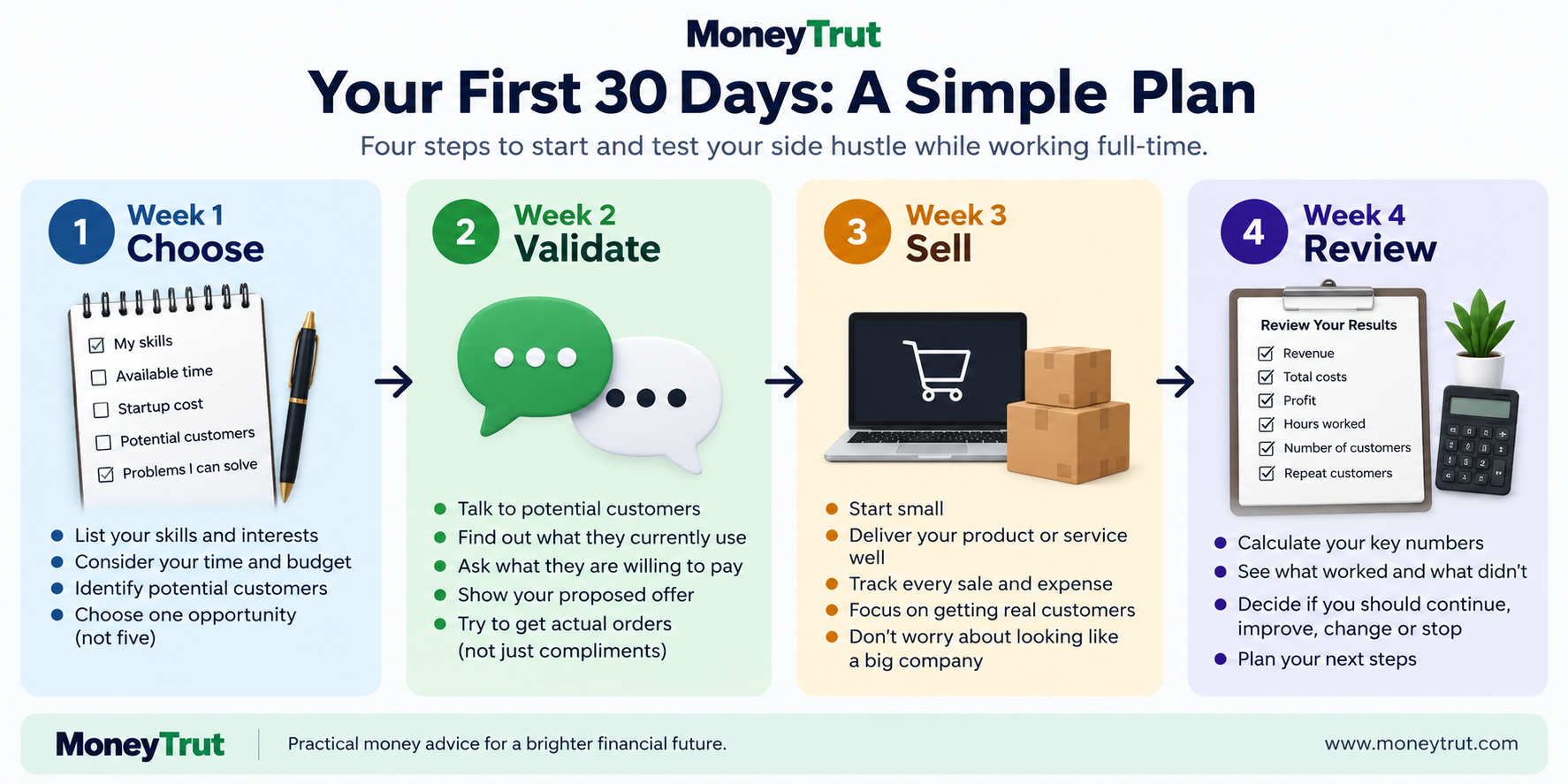
You can structure your first 30 days like this.
Week 1: Choose the opportunity
Write down:
- Your skills
- Available capital
- Available hours
- Potential customers
- Problems you can solve
Select one opportunity.
Not five.
Week 2: Validate demand
Talk to potential customers.
Ask what they currently use.
Find out what they pay.
Show them your proposed service or product.
Try to get actual orders, not just compliments.
"That's a nice idea" is not the same as someone paying you.
Week 3: Make your first sales
Start small.
Track every sale and expense.
Do not focus on looking like a big company.
Focus on delivering something people are willing to pay for.
Week 4: Review the numbers
Calculate:
Revenue
Total costs
Profit
Hours worked
Number of customers
Repeat customers
Customer acquisition cost
Then decide:
Continue? Improve? Change the offer? Stop?
Stopping an unprofitable experiment early is not failure.
It can be good financial management.
When Should You Scale the Side Hustle?
Don't scale simply because you are excited.
Scale when the numbers support it.
For example, suppose you have been selling a product for three months.
You consistently have customers.
You know your profit per unit.
You understand your costs.
You are turning away customers because you cannot keep enough inventory.
Now additional capital may make sense.
But if you are struggling to sell your first 20 units, buying 500 more units is probably not the solution.
Fix demand before scaling supply.
What If Your Side Hustle Starts Making More Than Your Salary?
This is where things become interesting.
If the business eventually produces more profit than your salary, you still do not have to quit immediately.
Consider:
- How consistent is the income?
- How dependent is it on you personally?
- How many customers do you have?
- Do you have savings?
- How much are your monthly expenses?
- Can the business survive a bad month?
- Are you properly tracking taxes and business expenses?
- Could you continue your job while hiring someone to handle operations?
- Is the business actually profitable after all costs?
A side hustle generating ₦600,000 in one unusually good month is not necessarily equivalent to a business that consistently produces ₦600,000 every month.
Consistency matters.
The Goal Isn't to Have More Work
This is perhaps the most important point.
A side hustle should not simply turn you into someone who works 18 hours a day.
The objective is to create additional economic value.
If you spend 100 hours per month on a side business and make ₦30,000, you need to question whether the model is worth continuing.
If you spend 20 hours and make ₦100,000, you may have something much more promising.
Over time, you want to improve the relationship between:
Time → Revenue → Profit
That is what makes a side hustle potentially scalable.
Bottom Line
Starting a side hustle while working full-time can be a smart way to increase your income, develop new skills and eventually build a business.
But don't start because somebody on social media says a particular business is making people rich.
Start with something you understand.
Find a real customer problem.
Test demand with as little money as reasonably possible.
Know your costs.
Separate revenue from profit.
Keep proper records.
Protect your main income.
And don't borrow heavily until you have evidence that the business model works.
Your first side hustle does not have to become a huge company.
It simply needs to teach you something valuable and, ideally, make more money than it costs you to operate.
If it works, you can scale it.
If it doesn't, you can learn from it and try something else without putting your financial stability at unnecessary risk.
Related MoneyTrut Articles
- How to Make Extra Money Without Quitting Your Job
- How to Make Money Online in Nigeria: Realistic Ways That Actually Work
- How to Make Money as a Freelancer in Nigeria: A Practical Beginner's Guide
- How to Manage Your Money When You Have Multiple Sources of Income
- How to Start a Small Business in Nigeria With Little Money

You must be logged in to post a comment.