

A fixed deposit is one of the simplest ways to earn interest on money you do not need immediately.
Instead of leaving your money in a regular savings account, you agree to keep a specific amount with a bank or other eligible financial institution for a predetermined period.
In return, the institution pays you interest according to the terms of the deposit.
For example, you could place ₦500,000 in a fixed deposit for six months and receive your principal plus interest when the deposit matures.
It sounds straightforward, but there are important details to understand before putting your money into one.
How long is the money locked up? What happens if you need it early? Is the interest guaranteed? How does a fixed deposit compare with Treasury bills or a money market fund?
This guide explains how fixed deposits work in Nigeria and what to consider before using one.
Fixed deposits can be useful for short- or medium-term financial goals, but they are not automatically the best option for every situation. Before opening one, compare the interest rate, maturity period, early-withdrawal conditions, fees, taxes where applicable and the protection that applies to the deposit.
What Is a Fixed Deposit?
A fixed deposit is a type of deposit where you place a specific amount of money with a bank or other eligible financial institution for a predetermined period.
The institution pays you interest for keeping the money there.
The period could be relatively short or extend for several months or longer, depending on the product.
For example, imagine you have ₦1 million that you will not need for six months.
Instead of leaving the entire amount in a regular savings account, you could place it in a six-month fixed deposit.
If the agreed interest rate were 12% per year, a simple illustration would be:
- Principal: ₦1,000,000
- Annual interest rate: 12%
- Period: 6 months
- Approximate simple interest: ₦60,000
That is only an illustration.
The actual amount you receive depends on the institution's quoted rate, how it calculates interest, applicable charges and taxes, and the exact terms of the deposit.
The important point is that the quoted annual rate is not the same as the amount you receive for every deposit period.
How Does a Fixed Deposit Work?

The process is generally straightforward.
Step 1: You choose how much to deposit
Suppose you have ₦500,000 available.
You decide that you can leave the money untouched for several months.
Step 2: You choose a maturity period
The financial institution may offer different periods.
For example:
- 30 days
- 90 days
- 180 days
- 365 days
The actual periods available depend on the institution.
Step 3: You agree on the interest rate
The institution gives you the applicable rate and explains the terms.
Do not look at the percentage alone.
Ask how much you will actually receive at maturity.
Step 4: Your money remains deposited
During the agreed period, the money is treated according to the fixed-deposit agreement.
If you withdraw it before maturity, the institution may reduce the interest payable or apply other conditions depending on the product.
Step 5: The deposit matures
At maturity, you receive your principal and the interest due under the agreement, subject to applicable deductions and terms.
You may then withdraw the money, renew the deposit or move the money elsewhere.
Fixed Deposit vs Savings Account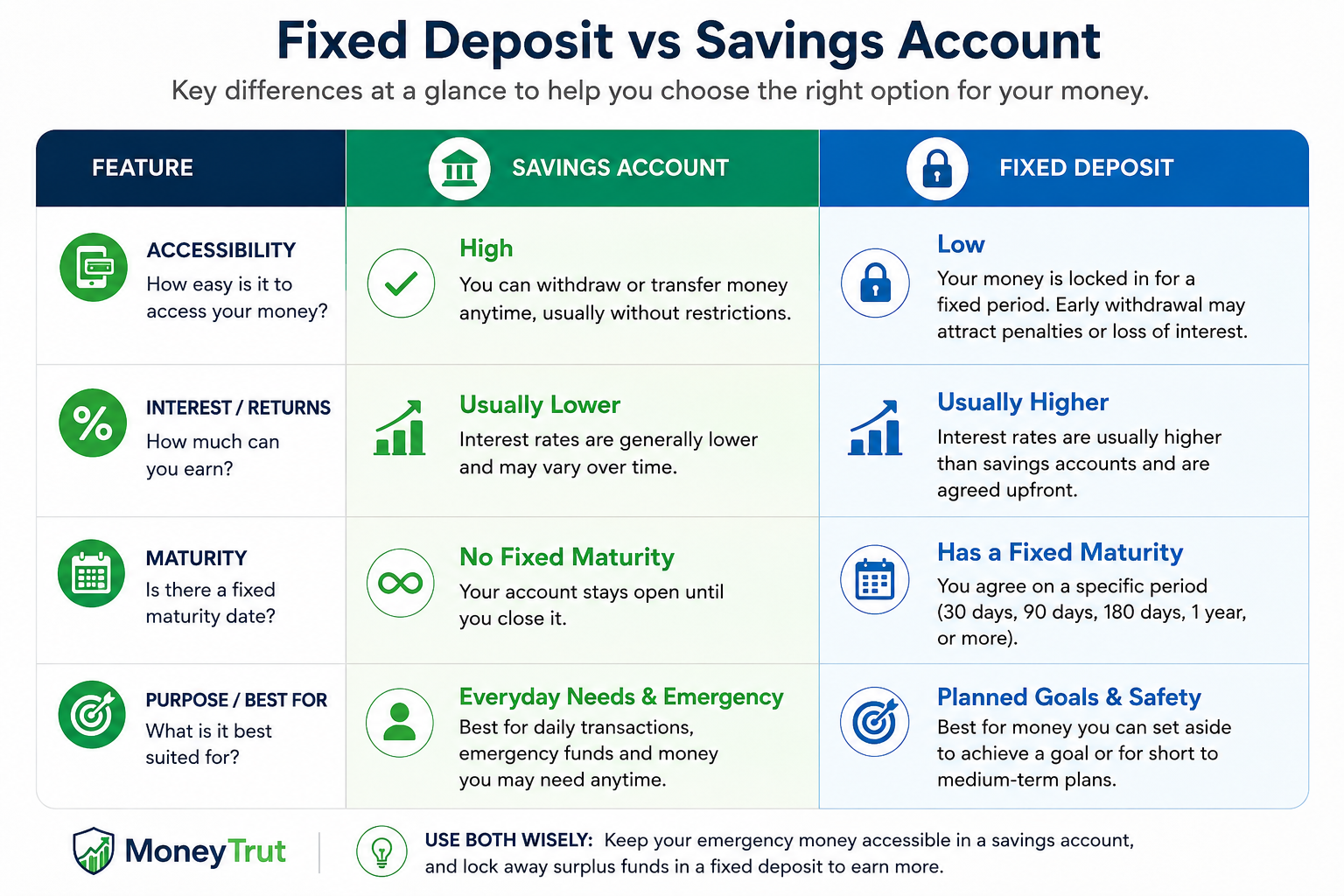
The biggest difference is accessibility.
A savings account is designed for regular access to your money.
A fixed deposit is designed for money that you can leave untouched for an agreed period.
| Feature | Savings Account | Fixed Deposit |
|---|---|---|
| Access to money | Generally easy | Restricted according to terms |
| Interest | Usually lower or variable | Usually agreed for the deposit period |
| Maturity date | No fixed maturity | Has a defined maturity period |
| Suitable for | Regular spending and reserves | Money you can set aside |
| Early withdrawal issue | Generally not applicable | May affect interest or terms |
| Main advantage | Liquidity | Potentially higher interest |
Neither is automatically better.
You can actually use both.
For example, you could keep your emergency fund accessible in savings while putting money intended for a known future expense into a fixed deposit.
MoneyTrut explains this distinction in more detail in:
Savings Account vs Fixed Deposit: Which Is Better?
How Much Can You Earn From a Fixed Deposit?
The answer depends on the amount, interest rate and period.
Suppose a bank offers a hypothetical annual interest rate of 10%.
If you deposit ₦500,000 for six months, a simple calculation would be:
₦500,000 × 10% × 6/12 = ₦25,000
So the illustrative interest would be ₦25,000.
Your maturity amount would then be approximately:
₦500,000 + ₦25,000 = ₦525,000
But this calculation should not be treated as an actual bank quotation.
Some institutions may calculate interest differently, and applicable deductions can affect the amount you ultimately receive.
Always ask for the net amount payable at maturity, not just the advertised annual rate.
What Happens If You Withdraw Early?
This is one of the most important questions to ask before opening a fixed deposit.
Suppose you put ₦1 million into a 12-month fixed deposit.
Six months later, you suddenly need ₦400,000.
Can you withdraw it?
The answer depends on the terms of the particular deposit.
Early withdrawal may result in:
- Reduced interest
- Loss of some or all expected interest
- Penalties or charges
- Conversion to another interest rate
- Other conditions specified in the agreement
This is why you should not put your emergency fund into a fixed deposit simply because the interest rate looks attractive.
If you may need the money tomorrow, locking it away for months can create a problem.
Is a Fixed Deposit Safe?
A fixed deposit is a deposit product, not an investment security like a Treasury bill or a mutual fund.
For eligible deposits held with covered institutions, the Nigeria Deposit Insurance Corporation (NDIC) provides deposit insurance subject to its applicable coverage limits and conditions.
That distinction matters.
Do not assume that every product advertised by a financial company is a bank deposit simply because it looks similar.
Before putting your money somewhere, understand whether you are:
- Making a bank deposit
- Buying a government security
- Buying units in a mutual fund
- Lending to a company
- Buying another type of investment
The legal structure determines the type of protection and risk involved.
Fixed Deposit vs Treasury Bills

A fixed deposit and a Treasury bill can both be used for money you do not need immediately, but they work differently.
A Treasury bill is a short-term government security.
A fixed deposit is a deposit arrangement with a financial institution.
The CBN describes Nigerian Treasury bills as short-term securities issued at a discount, with tenors ranging from 91 to 364 days. The CBN also notes that members of the public can invest in government securities through authorised channels.
The key differences include:
| Feature | Fixed Deposit | Treasury Bills |
|---|---|---|
| Structure | Deposit | Government security |
| Provider/issuer | Financial institution | Federal Government |
| Maturity | Depends on deposit terms | Defined maturity |
| Return | Interest under deposit terms | Difference between purchase price and maturity value |
| Early access | Subject to deposit terms | May require selling before maturity |
| Management | Bank/institution holds deposit | Investor owns security |
| Deposit insurance | Eligible deposits may be covered | Not a bank deposit |
Neither should be chosen simply because someone says it pays more.
Compare the actual net return, access to the money, risk and purpose of the investment.
For more detail:
What Is a Treasury Bill and How Does It Work in Nigeria?
Fixed Deposit vs Money Market Fund
The difference becomes even more important here.
A money market fund is a collective investment scheme.
Investors pool their money, and a professional fund manager invests the portfolio according to the fund's mandate.
A fixed deposit, on the other hand, is a deposit arrangement with the financial institution.
The SEC explains that collective investment schemes pool investors' money and that professional fund managers manage the investments on behalf of investors.
So, when comparing the two, ask:
Am I making a deposit or buying an investment product?
That one question can prevent a lot of confusion.
Read:
What Is a Money Market Fund and How Does It Work in Nigeria?
And:
Money Market Fund vs Treasury Bills: Which Is Better in Nigeria?
Example: Someone Earning ₦100,000 a Month
Suppose you earn ₦100,000 monthly and manage to save ₦20,000 each month.
After several months, you may accumulate a meaningful amount.
But don't automatically put every naira you save into a fixed deposit.
You first need to separate your money according to its purpose.
For example:
- ₦100,000 for emergencies → keep accessible
- ₦150,000 for a planned expense in three months → consider a suitable short-term option
- Long-term wealth-building money → consider a broader investment strategy
The exact amounts depend on your circumstances.
The important lesson is:
Where you keep your money should depend on when you need it.
Example: Someone Earning ₦500,000 a Month
Now consider someone earning ₦500,000 monthly.
Suppose this person has already built an adequate emergency reserve and has ₦1.5 million that will not be needed for the next six months.
A fixed deposit could be considered as one option.
But the person should still compare it with alternatives such as Treasury bills and money market funds.
For example:
Fixed deposit
You know the agreed deposit rate and maturity terms.
Treasury bill
You buy a government security with a defined maturity and return structure.
Money market fund
You invest in a professionally managed portfolio of short-term instruments.
The best choice depends on the person's objectives and the specific rates and terms available at the time.
Should You Put Your Emergency Fund in a Fixed Deposit?
Usually, you should be cautious.
The purpose of an emergency fund is not simply to earn interest.
It is to provide accessible money when something unexpected happens.
Imagine you have ₦700,000 as your emergency reserve and put all of it into a fixed deposit.
Two months later:
- Your car develops a serious problem.
- Your income is delayed.
- You have an urgent family expense.
If accessing the money early causes you to lose much of the interest or creates another problem, the higher return may not have been worth the reduced flexibility.
A better approach can be to keep enough emergency money accessible while considering fixed deposits for money you genuinely do not need immediately.
For more on emergency funds:
How Much Should You Have in an Emergency Fund?
What Should You Check Before Opening a Fixed Deposit?
Don't simply ask:
"What is your interest rate?"
Ask several questions.
1. What is the exact interest rate?
Find out whether it is quoted annually or for the actual deposit period.
2. How much will I receive at maturity?
This is more useful than looking at the percentage alone.
3. What is the minimum deposit?
Different institutions may have different minimum amounts.
4. What happens if I need the money early?
This is critical.
Ask specifically how early withdrawal affects your interest.
5. Is the interest paid upfront or at maturity?
The structure can differ.
6. Are there any fees or deductions?
Find out what will be deducted before you calculate your expected return.
7. What happens when the deposit matures?
Does it automatically renew?
If so, at what rate?
Don't assume that the rate you originally received will automatically apply to the next term.
Don't Chase the Highest Fixed-Deposit Rate
Suppose Bank A offers 10%.
Bank B offers 14%.
It may look obvious that Bank B is better.
But before moving your money, ask why the rates are different and whether the products have identical terms.
Check:
- Institution
- Deposit period
- Minimum deposit
- Interest payment structure
- Early-withdrawal rules
- Fees
- Deposit insurance eligibility
- Conditions attached to the quoted rate
A higher rate can be attractive, but the highest number is not automatically the best deal.
What If Inflation Is Higher Than Your Interest Rate?
This is one of the biggest limitations of fixed deposits.
Suppose your deposit earns 10% over a year while the prices of the goods and services you regularly buy rise faster than that.
Your account balance has increased, but your purchasing power may not have increased by the same amount.
This is why you should distinguish between:
Nominal return:
The percentage your money earns.
Real return:
What remains after considering the effect of inflation.
For someone trying to build wealth over many years, simply keeping money in fixed deposits may not be enough.
Fixed Deposit Is Not the Same as Investing for Long-Term Wealth
Fixed deposits can have a useful role in financial planning.
But they should not automatically become your entire investment strategy.
If you are investing for goals that are 10, 15 or 20 years away, you may need to consider a broader mix of assets.
That could involve equities, bonds, collective investment schemes and other appropriate investments.
The right mix depends on:
- Your time horizon
- Risk tolerance
- Risk capacity
- Financial goals
- Income stability
- Existing assets
- Need for liquidity
MoneyTrut explains the importance of dividing investments across different asset classes here:
What Is Asset Allocation and How Should You Divide Your Investments?
Who Should Consider a Fixed Deposit?
A fixed deposit may make sense for someone who:
- Has money they will not need immediately.
- Wants a relatively straightforward deposit product.
- Prefers knowing the agreed deposit terms upfront.
- Has already considered their emergency-fund needs.
- Wants to avoid the day-to-day price movements associated with market investments.
It may be less suitable if:
- You need immediate access to all your money.
- You have expensive debt that should be addressed first.
- You are still building your emergency fund.
- You are investing exclusively for long-term wealth growth.
- The available rate does not justify locking up your money.
A Simple Way to Think About It
Think of your money in layers.
Layer 1: Money you need now
Keep it accessible.
This can include money for daily expenses and immediate emergencies.
Layer 2: Money you need soon
Consider appropriate low-risk, short-term options based on when you need it.
Layer 3: Money you do not need for a while
This is where fixed deposits, Treasury bills, money market funds and other investments may become relevant.
Layer 4: Long-term wealth
This may require a diversified investment portfolio rather than relying entirely on cash or fixed deposits.
The mistake is not using a fixed deposit.
The mistake is using the same financial product for every purpose.

Bottom Line
A fixed deposit can be a useful tool for putting money aside for a defined period while earning interest.
But before opening one, look beyond the advertised rate.
Understand the maturity period, how the interest is calculated, what happens if you withdraw early, whether there are fees or deductions, what happens at maturity and what protection applies to the deposit.
Most importantly, match the product to the purpose of the money.
If you need the money immediately, liquidity may matter more than interest.
If you have money you can leave untouched for several months, a fixed deposit may be worth considering alongside alternatives such as Treasury bills and money market funds.
And if your goal is long-term wealth building, don't assume that a fixed deposit alone is enough.
MoneyTrut provides general educational information and is not a substitute for personalised financial, investment, tax or legal advice.

You must be logged in to post a comment.