

Money market funds are often considered by investors who want relatively lower-risk investments, income and easier access to their money than some longer-term investments may provide. But they are not the same as savings accounts, fixed deposits or Treasury bills, and they do not come with a guaranteed return.
This guide explains how money market funds work in Nigeria, what they invest in, how investors make money, the risks involved, how they compare with savings accounts and Treasury bills, and what to check before investing.
What Is a Money Market Fund?
A money market fund is a type of collective investment scheme (CIS).
Instead of each investor individually buying several short-term securities, many investors contribute money to the fund.
The fund manager then invests the pooled money according to the fund's stated investment strategy.
For example, a money market fund may invest in instruments such as:
- Treasury bills
- Bank placements
- Commercial papers
- Other short-term fixed-income or money-market instruments
The SEC Nigeria has described money market funds as funds that invest in short-term fixed-income instruments, including Treasury bills and bank placements.
So when you buy units of a money market fund, you are not directly buying a Treasury bill.
You are buying units in a fund whose portfolio may contain Treasury bills and other eligible investments.
That distinction is important.
How Does a Money Market Fund Work?

The basic process is fairly simple.
Imagine 1,000 investors each put money into a fund.
One person contributes:
₦50,000
Another contributes:
₦200,000
Another contributes:
₦1 million
The fund pools their money together.
A professional fund manager then invests the money according to the fund's rules.
The income generated by those investments contributes to the value or return of the fund, after applicable expenses and charges.
Your investment therefore depends on the performance of the underlying portfolio and the terms of the particular fund.
The SEC explains that collective investment schemes pool investors' money and are professionally managed under defined investment objectives.
What Does a Money Market Fund Invest In?
The exact portfolio varies from one fund to another.
However, money market funds generally focus on relatively short-term instruments.
These can include:
Treasury Bills
These are short-term government securities.
MoneyTrut recently explained them in:
What Is a Treasury Bill and How Does It Work in Nigeria?
A money market fund may hold Treasury bills as part of its portfolio.
Bank Placements
A fund can also place money with banks under appropriate arrangements.
Commercial Papers
Commercial paper is a short-term debt instrument issued by eligible companies.
It can provide income to the fund, but it introduces a different type of risk from government securities because the issuer is a company.
This is one reason you should not assume that every money market fund has exactly the same risk.
Are Money Market Funds Safe?
This is where investors need to be careful with the word safe.
Money market funds are generally designed to invest in relatively short-term instruments and may be less volatile than equity funds.
But that does not mean they are risk-free.
The fund can still be affected by:
- Credit risk
- Interest-rate changes
- Liquidity risk
- Inflation
- Changes in the value or performance of underlying investments
- Fund expenses
- Operational risks
The SEC emphasizes that investors should understand the risks associated with investments and make informed decisions.
Most importantly:
A money market fund is an investment, not a bank savings deposit.
That distinction affects how you should think about it.
Is a Money Market Fund the Same as a Savings Account?
No.
They may appear similar because both can be used for relatively short-term money, but they are different financial products.
| Feature | Money Market Fund | Savings Account |
|---|---|---|
| What you own | Units in an investment fund | Bank deposit |
| Money invested in | Short-term securities/instruments | Deposit with bank |
| Return | Depends on fund performance | Interest according to account terms |
| Investment risk | Exists | Different risk structure |
| Access to money | Depends on fund's redemption terms | Generally accessible subject to account terms |
| Deposit insurance | Not a bank deposit | Eligible deposits may qualify for NDIC protection |
| Management | Managed by fund manager | Bank manages deposit |
This difference is easy to overlook.
If you put ₦500,000 into a savings account, you have a deposit with the bank.
If you put ₦500,000 into a money market fund, you have purchased units in an investment scheme.
You should therefore not automatically treat the two as interchangeable.
Money Market Fund vs Treasury Bill
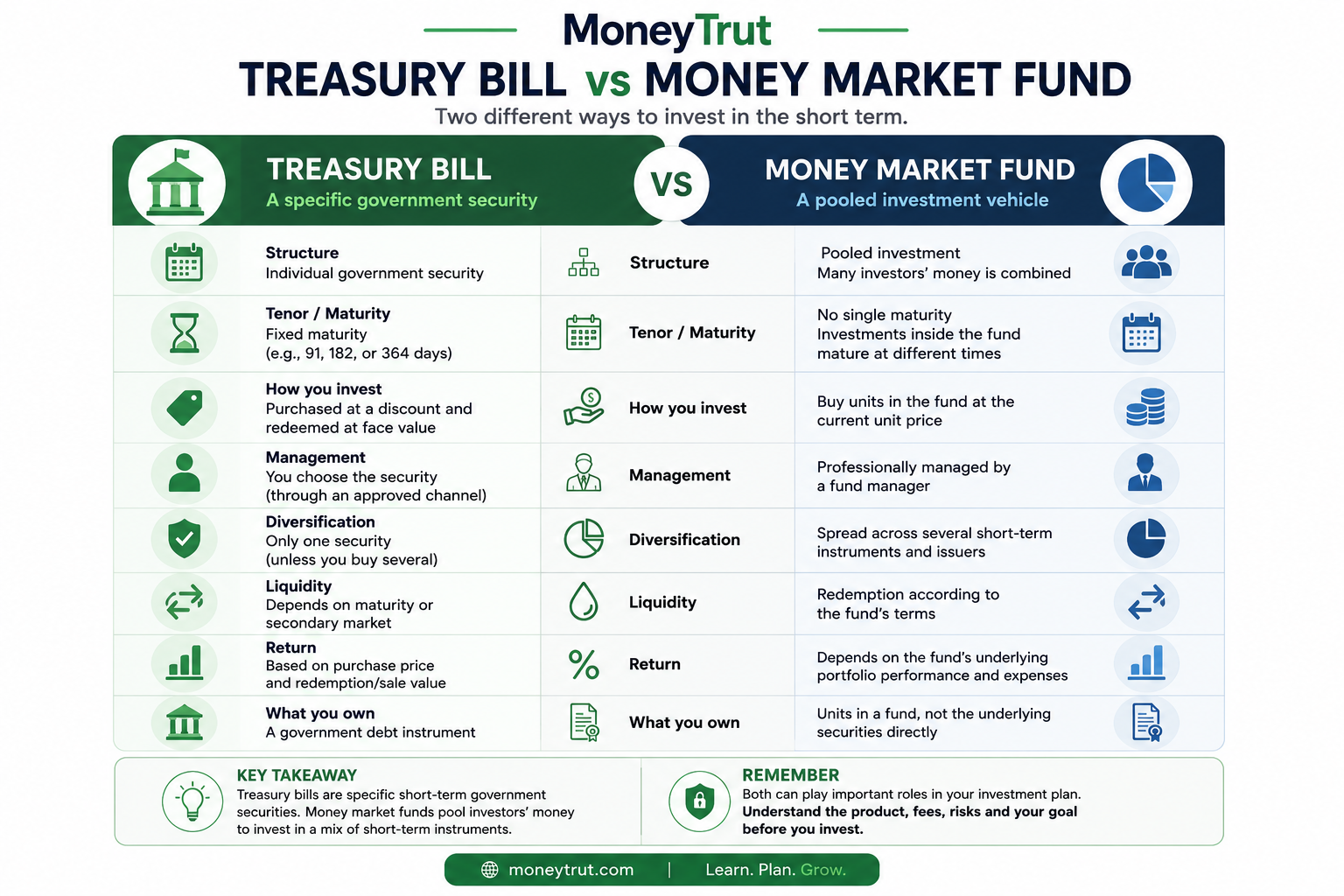
This is probably one of the most important comparisons for Nigerian investors.
A Treasury bill is a specific government security.
A money market fund is a pooled investment vehicle.
With a Treasury bill, you are investing directly in that security through an appropriate channel.
With a money market fund, your money is pooled with that of other investors and the fund manager decides which eligible short-term instruments to hold.
Consider this simplified comparison:
| Treasury Bill | Money Market Fund | |
|---|---|---|
| Structure | Individual government security | Pooled investment |
| Investments | Treasury bill | Portfolio of short-term instruments |
| Management | You choose the security | Fund manager manages portfolio |
| Diversification | Depends on what you own | Fund may hold several instruments |
| Maturity | Defined maturity date | No single maturity for the entire fund |
| Liquidity | Depends on maturity/secondary market | Redemption according to fund terms |
| Return | Based on purchase price and redemption/sale | Depends on underlying portfolio and expenses |
The CBN explains that Nigerian Treasury Bills are short-term securities issued at a discount, with tenors from 91 to 364 days.
That is fundamentally different from owning units of a fund.
Why Would Someone Choose a Money Market Fund?
There are several possible reasons.
1. Professional management
You don't have to personally select every short-term instrument.
A fund manager manages the portfolio according to the fund's investment mandate.
2. Diversification
Instead of putting all your money into one instrument, the fund may spread money across different eligible short-term investments.
Diversification is one of the principles MoneyTrut covered in:
What Is Investment Diversification and How Does It Work?
Diversification does not eliminate risk, but it can reduce dependence on one investment or issuer.
3. Accessibility
Depending on the fund, investors may be able to start with relatively modest amounts.
However, minimum investment amounts vary, so check the specific fund's current terms.
4. Convenience
The fund structure can make it easier for an investor to gain exposure to several short-term instruments without personally buying each one.
How Do You Make Money From a Money Market Fund?
The fund earns income from the investments it holds.
For example, suppose a fund invests part of its portfolio in Treasury bills.
The fund earns income from those investments.
It may also earn income from other eligible instruments.
After accounting for applicable expenses and other factors, the value of your investment can increase.
But the exact way returns are reflected depends on the particular fund.
Some funds may quote returns differently, and past performance should not be treated as a promise of future performance.
So if someone tells you:
"This money market fund gives exactly 20% every year."
Do not automatically assume that means you are guaranteed 20%.
Investment returns can change.
A Simple ₦100,000 Example
Suppose you invest:
₦100,000
in a hypothetical money market fund.
If the value of your investment increases by 10% over a particular period, it would become approximately:
₦110,000
before considering any applicable charges or other adjustments.
If the return were 5%, it would become:
₦105,000
If the fund's return were lower, your gain would also be lower.
These figures are purely illustrative.
They are not forecasts or current money market fund rates.
The actual return depends on the specific fund and its underlying investments.
What About ₦1 Million?
Suppose you invest:
₦1,000,000
If a hypothetical annualized return were 10%, a simple illustration would produce:
₦100,000 in gross growth over a year.
That would give:
₦1,100,000
before considering applicable fees, taxes and the effect of compounding or changes in the fund's actual return.
But there is an important reason not to use this example as a promise.
The fund's actual return can change over time.
The rate you see today may not be the rate you receive in the future.
Are Money Market Fund Returns Guaranteed?
Generally, you should not treat a money market fund's return as guaranteed.
A fund's historical return tells you what it achieved during a particular period.
It does not guarantee what it will earn in the future.
This is especially important when comparing investment advertisements.
If a platform says:
"Guaranteed 25% every year with zero risk,"
you should ask serious questions.
The SEC Nigeria warned in May 2026 about unregistered online investment schemes promising unrealistic or guaranteed returns and advised investors to verify the registration status of investment platforms and entities before investing.
A legitimate investment product should provide information about its objectives, risks, fees and terms.
What Are the Risks of Money Market Funds?
Credit Risk
If the fund invests in instruments issued by companies or financial institutions, the ability of those issuers to meet their obligations matters.
Interest-Rate Risk
Changes in interest rates can affect the value and income generated by fixed-income investments.
Liquidity Risk
A fund may have rules around when and how investors can redeem their units.
Do not assume that "money market" means instant access at all times.
Inflation Risk
Even if your investment increases in naira terms, inflation can reduce your purchasing power.
Reinvestment Risk
When short-term investments mature, the fund may need to reinvest the money at whatever rates are available at that time.
If rates fall, future returns may also decline.
Fund Expenses
Management and other expenses reduce the return that ultimately belongs to investors.
This is why looking only at the advertised return can be misleading.
Money Market Fund vs Fixed Deposit
Another common comparison is a money market fund versus a fixed deposit.
A fixed deposit is a deposit placed with a bank for an agreed period under specified terms.
A money market fund is an investment fund that invests in short-term instruments.
| Money Market Fund | Fixed Deposit | |
|---|---|---|
| Structure | Investment fund | Bank deposit |
| Manager | Fund manager | Bank |
| Return | Depends on underlying investments | Agreed according to deposit terms |
| Diversification | Usually across several instruments | Primarily exposure to the bank |
| Early withdrawal | Fund rules apply | Bank terms apply |
| Deposit insurance | Not a bank deposit | Eligible deposit may be covered by NDIC within applicable limits |
MoneyTrut already covers the broader comparison between savings accounts and fixed deposits:
Savings Account vs Fixed Deposit: Which Is Better?
Does a Money Market Fund Have a Maturity Date?
Usually, you should not think of a money market fund as having one maturity date in the way a Treasury bill does.
A Treasury bill might mature after 91, 182 or 364 days.
A money market fund is an ongoing investment scheme.
The underlying securities inside it mature at different times.
When one investment matures, the fund manager may reinvest the proceeds according to the fund's strategy.
This gives the fund a different structure from buying and holding one Treasury bill until maturity.
Can You Withdraw Money From a Money Market Fund?
You can generally request redemption of your units, but the exact process and timing depend on the fund.
Before investing, check:
- Minimum investment
- Minimum additional investment
- Redemption process
- Settlement period
- Cut-off time
- Fees
- Management expenses
- Any restrictions on withdrawals
Do not assume that every fund has identical redemption terms.
One fund may process withdrawals differently from another.
Who Regulates Money Market Funds in Nigeria?
Money market funds are part of the collective investment scheme framework regulated by the Securities and Exchange Commission (SEC) Nigeria.
The SEC provides investor education and investor-protection resources for participants in Nigeria's capital market.
This is important because you should not simply send money to someone advertising an "investment fund" on WhatsApp or social media.
First establish:
What is the legal investment product?
Who manages it?
Who is the registered operator?
What regulator oversees it?
How Do You Choose a Money Market Fund?
Don't choose one simply because its advertised return is the highest.
Look at the whole picture.
1. Check the fund manager
Find out who manages the fund and whether the relevant operator is properly registered.
2. Read the fund's documents
Understand what the fund is designed to invest in.
3. Check the fees
A high headline return can look less attractive after expenses.
4. Understand the portfolio
Find out whether the fund invests primarily in government securities, bank placements, commercial papers or a combination of instruments.
5. Check the redemption terms
Know how quickly you can get your money after requesting a withdrawal.
6. Look at historical performance
Past performance can help you understand how a fund has behaved.
But it is not a guarantee of future performance.
7. Consider your goal
Don't invest simply because everyone else is talking about money market funds.
Your investment should have a purpose.
What About Someone Earning ₦100,000 a Month?
Suppose you earn:
₦100,000 per month
and can consistently save ₦10,000.
If you have no emergency savings, your first priority may be building that financial buffer.
Putting all your available savings into an investment may leave you exposed when an unexpected expense occurs.
MoneyTrut explains how to build an emergency fund even with a low income:
How to Build an Emergency Fund With a Low Income
Once your financial foundation is stronger, a money market fund could be one investment option to research depending on your goals.
What About Someone Earning ₦500,000?
Suppose someone earns:
₦500,000 monthly
and has already built an adequate emergency reserve.
They might have several competing uses for their surplus:
- Debt repayment
- Short-term goals
- Long-term investments
- Retirement
- Business capital
- Cash reserves
A money market fund might potentially serve one part of that plan.
But it does not necessarily need to be the entire investment portfolio.
Someone investing for long-term wealth may also consider other assets depending on their goals and risk tolerance.
MoneyTrut explains risk tolerance here:
What Is Risk Tolerance and How Do You Know How Much Investment Risk You Can Take?
Is a Money Market Fund Good for Long-Term Investing?
It depends on what you mean by "long-term."
A money market fund can be useful for preserving relatively accessible capital or earning income on money that does not need to be invested in higher-volatility assets.
But if your goal is long-term wealth creation over several decades, relying exclusively on short-term investments may not provide the growth you need.
This is because long-term investing often requires exposure to assets with greater growth potential.
Stocks, for example, carry greater market volatility but can provide significant long-term capital-growth potential.
That is why your investment strategy should be connected to your time horizon.
Money Market Funds and Diversification
A money market fund itself can provide diversification because it may hold multiple short-term instruments.
But owning one money market fund does not necessarily mean your entire financial portfolio is diversified.
For example, imagine your entire wealth consists of:
₦10 million in one money market fund
You may have diversification within the fund.
But your overall wealth could still be concentrated in one investment category.
This is why it is useful to distinguish between:
Diversification within an investment
and
Diversification across your entire portfolio.
MoneyTrut explains this broader principle in:
What Is Investment Diversification and How Does It Work?
Money Market Funds and Asset Allocation
Your money market fund also needs to fit into your overall asset allocation.
For example, a hypothetical investor could have:
Emergency savings
→ accessible cash
Short-term investments
→ money market fund or other suitable short-term instruments
Medium-term investments
→ appropriate fixed-income investments
Long-term investments
→ diversified equity exposure and other suitable assets
The percentages will depend on the investor.
MoneyTrut explains how to think about this in:
What Is Asset Allocation and How Should You Divide Your Investments?
Questions to Ask Before Investing
Before putting money into a money market fund, ask:
What exactly does this fund invest in?
Who manages it?
What fees do I pay?
How are returns calculated or reported?
Can the return change?
How quickly can I withdraw my money?
Is there a minimum investment?
What risks does the fund take?
Who regulates the fund?
Can I verify the operator?
If you cannot get clear answers, don't rush to invest.
Watch Out for Fake Investment Funds
The growing popularity of online investing has also created opportunities for fraudsters.
Someone may create a professional-looking website, social-media account or WhatsApp group and call the product a "money market fund."
That does not make it a legitimate investment fund.
The SEC currently provides investors with tools for checking registered operators and also publishes warnings about investment scams.
If someone promises:
"Guaranteed 30% monthly."
or:
"No risk, guaranteed returns."
stop and investigate before sending money.
A high return with no meaningful risk is not something you should accept simply because the person selling it sounds convincing.
Bottom Line
A money market fund is a pooled investment that generally focuses on short-term instruments such as Treasury bills, bank placements and other money-market securities.
It can be useful for investors looking for exposure to short-term investments without having to personally select every security.
But it is not the same as a savings account, fixed deposit or Treasury bill.
A Treasury bill is a specific government security. A money market fund is a portfolio managed on behalf of multiple investors.
Money market funds can provide diversification and professional management, but their returns are not something you should automatically treat as guaranteed. Fees, underlying investments, interest rates, inflation and other risks all matter.
Before investing, understand the fund's strategy, fees, redemption terms and risks—and verify that you are dealing with a legitimate, regulated operator.
The best investment is not simply the one advertising the highest return. It is the one whose structure, risk and purpose actually fit your financial plan.

You must be logged in to post a comment.