

This guide explains how to price products and services in Nigeria, calculate your real costs, set a profit margin, avoid common pricing mistakes and adjust your prices when your business costs increase.
Why Pricing Matters More Than Many Small Businesses Realise
Imagine you sell a product for ₦10,000.
You might think you made ₦10,000 from the sale.
You didn't.
You still have to consider what you paid for the product, transportation, packaging, delivery, data, electricity, payment charges, advertising and other expenses connected to running the business.
If all of those costs add up to ₦8,500, your actual gross profit from the sale is only ₦1,500.
And even that may not be your final profit if you have other business expenses.
This is why revenue and profit are not the same thing.
A business can generate millions of naira in sales and still make very little profit.
The First Rule: Know Your Real Cost
Before deciding what to charge, calculate what the product or service actually costs you.
For a physical product, your cost might include:
- Purchase price
- Transportation
- Customs or import-related costs where applicable
- Packaging
- Delivery to customers
- Payment processing charges
- Storage
- Advertising
- Damaged or unsold inventory
- Electricity
- Staff or casual labour
- Other operating expenses
For a service business, your costs might include:
- Your time
- Internet and data
- Software subscriptions
- Equipment
- Electricity
- Transportation
- Advertising
- Outsourced work
- Payment charges
- Administrative expenses
If you don't know your costs, you're guessing at your price.
Example: A ₦10,000 Product
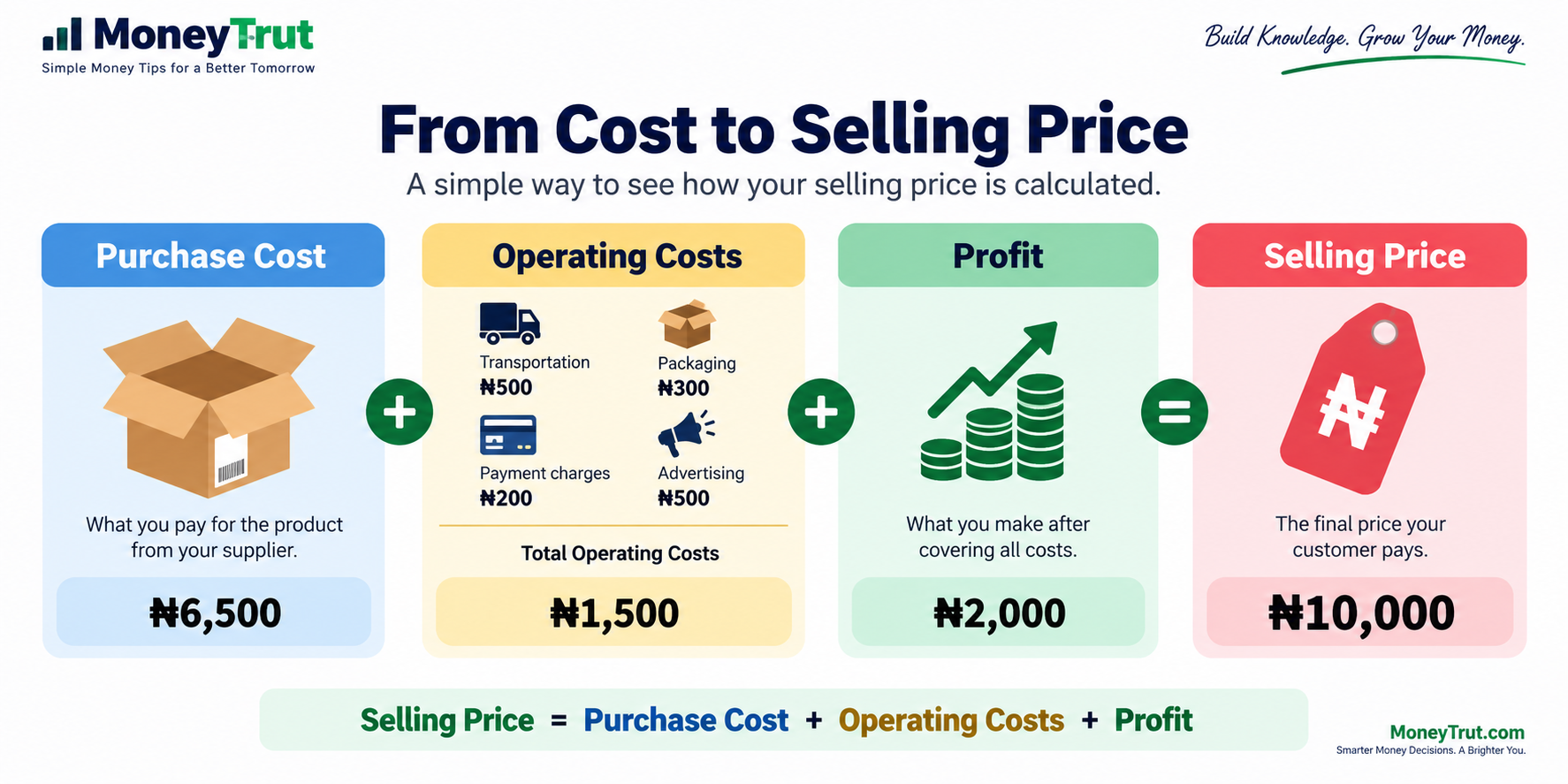
Suppose you buy an item for ₦6,500.
You also spend:
- ₦500 on transportation
- ₦300 on packaging
- ₦200 on payment and transaction-related costs
- ₦500 on advertising allocated to the sale
Your effective cost is:
₦6,500 + ₦500 + ₦300 + ₦200 + ₦500 = ₦8,000
If you sell it for ₦10,000:
₦10,000 − ₦8,000 = ₦2,000
Your gross profit is ₦2,000.
That is a 25% markup on cost, but your gross profit margin is 20% of the selling price.
Those two percentages are not the same.
This distinction becomes important as your business grows.
Markup and Profit Margin Are Different
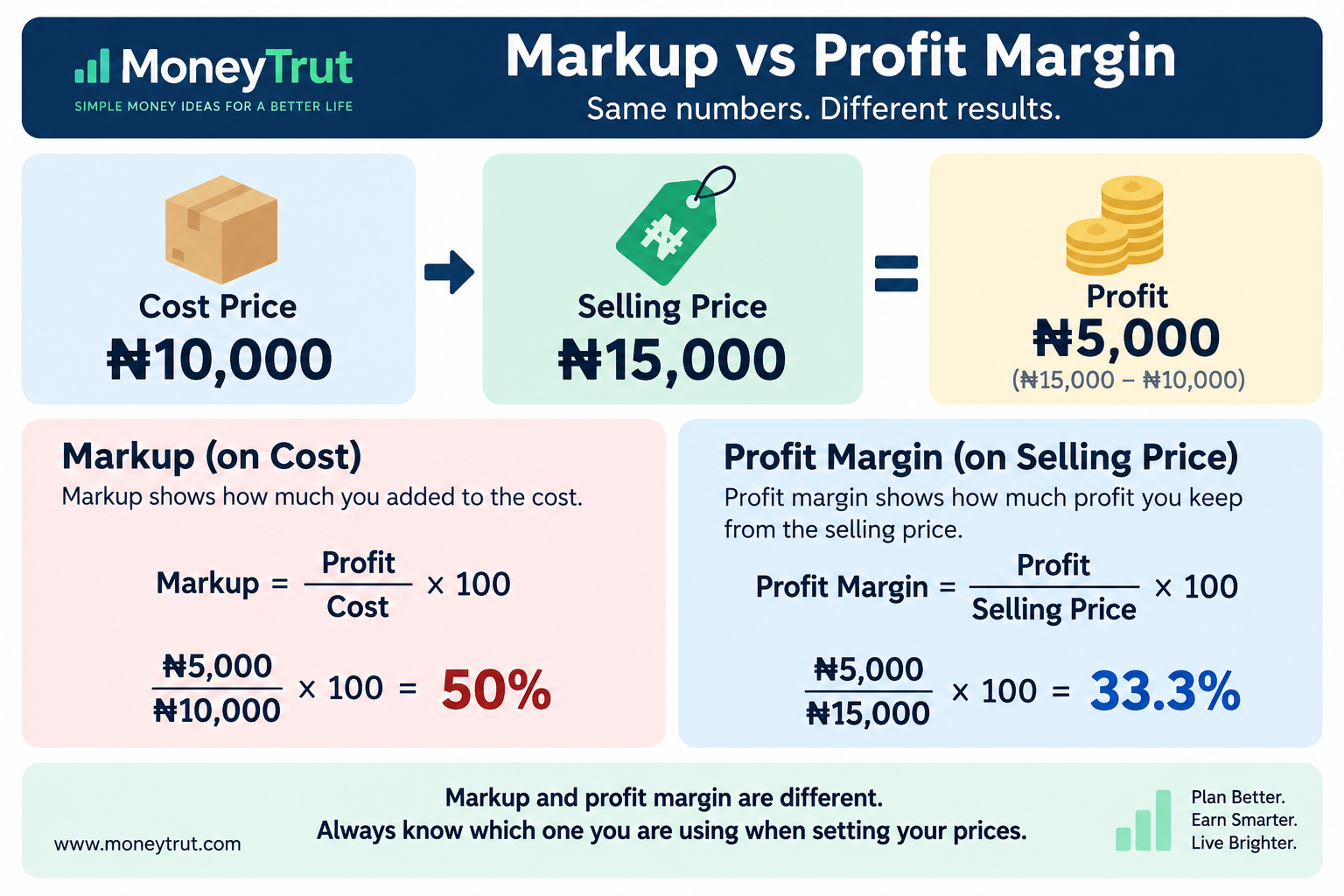
Suppose a product costs you ₦10,000 and you sell it for ₦15,000.
Your profit is:
₦15,000 − ₦10,000 = ₦5,000
Your markup is:
₦5,000 ÷ ₦10,000 = 50%
But your profit margin is:
₦5,000 ÷ ₦15,000 = 33.3%
So if someone says they want a 50% margin, you cannot simply add 50% to the cost.
For a desired margin of 50%, the calculation is:
Selling price = Cost ÷ (1 − desired margin)
If your cost is ₦10,000:
₦10,000 ÷ (1 − 0.50) = ₦20,000
At ₦20,000:
- Cost = ₦10,000
- Profit = ₦10,000
- Profit margin = 50%
Understanding this difference can prevent serious pricing mistakes.
Don't Forget Your Own Labour
One of the biggest mistakes small business owners make is treating their own time as free.
Suppose you make cakes from home.
A customer pays ₦50,000.
Your ingredients cost ₦20,000.
Packaging costs ₦3,000.
Transportation costs ₦2,000.
That leaves:
₦50,000 − ₦25,000 = ₦25,000
But suppose you spent six hours making the cake and another two hours shopping, communicating with the customer and delivering it.
You have spent approximately eight hours on the order.
If you never account for your time, you may think the business is more profitable than it really is.
Your labour has value.
Calculate Your Cost Per Hour for Services
Service businesses should pay particular attention to time.
Suppose you want your business to generate ₦300,000 per month for your personal income.
You estimate that you can realistically work 100 billable hours in a month.
That gives you:
₦300,000 ÷ 100 = ₦3,000 per billable hour
But your business also has expenses.
If you spend ₦100,000 per month on business expenses, you need to generate ₦400,000 before reaching your ₦300,000 target.
At 100 billable hours:
₦400,000 ÷ 100 = ₦4,000 per billable hour
This doesn't mean you must charge customers exactly ₦4,000 per hour.
You can charge per project instead.
But the calculation gives you a way to check whether your pricing is sustainable.
Don't Price Based Only on What Competitors Charge
Looking at competitors is useful.
Copying their prices blindly is not.
Suppose another business sells a product for ₦15,000.
You sell the same type of product, but your supplier charges you more.
If your cost is ₦14,000, copying the ₦15,000 selling price leaves you with only ₦1,000 before other expenses.
The competitor may have:
- A cheaper supplier
- Higher sales volume
- Lower delivery costs
- Better purchasing terms
- Lower overhead
- A different product quality
- A different target market
Your business economics are not necessarily the same.
Use competitors as a reference point, not as your entire pricing strategy.
Understand What Your Customers Are Actually Buying
Customers don't always choose the cheapest option.
They may pay more for:
- Better quality
- Faster delivery
- Reliability
- Convenience
- Better customer service
- Professional presentation
- Warranty or after-sales support
- Customisation
- Expertise
- Reputation
For example, two photographers may both charge ₦150,000.
One may provide only the photos.
The other may provide:
- Pre-shoot consultation
- Professional editing
- Online gallery
- Album
- Faster delivery
- Additional support
The second photographer may be able to justify a higher price because the customer is receiving a different overall package.
Three Common Pricing Approaches
There isn't one pricing method that works for every business.
1. Cost-Plus Pricing
You calculate your cost and add a markup.
For example:
Cost = ₦10,000
Desired markup = 40%
Selling price:
₦10,000 × 1.40 = ₦14,000
This is simple and useful for many products.
However, it doesn't automatically tell you whether customers are willing to pay ₦14,000.
2. Market-Based Pricing
You look at what comparable businesses charge and position your price around the market.
This is useful when customers can easily compare prices.
But don't forget your own costs.
A market price that is profitable for another business could be unprofitable for you.
3. Value-Based Pricing
Here, the price is influenced by the value or outcome you provide to the customer.
This is particularly useful for professional services.
For example, a consultant might charge more for helping a business solve a problem that could save the business millions of naira.
The client isn't necessarily paying for the consultant's two hours in a meeting.
They are paying for the expertise and potential value of the solution.
Which Pricing Method Should You Use?
Many small businesses are better off combining the approaches.
Start with your costs.
Then check the market.
Then consider the value you provide.
For example:
Your cost → Market range → Customer value → Final price
This is more reliable than simply asking:
"How much are other people selling it?"
Don't Ignore Small Expenses
Small expenses can quietly destroy your profit.
Consider a small online business selling ₦20,000 products.
You might remember the ₦14,000 purchase cost but forget:
- ₦500 packaging
- ₦500 delivery subsidy
- ₦300 transaction costs
- ₦700 advertising
- ₦300 miscellaneous costs
Your actual cost is:
₦16,300
Your apparent profit was ₦6,000.
Your actual gross profit is only:
₦20,000 − ₦16,300 = ₦3,700
That is a big difference.
Separate Fixed Costs From Variable Costs
This is another important concept.
Variable Costs
These change as you sell more.
Examples include:
- Product purchases
- Packaging
- Delivery
- Sales commissions
- Transaction-related costs
- Materials used for production
Fixed Costs
These generally don't change directly with each individual sale.
Examples can include:
- Shop rent
- Salaries
- Software subscriptions
- Some insurance costs
- Equipment financing
Understanding both helps you determine how many sales you need to make before the business becomes profitable.
Know Your Break-Even Point
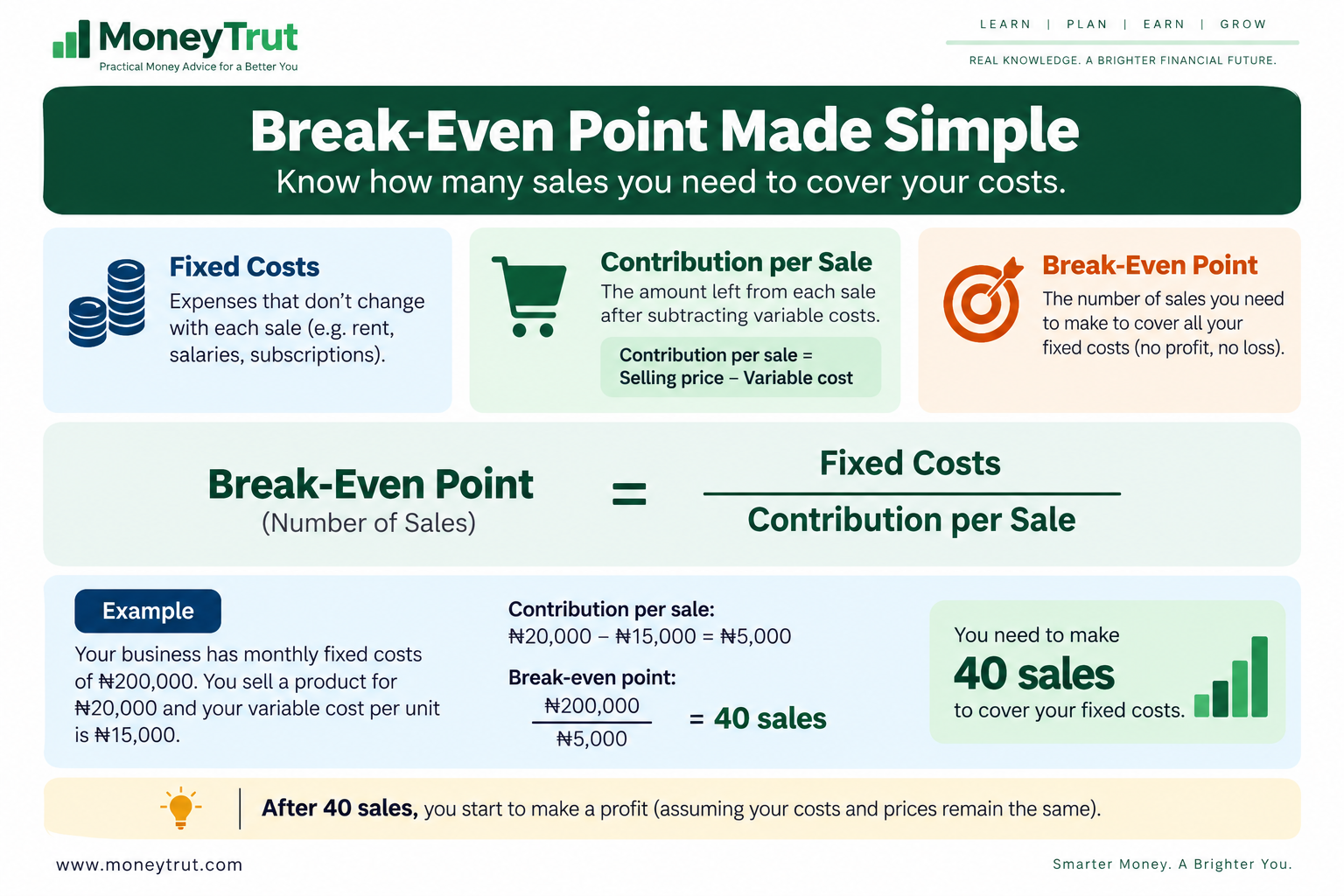
Your break-even point is where your revenue covers your costs.
Suppose your business has monthly fixed costs of ₦200,000.
You sell a product for ₦20,000.
After variable costs, you make ₦5,000 contribution toward fixed costs per unit.
You would need:
₦200,000 ÷ ₦5,000 = 40 units
to cover those fixed costs.
At 40 units, you're approximately at break-even.
After that, additional contribution can begin generating operating profit, assuming the underlying assumptions remain valid.
This calculation can be extremely useful before renting a shop or taking on significant expenses.
Don't Rent a Shop Before Your Numbers Make Sense
A physical shop can make your business look bigger.
It can also increase your costs dramatically.
Suppose you currently sell from home and generate ₦150,000 in monthly gross profit.
You consider renting a shop that will add ₦100,000 in monthly fixed expenses.
You need to know where the additional sales will come from.
If the shop doesn't generate enough additional profit to cover the new costs, your business may actually become weaker.
Growth should improve the economics of the business, not simply increase its expenses.
How to Know If Your Price Is Too Low
Your price may be too low if:
- You are constantly busy but have little money left
- Customers love the price but the business struggles
- You cannot replace inventory after selling it
- You depend on personal savings to keep operating
- You cannot pay yourself
- Every increase in costs puts you into a loss
- You have no money for marketing or equipment
- You are afraid to calculate your actual profit
A busy business isn't necessarily a profitable business.
How to Know If Your Price May Be Too High
A high price isn't automatically wrong.
But investigate if:
- Customers consistently reject the price
- Competitors offer comparable value for significantly less
- Customers don't understand what makes your product different
- Your sales volume has fallen sharply after a price increase
- You are targeting customers who cannot afford your offering
Before immediately cutting your price, ask whether the problem is actually the price.
It could be:
- Poor marketing
- Weak presentation
- Lack of trust
- Wrong target market
- Poor customer service
- Low perceived value
What to Do When Your Costs Increase
In Nigeria, business costs can change significantly.
Your supplier may increase prices.
Transportation may become more expensive.
Rent may increase.
Electricity, packaging, data and other operating expenses may also change.
The answer isn't always to absorb the increase.
Suppose your product cost increases from ₦8,000 to ₦10,000.
If you continue selling at ₦10,000 simply because "customers are used to that price," your margin may disappear.
You have several options:
Increase Your Price
This is the most direct approach.
Reduce Your Costs
Find a better supplier or improve your purchasing arrangements without compromising quality.
Change the Product
Offer a smaller package or different specification at a lower price.
Improve the Value
Add something useful that makes the new price easier for customers to accept.
Reduce Your Own Margin Temporarily
This may make sense if the cost increase is temporary, but it should be a conscious decision rather than something that happens accidentally.
Don't Surprise Customers Without Explanation
If you need to increase prices, communicate clearly.
You don't need to write a long apology.
Something as simple as:
"Due to increased supplier and operating costs, our prices will change from ₦15,000 to ₦17,000 from October 1."
is clearer than silently changing the price.
If you provide strong value, some customers will accept reasonable increases.
Use Different Packages

Instead of offering only one price, consider creating options.
For example, a service business could offer:
Basic — ₦50,000
- Core service
- Standard delivery
Standard — ₦100,000
- Core service
- Additional support
- Faster delivery
Premium — ₦180,000
- Full service
- Priority support
- Additional deliverables
This allows customers with different budgets to choose.
It also prevents you from trying to make one package suitable for everybody.
Don't Underprice Because You're Afraid of Losing Customers
Some business owners think:
"If I increase my price, everyone will leave."
Some customers may leave.
That doesn't necessarily mean the increase was wrong.
If you were previously selling a product for ₦10,000 and barely making money, keeping the price just to maintain sales can eventually destroy the business.
A sustainable business needs customers and enough margin to operate.
Discounting Can Be Dangerous
Discounts can help attract customers, clear inventory or encourage larger purchases.
But permanent discounting can train customers to wait for a lower price.
Suppose your normal price is ₦20,000.
You constantly advertise:
"₦20,000 — now ₦14,000!"
Customers may eventually stop believing that ₦20,000 is the real price.
Instead of discounting everything, consider targeted offers such as:
- First-order discount
- Bulk discount
- Referral discount
- Limited promotional offer
- Bundle pricing
- Loyalty reward
And always calculate the effect on your margin before offering the discount.
Track Your Prices and Profits
A simple spreadsheet can be enough.
For every major product or service, track:
| Item | Amount |
|---|---|
| Selling price | ₦20,000 |
| Product/material cost | ₦12,000 |
| Packaging | ₦500 |
| Delivery subsidy | ₦500 |
| Advertising allocation | ₦1,000 |
| Other variable costs | ₦500 |
| Estimated gross profit | ₦5,500 |
The numbers don't have to be perfect.
They just need to be good enough to show whether your pricing makes sense.
Review the numbers regularly rather than waiting until the business runs out of cash.
What If You Are Just Starting?
Don't spend weeks trying to calculate the perfect price before selling anything.
Start with a reasonable price based on:
- Your estimated costs
- Competitor prices
- Your target customer
- The value you provide
- Your desired profit
Then test the market.
If customers buy quickly and your capacity is limited, your price may be too low.
If nobody buys, investigate why.
If customers are interested but consistently say the price is too high, examine your value proposition and costs.
Pricing is often a process of learning.
Keep Business Money Separate From Personal Money
One of the easiest ways to lose track of profitability is to mix business and personal money.
Suppose your business receives ₦500,000 in sales.
You withdraw ₦200,000 for personal expenses.
Then you use another ₦100,000 to buy something unrelated to the business.
The business account may still show money, but you may no longer have enough working capital to replace inventory or pay suppliers.
Separate accounts and clear records make it easier to see what the business is actually generating.
This becomes increasingly important as the business grows.
When Should You Register Your Business?
Not every person needs to create a limited liability company immediately.
But as your business becomes more established, formal registration may become useful or necessary depending on your structure and activities.
Nigeria's Corporate Affairs Commission is responsible for registering business names and companies. The CAC says individual proprietors can register business names through its online process, and its current registration process includes name availability, completing the pre-registration information, uploading relevant documents and paying the required filing fee.
Registration can also make it easier to establish a formal business identity when dealing with certain clients, suppliers and institutions.
Don't register a business simply because someone on social media said every small business must immediately become a limited company.
Choose a structure that makes sense for your circumstances and obtain professional advice when necessary.
A Simple Pricing Formula You Can Use
For many small businesses, a useful starting point is:
Selling Price = Total Unit Cost + Desired Profit
But if you're working with a target profit margin, use:
Selling Price = Total Unit Cost ÷ (1 − Target Profit Margin)
For example, if your total unit cost is ₦12,000 and you want a 30% gross margin:
₦12,000 ÷ 0.70 = ₦17,143
You could then choose a practical market price around that figure after considering customer expectations and competitor pricing.
The formula gives you a starting point.
It does not replace market research.
The Difference Between Revenue, Gross Profit and Net Profit
These terms should not be confused.
Revenue
The total amount customers pay you.
Gross Profit
Revenue minus the direct costs associated with the goods or services sold.
Net Profit
What remains after operating expenses and other applicable costs are deducted.
For example:
Revenue: ₦1,000,000
Direct costs: ₦600,000
Gross profit: ₦400,000
Other operating expenses: ₦250,000
Approximate operating profit: ₦150,000
So saying:
"My business made ₦1 million this month"
does not mean you earned ₦1 million.
That distinction is essential when deciding whether a business is actually working.
Pricing Is Not Just About Mathematics
Numbers tell you what you need to charge to remain sustainable.
The market tells you what customers may accept.
Your positioning tells customers why they should choose you.
A successful pricing strategy therefore sits somewhere between:
Cost + Market + Value + Profit
Ignore any one of these and your pricing can become unstable.
Bottom Line
The right price is not simply the price that attracts the most customers.
It is the price that allows your business to serve customers while covering its costs and generating enough profit to survive and grow.
Start by knowing your real costs.
Account for your time.
Understand the difference between markup and margin.
Study competitors without blindly copying them.
Pay attention to the value you provide.
Review your prices when costs change.
And most importantly, stop judging your business by sales alone.
A business that sells ₦1 million and keeps ₦50,000 is very different from a business that sells ₦700,000 and keeps ₦200,000.
The goal isn't simply to sell more. The goal is to build a business that makes money.

You must be logged in to post a comment.