

If you have money you do not need immediately, you may eventually come across two popular options in Nigeria: money market funds and Treasury bills.
Both are commonly used for relatively conservative investing, and both can give your money the opportunity to earn returns without putting it directly into individual stocks.
But they are not the same thing.
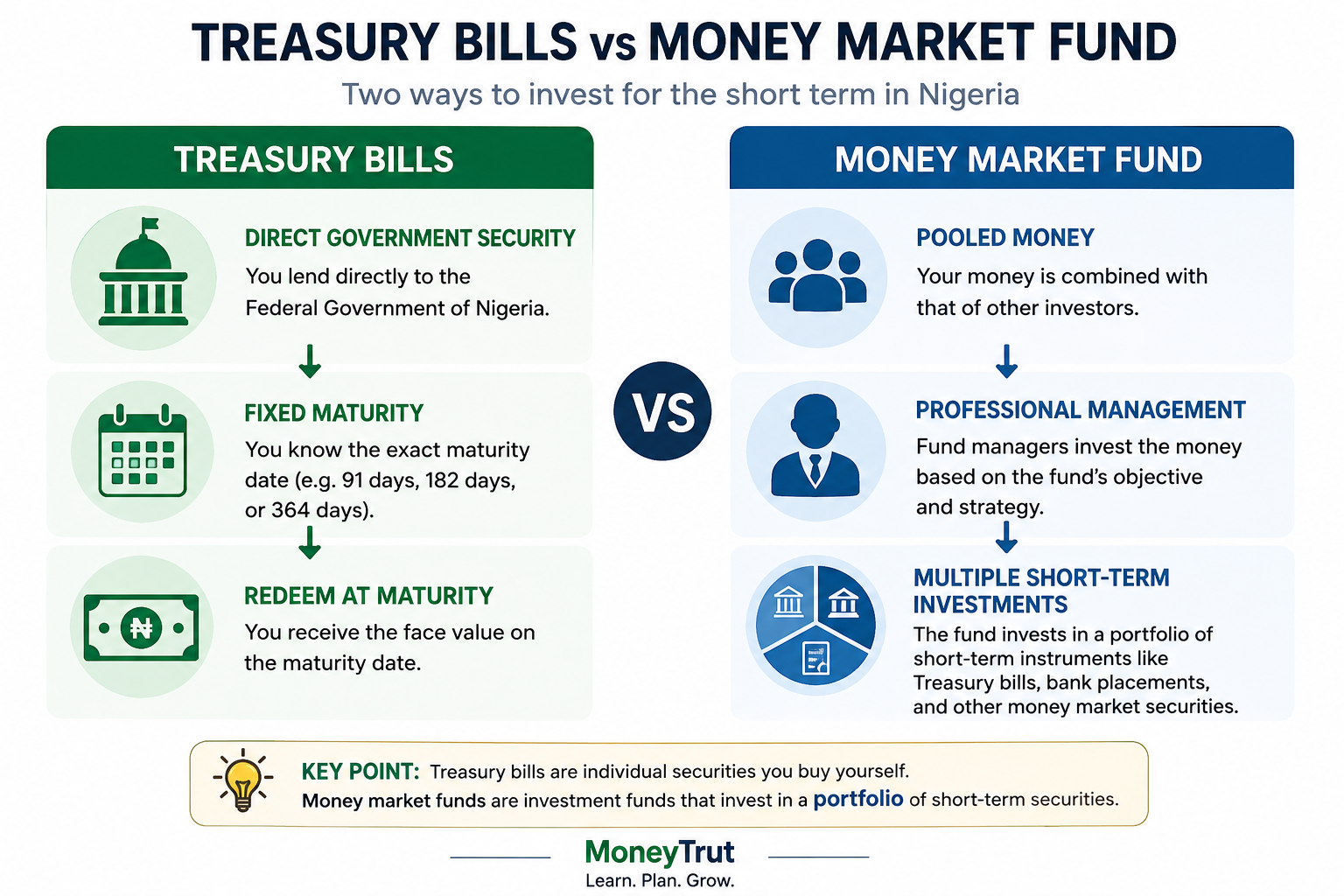
With a Treasury bill, you are investing directly in a short-term government security. With a money market fund, your money is pooled with that of other investors and managed by a fund manager who invests in short-term instruments.
So, which one is better?
The answer depends on how much money you have, how long you want to invest, how easily you need access to the money and how much responsibility you want to take for choosing the investment yourself.
A Treasury bill may make more sense if you want direct exposure to a government security and are comfortable with its maturity structure. A money market fund may be more convenient if you want professional management, diversification across short-term instruments and easier ongoing investing.
Neither option should automatically be considered "better." The right choice depends on your financial goal, time horizon, liquidity needs, risk tolerance and the specific product or fund you choose.
What Is a Treasury Bill?
A Treasury bill, commonly called an NTB in Nigeria, is a short-term government debt security.
When you buy one, you are effectively lending money to the government for a specified period. Nigerian Treasury bills are commonly issued with maturities such as 91 days, 182 days and 364 days.
Treasury bills are normally issued at a discount and redeemed at their face value when they mature.
For example, suppose a hypothetical Treasury bill has a face value of ₦100,000 but you purchase it for ₦95,000.
If you hold it until maturity and receive ₦100,000, the difference is ₦5,000.
The actual price and return depend on the prevailing market conditions and the terms of the particular issue.
The Central Bank of Nigeria provides information on government securities and explains how members of the public can participate through authorised channels.
You can learn more about Treasury bills in our earlier guide:
What Is a Treasury Bill and How Does It Work in Nigeria?
What Is a Money Market Fund?
A money market fund is a type of collective investment scheme.
Instead of each investor buying individual short-term securities themselves, investors' money is pooled together and managed by a professional fund manager.
The fund can invest in short-term instruments such as Treasury bills, bank placements and other eligible money-market securities, depending on the fund's mandate and regulations.
This means that when you invest ₦50,000 in a money market fund, you are not necessarily buying a particular Treasury bill worth ₦50,000.
You are buying units in a professionally managed investment fund.
The Securities and Exchange Commission (SEC) publishes information on collective investment schemes and provides data on the net asset values of registered schemes.
You can also read our full explanation:
What Is a Money Market Fund and How Does It Work in Nigeria?
Money Market Fund vs Treasury Bills: The Main Difference
The simplest way to understand the difference is this:
Treasury bills are individual securities. Money market funds are investment funds that invest in a portfolio of short-term securities and other eligible instruments.
That difference affects how you invest, how your money is managed and how you access it.
| Feature | Treasury Bills | Money Market Fund |
|---|---|---|
| What you own | A government security | Units in a collective investment scheme |
| Management | You choose when and what to buy | Professional fund manager manages the portfolio |
| Typical investments | Government Treasury bills | A portfolio of short-term instruments |
| Maturity | Fixed maturity | Fund generally continues operating |
| Diversification | Depends on what you buy | Built into the fund's portfolio |
| Liquidity | Depends on maturity or ability to sell | Redemption is subject to the fund's terms |
| Fees | Transaction-related costs may apply | Fund management and other expenses may apply |
| Return | Depends on purchase price and maturity | Depends on portfolio performance and expenses |
| Main decision | Which security and maturity to buy | Which fund to invest in |
Which One Is Safer?
This is where you need to be careful.
It is tempting to say that one is automatically safer than the other, but that oversimplifies the issue.
A Treasury bill is a government security, while a money market fund is a pooled investment whose assets can include several types of short-term instruments.
A money market fund therefore does not mean that your money is simply sitting in a bank account or directly invested in one Treasury bill.
The risk of a particular fund depends on what it holds, how it is managed and the terms of the fund.
You should therefore look beyond the words "money market" and examine the actual fund.
The SEC provides investor resources and a way to check registered capital-market operators.
Which One Gives Better Returns?
There is no permanent winner.
Treasury bill yields change over time, while money market fund returns can also change as the fund's underlying investments mature and are replaced.
For example, imagine the following hypothetical situation:
- You invest ₦500,000 in a Treasury bill.
- Another person invests ₦500,000 in a money market fund.
- The Treasury bill happens to produce an annualised return of 15%.
- The money market fund produces an annualised return of 14%.
That does not mean Treasury bills will always outperform money market funds.
The reverse can happen in another period.
More importantly, you should not compare a Treasury bill's quoted yield with a money market fund's advertised historical return without understanding fees, taxes where applicable, timing and how the return was calculated.
The CBN publishes government-security and money-market data, which can help investors understand the broader market environment.
What Happens If You Need Your Money Early?
This is one of the biggest practical differences.
Treasury bills
If you buy a Treasury bill and hold it until maturity, you generally wait until the maturity date to receive the face value.
If you need to exit before maturity, the process can involve selling the security through the appropriate market channel, and the price you receive may differ from what you originally paid.
Money market funds
Money market funds generally allow investors to request redemption of their units according to the fund's terms.
However, "easy to withdraw" does not mean "instant cash."
The fund's documentation should tell you how redemption works, including applicable processing times, minimum amounts, fees or other conditions.
This is important when deciding where to keep emergency money.
For money you may need immediately, your bank savings account may still be more appropriate than either investment.
You can also read:
How Much Should You Have in an Emergency Fund?
Example: You Have ₦100,000 to Invest
Suppose you have ₦100,000 left after paying your monthly expenses and you want to put it somewhere productive.
You have two options.
Option 1: Treasury bill
You use an authorised investment channel to buy a Treasury bill.
The security has a defined maturity date, and your return depends on the price at which you purchased it and the amount you receive at maturity.
You know from the beginning that this is a specific security with a specific maturity.
Option 2: Money market fund
You invest the ₦100,000 in a money market fund.
Your money becomes part of the fund's pooled assets.
The fund manager invests according to the fund's investment strategy, and your investment value changes based on the fund's performance and applicable expenses.
You are not responsible for selecting each underlying short-term security.
Neither choice is automatically better.
The important question is what you want the money to do.
What If You Have ₦1 Million?
The difference becomes even more useful to understand when you have a larger amount.
Suppose you have ₦1 million that you do not need for several months.
You might prefer Treasury bills if:
- You want a defined maturity date.
- You specifically want exposure to government securities.
- You are comfortable buying through an authorised channel.
- You understand how the investment works.
- You are prepared to hold the security according to your investment plan.
A money market fund might appeal to you if:
- You want professional management.
- You prefer diversification across short-term instruments.
- You want to make additional contributions over time.
- You prefer a fund structure rather than selecting individual securities.
- The fund's redemption terms suit your needs.
What About Someone Earning ₦150,000 a Month?
Suppose you earn ₦150,000 monthly.
You should not automatically invest a large percentage of your salary in either option simply because the return looks attractive.
Your priorities might be:
- Pay essential expenses.
- Build an emergency fund.
- Deal with expensive debt.
- Set aside money for short-term goals.
- Invest money that you can leave invested.
This is why investing should be connected to your overall financial plan.
For example, if you are still struggling to cover basic expenses every month, putting ₦50,000 into an investment while borrowing money for food or rent does not necessarily improve your financial position.
You can read:
How Much Should You Invest From Your Salary Each Month?
Money Market Funds Can Be More Diversified
One advantage of a money market fund is that you do not have to put all your money into one particular short-term security.
The fund manager can spread the portfolio across eligible investments according to the fund's mandate.
That can provide diversification that would be more difficult for a small investor to achieve alone.
But diversification does not eliminate risk.
A fund can still experience changes in returns, liquidity pressures, credit risk on certain underlying investments and the effects of changing interest rates.
This is why you should look at the fund's actual portfolio and documents rather than assuming every money market fund works exactly the same way.
Treasury Bills Give You More Direct Control
Treasury bills can appeal to investors who want to make the investment decision themselves.
You can consider:
- How much to invest.
- Which maturity you want.
- The prevailing yield.
- Whether you want to hold until maturity.
- How the investment fits into your cash-flow plans.
But greater control also means greater responsibility.
You need to understand the investment rather than simply transferring money and assuming somebody else is managing everything for you.
What About Fees?
Fees can make a difference, especially when comparing investments with relatively modest returns.
Money market funds may have management fees and other expenses disclosed in their fund documents.
Treasury bill investments can also involve transaction or intermediary costs depending on how you access them.
Therefore, don't compare investments based only on the headline return.
A better question is:
"How much will I actually have after all relevant costs?"
What About Inflation?
This is another issue investors sometimes overlook.
Suppose your investment earns 15% but prices rise significantly during the same period.
Your account balance may increase while your purchasing power grows much less—or even falls.
This means the goal should not simply be to find the investment with the highest nominal return.
You should ask whether the return is likely to keep pace with your financial objectives and inflation.
Money Market Fund or Treasury Bills for Short-Term Goals?
Consider the purpose of the money.
Money you need in a few weeks
A normal savings account may be more appropriate because immediate accessibility can matter more than investment return.
Money you can leave for several months
A money market fund or Treasury bill may be worth considering, depending on your circumstances.
Money you can leave for several years
You may need to look beyond money market funds and Treasury bills.
Long-term wealth building may require a broader portfolio that can include assets such as equities, bonds and other investments appropriate for your risk tolerance and time horizon.
Read:
What Is Asset Allocation and How Should You Divide Your Investments?
Don't Put Your Emergency Fund in the Wrong Place
An emergency fund has a different job from a long-term investment.
Its primary purpose is to provide money when something goes wrong.
For example, if your emergency fund is ₦600,000 and you suddenly need ₦300,000 for an urgent expense, you need access to that money without taking unnecessary investment risk.
This is why accessibility matters.
Your emergency fund does not have to produce the highest possible return.
It needs to be available when you need it.
You can learn more about building one here:
How to Build an Emergency Fund With a Low Income
How to Choose Between Them
Before choosing, ask yourself five questions.
1. When will I need the money?
If you need the money very soon, liquidity should be a major consideration.
2. Do I want a specific maturity date?
If yes, a Treasury bill may be more attractive.
3. Do I want someone to manage the investments?
If yes, a money market fund may be more convenient.
4. Have I checked the fees and terms?
Never invest simply because someone tells you that a fund or security "pays well."
Read the relevant documents.
5. Is the provider properly regulated?
This is particularly important in Nigeria's growing online investment market.
The SEC provides resources for investors to check registered operators and has warned investors about unregistered investment schemes promising unrealistic or guaranteed returns.
If someone tells you that an investment has guaranteed high returns with no risk, treat that as a major warning sign.
Don't Confuse a Money Market Fund With a Bank Deposit
This distinction is important.
When you put money in a bank savings account, you are making a deposit with a bank.
When you invest in a money market fund, you are buying an investment product.
The two have different structures, protections and risks.
Therefore, don't assume that because a money market fund invests in short-term instruments, it carries exactly the same protection as money sitting in a bank deposit account.
Always understand what product you are actually buying.
So, Which Is Better?
There is no universal winner.
Choose Treasury bills if you prefer direct exposure to a short-term government security, understand the maturity structure and are comfortable managing the investment yourself.
Consider a money market fund if you prefer professional management, portfolio diversification and a fund structure that allows you to invest without selecting individual securities yourself.
And if the money is part of your emergency fund and you may need it immediately, neither should automatically replace a readily accessible savings balance.
The best investment is not necessarily the one with the highest advertised return.
It is the one that fits your goal, time horizon, liquidity needs, risk tolerance and overall financial situation.
Bottom Line
Money market funds and Treasury bills can both play useful roles in a Nigerian investor's portfolio, but they solve slightly different problems.
A Treasury bill gives you direct exposure to a short-term government security with a defined maturity. A money market fund pools investors' money and gives them professionally managed exposure to a portfolio of short-term investments.
Before choosing, look beyond the advertised return.
Check the investment structure, maturity or redemption terms, fees, risks, provider and how the investment fits into your financial plan.
Most importantly, don't invest money simply because someone promises you a high return. Understand what you are buying first.
MoneyTrut provides general educational information and is not a substitute for personalised financial, investment, tax or legal advice.

You must be logged in to post a comment.