

Getting a salary increase should make life easier.
But for many people, that is not what happens.
You may move from earning ₦100,000 to ₦150,000 and still feel financially stressed. Later, you might earn ₦250,000 and discover that you are still struggling to save. Even someone earning ₦500,000 or ₦1 million a month can reach the end of the month wondering where the money went.
This does not necessarily mean the person is careless with money.
Sometimes, the problem is that spending increases along with income.
As your salary grows, your rent may increase, your car may become more expensive, you may eat out more often, subscribe to more services, take on larger responsibilities and gradually become comfortable with expenses that previously seemed unnecessary.
This is one of the reasons a higher income does not automatically create financial security.
The important question is not only "How much do I earn?"
It is:
"How much of what I earn actually improves my financial position?"
The solution is not necessarily to stop enjoying your money. Instead, create a deliberate system that allows your lifestyle to improve while ensuring that your savings, investments and financial security grow faster than your spending.
1. Your Income Can Increase Without Your Wealth Increasing
Income and wealth are not the same thing.
Your income is the money you receive.
Your wealth is more closely related to what you own, what you owe and how much financial capacity you have built over time.
Imagine two people.
Person A earns ₦500,000 monthly.
They spend almost everything they earn and have very little savings.
Person B earns ₦250,000 monthly.
They consistently save, invest and avoid unnecessary debt.
Person A earns twice as much.
But Person B may have a stronger financial position.
This is why salary alone does not tell you whether someone is financially secure.
2. Lifestyle Inflation Is Often the Hidden Problem
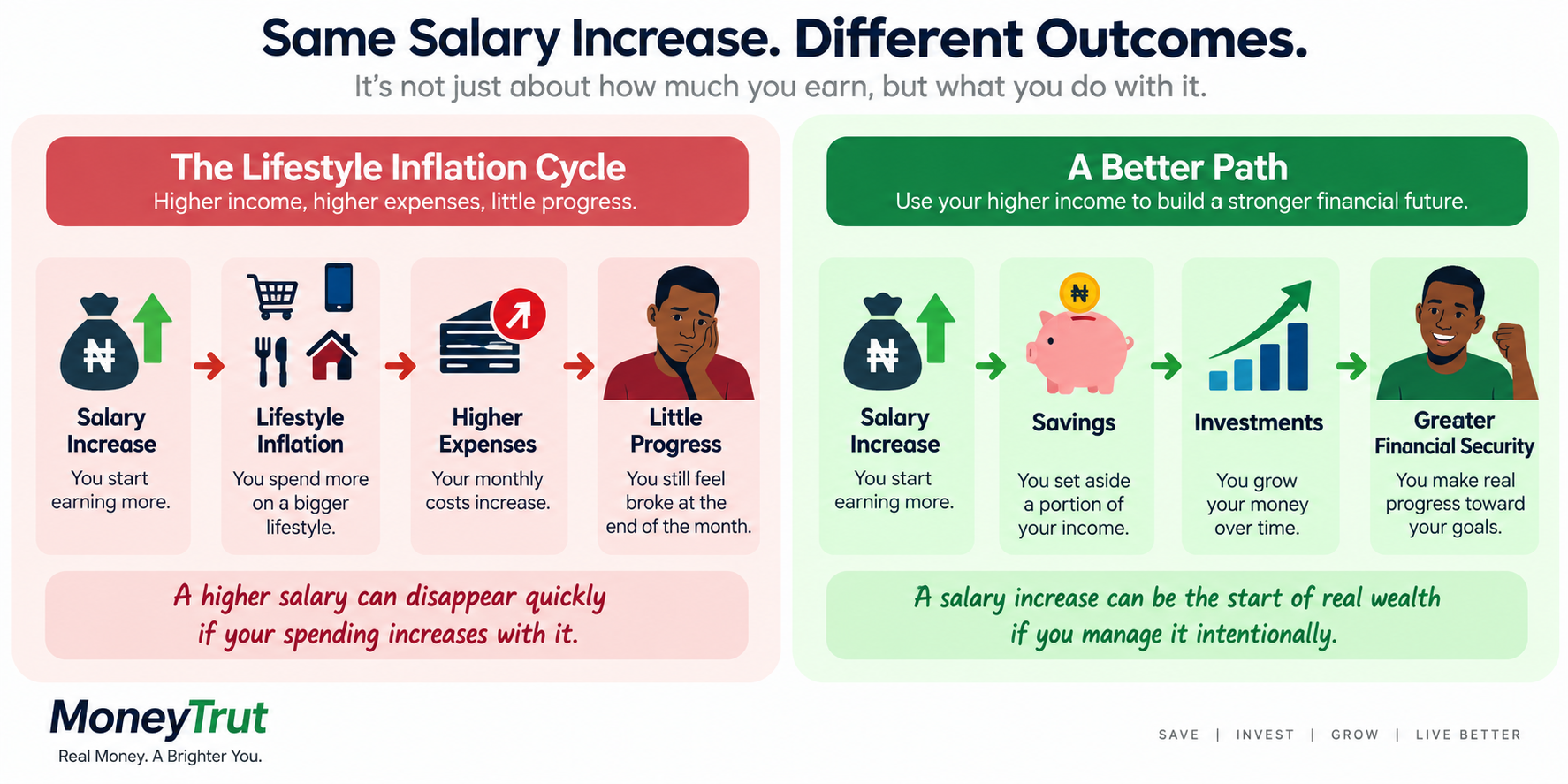
Lifestyle inflation happens when your spending rises as your income rises.
Suppose you earn:
₦100,000 per month
You may learn to manage your expenses around that amount.
Then your salary increases to:
₦150,000
Instead of allowing some of the extra ₦50,000 to improve your financial position, you might gradually increase your spending.
You start ordering more expensive food.
You upgrade your phone.
You take more expensive transportation.
You move into a more expensive apartment.
You increase your entertainment budget.
Eventually, your new lifestyle costs ₦150,000.
Your income increased.
But your financial breathing room did not.
3. The Problem Usually Happens Gradually
Lifestyle inflation is dangerous partly because it does not always feel like a major decision.
You may not wake up one morning and decide:
"I am going to increase my expenses by ₦100,000 every month."
Instead, it happens in small steps.
You start with:
"I can afford an extra ₦5,000."
Then:
"I can afford a better phone."
Then:
"My salary has increased, so I deserve a better apartment."
Then:
"I can afford to eat out more often."
None of these decisions is necessarily wrong.
The problem is what happens when all of them become permanent expenses.
4. A Salary Increase Should Not Automatically Become a Spending Increase
Suppose your salary increases from:
₦200,000 → ₦300,000
That is an additional:
₦100,000 per month
You could allow the entire ₦100,000 to disappear into lifestyle expenses.
Or you could decide that part of the increase belongs to your future self.
For example:
₦50,000 — savings/investments
₦30,000 — improved lifestyle
₦20,000 — financial goals or debt repayment
The exact allocation depends on your situation.
The important principle is:
Don't let your entire salary increase become a new monthly bill.
5. Your Fixed Expenses Matter More Than Small Purchases
People often focus heavily on small expenses.
They worry about spending ₦2,000 on lunch while ignoring a ₦600,000 annual rent increase.
But large recurring expenses can have a much bigger effect on your finances.
Consider someone whose income increases by ₦100,000 per month.
They move into a more expensive apartment that costs an additional ₦700,000 per year.
That is roughly:
₦700,000 ÷ 12 = ₦58,333 per month
A large portion of the salary increase has already disappeared.
Now add:
- more expensive transportation;
- higher electricity costs;
- increased food spending;
- additional subscriptions;
- more entertainment.
The entire salary increase can disappear surprisingly quickly.
6. Your New Salary Can Create New Expectations
As your income increases, people may begin to expect more from you.
Family responsibilities may increase.
Friends may assume you can afford more.
You may start feeling pressure to dress differently, drive a better car or live in a more expensive neighbourhood.
Some of these expenses may be necessary.
Others may be driven mainly by expectations.
You need to distinguish between:
"I can afford this."
and
"I need this."
They are not the same statement.
7. Helping Family Can Also Increase With Income
This is particularly important when your income supports other people.
Suppose you earn ₦150,000 and regularly send ₦20,000 to family.
Later, your income rises to ₦300,000.
Family members may assume you can now provide much more.
You may increase your support to ₦70,000 or ₦100,000.
Again, supporting family is not necessarily a bad financial decision.
But if every increase in income immediately creates new obligations, your personal financial position may not improve much.
A useful approach is to decide in advance how much you can sustainably contribute.
8. More Money Can Make Overspending Easier
When money is tight, you notice almost every expense.
When your income increases, some purchases no longer feel significant.
A ₦5,000 expense may not seem important when you earn ₦500,000.
But if you make ten similar purchases during the month:
₦5,000 × 10 = ₦50,000
And that is only one category of spending.
The issue is not that every ₦5,000 purchase is bad.
The issue is that small expenses can become large when repeated.
9. A Higher Income Can Also Make Debt Easier to Obtain
Higher income can increase your borrowing capacity.
That can be useful when debt is used carefully.
But it can also create a trap.
Suppose you previously could not afford a ₦3 million car loan.
After your salary increases, the lender is willing to approve it.
You now qualify for the loan, so you take it.
Then you add:
- insurance;
- fuel;
- maintenance;
- repairs;
- registration;
- parking;
- other running costs.
Your salary increased, but so did your financial obligations.
This is why being able to borrow more does not mean you should borrow more.
10. Your Emergency Fund Should Grow With Your Lifestyle
As your income and expenses increase, your emergency fund may need to increase too.
Suppose your essential monthly expenses were:
₦100,000
An emergency fund based on several months of essential expenses would require less money than someone whose essential expenses have increased to:
₦250,000
If your lifestyle becomes more expensive, your financial safety net may need to reflect that.
MoneyTrut explains this in:
How Much Should You Have in an Emergency Fund?
If you are starting with a low income, see:
How to Build an Emergency Fund With a Low Income
11. Don't Wait Until the End of the Month to Save
One reason people remain financially stretched despite earning more is that they save whatever is left.
The problem is that there may be nothing left.
Suppose you earn:
₦300,000
During the month, you spend:
₦295,000
You tell yourself:
"I'll save the remaining ₦5,000."
That is unlikely to build meaningful wealth quickly.
Instead, decide how much should go toward savings or investments before the money becomes available for ordinary spending.
MoneyTrut discusses this approach in:
How Much Should You Save From Your Salary Every Month?
12. Give Every Increase a Job
One useful way to prevent lifestyle inflation is to give your salary increase a specific purpose.
Suppose your salary increases by:
₦80,000 per month
You could decide before receiving the first increased salary:
₦40,000 — investment
₦20,000 — emergency fund or savings goal
₦20,000 — lifestyle improvement
Now the increase has a structure.
Without a plan, the money may simply become available for spending.
13. Don't Upgrade Everything at Once
A salary increase does not require an immediate lifestyle transformation.
You don't have to simultaneously:
- move to a more expensive apartment;
- buy a new phone;
- upgrade your car;
- increase your entertainment;
- change your wardrobe;
- start expensive subscriptions.
If you want to improve your lifestyle, choose the things that genuinely matter to you.
You might decide that better housing is worth the additional cost.
That's fine.
But perhaps you don't also need a more expensive car and significantly higher entertainment spending at the same time.
14. Calculate the Annual Cost of Lifestyle Upgrades
Monthly costs can look small.
Annual costs can look very different.
Suppose a new subscription costs:
₦8,000 per month
That is:
₦8,000 × 12 = ₦96,000 per year
Suppose a lifestyle upgrade costs an additional:
₦25,000 per month
That's:
₦25,000 × 12 = ₦300,000 per year
This calculation can change how you think about recurring expenses.
Before adding a permanent monthly expense, multiply it by 12.
Ask yourself:
"Am I comfortable spending this much every year?"
15. Don't Confuse Looking Wealthy With Being Wealthy
A person can look financially successful without having much financial security.
They may have:
- an expensive phone;
- a nice car;
- designer clothing;
- expensive restaurants;
- a large apartment.
But those things do not necessarily indicate wealth.
Someone else may look ordinary while quietly building:
- emergency savings;
- investments;
- business assets;
- retirement savings;
- debt-free ownership.
What you see is consumption.
You don't necessarily see the person's balance sheet.
16. Your Savings Rate Can Matter More Than Your Salary Increase
Imagine your salary increases from:
₦200,000 → ₦300,000
If you save nothing from the additional ₦100,000, the salary increase may have little long-term impact.
But suppose you consistently direct:
₦50,000 per month
toward savings or investments.
Over one year, that becomes:
₦50,000 × 12 = ₦600,000
That is before considering any investment returns.
The point is not that everyone should save exactly ₦50,000.
The point is that consistency can turn an income increase into actual financial progress.
17. Don't Increase Spending Before the Salary Increase Is Certain
Sometimes people start spending money based on an expected promotion, bonus or future income.
That can be risky.
Suppose you expect your salary to increase next month.
You immediately take on:
- a higher rent;
- a new loan;
- additional subscriptions.
Then the promotion is delayed.
Your expenses have increased even though your income has not.
A better approach is to make permanent lifestyle decisions after the higher income is actually established.
18. Pay Attention to One-Time Income Too
The same principle applies to bonuses, commissions, business profits and unexpected income.
If you receive:
₦500,000
you do not necessarily need to spend all ₦500,000.
Depending on your circumstances, you could divide it between:
- emergency savings;
- investments;
- debt repayment;
- a specific financial goal;
- something enjoyable.
Enjoying part of the money is not automatically irresponsible.
The important thing is avoiding the assumption that every extra naira must immediately become consumption.
19. Your Financial Goals Should Increase as Your Income Increases
If you earn ₦100,000, your financial goal might be building your first ₦100,000 emergency fund.
Later, at ₦300,000 monthly income, your goals may change.
You may want to:
- build a larger emergency fund;
- invest regularly;
- save for a house;
- start a business;
- pay off expensive debt;
- build retirement savings.
Your financial system should evolve as your income changes.
20. Use a Salary Increase as a Chance to Build Wealth
A salary increase is an opportunity.
You can use it to create a better lifestyle today.
You can also use it to create a better financial position tomorrow.
The strongest approach is usually a balance.
For example:
Some for today.
Some for emergencies.
Some for investments.
Some for important goals.
This allows you to enjoy the benefit of earning more without allowing your entire financial life to expand around the new income.
A Practical Example: From ₦200,000 to ₦300,000
Suppose someone earns ₦200,000 and receives a salary increase to ₦300,000.
Before the increase, their monthly essential expenses are:
₦130,000
They currently save:
₦30,000
After the increase, they could simply increase spending to ₦300,000.
But another option is:
₦130,000 — essential expenses
₦40,000 — lifestyle improvement
₦50,000 — savings/investments
₦30,000 — financial goals or debt repayment
₦50,000 — other planned expenses and flexibility
The numbers are only an illustration.
The important point is that the extra income is deliberately assigned instead of automatically disappearing into lifestyle inflation.
How to Know If Lifestyle Inflation Is Becoming a Problem
Ask yourself these questions:
1. Has my income increased but my savings barely changed?
2. Do I spend almost everything I earn regardless of how much I make?
3. Have my fixed monthly expenses increased significantly?
4. Do I take on new debt whenever my income increases?
5. Do I feel financially stretched despite earning more than before?
6. Have my financial goals remained unchanged while my lifestyle has expanded?
7. Would I struggle if my income dropped temporarily?
If several answers are yes, your lifestyle may be growing faster than your financial security.
What to Do After Your Next Salary Increase
When your next increase arrives, don't immediately change your lifestyle.
Instead:
Step 1: Calculate your new take-home income.
Step 2: Review your existing essential expenses.
Step 3: Decide how much of the increase goes toward savings or investments.
Step 4: Decide whether any debt should be reduced faster.
Step 5: Increase your lifestyle deliberately rather than automatically.
Step 6: Review the plan after three to six months.
This gives you a chance to enjoy earning more while still making measurable financial progress.
The Bottom Line
Earning more money can improve your life, but a higher salary does not automatically make you wealthier.
If your expenses rise at the same speed as your income, you may continue feeling broke even after several salary increases.
The goal is not to avoid spending money or live as cheaply as possible forever. It is to make sure that your financial security grows alongside your lifestyle.
When your income increases, allow yourself to enjoy some of it. But also use part of the increase to build savings, invest, reduce debt and strengthen your financial position.
The real benefit of a salary increase is not simply being able to spend more. It is having more money available to build a better financial future.

You must be logged in to post a comment.