

You finally earn more.
Your salary increases from ₦150,000 to ₦250,000. Later, perhaps it reaches ₦500,000 or even ₦1 million.
You tell yourself things should become easier.
You should be able to save more. Pay off debt. Build an emergency fund. Start investing. Perhaps even save for land, a car, a house or a business.
But months pass, and the goal still feels far away.
You may even look back and wonder where the money went.
This is one of the uncomfortable truths about personal finance: earning more money does not automatically make you better at reaching financial goals.
Sometimes the problem is income.
But sometimes the problem is the financial system you are using.
The Central Bank of Nigeria's financial literacy framework specifically includes helping individuals set realistic and achievable financial goals, while the CBN also describes financial literacy as having the knowledge and skills to manage financial resources effectively.
So if you keep setting money goals and abandoning them, the answer may not be to simply "try harder."
You may need a better system.
1. Your Goal Is Too Vague
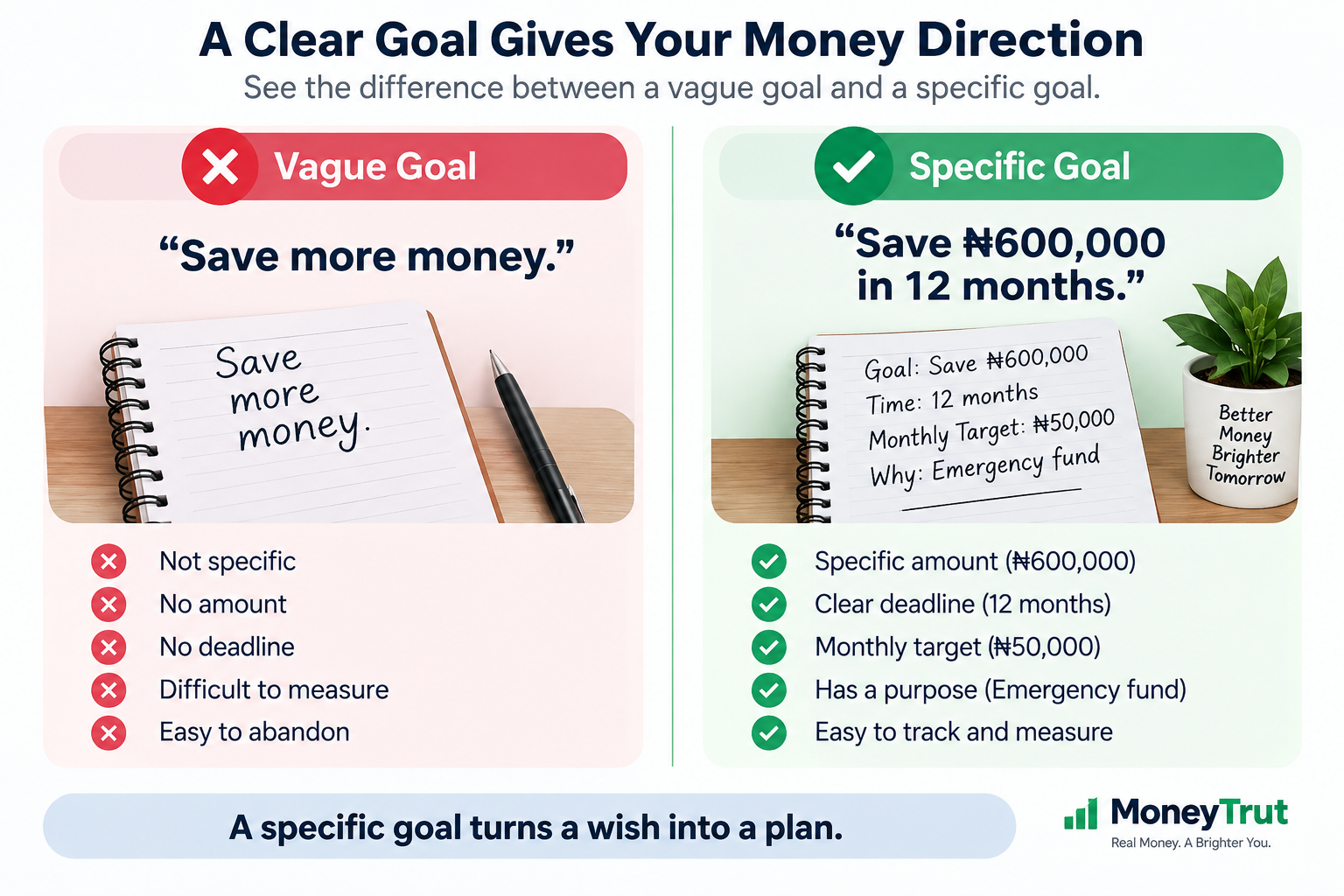
" I want to save more money" is not really a financial goal.
Neither is:
- I want to invest more.
- I want to become wealthy.
- I want to stop wasting money.
- I want to have more savings.
These statements may describe what you want, but they do not tell your money what to do.
Compare:
Vague goal:
"I want to save more."
Specific goal:
"I want to save ₦600,000 for my emergency fund over the next 12 months."
The second goal gives you something measurable.
₦600,000 divided by 12 months is ₦50,000 per month.
Now the question becomes:
Can I consistently find ₦50,000 every month?
That is a much better financial question.
2. You Set a Goal Without Checking Whether Your Income Can Support It
This is one of the biggest mistakes.
Someone earning ₦200,000 may decide to save ₦100,000 every month because they want to reach a target quickly.
It sounds disciplined.
But if the remaining ₦100,000 cannot realistically cover rent, food, transportation, electricity, family obligations, phone bills and other expenses, the plan is likely to collapse.
The person may save ₦100,000 in January.
Then withdraw ₦30,000 in February.
Withdraw another ₦40,000 in March.
Eventually, the savings disappear.
The problem was not necessarily a lack of discipline.
The target was not compatible with the person's actual cash flow.
A smaller goal that survives for 12 months is usually more useful than an aggressive goal that survives for six weeks.
3. You Treat Every Month as If It Will Be the Same
Real life does not work that way.
One month may be normal.
The next month may bring:
- School fees
- Rent
- Medical expenses
- Car repairs
- Family ceremonies
- Travel
- Annual subscriptions
- Insurance
- Business expenses
- Unexpected home repairs
This is why a financial plan can look perfect on paper and still fail in real life.
Suppose someone earns ₦500,000 monthly and plans to save ₦100,000.
That appears straightforward.
But if December requires ₦250,000 for family and holiday expenses, or January brings school fees, the person may stop saving entirely.
The problem is not that the goal was wrong.
The problem is that irregular expenses were not included in the plan.
This is where a sinking fund can help.
Instead of waiting for an annual expense to arrive, you save toward it gradually.
MoneyTrut explains this approach in more detail in:
What Is a Sinking Fund and How Does It Work?
4. You Save Whatever Is Left Over
This sounds harmless:
"I'll spend what I need to spend, then save whatever remains."
The problem is that there may be nothing left.
If ₦500,000 enters your account and you treat the entire ₦500,000 as available money, your lifestyle can easily absorb most of it.
You might spend:
₦150,000 on housing and utilities.
₦100,000 on food and transportation.
₦50,000 helping family.
₦40,000 on entertainment and eating out.
₦30,000 on miscellaneous expenses.
Then another ₦50,000 disappears through small purchases.
Suddenly, the ₦80,000 you planned to save is gone.
A better approach is to give the goal its money before discretionary spending has a chance to consume it.
For example:
Salary: ₦500,000
Savings: ₦75,000
Investments: ₦50,000
Essential expenses: ₦300,000
Flexible spending: ₦75,000
The exact percentages do not have to be identical for everyone.
The important principle is that saving and investing should be planned rather than treated as leftovers.
MoneyTrut's guide on how much to save from your salary explains this in greater detail:
How Much Should You Save From Your Salary Every Month?
5. You Have Too Many Financial Goals at the Same Time
This is another hidden problem.
You want to:
- Buy land
- Buy a car
- Build an emergency fund
- Start a business
- Invest in stocks
- Pay school fees
- Travel
- Renovate your house
- Pay off debt
All of them are legitimate goals.
But trying to fund all of them simultaneously can make your money ineffective.
Imagine you have ₦100,000 available each month for financial goals.
Instead of putting meaningful money toward one or two priorities, you divide it into ten different goals.
Each receives ₦10,000.
After six months, you have ₦60,000 in each account.
You have been saving consistently, but nothing feels finished.
Sometimes the solution is not to save more.
It is to prioritize better.
For example:
Priority 1: Emergency fund
Priority 2: High-cost debt
Priority 3: Long-term investing
Priority 4: Major purchase
Once Priority 1 is adequately funded, you can redirect more money toward Priority 2.
6. Your Goals Compete With Your Lifestyle
This is where many people struggle after receiving a salary increase.
You decide to save ₦100,000 more each month.
But your lifestyle also expands.
A better phone.
More expensive restaurants.
More frequent outings.
Higher-quality clothing.
More subscriptions.
More transportation convenience.
More financial support for relatives.
None of these expenses is automatically wrong.
The problem is when every increase in income immediately becomes an increase in spending.
Then your financial goals never benefit from the additional income.
This is why earning more does not necessarily create financial progress.
If your salary increases from ₦300,000 to ₦500,000, you have gained ₦200,000 of additional monthly income.
You do not have to spend all ₦200,000.
You could decide that:
- ₦80,000 goes toward savings
- ₦50,000 goes toward investing
- ₦40,000 improves your lifestyle
- ₦30,000 provides additional flexibility
That way, your standard of living improves and your financial position improves.
7. You Don't Have an Emergency Fund
One unexpected expense can destroy months of progress.
Imagine that you have finally saved ₦400,000 toward a long-term goal.
Then your car develops a serious problem costing ₦180,000.
If you have no emergency fund, you may have to take the ₦180,000 from the money you were saving.
Your goal suddenly moves backward.
This is why an emergency fund is not simply another savings target.
It protects your other financial goals from unexpected expenses.
If you are starting from a low income, you do not necessarily need to build a huge emergency fund immediately.
Start with a realistic target and increase it gradually.
MoneyTrut's guides can help:
How Much Should You Have in an Emergency Fund?
How to Build an Emergency Fund With a Low Income
8. You Depend Too Much on Motivation
Motivation feels powerful at the beginning.
You get paid.
You feel determined.
You transfer money into savings.
You promise yourself that this time will be different.
Then two or three weeks later, the motivation disappears.
Your financial system should not depend entirely on how motivated you feel.
A better approach is to make the desired behaviour easier.
For example, if you receive ₦300,000 and want to save ₦50,000, make the ₦50,000 transfer part of your normal payday routine.
The objective is to reduce the number of times you have to make the decision.
The SEC similarly emphasizes clear investment goals, consistent investing and discipline when discussing long-term investment success.
9. Your Goal Has No Deadline
"Save ₦1 million" is better than "save more."
But it is still incomplete.
When do you want the ₦1 million?
Without a deadline, there is little pressure to determine what needs to happen each month.
Suppose your target is ₦1 million in 12 months.
You need roughly:
₦1,000,000 ÷ 12 = ₦83,333 per month
If the target is two years:
₦1,000,000 ÷ 24 = ₦41,667 per month
Same target.
Completely different monthly requirement.
A deadline turns a wish into a plan.
10. You Don't Track Your Progress
You cannot easily fix a financial goal that you never measure.
If your goal is to save ₦1 million, track the balance.
For example:
| Month | Target Balance |
|---|---|
| Month 1 | ₦83,333 |
| Month 2 | ₦166,666 |
| Month 3 | ₦249,999 |
| Month 4 | ₦333,332 |
| Month 5 | ₦416,665 |
| Month 6 | ₦499,998 |
| Month 12 | ₦999,996 |
The small differences caused by rounding do not matter.
The important thing is that you know whether you are ahead or behind.
You can then adjust before the problem becomes too large.
11. Your Goal Is Based on What You Wish You Could Save, Not What You Actually Save
Look at your past three to six months.
How much did you actually save?
Not how much you intended to save.
Not how much you think you should have saved.
How much actually remained in your savings?
That number is useful.
If you have been earning ₦400,000 and historically saving about ₦40,000 per month, suddenly setting a target of ₦150,000 may be unrealistic unless something changes.
You need to identify what will change.
Will your income increase?
Will you reduce housing costs?
Will you stop a major recurring expense?
Will you take on additional income?
Will you restructure your debt?
A financial goal should be connected to an actual change in your financial behaviour.
12. You Increase Income Without Giving the Extra Money a Job
Increasing income is important.
But an income increase without a plan can simply increase spending.
Imagine your salary increases by ₦100,000.
Before the increase, you were already managing your lifestyle.
You could decide:
₦40,000 — emergency fund/savings
₦30,000 — investments
₦20,000 — debt repayment
₦10,000 — lifestyle improvement
Now the increase is actively improving your financial position.
This is particularly important for people who have multiple sources of income.
If you earn salary plus freelance income, business income or side-hustle income, do not allow the extra money to become invisible spending money.
MoneyTrut covers this in:
How to Manage Your Money When You Have Multiple Sources of Income
13. You Try to Invest Before Fixing the Foundation
Investing can help build long-term wealth, but investing does not solve every financial problem.
If you have no emergency fund and frequently need to withdraw your investments to pay unexpected bills, your investment plan becomes difficult to maintain.
Similarly, if expensive debt is consuming a large portion of your income, putting every available naira into investments may not be the best first priority.
A stronger sequence might be:
1. Understand your cash flow
2. Build an initial emergency reserve
3. Deal with expensive or urgent debt
4. Establish regular savings
5. Start or increase long-term investing
The right order depends on the individual's circumstances.
The SEC also recommends that investors establish clear goals, understand their risk tolerance and invest consistently rather than making decisions impulsively.
14. You Think Missing One Month Means You Have Failed
This mindset can be surprisingly destructive.
Suppose your goal is to save ₦60,000 every month.
You manage:
January — ₦60,000
February — ₦60,000
March — ₦60,000
April — ₦20,000
May — ₦70,000
You might feel that the plan failed because April was bad.
But you actually saved ₦270,000 in five months.
Personal finance is not about having a perfect financial month every month.
It is about building a system that continues working despite imperfect months.
If your income or expenses change, adjust the plan and continue.
A Better Way to Set a Financial Goal

Instead of simply saying:
"I want to save ₦1 million."
Use this structure:
What: Save ₦1 million.
Why: Build an emergency fund / pay school fees / buy equipment / make a property deposit.
When: Within 12 months.
Monthly target: About ₦83,333.
Where: A separate savings vehicle.
Source: Salary and/or additional income.
Protection: Do not use it for normal spending.
Review: Check progress every month.
Now you have something that can actually be managed.
What If You Simply Don't Earn Enough?
This is important.
Not every financial problem can be solved by budgeting.
If someone earns ₦80,000 and essential living expenses consume ₦75,000, telling that person to simply "save more" is not realistic.
The answer may require a combination of:
- Increasing income
- Reducing major fixed expenses
- Finding additional income
- Negotiating expenses
- Delaying non-essential goals
- Changing the financial target
- Extending the timeline
This is why financial advice should not shame people for having low incomes.
Sometimes the mathematics genuinely does not work.
If your essential expenses are ₦150,000 and your income is ₦120,000, you do not have a savings problem first.
You have a cash-flow problem.
And that needs to be addressed before aggressive savings targets make sense.
How to Reset a Financial Goal That Has Failed
If you have repeatedly failed at the same financial goal, don't simply set the same goal again.
Do a reset.
Step 1: Look at what actually happened
Review the last three to six months.
Where did your money go?
Step 2: Identify what kept disrupting the goal
Was it:
- Rent?
- Family obligations?
- Food?
- Transportation?
- Debt?
- Impulse spending?
- Emergencies?
- Irregular income?
Step 3: Separate predictable expenses from emergencies
If you knew the expense was coming, it probably belongs in your normal financial plan or a sinking fund.
Step 4: Reduce the target if necessary
A goal that is achievable is better than an impressive goal you repeatedly abandon.
Step 5: Give the goal a deadline
Turn the total target into a monthly or weekly requirement.
Step 6: Automate or separate the money
Make it harder to accidentally spend.
Step 7: Review monthly
Do not wait until the end of the year to discover that you are far behind.
A Simple Example
Imagine Ada earns ₦500,000 per month.
She wants to save ₦1.2 million in one year.
Her first attempt is simple:
"I'll save whatever is left."
After several months, she has saved only ₦250,000.
Instead of concluding that she is bad with money, she changes the system.
She decides:
Monthly salary: ₦500,000
Emergency fund: ₦50,000
Long-term investment: ₦50,000
Rent/annual expenses fund: ₦40,000
Essential spending: ₦280,000
Flexible spending: ₦80,000
Now ₦140,000 has a predetermined financial purpose.
She may not hit every target perfectly every month, but the system makes progress much more likely.
And if ₦140,000 turns out to be too aggressive, she can adjust it rather than abandoning the entire plan.
The Real Problem May Not Be Your Income
One of the biggest money lessons is that financial progress has several moving parts.
Income determines how much money comes in.
Spending determines how much leaves.
Saving determines how much you keep.
Investing determines how some of what you keep can potentially grow.
Planning determines whether your money is available when you actually need it.
You need all of these to work together.
The SEC's investor education resources similarly emphasize informed decisions, clear objectives, risk awareness and consistent investing as part of responsible investing.
Bottom Line
If you keep failing to reach your financial goals, don't immediately conclude that you need a higher salary.
You might.
But the problem could also be that your goal is vague, unrealistic, poorly timed or competing with too many other priorities.

A good financial goal should have a specific amount, purpose, deadline and plan for where the money will come from.
It should also survive a normal month—not just the month when everything goes perfectly.
The goal is not to create a perfect financial life.
The goal is to build a money system that keeps moving you forward even when real life gets in the way.
Your financial goal should not depend on motivation. It should be built into the way you manage your money.

You must be logged in to post a comment.