

One of the most common investing questions is:
“What percentage of my salary should I invest every month?”
You may have heard rules such as:
“Invest 20% of your income.”
Or:
“Invest at least 10%.”
Those rules can be useful starting points, but they are not universal.
Someone earning ₦50,000 a month cannot necessarily follow the same investment strategy as someone earning ₦500,000 or ₦2 million.
Your rent, food, transportation, family responsibilities, debt, emergency savings and financial goals all matter.
The better question isn't:
“What percentage should everyone invest?”
It's:
“How much can I invest consistently without putting my financial stability at risk?”
The Short Answer
For many people, investing somewhere around 5% to 20% of take-home income can be a reasonable starting range, depending on their financial situation.
But don't treat that range as a rule.
If you're earning a modest income and struggling to cover essential expenses, 5% may already be meaningful.
If you're earning a high income with manageable expenses and no expensive debt, you may eventually be able to invest 20%, 30% or more.
The important thing is to make the amount:
Affordable → Consistent → Appropriate for your goals.
Saving and Investing Are Not the Same Thing
Before deciding how much to invest, separate two concepts.
Saving
Saving is generally money you're setting aside for:
- Emergencies
- Short-term goals
- Upcoming expenses
- Planned purchases
- Financial reserves
Investing
Investing is money you put into assets with the expectation of generating returns over time.
Investments can rise or fall in value.
That means money you may need soon shouldn't automatically be treated as investment money.
MoneyTrut previously covered this distinction when discussing How to Build a Simple Investment Portfolio in Nigeria.
Don't Invest Before Building Any Financial Cushion
Imagine you earn:
₦100,000 a month.
You have no emergency savings.
You invest ₦20,000 every month.
Then your phone breaks, you have an unexpected medical bill, or you suddenly need to travel.
If you have no cash reserve, you may have to sell an investment at the wrong time or borrow money.
That defeats part of the purpose of investing.
Your financial foundation matters.
MoneyTrut's How Much Should You Have in an Emergency Fund? explains how to think about the amount you should keep available for emergencies.
So What Percentage Should You Invest?
There is no single percentage that works for everybody.
Instead, think in stages.
Stage 1: Financially Unstable
If you're struggling to cover basic expenses, focus first on financial stability.
Your priority may be:
Income → essentials → small emergency savings → debt management
Investing may be small or even temporarily postponed.
That isn't failure.
You cannot sustainably invest money you don't actually have.
Stage 2: Building Stability
Once your basic expenses are covered, you can begin building an emergency fund while investing a modest amount.
For example:
5%–10% of income
may be a reasonable starting point for some people.
Stage 3: Financially Stable
Once you have a reasonable emergency reserve and manageable debt, you may be able to increase investment contributions.
For some people:
10%–20%
could be realistic.
Stage 4: High Savings Capacity
If your income is high relative to your expenses, you may eventually be able to invest:
20%–30%+
without sacrificing your lifestyle or financial security.
The percentage should reflect your actual financial capacity.
What About Someone Earning ₦50,000?
Suppose your take-home income is:
₦50,000
and you can realistically set aside:
₦2,500–₦5,000
per month.
That represents:
5%–10%
of your income.
That may not sound like much.
But consistency matters.
If you invest ₦5,000 every month, that's:
₦60,000 a year
before investment returns.
More importantly, you're developing the habit of paying yourself first.
But if your income barely covers your essential expenses, don't force yourself to invest simply because someone online says you should.
Building a small emergency reserve may be the better first step.
What About ₦70,000?
At:
₦70,000
a month, 10% would be:
₦7,000
20% would be:
₦14,000
But whether ₦7,000 or ₦14,000 is appropriate depends on your expenses.
If your monthly essential expenses are already ₦65,000, investing ₦14,000 isn't realistic.
If your expenses are ₦45,000 and you have stable income, you may have more flexibility.
What About ₦80,000?
At:
₦80,000
10% is:
₦8,000
15% is:
₦12,000
20% is:
₦16,000
Again, these are examples, not instructions.
Your actual investment amount should come from your budget.
What About ₦100,000?
Suppose you earn:
₦100,000
and decide to invest 10%.
That's:
₦10,000 per month.
Over one year:
₦120,000
would be contributed before returns.
If you eventually increase that to 15%, your monthly investment becomes:
₦15,000.
The important thing is that the amount should be sustainable.
A contribution you can maintain for years is generally more useful than an aggressive contribution you abandon after three months.
What About ₦150,000?
At:
₦150,000
10% = ₦15,000
15% = ₦22,500
20% = ₦30,000
Someone with relatively low expenses might comfortably invest ₦30,000.
Someone supporting a large household might not.
Income alone doesn't tell us the answer.
What About ₦250,000?
At:
₦250,000
10% = ₦25,000
15% = ₦37,500
20% = ₦50,000
If your financial foundation is strong, investing ₦50,000 every month could become a substantial long-term habit.
But if you have expensive debt, you should also consider whether paying down that debt deserves priority.
MoneyTrut's How to Pay Off Debt Faster Without Ruining Your Finances looks at how debt repayment can fit into a broader financial plan.
What About ₦300,000?
At:
₦300,000
10% = ₦30,000
15% = ₦45,000
20% = ₦60,000
At this income level, the difference between saving and investing becomes increasingly important.
You may be able to build your emergency fund while also making regular investment contributions.
The goal isn't to invest every naira left after expenses.
The goal is to establish a financial system that works.
What About ₦500,000?
Suppose you earn:
₦500,000
and your financial situation allows you to invest 20%.
That's:
₦100,000 per month.
Over a year:
₦1.2 million
would be contributed before investment returns.
This is where consistent investing can become particularly powerful.
But don't assume that earning ₦500,000 means you should automatically invest ₦100,000.
Your expenses matter.
Someone paying high rent, supporting parents, paying school fees and servicing debt may have a much smaller investable surplus.
MoneyTrut's How Much Should You Save From a ₦500,000 Salary? provides a broader look at saving at this income level.
What About ₦1 Million?
At:
₦1,000,000
10% = ₦100,000
20% = ₦200,000
30% = ₦300,000
If your lifestyle costs ₦850,000 every month, investing ₦300,000 isn't realistic.
But if you can live comfortably on ₦600,000, investing ₦300,000 could potentially be achievable.
This illustrates an important principle:
The amount you earn matters less than the gap between what you earn and what you need to spend.
What About ₦1.5 Million?
At:
₦1.5 million
20% would be:
₦300,000
30% would be:
₦450,000
At this income level, lifestyle inflation can become a bigger issue.
When income rises, people often increase spending at the same time.
A better approach can be to increase your investment contribution whenever your income increases.
For example:
Income rises by ₦200,000.
Instead of allowing the entire ₦200,000 to disappear into additional spending, you could direct part of the increase toward investing.
What About ₦2 Million?
At:
₦2 million
20% = ₦400,000
30% = ₦600,000
40% = ₦800,000
Someone with a high income and relatively low obligations may be able to invest a large percentage.
But again, there is no prize for investing the highest percentage.
The objective is to build wealth while maintaining a sustainable financial life.
A Better Way to Calculate Your Investment Amount
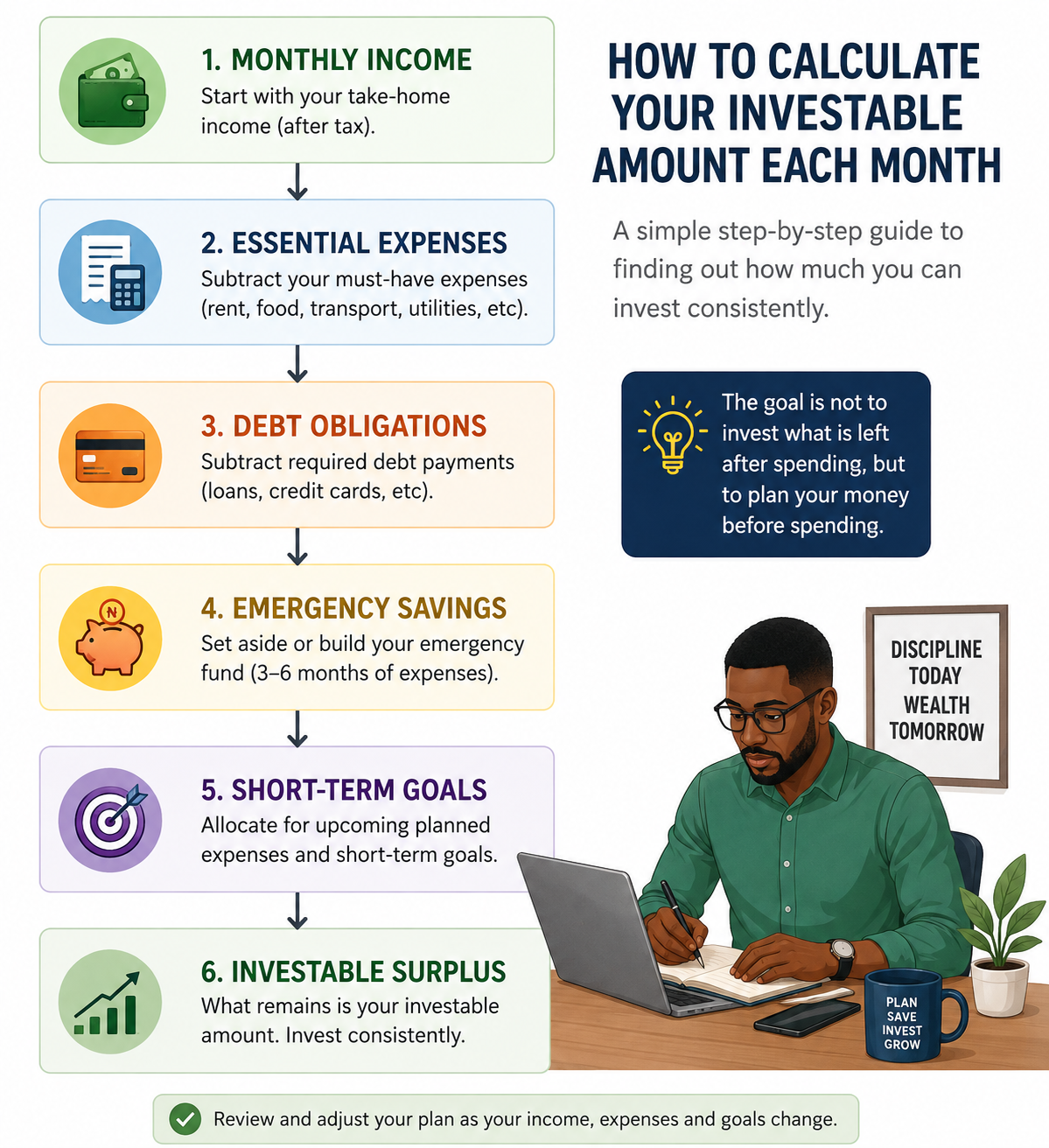
Instead of choosing a percentage first, start with your income.
Then subtract your essential financial commitments.
Step 1 — Take-home income
Start with what actually reaches your account.
Step 2 — Essential expenses
Subtract:
- Housing
- Food
- Transportation
- Utilities
- Healthcare
- Necessary family expenses
- Other essential commitments
Step 3 — Debt obligations
Account for required debt payments.
Step 4 — Emergency savings
If your emergency fund isn't adequate, allocate part of your available surplus toward building it.
Step 5 — Short-term goals
Account for expenses you know are coming.
Step 6 — Invest the sustainable surplus
What remains can be divided between additional savings and investments according to your goals.
This approach is more realistic than blindly applying a percentage.
Use a Percentage as a Starting Point, Not a Law
Percentage rules are useful because they make financial planning simple.
But they can become dangerous when people treat them as universal laws.
For example:
Person A
Income: ₦100,000
Expenses: ₦90,000
Person B
Income: ₦500,000
Expenses: ₦250,000
A 20% investment rule would mean:
Person A invests ₦20,000.
Person B invests ₦100,000.
But Person A would be left with only ₦10,000 after expenses.
Person B would still have ₦150,000.
Clearly, the same percentage doesn't produce the same financial reality.
Consider Your Income Stability
Your income isn't always predictable.
This is especially important for:
- Freelancers
- Commission-based workers
- Business owners
- Contractors
- Self-employed people
- People whose salaries vary
If your income changes significantly each month, don't necessarily commit yourself to a fixed investment amount you may struggle to maintain.
Instead, you could use a percentage of whatever income you actually receive.
MoneyTrut's How to Budget When Your Income Changes Every Month explores this problem in more detail.
Example of Investing With Variable Income
Suppose your monthly income is:
January: ₦180,000
February: ₦120,000
March: ₦250,000
April: ₦150,000
Instead of promising to invest ₦50,000 every month, you might choose a percentage-based approach.
For example:
10% of monthly income
That would produce:
January → ₦18,000
February → ₦12,000
March → ₦25,000
April → ₦15,000
Your investment amount changes with your income.
That can be easier to sustain.
What If You Have No Emergency Fund?
Don't automatically direct every available naira into investments.
Suppose you have:
₦100,000
in savings and no emergency reserve.
You might decide that building financial protection is more important than aggressively investing.
This doesn't mean you can never invest.
It means you're building the foundation first.
What If You Have High-Interest Debt?
Suppose you owe:
₦500,000
and the debt carries a high interest cost.
At the same time, you're investing money hoping to earn a return.
You need to consider the economics of both decisions.
If the debt is expensive, reducing it can provide a more predictable financial benefit than investing in a risky asset with uncertain returns.
That doesn't mean everyone must stop investing until every debt is gone.
But debt should not be ignored.
What If Your Employer Provides Retirement Contributions?
If your employment arrangement includes retirement or pension contributions, understand how those contributions interact with your personal investment plan.
Your personal investments don't necessarily have to replace every other form of long-term saving.
Instead, consider your overall retirement and wealth-building position.
Should You Invest Before Saving?
Not necessarily.
Think about the purpose of the money.
If you need:
₦300,000 for rent in four months,
that's not long-term investment money.
If you have:
₦300,000
that you don't expect to need for 10 years, the situation is completely different.
The time horizon matters.
What Should You Invest In?
Once you've determined how much you can invest, the next question is where the money should go.
Your options may include:
- Mutual funds
- Government securities
- Fixed-income investments
- Stocks
- Other appropriate investments
Don't choose an investment simply because it produced the highest return recently.
Your investment should match your:
Goal → Time horizon → Risk → Portfolio
MoneyTrut's What Should You Invest in First? A Beginner's Guide provides a starting point for thinking through those choices.
Don't Put Every Investment Contribution Into One Asset
Suppose you're investing:
₦50,000 every month.
You don't necessarily need to put all ₦50,000 into one stock.
You might instead build a diversified strategy appropriate for your goals and risk tolerance.
MoneyTrut explains this more fully in:
How to Build an Investment Portfolio in Nigeria.
The Power of Increasing Your Investment Rate
One of the easiest ways to increase long-term investing is to increase the percentage when your income rises.
Suppose you earn:
₦200,000
and invest:
10% = ₦20,000
Later your salary increases to:
₦300,000.
Instead of continuing to invest exactly ₦20,000, you could increase the contribution.
At 15%, that would be:
₦45,000.
The combination of higher income and a higher investment rate can accelerate wealth building.
Don't Increase Your Lifestyle Every Time Your Salary Increases
This is lifestyle inflation.
Suppose your salary rises from:
₦300,000 → ₦500,000.
You now have an additional:
₦200,000
each month.
If the entire increase goes toward a more expensive apartment, car, restaurants and subscriptions, your investment capacity may barely change.
But if you allocate part of the increase toward investing, your lifestyle can still improve while your wealth-building rate increases.
Automate Your Investments When Possible
One of the easiest ways to stay consistent is to remove the decision from your monthly routine.
Instead of waiting until the end of the month to see what's left:
Income arrives → investment contribution → expenses → remaining money
You can structure your finances so that your intended investment amount is transferred automatically where the investment provider supports it.
The objective is not to make investing complicated.
It's to make consistency easier.
Don't Invest Money You Can't Afford to Lose
This doesn't mean you should expect every investment to become worthless.
It means you should understand that investments can carry risk.
If losing or temporarily being unable to access a particular amount would cause you to miss rent, school fees or other essential obligations, that money may not belong in a high-risk investment.
Your investment strategy should protect your financial stability rather than threaten it.
A Simple Monthly Investment Framework
You can use this as a starting framework:
If you're financially unstable
Focus primarily on:
Essential expenses + emergency savings + debt management
Invest only if you genuinely have room.
If you're becoming financially stable
Consider:
5%–10% investing
while continuing to strengthen your emergency fund and financial position.
If you're financially stable
Consider:
10%–20% investing
depending on your goals and available surplus.
If you have a high savings capacity
Consider:
20%–30%+
if your income and financial situation comfortably support it.
These are planning ranges, not financial rules.
What If You Can Only Invest 5%?

That's okay.
If you earn:
₦100,000
and invest:
₦5,000
every month, you're still building the habit.
Don't compare your ₦5,000 contribution with someone's ₦200,000 contribution.
Their income may be completely different.
Focus on increasing your own capacity over time.
What If You Can Invest 30%?
That's also fine if it's sustainable.
Suppose you earn:
₦500,000
and can comfortably invest:
₦150,000
each month.
That's 30%.
If your emergency fund is adequate, your debt is under control and your essential needs are covered, there is nothing inherently wrong with investing more than the commonly quoted 10% or 20%.
What If You Can Invest 40% or More?
High earners or people with low expenses may be able to invest a very large percentage of their income.
That's not necessarily excessive.
But don't sacrifice important financial needs simply to achieve a high investment rate.
Money is supposed to improve your life.
A financial plan that leaves you constantly struggling just so you can boast about investing 40% isn't necessarily a good plan.
Review Your Investment Percentage Every Time Your Situation Changes
You should reconsider your investment contribution when:
- Your salary increases
- Your salary decreases
- You change jobs
- You get married
- You have a child
- Your rent changes
- You take on major debt
- Your emergency fund becomes adequate
- You reach an important financial goal
Your investment rate doesn't have to remain fixed forever.
The Bottom Line
There is no magic percentage of salary that every Nigerian should invest.
For some people, 5% is a realistic starting point.
For others, 10%–20% may be achievable.
And someone with a high income and low financial obligations may eventually invest 30% or more.
The important thing is not to force yourself into a percentage that doesn't match your financial reality.
Start with what you can sustain.
Build your emergency fund.
Manage expensive debt.
Understand your goals.
Then invest consistently.
And whenever your income increases, consider increasing your investment contribution instead of allowing your entire salary increase to become additional spending.
Whether you earn ₦50,000, ₦70,000, ₦100,000, ₦150,000, ₦250,000, ₦300,000, ₦500,000, ₦1 million, ₦1.5 million or ₦2 million a month, the same principle applies:
Don't invest a percentage just because someone told you to. Invest an amount that fits your financial life and that you can consistently maintain.

You must be logged in to post a comment.