
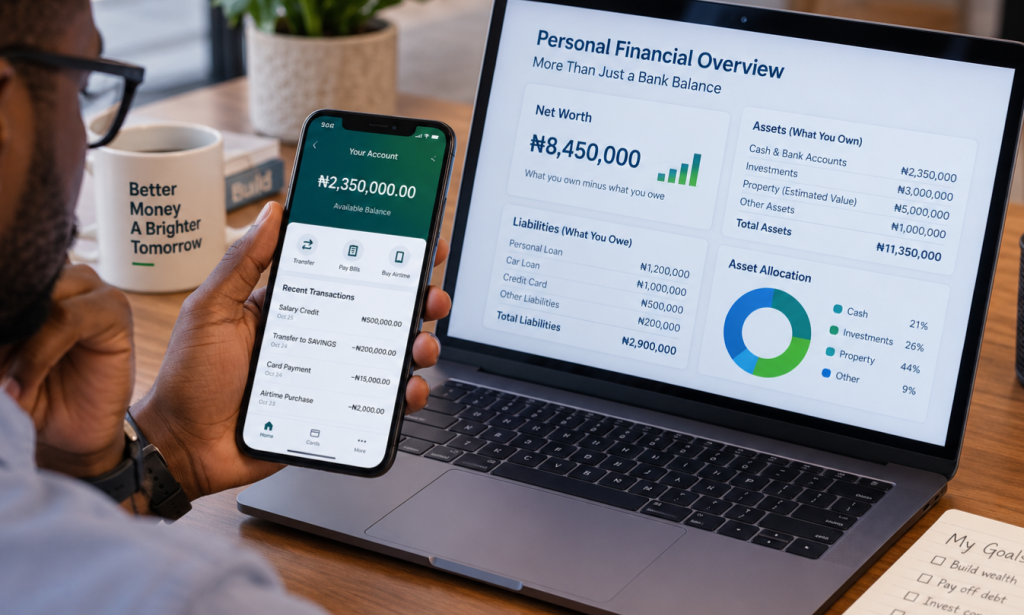
Open your banking app.
You see ₦2 million.
It feels good.
You may even think:
"I'm doing well financially."
But what if you also owe ₦3 million?
Or what if the ₦2 million is money you need to spend on rent, school fees, business inventory or someone else's money that you are holding temporarily?
Your bank balance can tell you how much money is sitting in that account.
It cannot tell you whether you are wealthy.
This is one of the easiest financial mistakes to make because your bank balance is visible.
Your net worth is not.
You can check your bank balance in seconds.
Calculating your actual financial position requires looking at everything you own and everything you owe.
And sometimes the person with ₦500,000 in the bank is in a stronger financial position than someone with ₦5 million.
It depends on the rest of the picture.
Your Bank Balance Is Just One Number
Suppose two people have the following balances.
Person A: ₦5 million in the bank.
Person B: ₦1 million in the bank.
At first glance, Person A appears wealthier.
But now look deeper.
Person A
Cash: ₦5 million
Debt: ₦8 million
Net worth from these figures: −₦3 million
Person B
Cash: ₦1 million
Investments and other assets: ₦7 million
Debt: ₦500,000
Net worth from these figures: ₦7.5 million
Person B has much less cash.
But Person B has a stronger overall financial position.
This is why cash and wealth are not the same thing.
What Is Wealth?
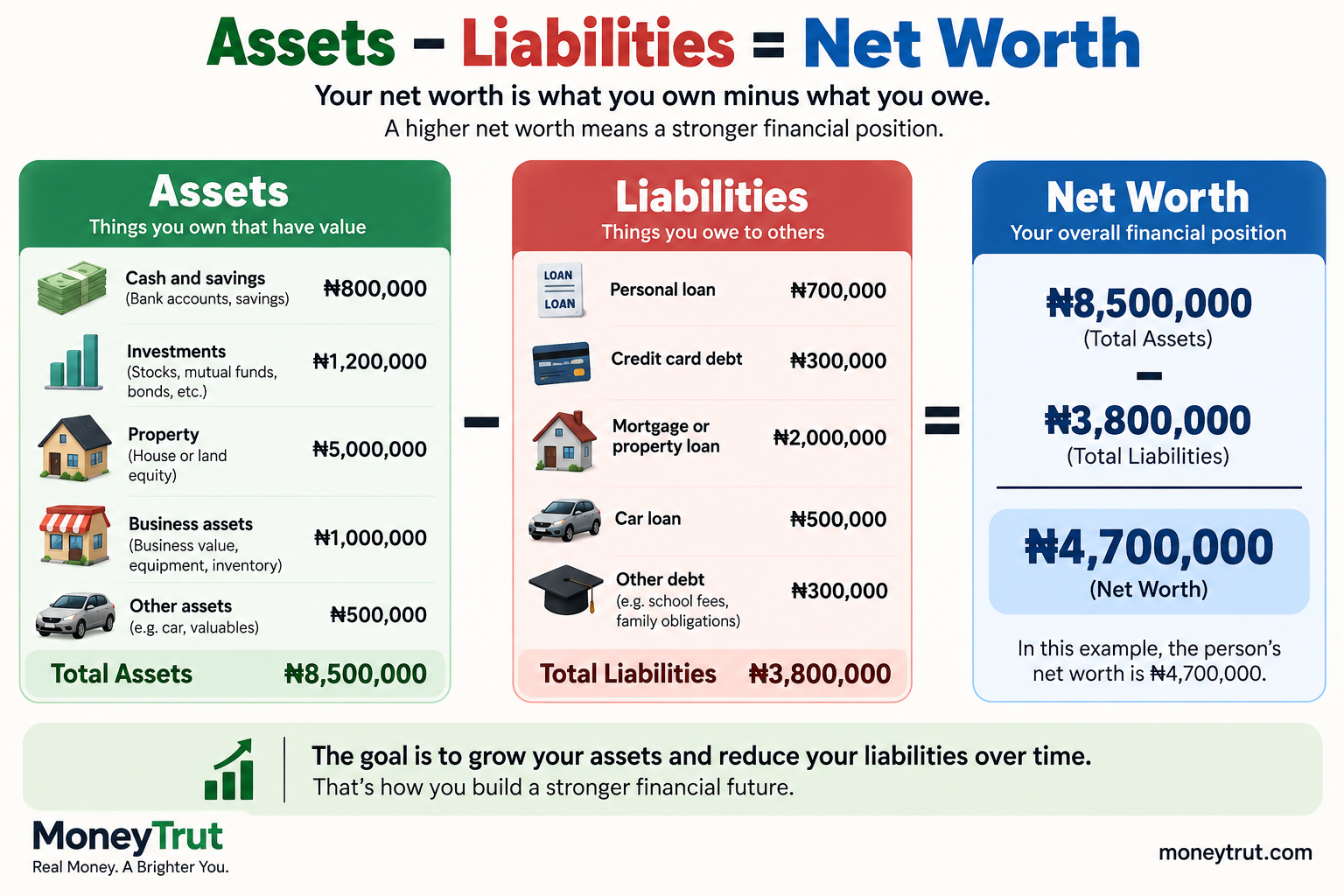
There is no single definition that captures every aspect of wealth, but for personal finance, a useful starting point is net worth.
A simple formula is:
Net worth = What you own − What you owe
What you own can include:
- Cash
- Savings
- Investments
- Property
- Business interests
- Other valuable assets
What you owe can include:
- Personal loans
- Credit balances
- Business debt you are personally responsible for
- Mortgage or property debt
- Other outstanding obligations
The result gives you a snapshot of your financial position.
Income Is Not Wealth Either
This is another common misconception.
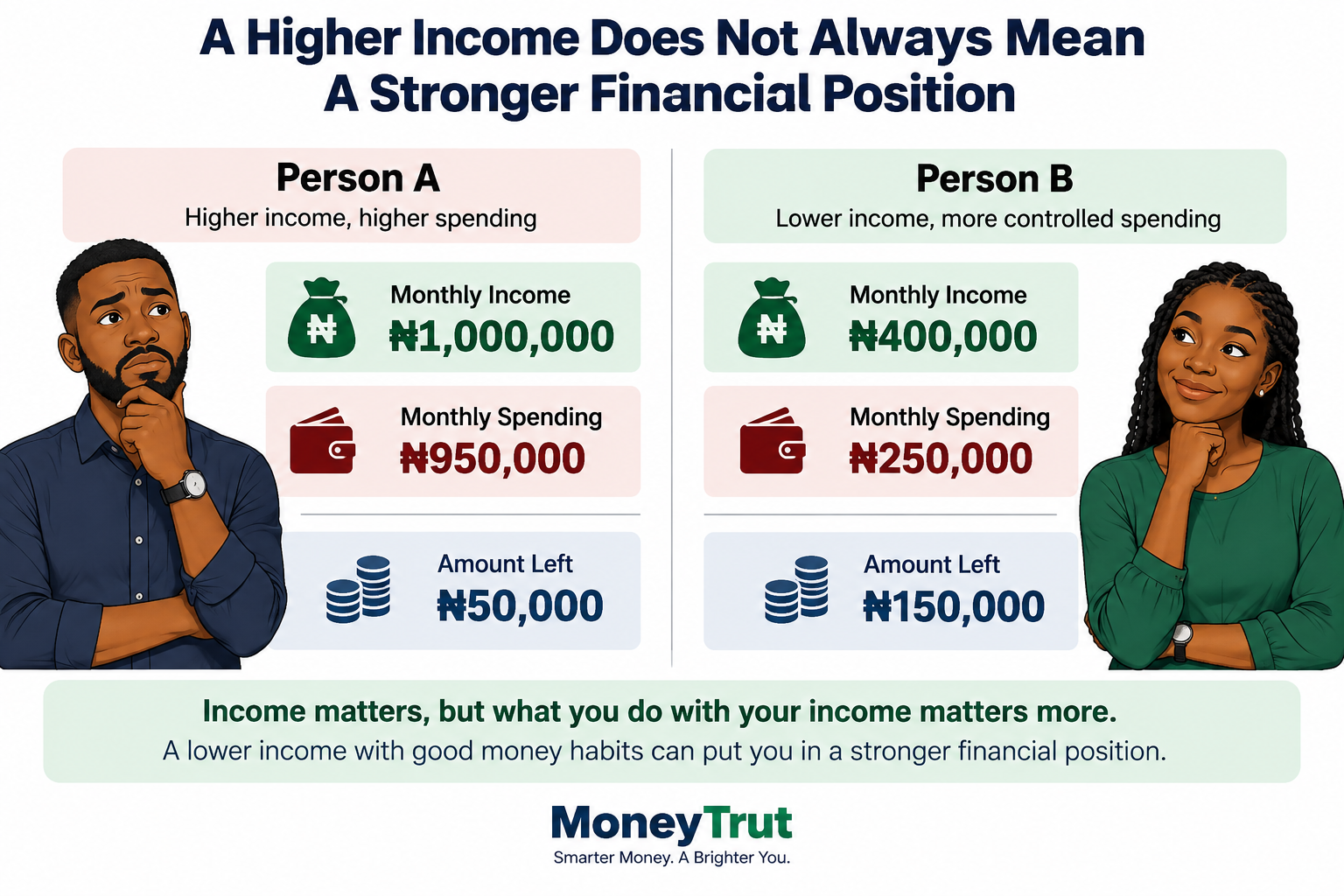
Someone earning ₦1 million every month is not automatically wealthier than someone earning ₦400,000.
Consider two people.
Person A
Monthly income: ₦1 million
Monthly spending: ₦950,000
Monthly amount left: ₦50,000
Person B
Monthly income: ₦400,000
Monthly spending: ₦250,000
Monthly amount left: ₦150,000
Person A earns much more.
But Person B is keeping more money each month.
Now imagine Person B consistently saves and invests the difference over several years.
Income matters.
But what happens to your income after you receive it matters too.
MoneyTrut explores this broader issue in:
Why You Still Feel Broke Even When Your Salary Increases
A Large Bank Balance Can Be Temporary
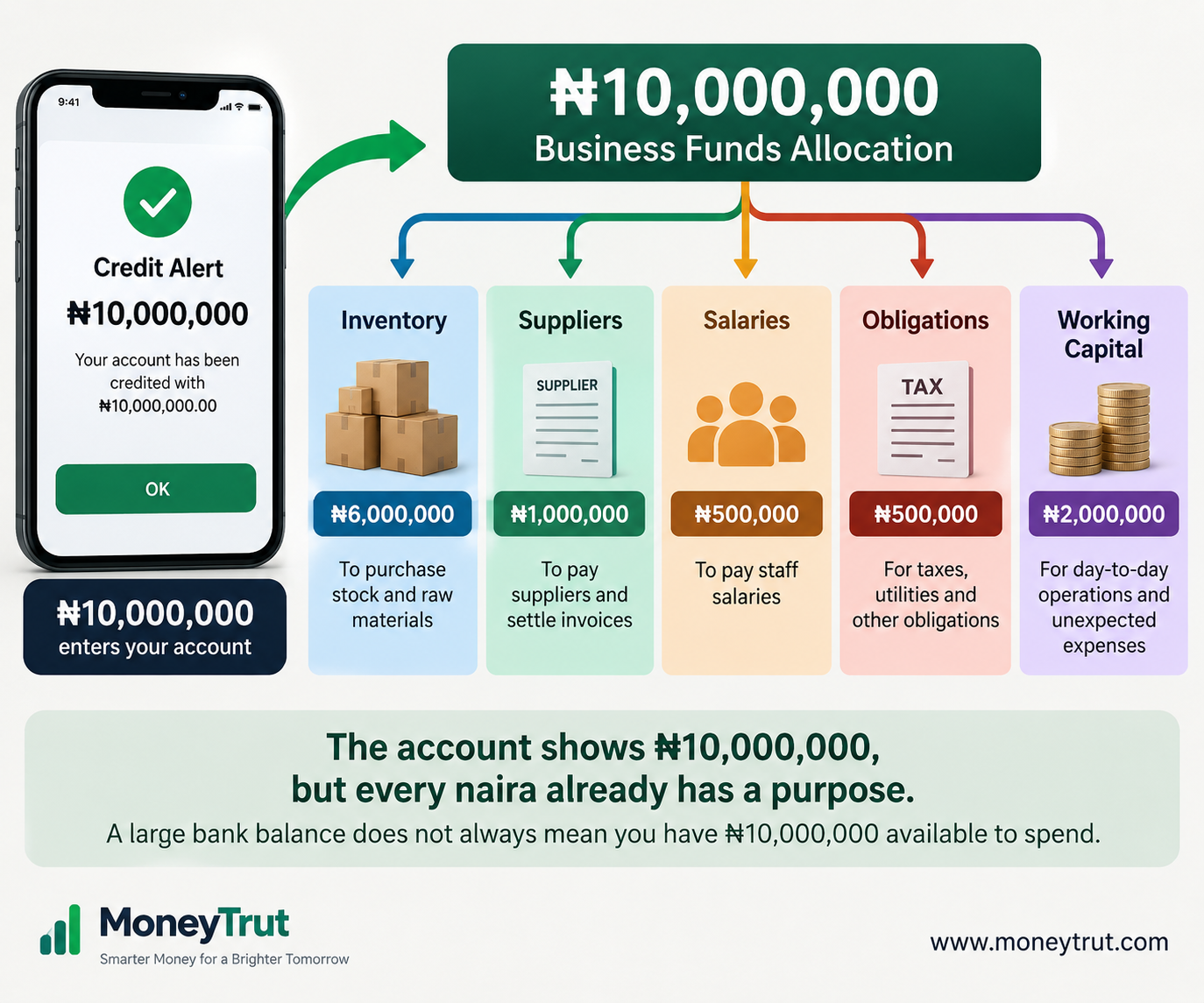
Imagine a business owner receives ₦10 million into a bank account.
Someone sees the balance and assumes:
"This person has ₦10 million."
But the money may actually belong to the business.
Perhaps:
- ₦6 million is for inventory
- ₦1 million is for suppliers
- ₦500,000 is for salaries
- ₦500,000 is for taxes and other obligations
- ₦2 million is working capital
The account has ₦10 million.
But that does not mean the owner personally has ₦10 million available to spend.
This is why business owners need to separate business money from personal money.
MoneyTrut discusses that principle in:
How to Manage Your Money When You Have Multiple Sources of Income
The Money in Your Account May Already Have a Job
This is one of the biggest reasons a bank balance can be misleading.
Suppose you earn ₦500,000.
Your account shows ₦500,000.
But you already know:
₦150,000 — rent
₦80,000 — school fees
₦50,000 — emergency savings
₦50,000 — investment
₦70,000 — debt repayment
₦100,000 — monthly expenses
That ₦500,000 is not really "free money."
Almost every naira already has a purpose.
If you spend the money simply because the account balance looks high, you may create a financial problem later.
This is one reason budgeting is useful.
A budget gives your money a job before you spend it.
MoneyTrut explains this in:
How to Create a Monthly Budget That Actually Works
Cash Is Valuable, But Cash Alone Does Not Build Wealth
Cash is important.
You need money that is accessible for:
- Daily expenses
- Emergencies
- Short-term obligations
- Unexpected bills
- Planned purchases
But keeping every naira in cash indefinitely can create another problem.
Over the long term, your financial goals may require assets that can potentially grow.
Depending on your circumstances and risk tolerance, these can include things such as:
- Government securities
- Bonds
- Mutual funds
- Equities
- Property
- A productive business
The appropriate investment depends on the goal, time horizon and risk involved.
The SEC's investor education resources emphasize understanding investments, risks and making informed decisions rather than simply chasing returns.
But Having Investments Does Not Automatically Make You Wealthy
This is another important distinction.
Someone can own investments and still have poor finances.
For example:
Investments: ₦5 million
Debt: ₦4.5 million
Cash: ₦100,000
The person owns valuable assets.
But they also have substantial debt and very little liquid cash.
This may not be a comfortable financial position.
Wealth is not about owning one impressive asset.
It is about the relationship between your assets, debts, income, spending and financial needs.
Your Net Worth Can Be More Useful Than Your Bank Balance
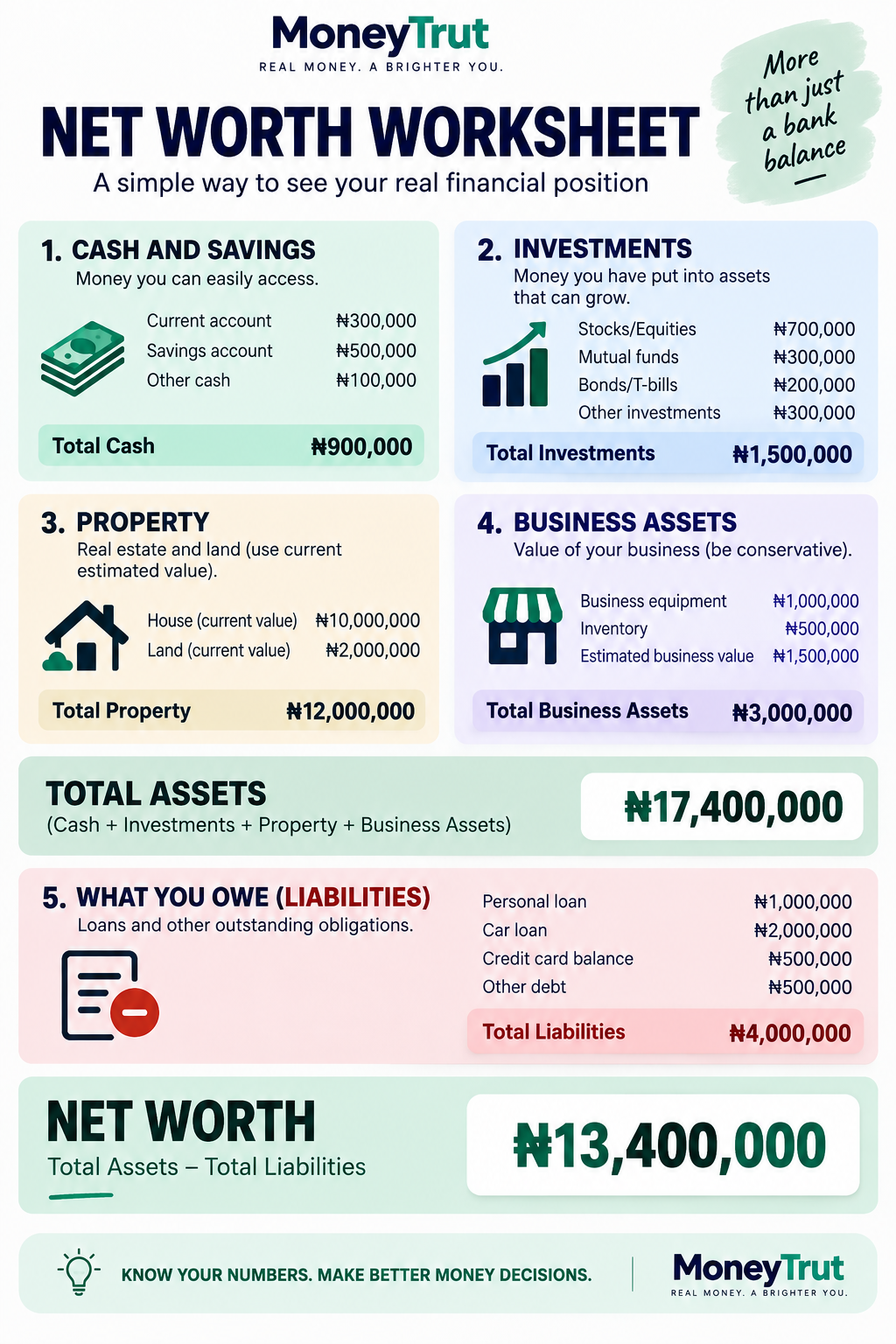
Suppose you want to know whether you are becoming financially stronger.
Instead of looking only at your bank balance, calculate your net worth periodically.
For example:
What You Own
Cash and savings: ₦800,000
Investments: ₦1.2 million
Property equity: ₦2 million
Business value: ₦500,000
Total assets: ₦4.5 million
What You Owe
Personal loan: ₦700,000
Other debt: ₦300,000
Total liabilities: ₦1 million
Net Worth
₦4.5 million − ₦1 million = ₦3.5 million
That ₦3.5 million gives you a much broader picture than the ₦800,000 sitting in your bank accounts.
What If Your Net Worth Is Negative?
That is not necessarily a permanent situation.
Imagine a young professional has:
Assets: ₦1 million
Debt: ₦2 million
Net worth:
−₦1 million
It may look discouraging.
But if the person begins to:
- Increase income
- Reduce unnecessary spending
- Pay down debt
- Build savings
- Invest gradually
- Avoid taking on unnecessary new debt
their financial position can improve.
The important thing is to know where you are starting.
You cannot improve a number you never measure.
A High Salary Can Hide a Weak Financial Position
Imagine someone earns ₦1.5 million per month.
They drive an expensive car.
They live in a nice apartment.
They eat at expensive restaurants.
They travel frequently.
From the outside, they look wealthy.
But suppose they also have:
₦8 million in personal debt
₦500,000 in savings
No investments
Monthly expenses of ₦1.4 million
The lifestyle looks impressive.
The balance sheet may not.
This is why appearances are a poor way to measure financial success.
The Person With the Smaller Lifestyle May Be Stronger Financially
Now consider someone earning ₦600,000.
They live in a modest apartment.
They use an affordable car or public transport.
They spend carefully.
They have:
₦1.5 million emergency savings
₦2 million in investments
₦500,000 in cash
₦200,000 debt
Their lifestyle may not look as impressive.
But financially, they may be in a much stronger position.
This is why comparing your lifestyle with someone else's can be misleading.
You can see what somebody buys.
You cannot see their balance sheet.
Your Bank Balance Can Actually Be Too High
This sounds strange.
Shouldn't having more cash be good?
Usually, having more cash is better than having no cash.
But there can be a point where keeping large amounts of money idle becomes inefficient relative to your goals.
Suppose someone has ₦10 million sitting in an ordinary account.
They don't need the money for years.
They have no emergency reason to keep all of it immediately accessible.
Depending on their circumstances, they may want to consider whether some of that money should be allocated toward suitable savings or investment vehicles instead.
The correct choice depends on:
- Time horizon
- Risk tolerance
- Liquidity needs
- Expected returns
- Fees
- Taxes where applicable
- Safety of the institution/product
The answer is not automatically "invest everything."
Cash still has an important role.
Your Bank Balance Can Also Be Too Low
The opposite is equally important.
Someone may say:
"I have ₦10 million invested, so I don't need cash."
Then an emergency happens.
They need ₦300,000 immediately.
But their money is tied up in assets that are difficult or costly to liquidate quickly.
Now their large investment portfolio does not solve the immediate problem.
This is why financial planning needs both:
Liquidity
and
Long-term growth.
Your emergency fund exists partly to prevent you from being forced to sell long-term investments at the wrong time.
What Is the Difference Between Cash and Liquid Assets?
Cash is money that is immediately available.
Liquid assets are assets that can generally be converted to cash relatively easily without a major loss in value, although the exact meaning and liquidity can vary by asset.
For example, money in an accessible bank account is highly liquid.
Some investments may also be relatively liquid.
A property is generally much less liquid because selling it can take time and involve significant transaction costs.
This matters when deciding how much money you should keep readily accessible.
Your House Does Not Automatically Mean You Are Financially Secure
Owning property can contribute significantly to net worth.
But property is not the same as cash.
Suppose you own a house worth:
₦50 million
and have:
₦200,000 in your bank account.
You may have substantial wealth tied up in property.
But if you suddenly need ₦500,000 for an emergency, the house cannot easily solve the problem.
This is why net worth and financial security are related but not identical.
A person can have significant assets but poor liquidity.
What About Cars?
A car can be valuable.
But it usually should not be treated the same way as an investment that is expected to appreciate.
Cars generally lose value over time, while also requiring:
- Fuel
- Maintenance
- Insurance
- Repairs
- Registration
- Other operating costs
A ₦15 million car does not necessarily mean you are ₦15 million wealthier in a practical financial sense.
If you financed the car with debt, your actual equity may be much lower.
A Business Can Be an Asset Too
Suppose you own a profitable business.
The business may have:
- Equipment
- Inventory
- Customers
- Intellectual property
- Brand value
- Cash flow
- Contracts
Depending on how it is structured and valued, the business may contribute to your overall wealth.
But business value can be difficult to estimate.
You should not simply say:
"My business made ₦5 million this year, so my business is worth ₦5 million."
Revenue, profit and business value are different concepts.
This is one reason proper business records matter.
Don't Count Money That Isn't Yours
Imagine someone sends you ₦1 million to help them pay a supplier.
The money sits in your account.
Your balance increases by ₦1 million.
But your wealth has not increased by ₦1 million.
You are holding someone else's money temporarily.
The same principle applies to:
- Business funds
- Client money
- Salary advances
- Loans received
- Money held on behalf of someone else
A bank balance is simply a record of money in an account.
It does not tell you who ultimately has an economic claim to every naira.
Debt Can Make a Large Balance Misleading
Suppose you have:
Bank balance: ₦5 million
Outstanding loan: ₦4 million
If the ₦5 million is genuinely yours and there are no other significant assets or liabilities, your net financial position from those two figures is approximately:
₦5 million − ₦4 million = ₦1 million
The bank balance is ₦5 million.
Your net position is ₦1 million.
This is why debt must always be considered when measuring financial progress.
Don't Celebrate Borrowed Money as Wealth
This becomes especially important when someone receives a large loan.
Suppose your bank balance increases by:
₦10 million
because you received a business loan.
Your account now shows ₦10 million more.
But you have also acquired a ₦10 million obligation, plus the applicable financing cost.
You have access to capital.
You have not suddenly become ₦10 million richer.
The money may help you build wealth if it is used productively and managed properly.
But borrowing itself is not wealth creation.
How to Track Your Real Financial Progress
Instead of checking only your bank balance, track four numbers.
1. Income
How much money comes in?
2. Spending
How much goes out?
3. Net worth
What do you own minus what you owe?
4. Financial reserves
How much money could you access if something went wrong?
These four numbers tell you much more than a bank balance alone.
Your Savings Rate Matters Too
Suppose you earn ₦500,000.
If you save ₦100,000, your savings rate is:
₦100,000 ÷ ₦500,000 = 20%
Now suppose your salary increases to ₦800,000.
If you save ₦120,000, your savings rate has actually fallen:
₦120,000 ÷ ₦800,000 = 15%
Your savings amount increased.
But your savings rate decreased.
This is another reason income alone is not enough to measure progress.
MoneyTrut has a dedicated guide on this:
How Much Should You Save From Your Salary Every Month?
Your Emergency Fund Is Part of Financial Strength
A person with ₦1 million in investments and ₦5,000 in accessible cash may be less prepared for a short-term emergency than someone with ₦500,000 in accessible savings.
That does not mean the second person is wealthier.
It means they may have better short-term liquidity.
This distinction matters.
Your emergency fund is designed to provide a financial buffer when life does not follow your budget.
MoneyTrut explains how much you may need here:
How Much Should You Have in an Emergency Fund?
What Does Financial Progress Actually Look Like?
It may look less impressive than you expect.
Financial progress can mean:
Month 1: ₦500,000 debt
Month 12: ₦200,000 debt
That's progress.
It can mean:
Emergency fund: ₦50,000 → ₦300,000
That's progress.
It can mean:
Investments: ₦200,000 → ₦800,000
That's progress.
It can mean:
Net worth: ₦1 million → ₦2 million
That's progress.
It does not have to look like buying a new car or moving into a more expensive apartment.
Your Net Worth Can Increase Even When Your Bank Balance Falls
Suppose you have:
₦2 million cash
You use:
₦1 million
as a deposit toward a productive asset.
Your bank balance falls to:
₦1 million.
At first glance, it looks like you became poorer.
But if the asset adds ₦1 million of value to your net worth, your overall financial position may not have declined.
This is why looking only at your bank account can sometimes give you the wrong impression.
Money moved from one form of wealth to another.
But Don't Use "Investing" as an Excuse to Empty Your Bank Account
There is a danger on the other side.
Someone may say:
"Cash is not wealth, so I'm investing everything."
That can be dangerous.
You still need enough accessible money for:
- Emergencies
- Bills
- Near-term goals
- Unexpected expenses
- Normal cash flow
The objective is not to have the smallest possible bank balance.
The objective is to have an appropriate amount of liquid money for your needs while allocating longer-term money according to your goals and risk tolerance.
How to Calculate Your Net Worth
You can do this once every few months.
Step 1: List your cash
Include:
- Bank accounts
- Savings
- Other readily accessible cash
Step 2: List your investments
Include relevant investments at their current approximate value.
Step 3: List other assets
For example:
- Property
- Business interests
- Other significant assets
Be conservative when valuing assets whose market value is uncertain.
Step 4: List your debts
Include:
- Loans
- Credit balances
- Other significant obligations
Step 5: Subtract debt from assets
For example:
Assets: ₦8 million
Debts: ₦2 million
Net worth: ₦6 million
Then repeat the calculation periodically.
A Simple Nigerian Example
Let's say Emeka earns ₦700,000 per month.
He has:
Bank savings: ₦600,000
Investments: ₦1.5 million
Car equity: ₦1 million
Business value: ₦700,000
Total assets:
₦3.8 million
He owes:
Personal loan: ₦500,000
Other debt: ₦300,000
Total liabilities:
₦800,000
His approximate net worth is:
₦3.8 million − ₦800,000 = ₦3 million
If he later increases his savings and investments while reducing his debt, his net worth can rise even if his bank balance does not increase dramatically.
That is meaningful financial progress.
What Should You Pay More Attention To?
Instead of asking only:
"How much money is in my bank account?"
Ask:
"Is my net worth increasing?"
"Am I reducing expensive debt?"
"Is my emergency fund becoming stronger?"
"Am I saving consistently?"
"Am I investing appropriately for my goals?"
"Is my income increasing without my expenses increasing at the same rate?"
"Can I handle an unexpected financial problem?"
These questions give you a much clearer picture of your financial health.
Don't Compare Your Bank Balance With Someone Else's
You may see someone posting:
"I just crossed ₦10 million in savings."
You don't know:
- Their debts
- Their income
- Their assets
- Their family obligations
- Whether the money belongs to a business
- Whether they are holding someone else's money
- Whether the screenshot is even genuine
Social media is particularly poor at showing complete financial information.
Compare your current financial position with your previous financial position.
That is a much more useful measurement.
The Goal Is Not to Have a Huge Bank Balance
A huge bank balance can feel reassuring.
And having substantial liquid savings can certainly be valuable.
But your ultimate financial goal should be broader than seeing a large number when you open your banking app.
You want money that:
- Supports your current life
- Protects you against emergencies
- Helps you achieve important goals
- Can potentially grow over time
- Reduces unnecessary financial stress
- Gives you greater financial flexibility
That is much closer to financial security than simply having a large balance.
Bottom Line
Your bank balance tells you how much money is sitting in an account.
It does not tell you how wealthy you are.
To understand your financial position, look beyond the balance.
Consider your:
Income.
Spending.
Savings.
Investments.
Assets.
Debt.
Liquidity.
Net worth.
A person with ₦5 million in the bank and ₦8 million in debt may be in a weaker position than someone with ₦1 million in the bank, ₦7 million in assets and only ₦500,000 in debt.
The number you see in your banking app is important.
But it is only one piece of the picture.
Don't measure your financial success by how much money passes through your account. Measure it by how much financial strength you are building and keeping.
Related MoneyTrut Articles
- Why You Still Feel Broke Even When Your Salary Increases
- How to Create a Monthly Budget That Actually Works
- How Much Should You Save From Your Salary Every Month?
- How Much Should You Have in an Emergency Fund?
- How to Build Wealth From a Small Income
- How Much Should You Invest From Your Salary Each Month?

You must be logged in to post a comment.