
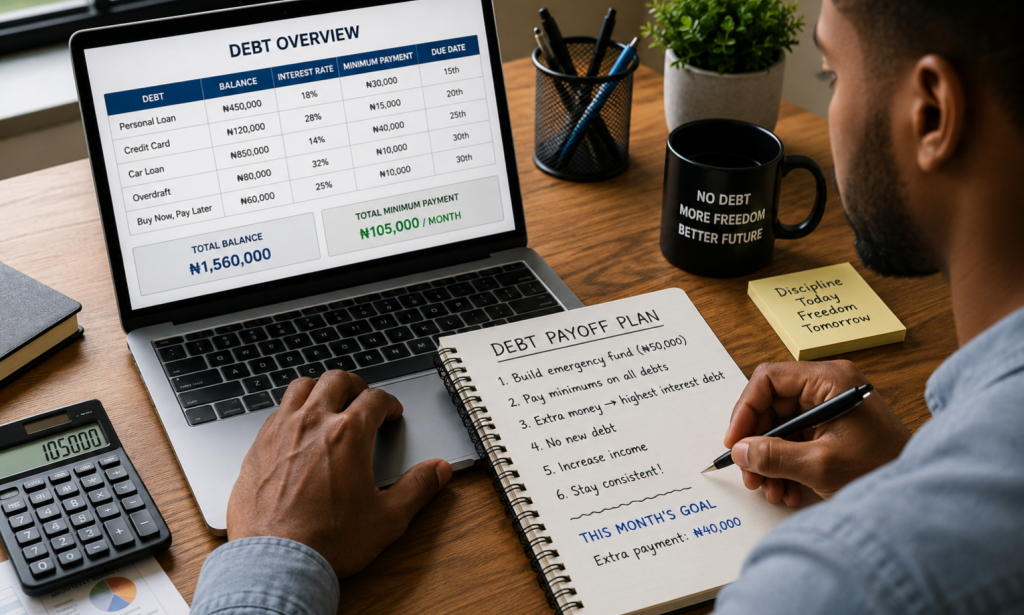
Debt can make a decent salary feel surprisingly small.
You might earn ₦300,000, ₦500,000 or even ₦1 million a month, but if a large portion of that money immediately goes toward loan repayments, there may be very little left for saving, investing or dealing with unexpected expenses.
That is why paying off debt isn't simply about becoming debt-free.
It's about creating financial breathing room.
The faster you can reduce expensive debt without creating another financial problem, the more of your future income you can control.
But there is a right way and a wrong way to do it.
Throwing every naira at your debt while leaving yourself with nothing for emergencies may force you to borrow again the next time something goes wrong.
A better strategy is to understand your debts, protect a basic financial cushion, reduce expensive debt aggressively and gradually redirect the money toward savings and long-term goals.
First, Understand What Kind of Debt You Have
Not all debt deserves exactly the same treatment.
Start by making a list of everything you owe.
Include:
- personal loans
- credit cards
- overdrafts
- salary advances
- buy-now-pay-later balances
- business loans
- car loans
- family or personal debts
- other outstanding obligations
For each debt, record:
| Debt | Balance | Interest/charges | Monthly payment | Due date |
|---|---|---|---|---|
| Loan A | ₦300,000 | Check lender | ₦50,000 | 15th |
| Loan B | ₦150,000 | Check lender | ₦30,000 | 25th |
| Credit balance | ₦80,000 | Check lender | ₦20,000 | 30th |
The exact interest calculation will depend on the lender and product.
The point is to stop thinking about your debt as one large, confusing number.
Know exactly what you owe.
Why High-Interest Debt Deserves Priority
High-interest debt can grow quickly because interest and fees continue adding to what you owe.
This is one reason financial education resources recommend dealing with expensive debt before putting significant amounts of money into higher-risk investments.
Investor.gov notes that eliminating high-interest debt can be more beneficial and less risky than trying to earn an investment return while carrying that debt.
Imagine you have expensive debt charging a very high rate.
If you put extra money into an investment that earns an uncertain return while the debt continues accumulating at a high rate, you are taking investment risk while already paying a known financial cost.
That doesn't mean every debt should be paid off before you save or invest.
It means the interest rate and terms of the debt matter.
Step 1: Stop Adding New Debt
This sounds obvious, but it is where many debt repayment plans fail.
You make an extra ₦30,000 payment on your loan.
Then another unexpected expense appears.
You borrow ₦40,000.
Your debt hasn't really improved.
Before aggressively attacking your existing debt, look at why you keep borrowing.
Ask:
Why did I take the debt in the first place?
Was it:
- an emergency?
- a lifestyle purchase?
- rent?
- school fees?
- business expenses?
- medical costs?
- an income shortfall?
- existing debt being rolled into new debt?
If the underlying problem hasn't changed, paying off the balance may only provide temporary relief.
Step 2: Build a Small Emergency Cushion
If you have absolutely no savings, consider building a small emergency reserve while making your required debt payments.
Why?
Because life doesn't stop while you're paying debt.
Your car can break down.
Your phone can fail.
You can have an unexpected medical expense.
Your income can be delayed.
If you have nothing available, you may have to borrow again.
The Consumer Financial Protection Bureau explains that emergency savings can help people handle unexpected expenses without relying on credit or loans, and that even a small amount can provide some financial security.
If you're starting with little or no savings, see our guide How to Build an Emergency Fund With a Low Income for a practical approach to getting started.
You don't necessarily need a huge emergency fund before starting aggressive debt repayment.
Your first target might be:
₦20,000
then:
₦50,000
then:
₦100,000
The appropriate amount depends on your income, household responsibilities and the types of emergencies you are most likely to face.
You can also read How Much Should You Have in an Emergency Fund? for a closer look at setting an appropriate target.
Once you have a basic cushion, you can direct more of your available cash toward expensive debt.
Step 3: Choose Your Debt-Payment Strategy

There are two popular approaches.
The Debt Avalanche
Pay the minimum required on all debts.
Then put all additional money toward the debt with the highest interest rate or most expensive borrowing cost.
Once that debt is gone, move the extra payment to the next most expensive debt.
This approach can reduce the total interest you pay, assuming the debt rates and fees are evaluated correctly.
The Debt Snowball
Pay the minimum on all debts.
Then put additional money toward the smallest balance first, regardless of interest rate.
Once it is gone, move that payment to the next smallest debt.
The advantage is psychological.
Getting rid of a small debt can give you a quick win and make the overall process feel more manageable.
Which One Is Better?
If your primary goal is minimizing interest, the highest-cost-debt approach is generally the more mathematically efficient option.
The Consumer Financial Protection Bureau describes both the highest-interest-rate method and the snowball method as common debt-reduction strategies.
If motivation is your biggest problem and eliminating a small balance would help you stay committed, the snowball method may be easier to maintain.
The most important thing is not choosing the "perfect" method.
It's consistently paying down the debt.
Step 4: Don't Ignore Minimum Payments
While attacking one debt aggressively, continue making the required payments on your other debts.
For example:
Debt A: ₦50,000 minimum
Debt B: ₦30,000 minimum
Debt C: ₦20,000 minimum
If you have an additional ₦50,000 available, you might pay:
- Debt A: ₦100,000
- Debt B: ₦30,000
- Debt C: ₦20,000
The exact allocation depends on which debt you are targeting.
The important principle is:
Don't stop paying the other required debts while focusing on one.
Step 5: Find Your Debt-Attack Money
You don't necessarily need a completely new source of money to accelerate debt repayment.
Start with your existing budget.
Suppose you earn:
₦500,000
Your monthly expenses are:
₦350,000
Your minimum debt payments are:
₦80,000
That leaves:
₦70,000
If you can safely direct ₦40,000 of that toward your target debt, your monthly debt payment becomes much more powerful.
You might also find another ₦10,000–₦20,000 by reducing unnecessary spending.
The important thing is to avoid creating a budget so aggressive that you immediately have to borrow again.
Step 6: Attack Large Recurring Expenses
When trying to repay debt, people often focus on tiny purchases.
Cutting a ₦2,000 expense is useful.
But reducing a recurring ₦30,000 or ₦50,000 expense can have a much larger effect.
Look at:
- housing
- transportation
- subscriptions
- expensive phone/data plans
- eating out
- unnecessary recurring services
- expensive financing arrangements
Suppose you reduce a recurring expense by ₦20,000.
That's:
₦20,000 × 12 = ₦240,000 per year.
That could make a meaningful difference to your debt balance.
Step 7: Use Extra Income to Accelerate Repayment
Extra money can dramatically shorten your debt repayment period.
This might include:
- overtime
- bonuses
- freelance income
- commissions
- business profits
- temporary work
- selling unused items
- other legitimate income
You don't necessarily have to send 100% of every extra naira to debt.
For example, an additional ₦100,000 could be divided:
₦70,000 → debt
₦20,000 → emergency savings
₦10,000 → personal use
The exact split depends on your circumstances.
The important thing is to stop every extra payment from automatically becoming lifestyle spending.
Step 8: Be Careful With Debt Consolidation
Debt consolidation can sound attractive.
You take several debts and combine them into one.
But consolidation isn't automatically a good deal.
Before accepting a new loan, compare:
- interest rate
- total repayment
- fees
- loan duration
- monthly payment
- penalties
- insurance or other charges
- whether the new loan is secured
- what happens if you miss payments
A lower monthly payment doesn't necessarily mean a cheaper loan.
For example, extending a loan from two years to five years could reduce the monthly payment while increasing the total amount you pay.
Always compare the total cost, not just the monthly instalment.
Step 9: Don't Take a New Loan Just to Feel Debt-Free
One of the most dangerous cycles is:
Loan → repayment pressure → new loan → repayment pressure → another loan.
A new loan may temporarily make your finances look better because several payments have been combined.
But if the underlying spending or income problem remains, the debt can return.
Before taking new debt, ask:
Will this actually reduce my total borrowing cost, or am I simply moving the problem somewhere else?
Step 10: Don't Empty Your Emergency Savings to Pay Debt
This requires judgment.
If you have ₦300,000 in savings and ₦100,000 of expensive debt, using some savings to reduce the debt may make sense.
But if you have ₦300,000 saved and ₦300,000 of debt, leaving yourself with zero cash may be risky.
What happens if an emergency occurs the following week?
You may have to borrow again.
That defeats the purpose.
A better approach can be to maintain a basic emergency cushion while aggressively reducing expensive debt.
The exact balance depends on your circumstances.
Step 11: Make Your Debt Payment Automatic
If possible, schedule your debt payments around your income date.
If you receive your salary on the 25th, don't wait until the last day before the payment is due.
Put the payment into your financial plan immediately.
This reduces the temptation to spend money that is already committed.
The same principle applies to savings.
Automatic transfers can help make saving more consistent.
Step 12: Use the Money From a Finished Debt to Attack the Next One
This is where debt repayment can accelerate.
Suppose you are paying:
Debt A: ₦50,000/month
You finally clear it.
Don't immediately increase your lifestyle by ₦50,000.
Instead, take that same ₦50,000 and add it to your payment on Debt B.
If Debt B was previously receiving:
₦30,000
it now receives:
₦80,000
Once Debt B is gone, that entire amount can move to Debt C.
This creates a snowball effect even if you're using the highest-interest approach.
A Realistic Example: Earning ₦500,000 With Debt
Let's say someone earns:
₦500,000/month
Their monthly expenses are:
- Housing: ₦120,000
- Food: ₦80,000
- Transport: ₦50,000
- Family support: ₦40,000
- Utilities/communication: ₦30,000
- Personal spending: ₦30,000
Total:
₦350,000
They also have:
₦100,000 in minimum debt payments
That leaves:
₦50,000
There isn't much room.
Instead of simply saying "pay your debt faster," the person needs to examine the entire financial structure.
If they can reduce expenses by ₦20,000 and earn an additional ₦30,000, they now have:
₦100,000 of additional breathing room.
That could substantially change the repayment timeline.
This is an important MoneyTrut principle:
Debt repayment is not always about squeezing harder. Sometimes it's about creating more room.
What If You Earn ₦100,000?
Debt repayment can be particularly difficult on a low income.
Suppose you earn:
₦100,000
and essential expenses consume:
₦85,000
You only have ₦15,000 before considering unexpected expenses.
Telling you to pay an additional ₦30,000 toward debt isn't realistic.
Your priorities may instead be:
- keep essential bills current
- avoid new high-cost borrowing
- maintain a small emergency cushion
- negotiate or restructure debt where appropriate
- reduce major expenses if possible
- find ways to increase income
- then accelerate debt repayment
There is no shame in recognizing that the numbers don't currently work.
Sometimes income is the constraint.
What If You Earn ₦1 Million?
A higher income creates more opportunity to eliminate debt quickly, but only if the additional income isn't absorbed by lifestyle inflation.
Suppose someone earns:
₦1,000,000
but spends:
₦850,000
and has:
₦100,000 in debt payments.
Only ₦50,000 remains.
Someone earning ₦500,000 with disciplined spending might actually have more financial flexibility.
This is why income alone doesn't determine financial health.
Your financial margin matters.
Should You Stop Investing While Paying Debt?
Not necessarily.
It depends heavily on the type and cost of the debt, your emergency savings and your long-term goals.
But expensive debt deserves serious attention.
Investor.gov advises investors to control high-interest debt and establish emergency savings as part of a broader wealth-building plan.
A sensible sequence for many people can look like:
Basic emergency cushion
↓
Required debt payments
↓
Aggressive repayment of expensive debt
↓
Larger emergency fund
↓
Long-term investing
But this isn't a rigid formula.
For example, someone with low-cost debt may reasonably invest while making scheduled debt payments.
Someone carrying extremely expensive debt may have a stronger reason to prioritize repayment.
What About Family or Friends You Owe?
Personal debt can be complicated because money and relationships are involved.
If you owe someone money, don't simply avoid the conversation.
Be clear about:
- how much you owe
- what you can afford
- when you can pay
- whether instalments are acceptable
If you've promised a repayment date and cannot meet it, communicate before the date rather than disappearing.
Financial problems are difficult enough without damaging relationships through poor communication.
How Long Will It Take to Become Debt-Free?
You can estimate the basic timeline by dividing your balance by your monthly principal payment, but the actual timeline can be longer because of interest and fees.
For example, suppose you owe:
₦600,000
and pay:
₦50,000 per month
A simple calculation suggests:
₦600,000 ÷ ₦50,000 = 12 months
But this is only a rough illustration.
If interest continues accumulating, you will pay more than ₦600,000 in total and may need more than 12 months.
That is why you should use the actual interest rate, fees and repayment schedule when calculating your expected payoff date.
What Happens After You Pay Off the Debt?
This is where many people make another mistake.

They finish paying a loan and immediately absorb the old payment into their lifestyle.
Instead, redirect it.
Suppose you were paying:
₦70,000 per month
toward a loan.
Once the loan is gone, continue moving that ₦70,000 somewhere useful.
For example:
₦40,000 → emergency fund
₦20,000 → investing
₦10,000 → another financial goal
You have already learned to live without the ₦70,000.
Now make that money work for your future.
Once your debt is under control, the next question becomes how much of your income you should continue putting aside. See How Much Should You Save From Your Salary Every Month? for practical savings targets across different income levels.
A Simple Debt-Payoff Plan
If you're overwhelmed by your debts, start here.
1. List every debt
Balance, interest/charges, minimum payment and due date.
2. Stop unnecessary new borrowing
Don't keep digging while trying to climb out.
3. Build a small emergency cushion
Even a modest reserve can help reduce the need to borrow when something unexpected happens.
4. Continue required payments
Don't neglect other debts while attacking one.
5. Choose your target debt
Usually the most expensive debt if minimizing interest is the priority, or the smallest balance if the snowball method is more likely to keep you motivated.
6. Find additional money
Reduce major expenses and look for legitimate ways to increase income.
7. Put the extra money toward the target
Be consistent.
8. Roll the payment forward
When one debt disappears, move that payment to the next target.
9. Don't immediately increase your lifestyle
Turn your new financial breathing room into savings and investments.
The Bottom Line
Getting out of debt isn't about making one huge payment.
It's about creating a system that steadily reduces what you owe without leaving you financially exposed.
Start by understanding every debt you have.
Keep up with required payments.
Build a basic emergency cushion so that every unexpected expense doesn't become another loan.
Then focus your extra money on the debts that are costing you the most, while looking for ways to reduce major expenses and increase income.
And when a debt is finally gone, don't let its monthly payment disappear into your lifestyle.
Redirect it toward savings, investing and financial security.
The real victory isn't simply reaching a zero debt balance.
It's reaching the point where more of your income belongs to your future than to your past.

You must be logged in to post a comment.