

How much money should you actually keep in your savings account?
Too little, and an unexpected expense can push you into debt.
Too much, and you may have money sitting idle when some of it could potentially be working toward longer-term financial goals.
There isn't one perfect savings balance for everyone.
Someone earning ₦100,000 a month with significant family responsibilities may need a very different cash reserve from someone earning ₦1 million with stable income and few financial obligations.
The better question is:
How much cash do you need to keep available for the things that could realistically happen before you need your money for something else?
That means separating your money according to its purpose.
You Don't Need All Your Money in One Account
One reason this question becomes confusing is that people often treat every naira in their bank account as "savings."
But there are different types of money.
You may have:
- Money for everyday spending
- Money for bills
- Emergency savings
- Money for predictable future expenses
- Money for short-term goals
- Long-term investments
These don't necessarily belong in the same place.
For example, money you expect to use for rent in three months has a different purpose from money you're investing for retirement 20 years from now.
Keeping these purposes separate can make your finances easier to manage.
Start With Your Monthly Essential Expenses
Your savings target shouldn't be based only on your salary.
It should also reflect what it actually costs you to live.
Suppose you earn:
₦500,000 per month
but your essential monthly expenses are:
₦300,000.
If you lose your income temporarily, replacing ₦500,000 of lifestyle spending isn't necessarily the immediate problem.
You need to cover essential expenses.
Those might include:
- Housing
- Food
- Transportation
- Utilities
- School-related expenses
- Healthcare
- Debt payments
- Other necessary household costs
This is why emergency funds are often discussed in terms of months of essential expenses, rather than simply months of salary.
MoneyTrut explains this in more detail in How Much Should You Have in an Emergency Fund?.
A Useful Starting Point: One Month of Essential Expenses
If you currently have almost no savings, don't become discouraged because someone says you need six months of expenses immediately.
Your first milestone can simply be:
One month of essential expenses.
Suppose your essential expenses are:
₦200,000 per month.
Your first target could be:
₦200,000.
That's already a meaningful improvement over having nothing available.
Once you reach that point, you can work toward a larger reserve.
Then Consider a Larger Emergency Fund
The appropriate emergency reserve depends on your circumstances.
Factors include:
- Income stability
- Number of dependants
- Debt obligations
- Health and insurance coverage
- Job security
- Whether you have multiple income sources
- How quickly you could replace your income
- How predictable your expenses are
Someone with a highly stable income and strong financial support may need less accessible cash than someone whose income changes significantly from month to month.
For some households, several months of essential expenses may be appropriate.
For others, a larger reserve may provide more protection.
There is no universal magic number.
What About the Common "Three to Six Months" Rule?
You've probably heard the recommendation to keep three to six months of expenses in an emergency fund.
It's a useful starting framework, not a law of personal finance.
Consider two people.
Person A
- Stable employment
- Two-income household
- Few dependants
- Low debt
- Good insurance coverage
Person B
- Irregular income
- Several dependants
- High fixed expenses
- Limited insurance
- Difficult-to-replace specialised income
It would make little sense to insist that both people need exactly the same cash reserve.
Person B may reasonably want a larger emergency fund.
The important thing is to understand why you're choosing your target.
Example: Someone Earning ₦100,000
Suppose you earn:
₦100,000 per month
and your essential expenses are:
₦85,000.
Saving a large emergency fund may be difficult.
If you tried to immediately save ₦500,000, you could become frustrated and give up.
A more realistic progression might be:
First target: ₦25,000
Second target: ₦50,000
Third target: ₦100,000
Then continue building from there.
The important thing is that your emergency reserve grows as your financial capacity improves.
MoneyTrut's How to Build an Emergency Fund With a Low Income explains this approach in greater detail.
Example: Someone Earning ₦300,000
Suppose your income is:
₦300,000
and your essential monthly expenses are:
₦200,000.
A three-month emergency target would be:
₦200,000 × 3 = ₦600,000.
A six-month target would be:
₦200,000 × 6 = ₦1.2 million.
That doesn't mean you need to save ₦1.2 million immediately.
You could build toward it gradually.
Example: Someone Earning ₦500,000
Suppose you earn:
₦500,000
and your essential expenses are:
₦300,000.
Three months of essential expenses:
₦900,000.
Six months:
₦1.8 million.
Again, these are illustrations rather than universal recommendations.
Your personal target may be lower or higher depending on your circumstances.
Example: Someone Earning ₦1 Million
Now consider someone earning:
₦1,000,000
with essential expenses of:
₦600,000.
Three months:
₦1.8 million.
Six months:
₦3.6 million.
The important observation is that the emergency-fund target is driven by essential spending and financial risk, not simply by salary.
Someone earning ₦1 million but spending ₦400,000 on essentials doesn't necessarily need an emergency fund based on ₦1 million of monthly spending.
Don't Forget Irregular Expenses
Your emergency fund shouldn't be the only savings you have.
Some expenses aren't emergencies.
They're simply predictable expenses that don't happen every month.
Examples include:
- Annual insurance
- School fees
- Vehicle maintenance
- Home repairs
- Professional fees
- Annual subscriptions
- Holiday expenses
- Gifts
- Property-related costs
If you know an expense is coming, it shouldn't automatically be classified as an emergency.
This is where a sinking fund can help.
MoneyTrut explains the concept in What Is a Sinking Fund and How Does It Work?.
Emergency Fund vs Sinking Fund
The distinction is simple.
Emergency fund:
For unexpected financial problems.
Sinking fund:
For expected expenses you know are coming.
For example:
Your car needs routine servicing every year.
That's not an emergency.
You could save:
₦20,000 per month
toward the expected cost.
Then the money is available when the expense arrives.
That keeps predictable expenses from constantly eating into your emergency savings.
How Much Should Stay in Your Everyday Account?
Your everyday bank account doesn't necessarily need to contain your entire emergency fund.
You could keep enough for:
- Upcoming bills
- Food
- Transportation
- Regular spending
- Short-term payments
and keep your emergency reserve separately.
This can make it less tempting to spend emergency money on ordinary purchases.
The exact setup depends on the accounts and financial products available to you.
Should Your Emergency Fund Be in Cash?
"Cash" doesn't necessarily mean keeping large amounts of physical notes at home.
For most people, an emergency fund should be:
Accessible + relatively stable + available when needed.
The purpose isn't to maximise investment returns.
It's to make sure money is available when an unexpected expense occurs.
Keeping large amounts of physical cash also introduces risks such as theft, loss or damage.
For most people, an appropriate bank or savings product may be more practical, subject to the terms, accessibility and protections that apply in their country.
Should You Keep Your Emergency Fund in a Savings Account?
Generally, the emergency portion of your money should prioritise:
- Safety
- Liquidity
- Accessibility
over aggressive growth.
A savings account or other suitable cash product may therefore make more sense for emergency money than a volatile investment.
The exact product depends on your country and the options available.
Before choosing an account, look at:
- Interest rate
- Fees
- Withdrawal restrictions
- Minimum balance
- Accessibility
- Deposit protection where applicable
Don't choose an account solely because it advertises the highest rate.
Understand the conditions attached to that rate.
But Don't Keep Every Naira in Savings
Once you've built an appropriate emergency reserve, you may not need to keep all additional money sitting in the same savings account.
Suppose you have:
₦2 million
in savings.
Your emergency target is:
₦1 million.
You also expect to spend:
₦300,000
on a known expense in the next few months.
That leaves:
₦700,000
that may not be required for those immediate purposes.
Depending on your goals and circumstances, some of that money could potentially be allocated toward longer-term objectives or investments.
The right choice depends on when you'll need the money and your tolerance for investment risk.
Think About When You'll Need the Money
A useful question for every pool of money is:
"When will I need this money?"
Within days or weeks
Keep it highly accessible.
Within a few months
Prioritise stability and accessibility.
In several years
You may have more options, depending on your goal and risk tolerance.
In decades
Long-term investing may be more relevant.
The longer you can leave money invested, the more opportunity you may have to accept some investment volatility in pursuit of long-term growth.
But longer time horizons don't eliminate risk.
Your Savings Balance Shouldn't Be a Competition
Someone on social media may say:
"I have ₦10 million in my savings account."
That number tells you almost nothing about whether their financial situation is better than yours.
Maybe they earn ₦5 million a month.
Maybe they have ₦20 million in debt.
Maybe they're saving for a house purchase next month.
Maybe the money belongs partly to their business.
Your savings target should be based on your circumstances, not somebody else's balance.
Don't Empty Your Savings Just to Invest
Investing can be important for long-term wealth building.
But completely emptying your emergency savings to invest can create a problem.
Suppose you have:
₦800,000
in total savings.
You decide to invest the entire amount.
Two months later, your car breaks down and costs:
₦250,000
to repair.
If you have no accessible cash, you may have to borrow money or sell the investment.
If the investment has fallen in value, you could be forced to sell at a loss.
That's why your emergency reserve and long-term investments serve different purposes.
What If Your Savings Account Is Earning Very Little?
This is where you need to separate emergency money from long-term money.
If your emergency reserve is earning a low return, that may be acceptable because its primary job is liquidity and safety.
But if you have money that you won't need for many years, keeping all of it in a low-return savings account may not be the most effective long-term strategy.
The solution isn't necessarily to move your emergency fund into risky assets.
Instead, determine which money genuinely needs to remain liquid.
Then consider appropriate options for the rest.
Rebuild Your Emergency Fund After Using It
An emergency fund isn't supposed to sit untouched forever.
If you use it for a genuine emergency, that's what it was designed for.
The next step is to rebuild it.
Suppose you had:
₦1 million
and an emergency required:
₦400,000.
You now have:
₦600,000.
Don't think:
"I still have ₦600,000, so I'm fine."
Your original target was ₦1 million.
Your next financial priority may be restoring that reserve.
Your Emergency Fund Should Change as Your Life Changes
Your savings target isn't permanent.
It may need to increase when:
- You have children
- Your rent increases
- You take on a large loan
- You become the primary income earner
- Your income becomes less stable
- You start a business
- Your household expenses increase
It could potentially decrease if:
- Your expenses fall
- Your income becomes more stable
- You gain another reliable income source
- Your debt obligations decrease
Review your target periodically rather than setting one number and forgetting about it.
What About Money Saved for a House or Car?
That's usually a separate goal.
Suppose you're saving:
₦3 million
for a car.
You shouldn't necessarily count the entire ₦3 million as your emergency fund.
If you spend it on the car, you have no emergency reserve left.
Instead, think of your money in separate buckets:
Emergency fund: ₦1 million
Car fund: ₦3 million
Investment portfolio: ₦2 million
The actual amounts will differ from person to person.
The important principle is assigning money to its intended purpose.
A Simple Savings Structure
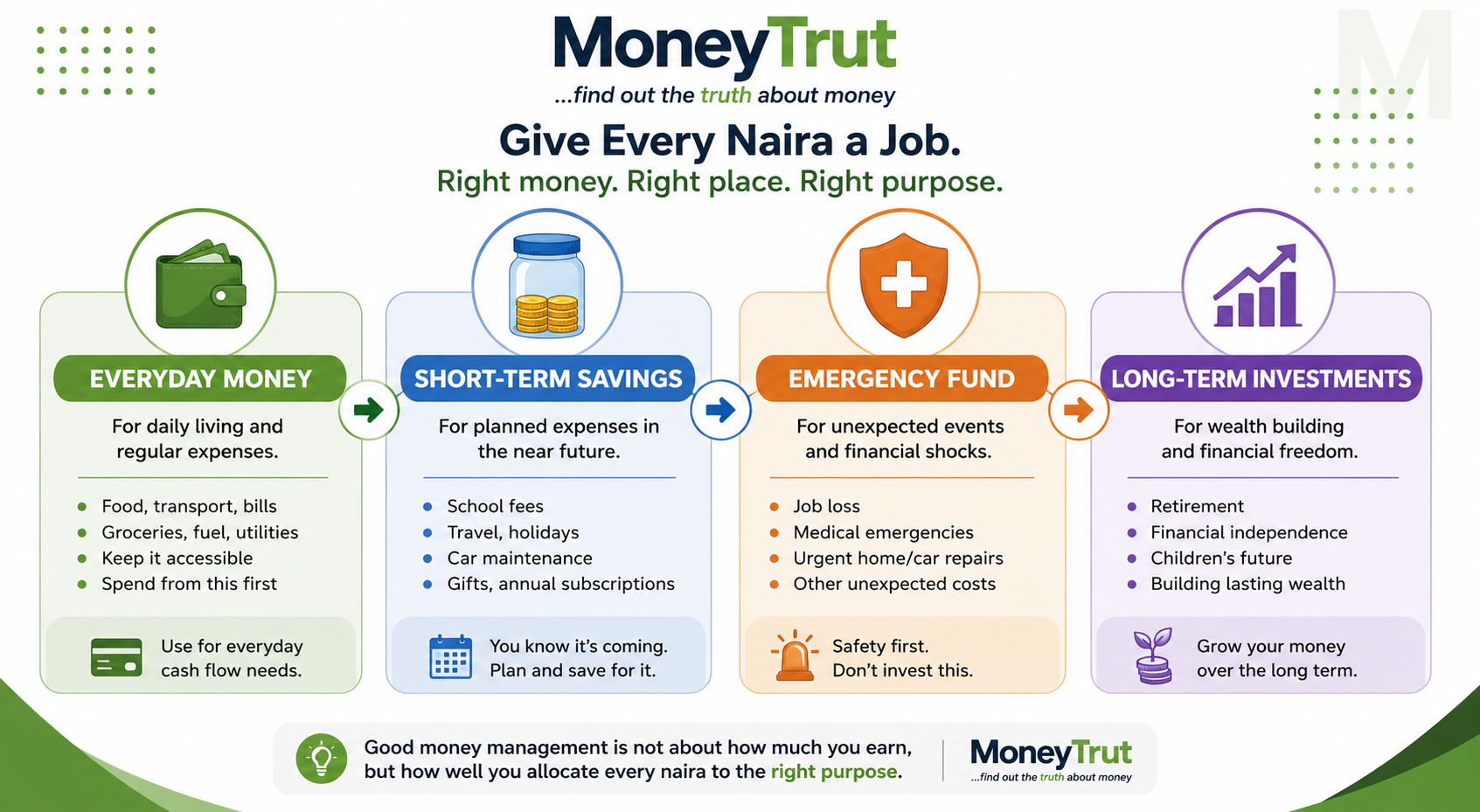
You could organise your money into four broad categories:
1. Everyday money
Used for normal monthly spending.
2. Short-term savings
For expenses you expect within the near future.
3. Emergency fund
For genuine unexpected financial problems.
4. Long-term investments
For goals that are far enough away to tolerate the risks associated with investing.
You don't necessarily need four separate bank accounts.
The categories are what matter.
How Much Should You Keep If Your Income Changes Every Month?
If your income is irregular, using a fixed percentage of salary may not work as well.
Instead, you can base your emergency target on your essential monthly expenses.
Suppose your essential expenses average:
₦250,000
per month.
A three-month emergency target would be:
₦750,000.
If your income varies between ₦300,000 and ₦700,000, the target doesn't necessarily need to change every month.
What changes is how quickly you can replenish the fund.
For more on managing irregular income, see How to Budget When Your Income Changes Every Month.
Saving From Your Salary Helps Build the Reserve
The easiest way to build savings is often to make saving part of the process rather than waiting to see what remains at the end of the month.
For example:
Salary:
₦500,000
Savings:
₦50,000
Available for expenses:
₦450,000
If that ₦50,000 is saved consistently:
₦50,000 × 12 = ₦600,000
in one year, before any interest.
Of course, actual savings depend on your expenses and financial obligations.
MoneyTrut covers the broader question in How Much Should You Save From Your Salary Every Month?.
What If You Can't Save Much Right Now?
Don't abandon the idea because your current income is tight.
Start with what is realistic.
If you can save:
₦5,000
per month, start there.
If you can eventually increase it to:
₦10,000
then:
₦20,000
then:
₦30,000
your savings capacity is improving.
The objective is not to follow someone else's percentage.
It's to build a sustainable habit and gradually increase your financial capacity.
Don't Let Your Emergency Fund Become a Spending Fund
One common problem is keeping emergency money in the same account used for everyday purchases.
You see:
₦800,000 balance
and think:
"I can afford this."
Then the balance becomes:
₦650,000.
Then:
₦500,000.
Eventually, you have no emergency reserve.
Creating some separation between everyday spending and emergency savings can make the boundary clearer.
So, How Much Should You Keep?
There isn't one universal number.
But a practical framework is:
First: Build a small emergency buffer.
Next: Work toward several months of essential expenses if your circumstances justify it.
Then: Separate emergency savings from money needed for predictable expenses.
Finally: Once your short-term needs and emergency reserve are adequately covered, consider whether additional long-term money should be invested according to your goals and risk tolerance.
For someone earning ₦100,000, the starting point may be tens of thousands of naira.
For someone earning ₦1 million with significant household obligations, an appropriate reserve could be several million naira.
The number isn't determined by salary alone.
The Bottom Line
The right amount of money to keep in a savings account depends on what the money is for, when you'll need it and how financially vulnerable you would be without it.
Keep enough accessible money to handle realistic short-term needs and emergencies.
Build your emergency fund around your essential expenses rather than blindly copying someone else's savings target.
Keep predictable expenses separate from genuine emergencies where possible.
And once you've built an appropriate cash reserve, don't assume every additional naira must remain in a savings account forever.
Money needed soon has a different job from money you're building for the next 10, 20 or 30 years.
The goal isn't to have the biggest savings balance.
The goal is to have the right amount of money in the right place for the job you need it to do.

You must be logged in to post a comment.