

Some expenses are not emergencies, but they can still wreck your budget when they arrive.
Your annual rent is due.
School fees are approaching.
You need to renew an important subscription or professional licence.
Your car needs servicing.
You know these expenses are coming, but somehow they still feel like emergencies when the bill arrives.
That is where a sinking fund can help.
A sinking fund is money you set aside gradually for a specific expense you know you will need to pay for in the future.
Instead of trying to find ₦300,000 when a large expense arrives, you save smaller amounts over several months.
For example, if you know you will need ₦300,000 in six months, you could set aside:
₦300,000 ÷ 6 = ₦50,000 per month
When the expense arrives, you already have the money.
You don't need to raid your emergency fund or immediately look for a loan.
What Is a Sinking Fund?
A sinking fund is a dedicated pool of savings for a known or expected future expense.
The important word is known.
You know the expense is likely to happen.
Examples include:
- Annual rent
- School fees
- Vehicle maintenance
- Insurance payments
- Professional fees
- House repairs you know are coming
- Christmas or holiday spending
- Planned travel
- Annual subscriptions
- Business expenses
- Electronics replacement
- Major household purchases
Instead of paying for these expenses entirely from the income you receive in the month they are due, you spread the cost across several months.
This makes your monthly budget more predictable.
Sinking Fund vs Emergency Fund
These two types of savings are often confused.
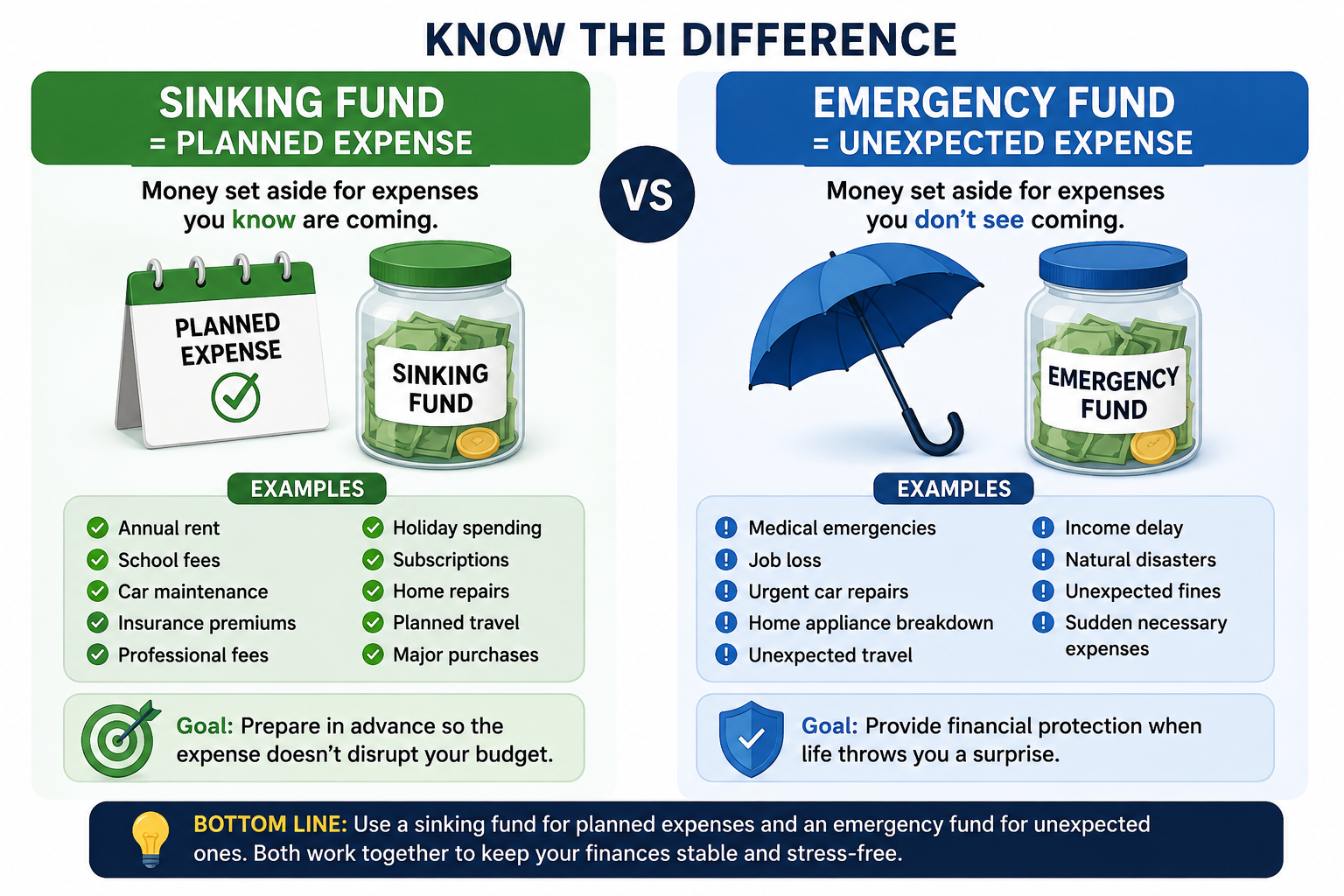
They serve different purposes.
A sinking fund is for something you expect.
For example:
You know your car will need servicing in six months.
You estimate the cost at ₦120,000.
You can create a car-maintenance sinking fund and save:
₦20,000 × 6 = ₦120,000
An emergency fund is for something you don't expect.
For example:
Your phone suddenly stops working.
You have an unexpected medical expense.
You lose part of your income.
Your refrigerator breaks unexpectedly.
These are situations you did not plan into your normal budget.
An emergency fund exists to provide financial protection when something unexpected happens. Consumer financial guidance also distinguishes emergency savings from regular or predictable expenses.
A simple way to remember the difference is:
Sinking fund = expected expense.
Emergency fund = unexpected expense.
Why Sinking Funds Matter
Without sinking funds, large predictable expenses can make your finances look worse than they actually are.
Imagine someone earns:
₦500,000 per month.
Their normal monthly expenses are:
₦400,000.
They normally have:
₦100,000 left.
Then their annual rent becomes due.
They suddenly need:
₦600,000.
If they haven't planned for it, they may need to borrow.
But the expense wasn't actually a surprise.
They knew the rent would eventually be due.
The problem wasn't necessarily the expense.
The problem was failing to prepare for it.
The Basic Sinking Fund Formula
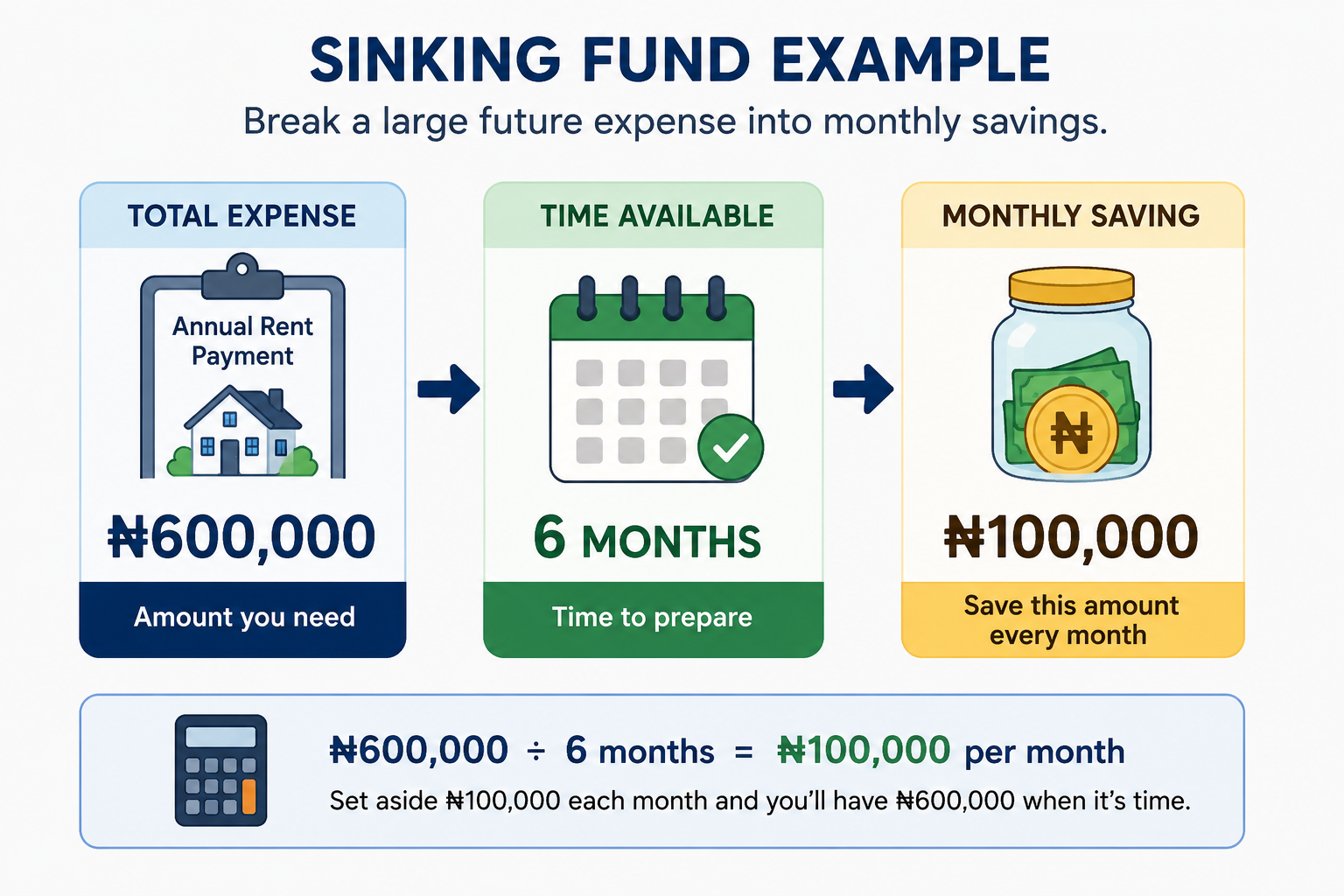
The calculation is simple:
Amount needed ÷ number of months until the expense = monthly saving required
For example:
You need:
₦240,000
in:
8 months
Calculation:
₦240,000 ÷ 8 = ₦30,000
You need to save:
₦30,000 per month.
That's much easier to manage than suddenly finding ₦240,000 when the bill arrives.
Example: Saving for Annual Rent
Suppose your annual rent and related housing costs total:
₦1,200,000
Your rent is due in 12 months.
Instead of waiting until the last few months, you could divide the amount across the year:
₦1,200,000 ÷ 12 = ₦100,000
So you could put:
₦100,000 per month
into a rent sinking fund.
After six months:
₦100,000 × 6 = ₦600,000
After 12 months:
₦100,000 × 12 = ₦1,200,000
The actual amount you need to save may be different if your rent changes, you already have some money set aside, or there are additional costs.
But the principle remains the same.
Example: School Fees
Suppose you expect school-related expenses of:
₦600,000
in eight months.
You could save:
₦600,000 ÷ 8 = ₦75,000 per month.
Instead of looking for ₦600,000 at once, you turn the expense into a monthly financial obligation.
That can make a major difference to your cash flow.
If the expense includes several payments at different dates, break the calculation down by payment rather than treating everything as one amount.
Example: Car Maintenance
Suppose you expect to spend approximately:
₦180,000
on vehicle maintenance over the next year.
You could save:
₦180,000 ÷ 12 = ₦15,000 per month.
At the end of the year, you would have:
₦180,000
available for the planned maintenance.
But there is an important caveat.
If your car suddenly develops an unexpected major fault, that may be an emergency rather than a routine maintenance expense.
The sinking fund doesn't eliminate the need for an emergency fund.
Example: Christmas and End-of-Year Spending
Many people know they will spend more money around the end of the year.
There may be:
- Food
- Travel
- Gifts
- Clothing
- Family events
- School expenses
- Other seasonal costs
Suppose you expect to spend:
₦240,000
during December.
If you start in January, you have roughly 12 months to prepare.
That could mean:
₦20,000 per month.
By December, you have:
₦20,000 × 12 = ₦240,000.
Instead of December becoming a financial crisis, you've been preparing for it throughout the year.
You Don't Need Ten Different Savings Accounts
The idea of sinking funds can become unnecessarily complicated.
You don't necessarily need a separate bank account for every expense.
You could have:
Emergency Fund
Short-Term Sinking Funds
Long-Term Savings
Then keep a simple record showing how much of your sinking-fund balance belongs to each goal.
For example:
| Goal | Target | Saved |
|---|---|---|
| Rent | ₦1,200,000 | ₦500,000 |
| School fees | ₦600,000 | ₦250,000 |
| Car maintenance | ₦180,000 | ₦90,000 |
| Christmas | ₦240,000 | ₦100,000 |
Total sinking-fund savings:
₦940,000
You don't need four different accounts if your bank doesn't make that convenient.
What matters is knowing what the money is for.
But Separate Money Mentally
Even if the money is physically sitting in one account, don't treat the entire balance as available spending money.
Suppose your account contains:
₦500,000
But your records show:
- Rent: ₦250,000
- School fees: ₦150,000
- Car maintenance: ₦50,000
- General sinking fund: ₦50,000
You don't actually have ₦500,000 available for a new phone or holiday.
The money already has jobs.
This is one of the most important habits when using sinking funds.
How Much Should You Put Into Sinking Funds?
There is no universal percentage.
It depends on the expenses you expect during the year.
Start by looking ahead.
Ask:
What large expenses do I already know are coming?
Make a list.
Then estimate the amount required for each.
For example:
Annual rent: ₦1,200,000
School expenses: ₦600,000
Vehicle maintenance: ₦180,000
Annual subscriptions: ₦120,000
Holiday spending: ₦240,000
Total planned expenses:
₦2,340,000
If you have 12 months to prepare:
₦2,340,000 ÷ 12 = ₦195,000 per month
That means your planned sinking-fund contributions would need to average about:
₦195,000 per month.
If that amount is impossible with your current income, that tells you something useful.
You may need to:
- Start earlier
- Reduce the target
- Cut other expenses
- Increase income
- Change the timing
- Prioritize the most important expenses
The calculation exposes the problem before the bill arrives.
What If You Earn ₦100,000?
This is where the concept needs to be adapted.
Suppose you earn:
₦100,000 per month.
You cannot simply create ₦200,000 of monthly sinking-fund obligations.
Your first priority may be essential living expenses and building a basic financial cushion.
If you can only set aside:
₦5,000 per month
that can still be useful.
For example:
₦5,000 × 12 = ₦60,000
You could use that money for a specific predictable expense.
If your income is tight, don't create unrealistic sinking-fund targets that force you to borrow.
Start with the expenses that are both predictable and financially important.
What If You Earn ₦500,000?
Suppose you earn:
₦500,000
and have several large annual expenses.
Your monthly budget might include:
₦80,000 → rent sinking fund
₦40,000 → school-fee sinking fund
₦15,000 → car maintenance
₦10,000 → annual bills
Total:
₦145,000
That means ₦145,000 of your monthly income has already been assigned to future expenses.
This is why looking only at your monthly bills can give you a false impression of how much money you have available.
A good budget should account for less frequent expenses too. The CFPB recommends looking back over several months to identify expenses that don't occur every month, such as annual bills, medical expenses, school costs and other irregular spending.
What If You Earn ₦1 Million?
Higher income can make sinking funds much easier to build, but the same principle applies.
Suppose you earn:
₦1,000,000
and decide to put:
₦200,000 per month
toward planned future expenses.
After one year:
₦200,000 × 12 = ₦2,400,000
That could cover several large predictable expenses.
But don't assume higher income means every future expense should become larger.
A sinking fund should help you prepare for your actual financial commitments, not justify lifestyle inflation.
Sinking Funds Can Help Stop New Debt
This is one of their biggest benefits.
Suppose your annual rent is due and you haven't saved anything.
You need:
₦1,000,000
You don't have the money.
A loan may suddenly look attractive.
But if you had been putting aside:
₦83,333 per month
for 12 months, you could have accumulated approximately:
₦999,996
before considering any interest earned or rounding differences.
The expense hasn't changed.
Your preparation has.
Sinking funds therefore don't make expenses cheaper.
They make large expenses easier to absorb.
Don't Use Your Emergency Fund for Every Planned Expense
This is another common mistake.
Someone sees a large upcoming bill and thinks:
"I'll just take it from my emergency fund."
If the expense was predictable, it probably shouldn't have been classified as an emergency in the first place.
For example:
Annual rent is generally not an emergency if you know when it is due.
School fees are generally not an emergency if the payment date is known.
A planned holiday is not an emergency.
A scheduled vehicle service is not an emergency.
These expenses should normally be incorporated into your broader financial plan.
Your emergency fund can then remain available for genuine unexpected problems.
What If the Expense Changes?
This is common.
Suppose you estimate school expenses at:
₦500,000
but the actual amount becomes:
₦600,000.
Don't panic.
Update the target.
If you have six months left:
₦600,000 ÷ 6 = ₦100,000 per month.
If ₦100,000 is no longer affordable, you have several options.
You could:
- Reduce another expense
- Increase income
- Use part of another appropriate savings goal
- Start earlier next time
- Adjust the target
- Discuss payment arrangements where available
The point of a sinking fund isn't perfect prediction.
It's preparation.
What If You Start Late?
This happens all the time.
Suppose you need:
₦600,000
in three months.
You have saved:
₦100,000.
You still need:
₦500,000.
Divide that across three months:
₦500,000 ÷ 3 = approximately ₦166,667 per month.
If that's impossible, you now know the problem early enough to make a decision.
You might reduce the expense, find additional income, use an appropriate existing savings balance or negotiate a payment schedule if possible.
That is much better than waiting until the due date and discovering you have no options.
Sinking Funds for Business Owners
Sinking funds aren't only for households.
Small businesses can use the same principle.
For example:
- Equipment replacement
- Annual software costs
- Insurance
- Business registration
- Professional fees
- Website costs
- Tax obligations where applicable
- Planned maintenance
- Marketing campaigns
Suppose a business expects to replace equipment costing:
₦1,200,000
in 12 months.
It could plan:
₦1,200,000 ÷ 12 = ₦100,000 per month.
The business doesn't have to wait until the equipment fails and then scramble for money.
Planning ahead can make business cash flow more predictable.
Sinking Fund vs Savings Goal
The terms can overlap.
A savings goal might be:
"I want ₦1 million."
A sinking fund is more specific:
"I need ₦1 million for rent in 10 months."
The second one has:
- A defined purpose
- A target amount
- A deadline
- A required monthly contribution
That makes it easier to calculate and track.
A Simple Sinking-Fund System
You can create your system in five steps.
Step 1: Look 12 months ahead
Write down major expenses you expect.
Step 2: Estimate the cost
Don't use a completely unrealistic figure.
Check previous bills where possible.
Step 3: Set the deadline
When will you actually need the money?
Step 4: Calculate the monthly contribution
Use:
Target amount ÷ months remaining
Step 5: Review the target regularly
If prices change or your circumstances change, update your calculation.
This is much easier than waiting until the expense arrives.
A Practical Example for a ₦500,000 Income
Let's put everything together.
Suppose someone earns:
₦500,000 per month.
Their planned annual expenses include:
| Expense | Annual target | Monthly sinking-fund contribution |
|---|---|---|
| Rent | ₦600,000 | ₦50,000 |
| School expenses | ₦360,000 | ₦30,000 |
| Car maintenance | ₦120,000 | ₦10,000 |
| Annual bills | ₦120,000 | ₦10,000 |
| Christmas/travel | ₦120,000 | ₦10,000 |
Total:
₦1,320,000 per year
Monthly contribution:
₦110,000
That ₦110,000 should be treated as part of the person's monthly financial commitments.
It isn't spare money.
The remaining income must then cover regular living expenses, emergency savings, debt repayment, investing and discretionary spending as appropriate.
This is where sinking funds become powerful.
They force you to recognize that some "unexpected" expenses are actually predictable.
What About Emergency Savings?
A sinking fund should not replace your emergency fund.
You may need both.
For example:
Emergency fund: unexpected medical bill
Rent sinking fund: annual rent
School sinking fund: school fees
Car sinking fund: planned servicing
Each has a different purpose.
For guidance on determining the size of your emergency reserve, see How Much Should You Have in an Emergency Fund?.
If you're still trying to build your first emergency reserve, our guide How to Build an Emergency Fund With a Low Income can help you start with smaller amounts.
Your Budget Should Include These Expenses
A common budgeting mistake is planning only for monthly expenses.
For example:
Rent: monthly
Food: monthly
Transport: monthly
Electricity: monthly
But then:
School fees: ignored
Car maintenance: ignored
Annual subscriptions: ignored
Christmas: ignored
Insurance: ignored
Professional fees: ignored
The budget appears balanced until those expenses arrive.
A better approach is to turn large annual or irregular costs into monthly numbers.
If you expect to spend ₦240,000 on an expense every year, think of it as:
₦20,000 per month.
That doesn't necessarily mean you have to transfer ₦20,000 every month if your cash flow doesn't allow it.
But you should recognize that the expense exists.
What If You Have Debt?
If you have expensive debt, you may need to balance sinking-fund contributions against debt repayment.
Don't automatically save for every possible future expense while ignoring high-cost debt.
For example, if you are carrying expensive debt and also need to prepare for a known expense, prioritize based on:
- The cost of the debt
- How soon the expense is due
- Whether the expense is essential
- Whether you already have some savings
- Your income stability
You can also read How to Pay Off Debt Faster Without Ruining Your Finances for a broader debt-repayment strategy.
How Sinking Funds Fit Into Your Monthly Budget
A strong budget can give different portions of your income different jobs.
For example:
Income
↓
Essential expenses
↓
Debt payments
↓
Emergency savings
↓
Sinking funds
↓
Long-term savings/investing
↓
Discretionary spending
The exact order can change depending on your circumstances.
The important thing is that planned future expenses are visible.
If you want to improve your overall budgeting system, see How to Create a Monthly Budget That Actually Works.
The Biggest Mistake: Treating the Sinking Fund as Extra Money
This is worth repeating.
If you have:
₦200,000
in your rent sinking fund, that money isn't spare.
It already has a job.
If you spend it on something else, you've effectively borrowed from your future self.
When rent becomes due, you'll still need the money.
A sinking fund works only if you respect the purpose assigned to it.
The Bottom Line
A sinking fund is a simple way to prepare for expenses you know are coming.
Instead of waiting for a large bill and trying to find the money at once, you divide the cost across the months available.
If you need ₦600,000 in six months, saving ₦100,000 each month is easier to plan for than suddenly finding ₦600,000.
More importantly, sinking funds help you distinguish between unexpected emergencies and predictable expenses.
Your emergency fund protects you from surprises.
Your sinking funds prepare you for the expenses you already know are coming.
When you combine both with a realistic budget, you stop treating every large bill as a financial emergency.
And that is the real advantage:
You aren't just saving money. You're giving future expenses a place in today's financial plan.

You must be logged in to post a comment.