

If you earn ₦100,000 a month, how much should you save?
What about ₦300,000?
Or ₦500,000?
Or ₦1 million?
You will often hear a simple answer: save 10% or 20% of your income.
That can be a useful starting point, but it isn't a rule that works for everyone.
Someone earning ₦1 million with few financial obligations may be able to save a large portion of their income.
Someone earning ₦300,000 while supporting a family and paying debt may struggle to save 10%.
And someone earning ₦100,000 may need to start with a much smaller amount.
The better question is not:
"What percentage should everyone save?"
It is:
"How much can I save consistently without making my basic financial situation worse?"
That is the number you need to find.
There Is No Perfect Savings Percentage
A percentage can be useful because it gives you a target.
For example, if you earn ₦500,000:
10% = ₦50,000
20% = ₦100,000
30% = ₦150,000
But those numbers don't tell us whether the person can actually afford to save them.
Imagine two people who both earn ₦500,000.
Person A has:
- no dependants
- low rent
- no major debt
- stable employment
Person B has:
- three children
- high housing costs
- loan repayments
- family responsibilities
- unstable income
Telling both people to save exactly ₦100,000 every month ignores their very different financial situations.
A savings target should fit your reality.
What Should You Save For?
Before deciding how much to save, decide what the money is for.
Savings can serve different purposes.
Emergency savings
Money for unexpected expenses such as urgent repairs, medical costs or a loss of income.
Short-term goals
Money for expenses you expect within the next few months or years.
Examples include:
- school fees
- rent
- a vehicle
- a major household purchase
- travel
- professional expenses
Long-term goals
Money for goals that are further away.
Examples include:
- buying a home
- retirement
- children's education
- long-term wealth building
Investing
Money intended for assets that may grow over the long term.
These categories should not always be treated as one big savings account.
An emergency fund, for example, serves a different purpose from money you intend to invest for 20 years.
The CFPB recommends setting aside money for unexpected expenses while also considering longer-term financial goals.
Start With Your Take-Home Income
Base your savings calculation on the money you actually have available to spend.
If your salary is ₦600,000 but deductions leave you with ₦540,000, your practical budget should start with ₦540,000.
The question is:
How much of that ₦540,000 can you consistently set aside?
This is more useful than calculating savings from a salary figure you never actually receive.
Step 1: Calculate Your Essential Expenses
Before choosing a savings target, calculate what it costs to maintain your basic life.
Include things such as:
- housing
- food
- transportation
- electricity
- water
- communication
- healthcare
- school expenses
- minimum debt payments
- essential family obligations
For example:
Take-home income: ₦500,000
Essential expenses: ₦320,000
That leaves:
₦180,000
But the entire ₦180,000 isn't automatically available for savings.
You may still need to account for:
- personal spending
- irregular expenses
- debt above the minimum payment
- family needs
- emergency savings
- investments
This is why your savings rate should come after understanding your actual cash flow.
Step 2: Calculate What You Can Realistically Save
Now subtract your realistic monthly expenses from your take-home income.
For example:
| Monthly income | ₦500,000 |
|---|---|
| Essential expenses | ₦300,000 |
| Family obligations | ₦40,000 |
| Debt payments | ₦30,000 |
| Personal/discretionary spending | ₦40,000 |
| Potential savings | ₦90,000 |
This person could potentially save ₦90,000.
That's an 18% savings rate.
But if ₦90,000 is too aggressive and causes the person to borrow money before payday, the target is probably too high.
A sustainable ₦60,000 may be better than an unrealistic ₦90,000.
A Practical Savings Range by Income

The following examples are illustrative, not recommended universal percentages.
| Take-home income | Possible starting savings range |
|---|---|
| ₦100,000 | ₦5,000–₦10,000 |
| ₦200,000 | ₦10,000–₦25,000 |
| ₦300,000 | ₦20,000–₦50,000 |
| ₦400,000 | ₦30,000–₦70,000 |
| ₦500,000 | ₦40,000–₦100,000 |
| ₦750,000 | ₦75,000–₦150,000 |
| ₦1,000,000 | ₦100,000–₦250,000 |
These figures are not financial rules.
They are simply examples showing how a savings target might look at different income levels.
Your actual number could be below or above these ranges.
If you're supporting a large family, paying expensive debt or dealing with high housing costs, your affordable savings rate may be lower.
If your expenses are low and your income is stable, you may be able to save considerably more.
If You Earn ₦100,000
Saving money on ₦100,000 can be difficult, particularly if most of your income goes toward necessities.
Suppose your take-home income is:
₦100,000
and you can realistically set aside:
₦5,000
That's only 5%.
It may not look impressive.
But after one year:
₦5,000 × 12 = ₦60,000
That is ₦60,000 you would not have had if you saved nothing.
If your income increases later, you can increase the amount.
The important thing is to establish a sustainable habit without sacrificing essential expenses.
Even small, consistent savings can provide some financial protection, particularly for someone who currently has no emergency reserve.
If You Earn ₦200,000
Suppose you earn ₦200,000 and can save ₦20,000 per month.
That's:
10% of your income.
After one year:
₦20,000 × 12 = ₦240,000
If you receive bonuses or additional income, you could potentially add some of that to your savings.
But don't assume every month will be identical.
If your income fluctuates, use a system that allows you to save more during stronger months and less during difficult ones.
If You Earn ₦300,000
Suppose you earn ₦300,000 and save:
₦30,000 per month.
That's 10%.
After one year:
₦360,000
If you can increase that to ₦50,000:
₦50,000 × 12 = ₦600,000
The difference is significant.
But don't increase your savings target simply because the mathematics looks attractive.
Make sure the higher amount doesn't force you to borrow later.
If You Earn ₦500,000
This is where many people want a simple answer.
If you earn ₦500,000, saving:
10% = ₦50,000
15% = ₦75,000
20% = ₦100,000
25% = ₦125,000
30% = ₦150,000
Which one is correct?
There isn't a universal answer.
If your essential expenses are ₦350,000 and you have significant family obligations, ₦150,000 may be unrealistic.
If your essential expenses are only ₦250,000 and you have little debt, ₦100,000 or more may be achievable.
For a detailed example specifically focused on this income level, see:
How Much Should You Save From a ₦500,000 Salary?
If You Earn ₦1 Million
A ₦1 million monthly income gives you more room to save, but it doesn't guarantee financial security.
Suppose your monthly income is ₦1 million.
If you save:
10% = ₦100,000
After one year:
₦1.2 million
At:
20% = ₦200,000
you would save:
₦2.4 million per year
At:
30% = ₦300,000
you would save:
₦3.6 million per year
before considering interest or investment returns.
But again, the question is not how impressive the number looks.
If saving ₦300,000 means you repeatedly run out of money and borrow ₦100,000 before payday, the strategy isn't working.
What If You Can't Save 10%?
Don't let the 10% or 20% rule discourage you.
If you can only save:
₦2,000
start with ₦2,000.
If you can save:
₦5,000
start with ₦5,000.
If you can save ₦25,000, start there.
The important thing is to create a savings habit that you can maintain.
The CFPB specifically notes that people living paycheck to paycheck or with irregular income may find saving difficult, but even a small amount can provide some financial security.
If you regularly run out of money before payday, read How to Stop Living From Paycheck to Paycheck for practical steps to improve your cash flow.
The target can increase later.
What If You Currently Save Nothing?
Don't try to jump immediately from zero to an enormous savings target.
Start with a small automatic amount.
For example:
₦5,000 every payday
or:
₦10,000 every month
Once that becomes normal, increase it.
You might move from:
₦10,000 → ₦15,000 → ₦20,000 → ₦30,000
over time.
This approach can be easier to maintain than setting an aggressive target you abandon after two months.
Build Your Emergency Fund Before Chasing Bigger Goals
If you don't have any emergency savings, building a basic financial cushion can be an important priority.
An emergency fund is designed for unexpected expenses, not routine spending.
For example:
- urgent repairs
- unexpected medical costs
- sudden loss of income
- essential household emergencies
The amount you need depends on your circumstances.
If you're starting from a low income, our guide How to Build an Emergency Fund With a Low Income explains how to start without waiting until you can save a large amount.
You can also read How Much Should You Have in an Emergency Fund? for a more detailed look at setting an emergency-fund target.
Don't Confuse Savings With Investing
Saving and investing are related, but they are not the same thing.
Savings are generally intended to preserve money for short-term needs and emergencies.
Investing involves putting money into assets with the expectation of long-term growth, while accepting the possibility of losing some or all of the money.
Investor.gov recommends considering emergency savings and controlling high-interest debt as part of building financial security before focusing heavily on long-term investing.
For example, money you may need next month for an emergency should not normally be treated the same way as money you won't need for decades.
Your time horizon matters.
What If You Have High-Interest Debt?
This is where your savings strategy may need to change.
Suppose you have:
₦100,000 in savings
but also have expensive debt that continues to accumulate substantial interest.
You shouldn't automatically invest every available naira simply because investing is good for long-term wealth.
Your financial priorities may need to include:
- maintaining some emergency cash
- meeting required debt payments
- reducing expensive debt
- then increasing longer-term savings and investments
The exact order depends on the debt, interest rate, penalties, income stability and your circumstances.
But don't ignore expensive debt while building a large pile of cash that earns very little.
What If You Support a Family?
Your savings target should reflect your responsibilities.
Someone living alone may be able to save 25% of their income.
Someone supporting children, parents and other relatives may not.
That doesn't mean the second person shouldn't save.
It means the percentage needs context.
For example, suppose:
Income = ₦500,000
Family and essential expenses = ₦400,000
That leaves ₦100,000 before other expenses.
Saving ₦100,000 would leave nothing for unexpected costs or personal spending.
A more realistic target might be:
₦30,000–₦50,000
while working on reducing expenses or increasing income.
The right savings amount is the one that fits your financial reality.
What If Your Income Changes Every Month?
If you're self-employed, freelance or work on commission, saving a fixed amount may be difficult.
Instead, consider using a percentage or a tiered approach.
For example:
Minimum monthly savings: ₦20,000
Then, whenever income is higher than normal, save a portion of the additional income.
Suppose you normally earn ₦300,000 but receive ₦500,000 one month.
The additional ₦200,000 could be divided between:
- emergency savings
- upcoming expenses
- debt repayment
- investing
- personal spending
This allows your savings to grow without forcing you to maintain a fixed contribution that may become impossible during weaker months.
Save Before You Spend—But Don't Ignore Your Bills
“Pay yourself first” is useful advice, but it can be misunderstood.
It doesn't mean transferring half your salary to savings and then discovering you cannot pay rent.
It means giving savings a deliberate place in your financial plan.
If you earn ₦500,000 and determine that ₦50,000 is affordable, you can transfer that amount shortly after payday and budget the remaining ₦450,000.
Automatic transfers can help because they turn saving into a routine rather than something you have to remember every month.
But make sure the transfer amount is realistic enough that you don't end up borrowing to cover basic expenses.
Increase Your Savings When Your Income Increases
One of the easiest opportunities to increase savings is when your income rises.
Suppose you currently earn:
₦400,000
and receive a raise to:
₦500,000.
Don't automatically increase your lifestyle by the full ₦100,000.
You could allocate part of the increase to savings.
For example:
₦50,000 → additional savings
₦30,000 → improved lifestyle
₦20,000 → another financial goal
The exact split is up to you.
The principle is:
Let some of your income growth improve your financial position.
Use Extra Income Strategically
Your regular salary isn't necessarily your only opportunity to save.
You may occasionally receive:
- bonuses
- commissions
- freelance income
- overtime
- business profits
- gifts
- refunds
- other unexpected income
Instead of treating every extra payment as spending money, consider giving it a specific purpose.
For example, an additional ₦100,000 could become:
₦50,000 emergency savings
₦30,000 debt repayment
₦20,000 personal spending
This allows you to enjoy some of the money without allowing every unexpected payment to disappear.
How Long Will It Take to Build ₦1 Million?
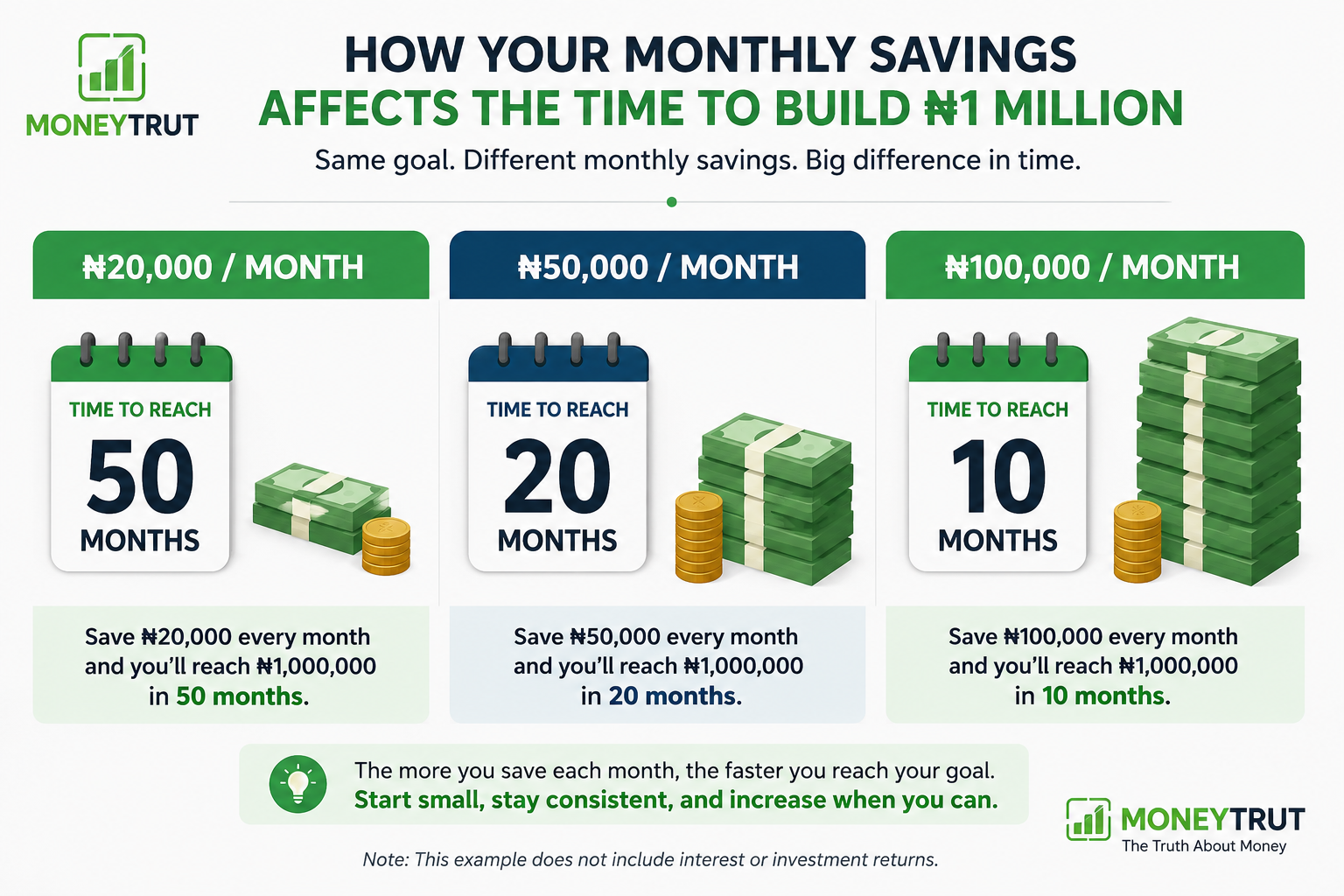
Let's look at the mathematics.
If you save:
₦20,000 per month
it would take:
₦1,000,000 ÷ ₦20,000 = 50 months
That's about 4 years and 2 months, before considering interest or investment returns.
At:
₦50,000 per month
it would take:
20 months
At:
₦100,000 per month
it would take:
10 months
This is why increasing your savings rate can have a significant effect.
But there is another lesson here:
Increasing income can be just as important as cutting expenses.
If someone earning ₦200,000 can increase their income to ₦300,000 while keeping their essential expenses relatively stable, their ability to save may change dramatically.
Don't Sacrifice Everything Just to Hit a Savings Target
Saving money is important.
But a savings target shouldn't make you financially unstable.
If you stop paying essential bills, take on expensive debt or constantly withdraw your savings to survive, your savings strategy needs to be reconsidered.
A sustainable plan should allow you to:
- pay essential expenses
- meet required debt payments
- save regularly
- handle normal life
- prepare for irregular costs
- make progress toward longer-term goals
The objective isn't to win a savings competition.
It's to become financially stronger.
A Simple Savings System You Can Start This Month
If you're unsure what to do, start with four steps.
1. Calculate your take-home income
Use the amount that actually reaches you.
2. Calculate your essential expenses
Know what you need to maintain your basic financial responsibilities.
3. Choose a realistic starting amount
It might be 5%.
It might be 10%.
It might be 20%.
It might be ₦5,000.
The percentage is less important than whether you can maintain it.
4. Automate it where practical
Set up a recurring transfer shortly after your income arrives.
Then review the amount after several months.
If your finances have improved, increase it.
A Better Way to Think About Savings
Instead of asking:
“What percentage should I save?”
ask these five questions:
1. What do I earn after deductions?
2. What does my essential life actually cost?
3. How much debt do I have?
4. How much emergency savings do I currently have?
5. What amount can I save every month without needing to borrow it back?
That last question is particularly important.
If you save ₦100,000 and then borrow ₦70,000 before payday, you haven't really saved ₦100,000.
You've moved money around.
Your savings target should help you become more financially secure—not create another cash-flow problem.
The Bottom Line
There is no magic percentage that every person should save from their salary.
Ten percent can be a useful starting point.
Twenty percent may be achievable for someone with plenty of financial margin.
Five percent may be a major achievement for someone with a low income and heavy responsibilities.
What matters most is that your savings target is realistic, consistent and connected to an actual financial goal.
Start with what you can afford.
Build an emergency cushion.
Prepare for predictable expenses.
Reduce expensive debt.
Increase your savings when your income increases.
And as your financial position improves, let your savings rate improve with it.
The goal isn't simply to say that you save 20% of your salary.
The goal is to reach the point where your savings give you options instead of your next payday determining what happens next.

You must be logged in to post a comment.