
You check your bank balance and notice that it is slightly lower than expected.
You look through your transaction history and see several deductions:
₦100 here.
₦50 there.
Another charge for a transfer.
Another deduction for a service you barely remember using.
None of them looks large enough to worry about.
But that's exactly how unnecessary banking costs can go unnoticed.
If you make several charged transactions every month, small amounts can eventually become a meaningful expense.
The good news is that not every bank charge is unavoidable.
Some charges are legitimate costs for services you actually use. Others may be reduced by changing how you bank, choosing a different payment channel, avoiding unnecessary transactions or questioning a charge you don't understand.
The goal isn't to avoid every bank fee.
It's to know what you're paying for and stop paying for things you don't need.
Why Bank Charges Deserve More Attention
Suppose someone earns:
₦100,000 a month.
If that person loses ₦1,500 to avoidable banking charges every month, that's:
₦1,500 × 12 = ₦18,000 a year.
For someone earning ₦500,000, ₦1 million or ₦2 million, ₦18,000 may not be financially significant.
But for someone earning ₦50,000, ₦70,000, ₦80,000 or ₦100,000, it can represent a meaningful portion of what could have gone toward savings, transport, food or an emergency fund.
And the point isn't that every ₦100 charge is unnecessary.
It's that you should understand why the money is leaving your account.
Not Every Bank Charge Is Unnecessary
This distinction matters.
Some banking services genuinely cost money.
For example, you may incur a fee for:
-
A particular transfer
-
Using another bank's ATM
-
Certain card services
-
International transactions
-
Some bill-payment services
-
Specific account services
The exact amount depends on the service, institution and applicable rules.
The Central Bank of Nigeria maintains a Guide to Charges covering banking and financial services, while newer circulars have modified some specific charges and policies over time.
So don't assume:
"My bank charged me, therefore the charge is illegal."
Instead ask:
"What is this charge for, and is it actually necessary for me?"
That's a much more useful question.
Start by Reading Your Bank Statement
Before trying to reduce charges, find out what you're actually paying.
Look through your transaction history for the last one to three months.
Search for descriptions relating to:
-
Transfer fees
-
ATM fees
-
Card fees
-
SMS or notification charges
-
USSD-related charges
-
Account-related charges
-
Foreign transaction fees
-
Bill-payment charges
-
Other service charges
You may discover something surprising.
You might think your bank charges are around:
₦300 a month.
But after adding everything together, you may discover you're spending:
₦1,000–₦2,000 or more.
The first step is measurement.
Track Bank Charges Like Any Other Expense
Your bank charges should be part of your financial budget.
MoneyTrut's article:
How to Create a Monthly Budget That Actually Works
explains why tracking actual spending is more useful than simply guessing where your money goes.
Bank charges belong in that exercise.
If you spend ₦800 on banking fees this month, record it.
If you spend ₦1,500 next month, record that too.
After a few months, you'll see whether the cost is occasional or recurring.
Use Your Own Bank's ATM When Practical
ATM charges are an area where your choice of machine can matter.
The CBN's February 2025 ATM-fee circular states that withdrawals from your own financial institution's ATM in Nigeria ("On-Us") attract no charge, while withdrawals from another institution's ATM ("Not-On-Us") can attract prescribed charges. For on-site ATMs of another institution, the circular specifies ₦100 per ₦20,000 withdrawal; for off-site ATMs, it specifies ₦100 plus a surcharge of not more than ₦500 per ₦20,000 withdrawal, with the surcharge disclosed at the point of withdrawal.
That means your ATM choice can affect what you pay.
If your own bank's ATM is conveniently available, using it can help you avoid the applicable charge for another institution's ATM.
You don't have to walk several kilometres to save ₦100.
But if another ATM is right in front of you and your own bank's ATM is nearby, the choice is worth considering.
Don't Make Unnecessary ATM Trips
There's another simple way to reduce ATM-related costs:
Plan your withdrawals.
Suppose you withdraw:
₦10,000 today
then ₦10,000 tomorrow
then ₦10,000 again two days later.
If your withdrawals involve a chargeable ATM transaction, repeated trips can increase your costs.
That doesn't mean you should carry large amounts of cash around just to avoid a fee.
It means you should avoid unnecessary withdrawals when electronic payment or a planned withdrawal would be safer and more convenient.
Use Electronic Payments When They Make Sense
Nigeria's payment system has increasingly shifted toward electronic channels, including internet banking, mobile payments and card-based transactions.
For many everyday purchases, paying electronically can be more convenient than repeatedly withdrawing cash.
But don't assume every electronic transaction is free.
Some electronic transfers and payment services can carry charges.
The point is to compare the available options.
Know the Difference Between Convenience and Necessity
Imagine you need to send:
₦2,000
to someone.
If you make several separate transactions instead of sending the required amount once, you may create unnecessary transaction costs.
For example:
₦2,000 + ₦2,000 + ₦2,000
is three transactions.
If one transaction would have achieved the same purpose, splitting the payments may be unnecessary.
Of course, don't combine transactions simply to save fees if doing so creates another problem.
The principle is:
Don't pay for three transactions when one will do.
Small Charges Can Become Big Over a Year
Let's use a simple example.
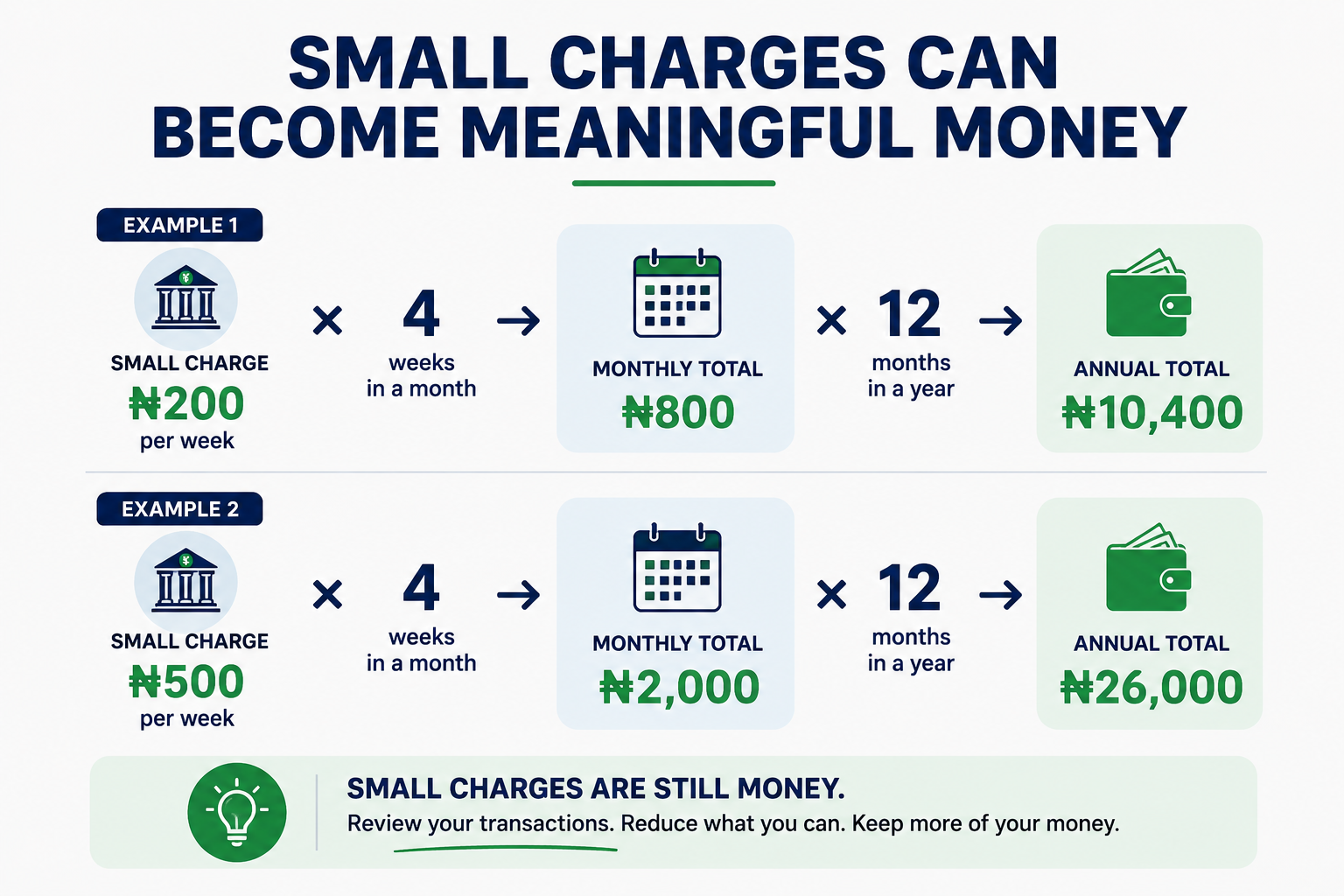
Suppose you incur:
₦200 per week
in avoidable banking costs.
That's approximately:
₦200 × 52 = ₦10,400 per year.
Now suppose the average is:
₦500 per week.
That's:
₦26,000 per year.
The individual charge doesn't look impressive.
The annual number does.
This is why MoneyTrut focuses on numbers rather than simply saying "small charges add up."
Example: Someone Earning ₦50,000
Suppose someone earns:
₦50,000 monthly.
Their financial margin may already be very small.
If they spend:
₦1,000
on avoidable bank charges each month, that's:
₦12,000 a year.
That is equivalent to:
24% of one month's ₦50,000 income.
The percentage makes the cost easier to understand.
The same ₦12,000 means something very different to someone earning ₦2 million per month.
This is why financial advice shouldn't treat every income level the same.
Example: Someone Earning ₦100,000
Suppose someone earns:
₦100,000
and spends:
₦1,500 monthly
on banking-related fees.
That's:
₦18,000 a year.
If the person is trying to build an emergency fund, that ₦18,000 could instead become part of their savings.
It may not solve their financial problems.
But it is still money.
Example: Someone Earning ₦500,000
Now consider someone earning:
₦500,000 monthly.
If their bank charges amount to:
₦3,000 per month
that's:
₦36,000 a year.
The amount may be relatively small compared with their income.
But if the person can eliminate the unnecessary portion without reducing convenience or security, there is little reason not to.
The principle remains the same:
Keep the money you don't need to spend.
Example: Someone Earning ₦1 Million
At:
₦1,000,000 monthly income
a few thousand naira in banking charges may not affect the person's budget significantly.
But higher income doesn't make waste suddenly become efficient.
Someone earning ₦1 million should still understand:
-
What they are being charged
-
Why they are being charged
-
Whether they need the service
-
Whether another legitimate option costs less
Good financial habits should continue as income increases.
Be Careful With Multiple Bank Accounts
Having multiple bank accounts isn't necessarily bad.
It can actually be useful.
For example:
Account 1 → Salary
Account 2 → Emergency savings
Account 3 → Business
Account 4 → Long-term goals
But having several accounts can also create unnecessary costs or confusion if you don't understand the conditions attached to them.
Before opening another account, ask:
-
Is there a maintenance fee?
-
Does the account require a minimum balance?
-
Does it come with a card?
-
Will I actually use it?
-
Are there transaction charges?
-
Is the account necessary?
Don't open an account simply because a bank employee or app encourages you to.
Open it because it serves a purpose.
Don't Keep Paying for Services You Don't Use
This is one of the easiest places to save money.
Suppose you have:
-
A card you rarely use
-
A banking service you no longer need
-
An account you opened years ago
-
A paid feature you forgot about
Review them.
If you don't need a service, find out whether it can be cancelled without creating another problem.
This is particularly important when people accumulate accounts as their financial lives become more complicated.
Understand Card Charges
Cards can have different charges depending on:
-
Card type
-
Currency
-
Account type
-
Issuing institution
-
Replacement
-
Renewal
-
International usage
The CBN's Guide to Charges contains prescribed fees for certain card-related services, although banks and financial institutions may have different products and additional terms within applicable regulatory limits.
Don't assume that every card-related deduction is the same.
Check your bank's current tariff and the applicable CBN framework.
Be Careful With International Transactions
International transactions can involve costs that don't apply to ordinary local transactions.
For example:
-
Foreign exchange conversion
-
International card transactions
-
Overseas ATM withdrawals
-
Foreign-currency card fees
-
Other intermediary or network charges
If you regularly make international payments, these costs can become much more significant than ordinary local transfer fees.
Before making a large foreign-currency transaction, understand:
How much will leave my account in total?
Not simply:
"What is the advertised exchange rate?"
Don't Assume a Free Transfer Means Everything Is Free
Some banking apps or promotions may advertise free transfers.
That's useful, but read the terms.
A "free transfer" doesn't necessarily mean:
Every banking service connected to the transaction is free.
There could be other costs depending on the service.
The safest approach is to check the transaction confirmation and your statement.
Review Your Bank's Current Tariff
This is one of the most useful habits you can develop.
Bank charges can change.
Regulatory rules can also change.
For example, CBN's ATM fee framework was revised in February 2025, and the new cash-related policies that took effect on January 1, 2026 changed the treatment of cash deposits and withdrawals.
So don't rely on a random social-media post from 2022 saying:
"This is the current bank charge."
Check your bank's current tariff and the relevant CBN guidance.
Know Your Rights as a Bank Customer
You don't have to accept every unexplained deduction without asking questions.
The CBN's Bank Customers' Bill of Rights says customers have a right to be informed about financial products and services, including relevant contractual terms and charges.
That means you can ask your bank:
"What is this charge?"
You can also ask:
"What service did I receive for this charge?"
And:
"Where is this charge stated in your tariff or terms?"
Those are reasonable questions.
What If You Think Your Bank Charged You Incorrectly?
Start with the bank.
The CBN's complaint process says customers should first lodge the complaint with the bank or financial institution where the issue originated. If the complaint is not resolved, the customer can escalate it through the CBN's complaint channels.
Don't immediately assume that a deduction is fraudulent.
First find out what it represents.
If the charge is incorrect or unauthorized, document the transaction and make a formal complaint.
Keep:
-
Transaction date
-
Amount
-
Transaction reference
-
Screenshot
-
Account statement
-
Bank response
-
Complaint reference number
Documentation makes disputes much easier to follow.
Don't Ignore Small Unauthorized Deductions
Suppose you notice:
₦300
you don't recognize.
It's tempting to ignore it.
Don't.
The amount may be small, but the underlying issue could matter.
If you see an unfamiliar transaction, investigate it.
You want to know whether it was:
-
A legitimate fee
-
A reversed transaction
-
A recurring service
-
A card transaction
-
A transfer
-
A mistake
-
Unauthorized activity
Your bank account deserves the same attention as your wallet.
Be Careful With USSD Transactions
USSD can be useful, particularly when you don't have reliable internet access.
But different transaction channels can have their own applicable charges.
If you frequently use USSD, check the applicable terms and charges rather than assuming every transaction costs the same.
And never share your PIN, OTP or other security credentials with someone claiming they need them to "reverse" a charge.
A bank representative should not need your confidential authentication details to investigate an ordinary transaction.
Failed Transactions Are Different From Bank Charges
Sometimes money is deducted even though a transaction fails.
This can be frustrating.
The important thing is to distinguish between:
A legitimate service charge
and:
Money temporarily debited because a transaction failed or is being reversed.
If a transaction fails, check whether the money is automatically reversed.
If it isn't, report it promptly and keep the transaction reference.
The CBN has continued to strengthen rules and oversight around electronic payments and customer protection, including measures aimed at improving transaction reliability and fraud response.
Don't Make Financial Decisions Based Only on Charges
There is a danger in becoming so focused on fees that you choose an inferior financial service simply because one particular charge is lower.
Suppose Bank A charges ₦50 less for a particular service but has:
-
Poor customer service
-
Frequent downtime
-
Weak branch access
-
Poor dispute resolution
-
Limited functionality
Bank B might cost slightly more for that service but work significantly better for your needs.
The cheapest bank is not necessarily the best bank.
The goal is:
reasonable cost + useful service + reliability + security.
A Simple Monthly Bank-Charge Audit
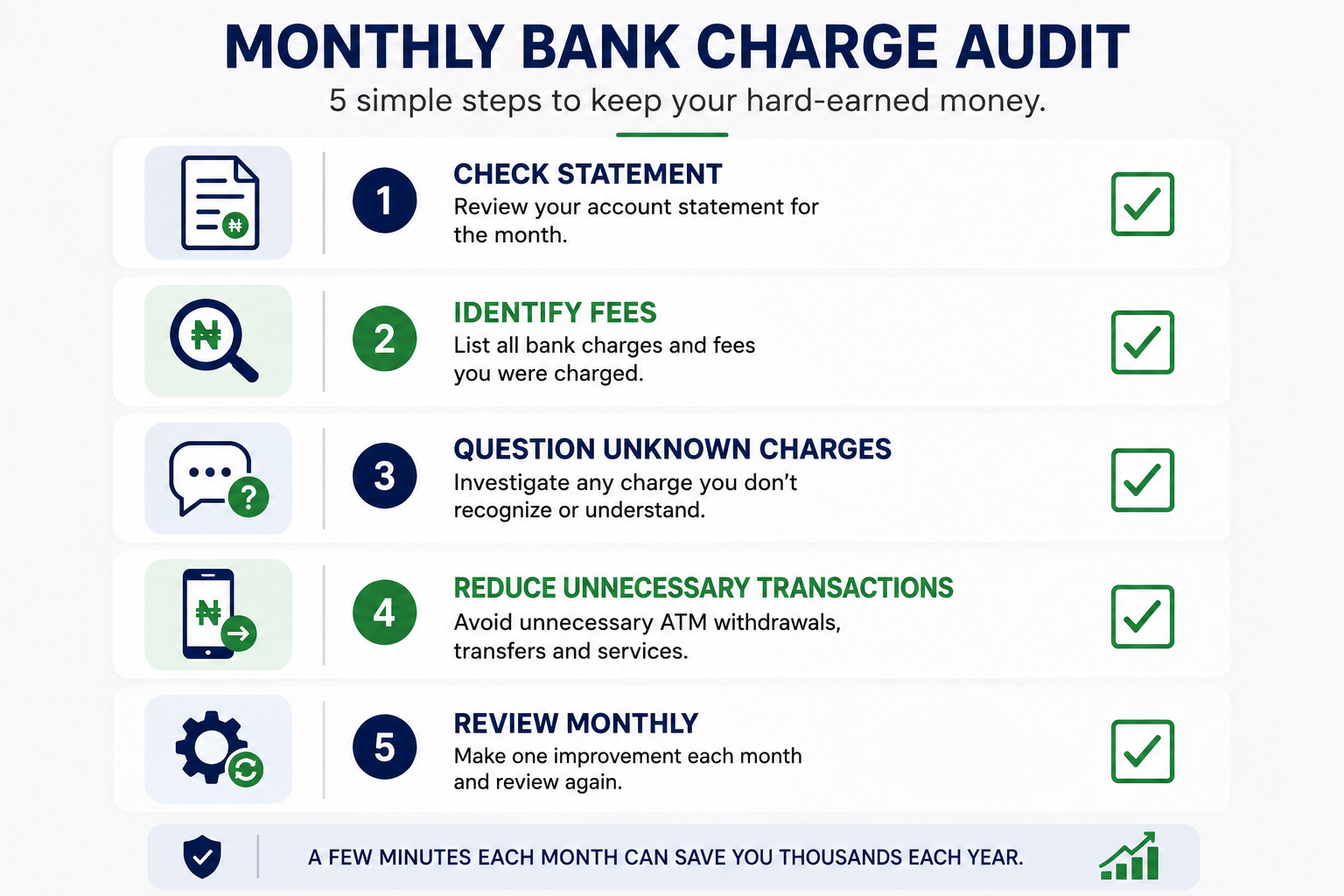
Once a month, spend five minutes reviewing your account.
Ask:
1. What bank charges did I pay?
Write them down.
2. Which ones were necessary?
Separate unavoidable costs from avoidable ones.
3. Did I pay ATM fees?
If yes, could you have used your own bank's ATM?
4. Did I make unnecessary transactions?
Look for repeated or avoidable transfers.
5. Did I pay for a service I don't use?
Consider cancelling it if appropriate.
6. Did I see an unfamiliar deduction?
Investigate it.
7. Can I change my banking behaviour next month?
Make one practical change.
This takes very little time.
Five Simple Ways to Reduce Banking Costs
If you don't want to analyse every transaction, start here.
1. Use your bank's ATM when practical
This can help you avoid applicable charges for using another institution's ATM.
2. Reduce unnecessary transactions
Don't make multiple transactions when one is sufficient.
3. Review your bank statements
You can't reduce costs you don't know you're paying.
4. Cancel services you don't need
Don't pay indefinitely for something you no longer use.
5. Question unexplained charges
Ask your bank for an explanation and check the applicable tariff.
What About Cash?
Cash still has a role in everyday life.
But CBN's January 2026 cash-related policies changed the framework around cash withdrawals and removed the previous limits and fees on cash deposits above specified thresholds, while imposing weekly withdrawal limits and excess-withdrawal charges above those limits. For individuals, the cumulative weekly withdrawal limit is ₦500,000 across channels, with excess withdrawal fees applying above the limit.
This means you should be particularly careful about relying on outdated information about Nigeria's cash-related bank charges.
Policies can change.
Check the current rules before making decisions involving large cash transactions.
Don't Carry Large Amounts of Cash Just to Avoid a Fee
Saving ₦100 isn't worth creating a major security risk.
If using your own bank's ATM avoids a fee and is convenient, that's sensible.
But if avoiding a small charge requires carrying a large amount of cash or travelling somewhere unsafe, the trade-off may not make sense.
Financial decisions should consider:
Cost + convenience + security + risk.
Not just cost.
The Bigger Goal Is Financial Efficiency
Avoiding bank charges isn't about becoming obsessed with every ₦10.
It's part of a bigger principle:
Make sure your money is doing what you intended it to do.
If ₦1,000 leaves your account every month because of services you don't need, that's money that isn't available for something else.
Over a year:
₦1,000 × 12 = ₦12,000.
That could contribute to an emergency fund.
It could help pay a bill.
It could reduce debt.
It could be invested.
It could simply remain in your account.
The choice is yours.
But you should make the choice—not lose the money without noticing.
The Bottom Line
You don't need to eliminate every bank charge.
Some are legitimate costs of using financial services.
The smarter approach is to understand them and eliminate the ones you can reasonably avoid.
Check your statements.
Know your bank's current tariff.
Use the most appropriate payment channel.
Avoid unnecessary transactions.
Use your own bank's ATM when practical.
Don't maintain accounts and services you don't need.
Question unexplained deductions.
And remember that banking rules and charges can change, so don't rely on old information circulating online.
Whether you earn ₦50,000, ₦100,000, ₦250,000, ₦500,000, ₦1 million or ₦2 million a month, the principle is the same:
Know where your money is going.
A ₦100 charge may look insignificant.
But money you understand is money you can manage.
And money you stop wasting can be put to better use.

You must be logged in to post a comment.