
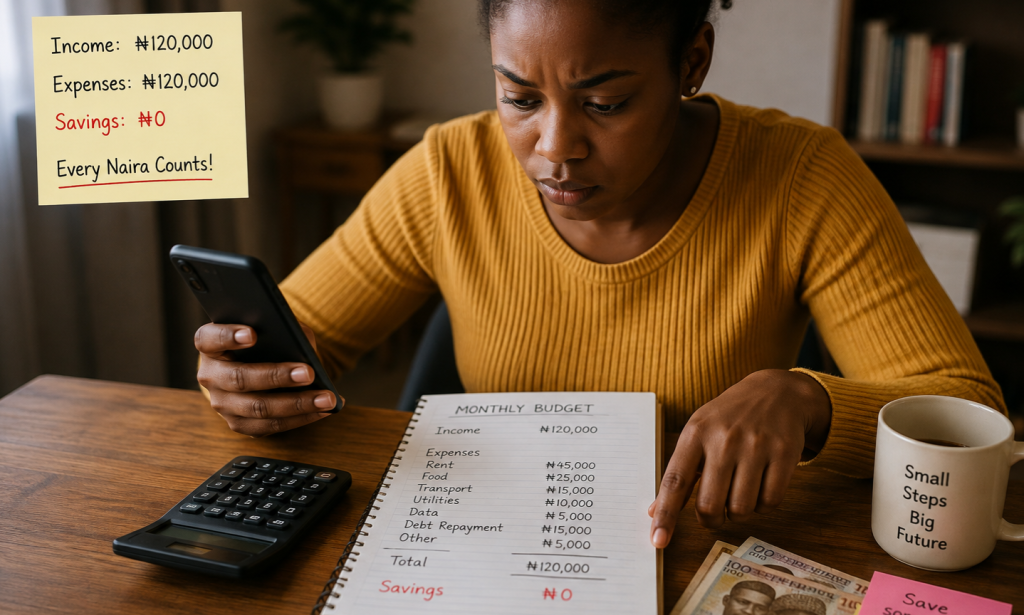
Saving money sounds simple until most of your income is already committed before the month begins.
If you earn ₦100,000 a month and your essential expenses take ₦90,000, being told to "save 20% of your income" isn't particularly helpful.
The same problem can happen on a ₦500,000 or ₦1 million income if housing, debt, family responsibilities and lifestyle expenses consume most of what you earn.
When money is tight, saving isn't about following a perfect percentage.
It's about creating some financial breathing room, even if you have to start small.
You may begin with ₦2,000, ₦5,000 or ₦10,000.
The amount matters, but the habit and the system matter too.
Start by Finding Out Where Your Money Is Going
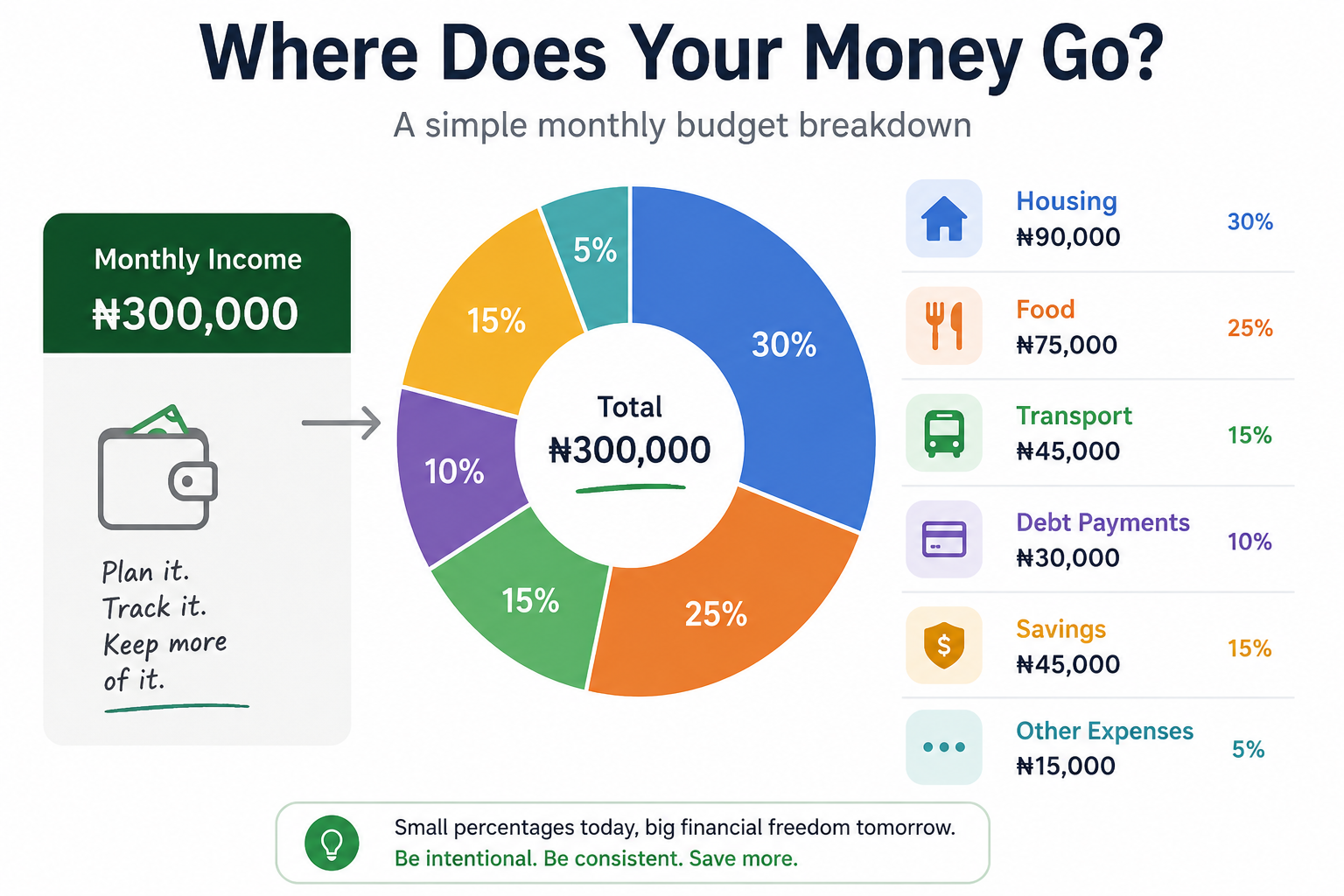
Before trying to save more, find out where your income is currently going.
For one month, record your spending.
Include:
- Rent or housing
- Food
- Transportation
- Utilities
- Data and phone bills
- Debt payments
- School expenses
- Family support
- Subscriptions
- Eating out
- Shopping
- Transfers
- Cash withdrawals
- Other regular expenses
Don't rely entirely on memory.
Small transactions can add up.
For example, spending ₦2,000 several times a week may not feel significant when viewed individually.
But:
₦2,000 × 15 = ₦30,000
That's ₦30,000 that has left your finances during the month.
The purpose of tracking isn't to make you feel guilty.
It's to show you what is actually happening.
Separate Needs From Wants
Once you've recorded your expenses, divide them into categories.
Needs
These are expenses required to maintain your basic life and obligations.
Examples:
- Housing
- Basic food
- Transportation
- Essential utilities
- Minimum debt payments
- Essential healthcare
- Necessary family obligations
Wants
These are expenses that may improve your lifestyle but aren't essential.
Examples:
- Eating out
- Entertainment
- Non-essential shopping
- Premium subscriptions
- Frequent leisure trips
- Expensive upgrades
The distinction isn't always perfect.
For example, transportation may be essential, but using the most expensive transport option available may not be.
Food is essential, but some food purchases are discretionary.
The objective isn't to eliminate everything enjoyable.
It's to understand what can actually be adjusted.
Don't Start by Cutting Everything
One of the easiest ways to fail at saving is to create an extremely restrictive budget.
You decide:
"No more eating out."
"No entertainment."
"No clothes."
"No personal spending."
"No anything."
You follow it for two weeks and then abandon the entire plan.
A better approach is to identify the expenses that make the biggest difference.
If reducing a recurring expense by ₦20,000 is possible, that may be more valuable than obsessing over ten ₦1,000 purchases.
Look for the large leaks first.
Focus on Your Biggest Expenses
For many households, the largest categories are likely to include:
- Housing
- Transportation
- Food
- Debt
- School-related expenses
- Family support
Suppose you spend:
₦100,000 on housing
₦60,000 on food
₦40,000 on transportation
₦30,000 on debt
₦20,000 on other expenses
Your total is:
₦250,000
Reducing a ₦2,000 subscription won't transform this budget.
But reducing transportation by ₦10,000 or finding a way to lower another major recurring expense could make a much larger difference.
This is why effective saving isn't always about cutting more things.
It's about cutting the right things.
Set a Small Savings Target First

If money is tight, don't make your first target unrealistic.
Suppose you earn:
₦100,000
and decide to save:
₦5,000 per month.
That's 5% of your income.
After one year:
₦5,000 × 12 = ₦60,000
That's before any interest or investment return.
₦60,000 may not solve every financial problem.
But it is significantly better than having nothing.
Once the habit becomes established, you can increase the amount when your income or financial situation improves.
What If You Can Only Save ₦1,000?
Then start with ₦1,000.
Don't dismiss a small amount simply because it isn't impressive.
If you save:
₦1,000 × 12 = ₦12,000
you have created a financial reserve that didn't exist before.
More importantly, you have established the habit of keeping some money rather than spending every naira that comes in.
The amount can increase later.
Automate Your Savings
One of the easiest ways to make saving more consistent is to move the money before you have a chance to spend it.
For example, if your income arrives on the 25th, you could schedule an automatic transfer shortly afterward.
If you want to save:
₦10,000 per month
you don't want to repeatedly ask yourself:
"Can I afford to save ₦10,000 this month?"
Instead, make it part of your financial system.
Of course, automation only works if the amount is realistic.
An automatic transfer that leaves you unable to pay essential bills is not good budgeting.
Save Before Your Money Disappears
A common pattern is:
Income arrives.
Bills are paid.
Spending happens.
The month ends.
Nothing is left.
Then you promise to save next month.
The problem is that "whatever is left" is often zero.
Instead, decide your savings amount before discretionary spending begins.
That might be:
₦5,000
₦10,000
₦20,000
or another realistic amount.
The right amount is the one you can sustain.
Use a Separate Savings Location
If your savings sit in the same account you use for daily spending, it can be easy to spend them.
Consider separating your savings from your everyday spending money.
You could have:
Daily spending
and:
Savings
The exact banking setup isn't important.
The objective is to create some psychological and practical separation between:
Money available to spend
and:
Money reserved for your future.
Build an Emergency Fund Gradually
If you don't have an emergency fund, your first savings goal may be to create a small financial cushion.
You don't have to begin with a huge target.
You can start with:
₦10,000
then:
₦25,000
then:
₦50,000
then continue building from there.
Your eventual target should reflect your expenses, income stability and responsibilities.
MoneyTrut explains this in more detail in How Much Should You Have in an Emergency Fund?.
And if your income is low, How to Build an Emergency Fund With a Low Income looks specifically at how to start when there isn't much money available.
Don't Use Your Emergency Fund for Planned Expenses
This is where many people get confused.
Suppose you know your annual rent is due in six months.
That isn't really an emergency.
Neither are:
- School fees you already know about
- Planned travel
- Annual subscriptions
- Scheduled vehicle maintenance
These should be included in your normal financial planning.
A sinking fund can help.
A sinking fund is money set aside gradually for a known future expense.
For example, if you need:
₦300,000
in six months:
₦300,000 ÷ 6 = ₦50,000 per month
For a fuller explanation, see What Is a Sinking Fund and How Does It Work?.
Your emergency fund can then remain available for genuinely unexpected problems.
Review Your Subscriptions
Subscriptions are easy to ignore because they are often relatively small.
But add them together.
For example:
Streaming: ₦5,000
Music: ₦2,500
Cloud storage: ₦3,000
Apps: ₦2,500
Other services: ₦2,000
Total:
₦15,000 per month
That's:
₦180,000 per year
You may decide every subscription is worth keeping.
That's fine.
But make the decision consciously.
If you don't use something, cancel it.
If you rarely use it, consider whether you need it every month.
Look at Your Food Spending
Food is essential, but the way you spend on food can sometimes be adjusted.
You might reduce costs by:
- Planning meals
- Cooking more often
- Buying commonly used items in sensible quantities
- Reducing food waste
- Comparing prices
- Limiting unnecessary delivery fees
- Taking advantage of reasonable promotions
- Preparing food ahead of time
The objective isn't to eat poorly.
It's to make the money you already spend on food go further.
Be Careful With Small Daily Spending
Small purchases can become significant when repeated.
Suppose you spend:
₦1,500
on an unnecessary purchase five days a week.
That is approximately:
₦1,500 × 5 × 4 = ₦30,000
in a four-week month.
Not every small purchase needs to be eliminated.
But if you identify several recurring purchases like this, you may discover why your budget feels tighter than expected.
Don't Ignore Debt
If you're paying significant interest on debt, saving and debt repayment need to be considered together.
Suppose you are trying to save ₦20,000 every month while simultaneously paying expensive debt.
Depending on the cost and terms of that debt, directing some additional money toward repayment may make more financial sense than accumulating large cash savings beyond your necessary emergency cushion.
MoneyTrut covers this in How to Pay Off Debt Faster Without Ruining Your Finances.
The important thing is not to empty your savings completely just to eliminate debt and then have to borrow again when an emergency occurs.
Increase Your Income When Cutting Costs Isn't Enough
There is a limit to how much you can cut.
If you earn:
₦100,000
and your essential expenses are:
₦95,000
there may simply not be enough room to make meaningful savings through cutting expenses alone.
You might reduce spending by ₦5,000.
But eventually you reach a floor.
At that point, increasing income may have a much greater effect.
Potential options could include:
- Freelancing
- Selling a skill
- Consulting
- Overtime
- Commission-based work
- Small business activity
- Selling unused items
- Developing an additional income stream
MoneyTrut's Make Money category will eventually explore these options in greater depth.
The important distinction is:
Don't assume every financial problem can be solved by cutting spending.
Sometimes the income side of the equation needs attention too.
What If You Earn ₦100,000?
If your income is ₦100,000, saving may need to start very small.
Suppose your essential expenses are:
₦85,000
You have:
₦15,000
remaining.
You might allocate:
₦5,000 → savings
₦5,000 → irregular expenses
₦5,000 → discretionary spending
This is only an example.
If your actual essential expenses are ₦95,000, then saving ₦5,000 may not be realistic every month.
Your first goal might instead be to find a way to create more income or reduce one major expense.
What If You Earn ₦300,000?
Suppose your monthly income is:
₦300,000
and your essential expenses are:
₦220,000
That leaves:
₦80,000
You might decide to put:
₦30,000 → emergency savings
₦20,000 → sinking funds
₦20,000 → debt repayment
₦10,000 → personal spending
Again, this is an illustration rather than a universal formula.
Your debt, family responsibilities and financial goals may require a different allocation.
What If You Earn ₦500,000?
Suppose you earn:
₦500,000
and spend:
₦350,000
on essential and important expenses.
You have:
₦150,000
remaining.
Instead of allowing the ₦150,000 to disappear through lifestyle spending, you could deliberately assign it.
For example:
₦50,000 → emergency fund
₦40,000 → sinking funds
₦30,000 → debt repayment
₦20,000 → investing
₦10,000 → discretionary spending
Your actual priorities may differ.
The point is to give the surplus a job.
If you're specifically earning ₦500,000, our article How Much Should You Save From a ₦500,000 Salary? provides another practical example.
What If You Earn ₦1 Million?
At ₦1 million a month, the challenge may look different.
If your essential expenses are:
₦500,000
you potentially have:
₦500,000
available for other goals.
But a high income doesn't automatically produce financial security.
If you spend the entire ₦1 million every month, you may still have little savings.
This is why savings should increase when your financial capacity increases.
You don't necessarily need to save a fixed percentage forever.
As your income grows, consider increasing the amount that goes toward:
- Emergency savings
- Long-term investments
- Retirement
- Business capital
- Future expenses
- Other financial goals
Watch Out for Lifestyle Inflation
Imagine your income increases from:
₦300,000 → ₦500,000
You might think:
"I can finally afford more."
And you can.
But if your expenses increase from:
₦250,000 → ₦450,000
you have gained income without gaining much financial breathing room.
Lifestyle improvements aren't automatically bad.
The problem occurs when every increase in income immediately becomes a permanent increase in expenses.
A better approach is to divide the improvement.
For example:
When your income increases, you might use part of the increase to improve your lifestyle and part to improve your financial position.
Use Windfalls Carefully
A windfall is money you weren't expecting as part of your normal monthly income.
Examples might include:
- Bonus
- Commission
- Business profit
- Gift
- Refund
- Sale of an asset
- Unexpected income
Suppose you receive:
₦200,000
You don't necessarily need to spend it all.
You could divide it.
For example:
₦100,000 → savings
₦50,000 → debt
₦30,000 → planned expense
₦20,000 → enjoyment
The exact split is personal.
The important thing is preventing occasional large payments from becoming completely invisible in your finances.
Make Saving Easier During Good Months
If your income changes from month to month, don't force yourself to save exactly the same amount every month.
Suppose you earn:
January: ₦250,000
February: ₦400,000
March: ₦650,000
You might save:
January: ₦10,000
February: ₦30,000
March: ₦100,000
This can be more realistic than insisting on ₦50,000 every month.
If your income is variable, MoneyTrut's How to Budget When Your Income Changes Every Month explains how to build a system around fluctuating income.
Don't Compare Your Savings to Someone Else's
Someone earning ₦1 million can potentially save more in absolute terms than someone earning ₦200,000.
That doesn't mean the second person's savings are insignificant.
If one person saves:
₦100,000
and another saves:
₦10,000
the numbers are different because their circumstances may be different.
The more useful question is:
Am I improving my own financial position?
If you previously saved nothing and now consistently save ₦10,000, that's progress.
If your income increases and you increase your savings from ₦20,000 to ₦50,000, that's progress too.
What If You Keep Spending Your Savings?
If you save money and then repeatedly withdraw it for ordinary spending, the problem may not be that you can't save.
The problem may be that your budget doesn't reflect your actual expenses.
Go back to your spending.
Ask:
What am I repeatedly using my savings to pay for?
If the answer is:
"Car maintenance"
then you may need a car-maintenance sinking fund.
If the answer is:
"School fees"
you need to plan for school expenses.
If the answer is:
"Food before payday"
your monthly food budget may be too low.
Your savings should not constantly be filling holes in a broken budget.
Don't Try to Invest Before You Can Save Consistently
Investing can help build wealth over the long term, but it doesn't solve a basic cash-flow problem.
If you don't have enough money to cover normal expenses and have no emergency reserve, taking investment risks may not be the first priority.
First create some financial stability.
Then consider appropriate long-term investments based on your goals, time horizon and risk tolerance.
MoneyTrut will cover investing in greater detail in its Investing category.
Make Your Savings Goal Specific
"Save more money" is vague.
Instead:
Save ₦60,000 for emergencies.
Or:
Save ₦120,000 for car maintenance.
Or:
Save ₦300,000 toward rent.
Specific goals are easier to measure.
You can see:
Target: ₦300,000
Current savings: ₦180,000
Remaining:
₦120,000
That is much more concrete than simply knowing you should "save more."
Use a Simple Monthly Savings System
If you want something practical, try this:
Step 1: Know your income
Start with what you realistically expect to receive.
Step 2: List essential expenses
Know what must be paid.
Step 3: Choose a realistic savings amount
Don't choose a number that will force you to borrow later.
Step 4: Set aside savings early
Move it away from everyday spending.
Step 5: Fund predictable future expenses
Use sinking funds where appropriate.
Step 6: Reduce expensive debt
Especially where borrowing costs are high.
Step 7: Increase savings when income increases
Don't allow every income increase to become lifestyle inflation.
Step 8: Review the system every month
Your financial situation changes.
Your budget should change with it.
A Simple Example
Suppose someone earns:
₦400,000
Their monthly expenses are:
| Category | Amount |
|---|---|
| Housing | ₦80,000 |
| Food | ₦70,000 |
| Transport | ₦40,000 |
| Utilities/communication | ₦30,000 |
| Family expenses | ₦30,000 |
| Debt | ₦30,000 |
| Personal spending | ₦30,000 |
| Total | ₦310,000 |
That leaves:
₦90,000
Instead of spending the ₦90,000 automatically, they could assign it.
For example:
₦30,000 → emergency savings
₦20,000 → sinking funds
₦20,000 → debt repayment
₦10,000 → long-term savings/investing
₦10,000 → discretionary spending
The exact allocation isn't the point.
The point is that the ₦90,000 has been given a purpose before it disappears.
If You Are Starting From Zero
Don't let the size of your long-term financial goal discourage you.
If your ultimate goal is to have several months of expenses saved, that doesn't mean you need to reach it immediately.
Start with the first milestone.
₦10,000.
Then:
₦25,000.
Then:
₦50,000.
Then:
₦100,000.
Continue building.
Financial security is usually built through repeated decisions rather than one dramatic financial move.
The Bottom Line
Saving money on a tight budget isn't about finding a perfect percentage of your income.
It's about creating a realistic gap between what comes in and what goes out.
Start by understanding where your money is going.
Cut the expenses that actually make a difference rather than trying to eliminate every small pleasure.
Set a savings target you can realistically maintain.
Build an emergency fund gradually.
Prepare for predictable expenses with sinking funds.
If you have expensive debt, include debt repayment in the plan.
And when cutting expenses is no longer enough, look at increasing your income.
Whether you earn ₦100,000, ₦500,000 or ₦1 million, the principle is the same:
Don't wait until you have "enough money" to start saving. Build the habit with what you have, then increase it as your financial capacity improves.

You must be logged in to post a comment.