

If you have started exploring investments in Nigeria, you have probably come across terms such as FGN bonds, government securities, Treasury bills, and fixed-income investments.
They can sound complicated at first, but the basic idea behind a government bond is relatively simple:
You lend money to the government, and the government agrees to pay you interest and return your principal according to the terms of the bond.
In Nigeria, Federal Government of Nigeria (FGN) bonds are debt securities issued by the Debt Management Office (DMO) on behalf of the Federal Government.
But buying a government bond is not simply a matter of giving the government money and waiting for it to come back.
The bond has a face value, coupon, maturity date and market price, and its value can change before maturity. Understanding these differences is important if you are considering government bonds as part of your investment portfolio.
Government bonds can provide relatively predictable income, but they are not completely free of investment risk. Inflation can reduce the purchasing power of your returns, while changes in interest rates can cause the market value of an existing bond to rise or fall.
The important thing is to understand how the bond works, how long your money will be invested, what you will earn, and what happens if you need your money before maturity.
What Is a Government Bond?
A government bond is a form of borrowing by a government.
Instead of borrowing only from banks or other financial institutions, a government can raise money from investors by issuing bonds.
For example, imagine the Federal Government wants to raise ₦100 billion.
It could issue bonds to investors. Investors provide the money, and in exchange, the government agrees to make interest payments and eventually repay the principal.
If you buy ₦1 million worth of a government bond, you are effectively lending ₦1 million to the government under the terms of that particular bond.
The DMO describes FGN bonds as debt securities issued for the Federal Government.
This is why bonds are fundamentally different from stocks.
When you buy shares, you acquire an ownership interest in a company.
When you buy a bond, you are a creditor or lender to the issuer.
The Securities and Exchange Commission (SEC) similarly explains bonds as debt instruments through which the issuer agrees to make interest payments and repay principal at maturity.
What Is an FGN Bond?
An FGN bond is a bond issued by the Federal Government of Nigeria.
The Debt Management Office issues FGN bonds on behalf of the Federal Government.
The money raised can be used to help finance government expenditure and other government funding requirements.
The important distinction is that the bond represents a debt obligation.
The government is borrowing from investors rather than selling ownership in the country.
How Do Government Bonds Work?
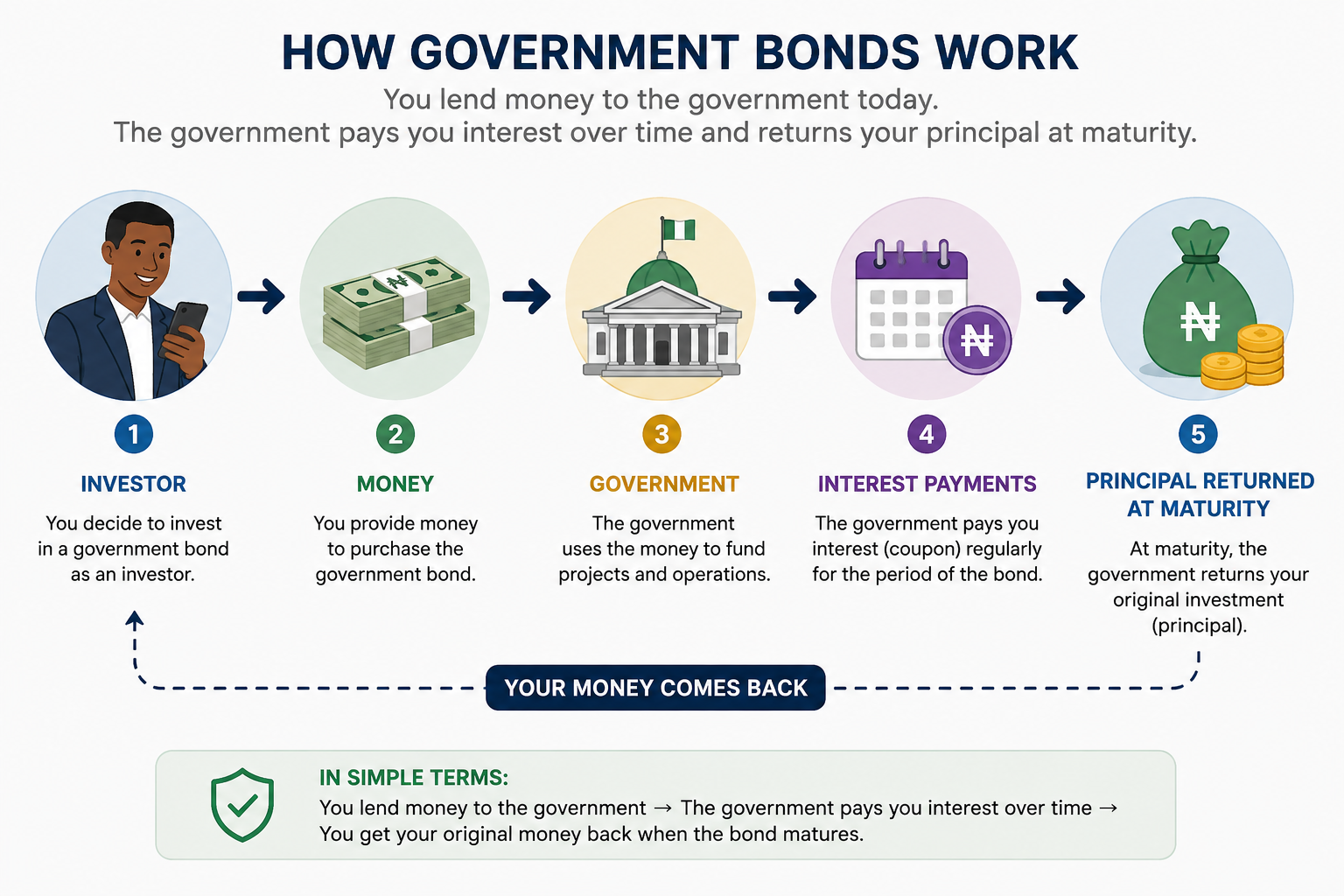
A government bond generally has several important features.
These include:
- Face value: The principal amount of the bond.
- Coupon: The stated interest payment associated with the bond.
- Maturity date: When the principal is due to be repaid.
- Price: What the bond costs when bought or traded.
- Yield: The return an investor receives based on the bond's price and cash flows.
For example, suppose you buy a hypothetical ₦1 million government bond with a 10% annual coupon.
A simplified calculation would be:
₦1,000,000 × 10% = ₦100,000 per year
If the bond pays interest twice a year, that could mean approximately:
₦50,000 every six months
At maturity, assuming the bond is held according to its terms and the principal is repaid in full, the ₦1 million principal would be returned.
This is only an illustration. The actual coupon, purchase price, payment schedule and maturity depend on the particular bond.
What Is a Bond Coupon?
The coupon is the stated interest associated with a bond.
For example, a bond with a ₦1 million face value and a 10% coupon has a stated annual coupon of ₦100,000.
The DMO explains that many FGN bonds have fixed interest rates and that coupon payments are generally made periodically.
One important point is that the coupon rate is not necessarily the same as your actual investment return.
Why?
Because you may buy an existing bond for more or less than its face value.
This is where price and yield become important.
Bond Price and Yield: Why They Matter
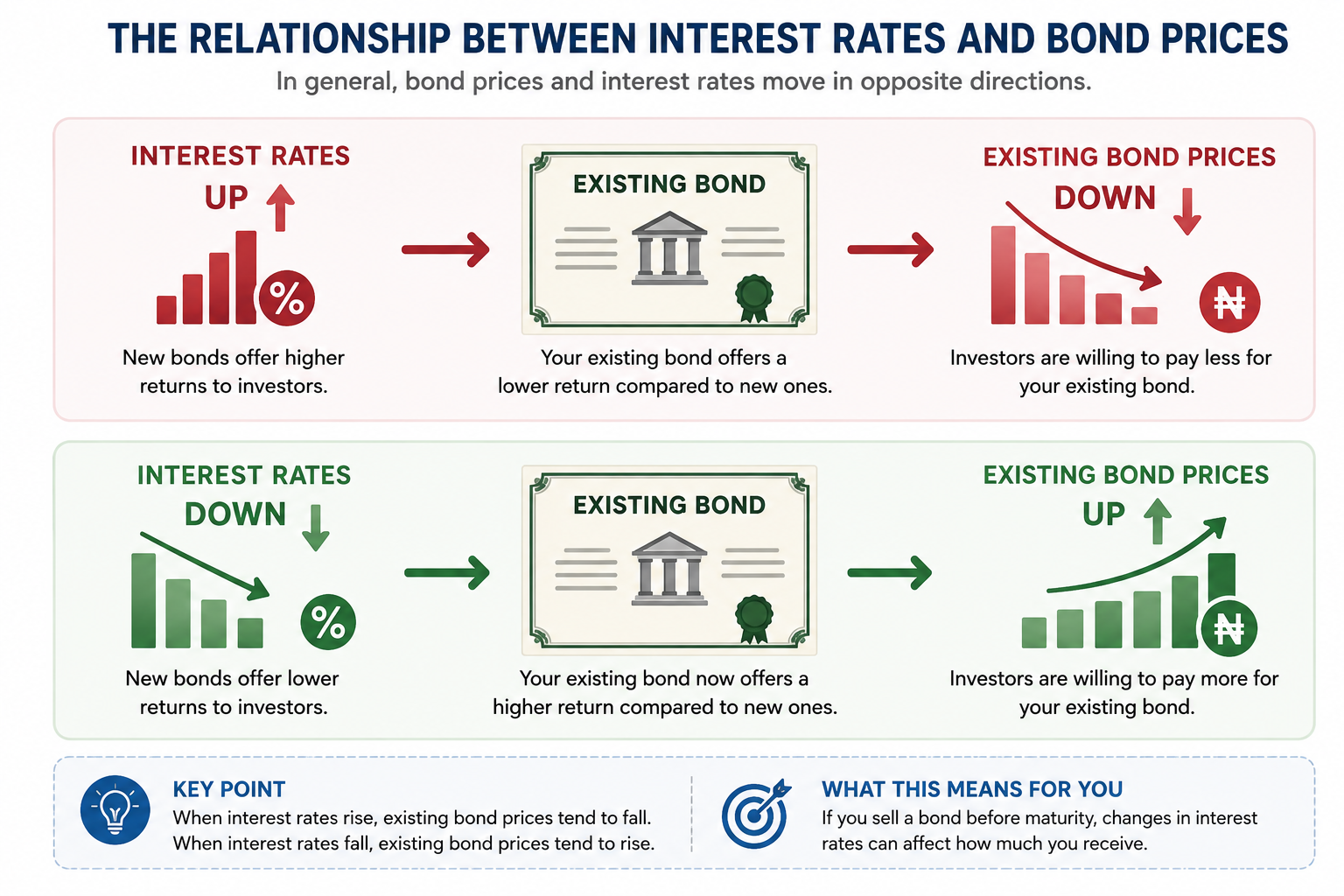
Suppose a bond has a face value of ₦1 million and pays a fixed coupon.
If market interest rates later rise, newly issued bonds may offer more attractive returns.
The older bond with the lower coupon may therefore become less attractive.
Its market price can fall.
If market interest rates fall, an existing bond with a relatively attractive coupon can become more valuable, potentially pushing its market price higher.
The SEC explains the relationship simply: bond prices and interest rates generally move in opposite directions.
This matters particularly if you intend to sell your bond before maturity.
If you simply hold the bond until maturity, short-term changes in its market price may be less important, although other risks still remain.
Can You Lose Money on a Government Bond?
This is where government bonds are sometimes misunderstood.
People often hear that government bonds are safe and assume there is no possible way to lose money.
That is too simplistic.
There are different types of risk to consider.
1. Interest-rate risk
If market interest rates rise after you buy a fixed-rate bond, the market price of your existing bond can fall.
This matters if you sell before maturity.
2. Inflation risk
Even if you receive all your interest and principal, inflation can reduce what that money can actually buy.
For example, receiving ₦1 million several years from now does not necessarily mean that ₦1 million will have the same purchasing power it has today.
3. Reinvestment risk
If you receive coupon payments and want to reinvest them, future investment opportunities may offer lower returns.
4. Liquidity risk
A bond may be tradable in the secondary market, but the price you receive when selling can depend on market conditions.
5. Sovereign risk
Government debt is still debt.
The fact that an instrument is issued by a government does not mean investors should ignore the broader fiscal and economic environment.
The key lesson is that lower risk does not mean zero risk in every sense.
Government Bonds vs Treasury Bills
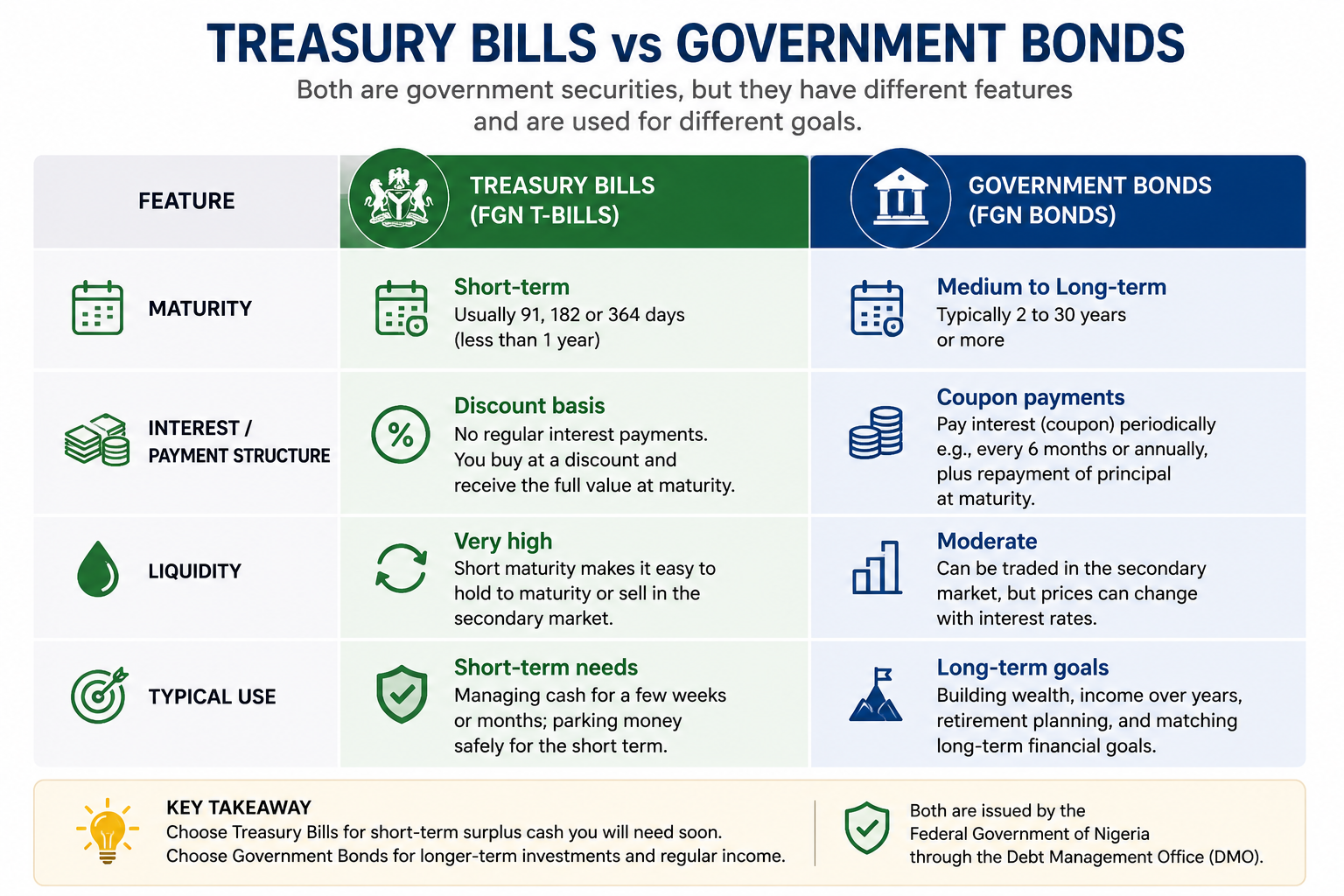
Government bonds and Treasury bills are both government securities, but they are not the same thing.
The biggest difference is generally maturity.
Treasury bills are short-term government securities.
Government bonds are generally issued for longer periods.
For example, a Treasury bill might mature in a matter of months, while a government bond can have a maturity measured in years.
That difference affects how you should think about the investment.
If you need your money relatively soon, locking money into a long-term bond may not make sense.
If you are investing for a longer-term objective, a government bond may fit better depending on your goals and risk tolerance.
If you want to understand Treasury bills in more detail, see our guide:
What Is a Treasury Bill and How Does It Work in Nigeria?
Government Bonds vs Fixed Deposit
A fixed deposit is a banking product.
A government bond is a debt security issued by a government.
With a fixed deposit, you place money with a bank for an agreed period under the bank's deposit terms.
With a government bond, you are lending to the government through the bond market.
They can also differ in how you access your money.
A fixed deposit may have specific early-withdrawal conditions imposed by the bank.
A bond can potentially be sold in the secondary market before maturity, but the amount you receive may be higher or lower than what you originally paid.
Read our guide to fixed deposits:
What Is a Fixed Deposit and How Does It Work in Nigeria?
Government Bonds vs Money Market Funds
A money market fund is different from directly buying a government bond.
A money market fund pools money from multiple investors and invests according to the fund's stated strategy, typically in short-term instruments.
This can provide diversification and professional management.
However, you are buying units of a fund rather than directly owning a particular government bond.
Read more:
What Is a Money Market Fund and How Does It Work in Nigeria?
You can also compare the two here:
Money Market Fund vs Treasury Bills: Which Is Better in Nigeria?
Government Bonds vs Corporate Bonds
The issuer is another major difference.
A government bond is issued by a government.
A corporate bond is issued by a company.
With a corporate bond, the company's ability to repay becomes particularly important.
A company experiencing financial difficulties may be unable to make payments according to the original terms.
Corporate bonds can therefore offer potentially higher returns than some government securities, but that additional return can come with additional credit risk.
The SEC notes that corporate and state bonds can carry higher returns alongside higher risks compared with FGN bonds.
For a broader explanation of bonds, see:
What Is a Bond and How Does It Work in Nigeria?
How Do You Make Money From Government Bonds?
There are generally two main ways an investor can benefit.
1. Coupon income
If the bond pays periodic interest, you receive those payments according to the bond's terms.
For example, a hypothetical ₦500,000 bond with a 10% annual coupon would have a stated annual coupon of ₦50,000.
The actual payment frequency depends on the specific bond.
2. Capital gain
If you sell a bond before maturity for more than you paid for it, you could make a capital gain.
For example:
You buy a bond for ₦950,000.
Later, market conditions cause someone to be willing to buy it for ₦980,000.
Your gross price gain would be:
₦980,000 − ₦950,000 = ₦30,000
But the reverse is also possible.
You could need to sell the bond for less than you paid.
This is why bond investing is not simply about the coupon rate.
A Simple ₦1 Million Example
Suppose you have ₦1 million and are considering a hypothetical government bond.
Assume:
- Face value: ₦1 million
- Coupon: 10% annually
- Maturity: 5 years
- Coupon payment: semi-annually
The stated annual coupon would be:
₦1,000,000 × 10% = ₦100,000
If paid twice a year:
₦100,000 ÷ 2 = ₦50,000
You could therefore receive approximately ₦50,000 every six months under this hypothetical example.
If you hold the bond until maturity and the issuer meets its obligations, the ₦1 million principal would then be repaid according to the bond's terms.
However, this example does not represent a current FGN bond rate or a specific bond offering.
Actual bonds have different coupons, prices, maturities and terms.
What If You Need Your Money Before Maturity?
This is one of the most important questions to ask before investing.
You do not necessarily have to wait until maturity.
FGN bonds can be traded in the secondary market through licensed broker-dealers, according to the DMO.
But there is an important catch.
Selling before maturity means you sell at the market price available at that time.
You might receive more than you originally paid.
You might receive less.
Therefore, you should not put money into a long-term bond if you know you may need the full amount urgently.
How Can You Buy Government Bonds in Nigeria?
There are generally two routes to consider.
Primary market
This is when the government issues bonds to investors.
The DMO conducts FGN bond auctions and uses appointed Primary Dealer Market Makers to participate in the primary market.
Secondary market
You can also access existing FGN bonds through the secondary market through licensed broker-dealers.
The DMO states that FGN bonds are traded in the secondary debt market through licensed broker-dealers.
The exact process, minimum investment and available bonds can depend on the particular offering or platform.
Before sending money, verify who you are dealing with and whether the relevant operator is properly authorized.
The SEC provides investor education and resources for checking registered operators and understanding investment risks.
How Much Money Do You Need to Invest?
There is no single amount that applies to every government bond product.
Different government securities and offerings can have different minimum investment requirements.
This is particularly important because people sometimes confuse standard FGN bonds with FGN Savings Bonds, which are designed with retail investors in mind.
The DMO's current subscription FAQ for FGN Savings Bonds states a minimum investment of ₦5,000 and says subscriptions can be made directly through its platform or through a distribution agent.
Therefore, don't assume that the minimum for one government bond product applies to every other government security.
Always check the terms of the specific offering.
Should You Invest in Government Bonds?
Government bonds may make sense for someone who:
- wants a fixed-income investment;
- wants exposure to government debt;
- has a medium- or long-term financial goal;
- values predictable coupon payments;
- understands that bond prices can change;
- does not need the invested money immediately;
- wants to diversify beyond cash or equities.
They may be less suitable if you:
- need the money very soon;
- have no emergency fund;
- have expensive consumer debt;
- are investing money needed for immediate living expenses;
- do not understand how bond prices and yields work;
- are buying solely because someone promised you a "guaranteed" high return.
Your emergency fund should generally be separated from long-term investments.
If you are still building one, see:
How Much Should You Have in an Emergency Fund?
Don't Confuse Safety With Guaranteed High Returns
One of the biggest mistakes new investors make is looking for an investment that offers high returns, no risk and guaranteed profits.
Those three things rarely go together.
Government bonds may have lower credit risk than many other investments, but that does not mean every bond investment will produce a high return or that you cannot lose money when selling before maturity.
And if someone online tells you that a government bond investment will produce unusually high guaranteed returns, slow down and investigate.
The SEC specifically provides investor-protection resources and encourages investors to understand investment risks and use regulated market participants.
Government Bonds Can Be Part of a Diversified Portfolio
You do not necessarily have to choose between bonds and stocks.
They can serve different purposes.
Stocks can provide long-term growth potential but can experience significant price movements.
Bonds can provide interest income and may behave differently from equities.
A diversified portfolio can combine different asset classes based on your:
- financial goals;
- investment time horizon;
- risk tolerance;
- risk capacity;
- income stability.
For more information, read:
What Is Investment Diversification and How Does It Work?
And:
What Is Asset Allocation and How Should You Divide Your Investments?
The Bottom Line
A government bond is essentially a way of lending money to the government in exchange for interest and repayment of the principal according to the bond's terms.
In Nigeria, FGN bonds are issued by the Debt Management Office on behalf of the Federal Government.
They can provide predictable income and can play an important role in a diversified investment portfolio.
But they are not simply "put your money in and forget about it" investments.
You need to understand the coupon, maturity, purchase price, yield, interest-rate risk, inflation risk and what happens if you need to sell before maturity.
If you are considering a government bond, don't start with the question, "How much will I make?"
Start with:
"What is this money for, how long can I leave it invested, and what risks am I taking to earn the return?"
That question will usually lead to a better investment decision.

You must be logged in to post a comment.