

Managing money for one person can be difficult.
Managing money for an entire family can be much harder.
There may be rent or mortgage payments, food, transportation, school expenses, healthcare, electricity, internet, debt payments, and support for relatives.
And unlike some expenses, most of these don't disappear simply because money is tight.
The answer isn't necessarily to create a complicated spreadsheet.
A good family budget should answer three basic questions:
How much money is coming in?
Where is it going?
What should happen with the money that remains?
If you can answer those questions honestly, you have the foundation of a workable family budget.
What Is a Family Budget?
A family budget is simply a plan for how household income will be used.
It should account for:
-
Income
-
Essential expenses
-
Debt payments
-
Savings
-
Irregular expenses
-
Family responsibilities
-
Discretionary spending
-
Financial goals
The important word is realistic.
A budget that looks perfect on paper but cannot survive a normal month isn't a good budget.
The Consumer Financial Protection Bureau recommends starting with a realistic picture of income and spending, including less frequent expenses that can otherwise be forgotten.
Step 1: Add Up the Family's Real Income
Start with the money the household actually receives.
This could include:
-
Salary
-
Business income
-
Freelance income
-
Commission
-
Rental income
-
Side income
-
Other regular income
If both partners work, include both incomes.
For example:
Partner 1: ₦450,000
Partner 2: ₦250,000
Other reliable income: ₦50,000
Total household income:
₦750,000
If some income is unpredictable, don't automatically treat the highest month as normal.
Use a conservative estimate.
This is particularly important when one or both partners are self-employed or earn commissions.
For households with fluctuating income, MoneyTrut's How to Budget When Your Income Changes Every Month provides a more detailed approach.
Step 2: List Every Major Household Expense
Now list what the family actually spends.
Start with the obvious expenses:
-
Housing
-
Food
-
Transportation
-
Electricity
-
Water
-
Internet
-
Phone bills
-
School expenses
-
Healthcare
-
Debt payments
-
Insurance where applicable
-
Family support
-
Savings
Then look for expenses that don't happen every month.
For example:
-
School uniforms
-
Annual rent
-
Vehicle maintenance
-
Birthdays
-
Christmas spending
-
Insurance renewals
-
Repairs
-
Medical expenses
-
Professional fees
-
Travel
These expenses are easy to forget because they aren't part of every monthly bank statement.
But they still have to be paid.
Step 3: Separate Monthly Expenses From Irregular Expenses
Suppose your family spends:
₦60,000 on transportation every month.
That's straightforward.
But suppose you also spend:
₦240,000 on vehicle maintenance throughout the year.
If you don't plan for that expense, the money may have to come from your emergency fund or a loan when the repair arrives.
Instead:
₦240,000 ÷ 12 = ₦20,000
You could set aside ₦20,000 per month for that future expense.
This is essentially a sinking fund.
MoneyTrut explains the concept in What Is a Sinking Fund and How Does It Work?.
Step 4: Calculate the Family's Essential Expenses
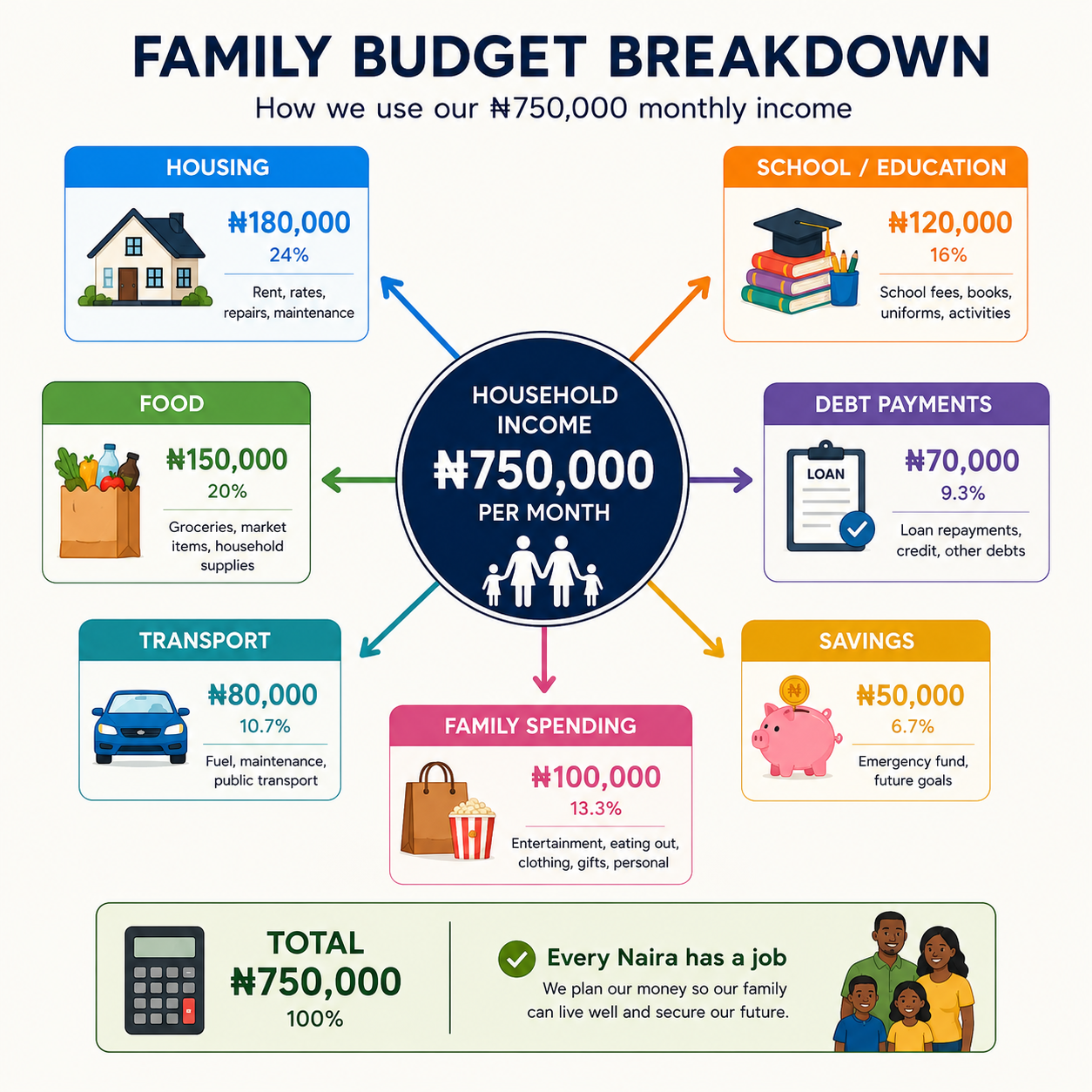
Now identify what the household absolutely needs to keep functioning.
For example:
| Expense | Monthly amount |
|---|---|
| Housing | ₦150,000 |
| Food | ₦120,000 |
| Transportation | ₦60,000 |
| Utilities | ₦35,000 |
| School expenses | ₦80,000 |
| Healthcare | ₦20,000 |
| Debt payments | ₦50,000 |
| Total | ₦515,000 |
If household income is:
₦750,000
then:
₦750,000 − ₦515,000 = ₦235,000
The family has ₦235,000 remaining for other goals and expenses.
That doesn't mean all ₦235,000 is available for spending.
There may still be irregular expenses, savings and discretionary spending to account for.
Step 5: Add Savings to the Budget
A common mistake is treating savings as whatever remains at the end of the month.
Sometimes nothing remains.
Instead, treat savings as one of the planned uses of household income.
For example:
Household income: ₦750,000
Essential expenses: ₦515,000
Savings: ₦50,000
Remaining:
₦185,000
Now the family has a defined amount going toward its financial future.
The savings could be divided between different goals.
For example:
₦30,000 → emergency fund
₦20,000 → future expenses
The amounts aren't universal.
The important thing is that savings has been given a place in the budget.
Even small, consistent amounts can help build financial resilience, particularly when unexpected expenses occur.
Step 6: Build an Emergency Fund
Families generally have more financial responsibilities than individuals living alone.
A single unexpected expense can affect the entire household.
For example:
Your car breaks down.
A child needs unexpected medical treatment.
A major appliance stops working.
Your income temporarily falls.
Without savings, the family may have to borrow.
An emergency fund provides a financial buffer for genuinely unexpected expenses.
MoneyTrut already covers this in:
How Much Should You Have in an Emergency Fund?
If money is particularly tight, start smaller.
₦10,000
is better than:
₦0
Then build gradually.
For lower-income households, How to Build an Emergency Fund With a Low Income provides a more focused approach.
Step 7: Don't Forget About Debt
Debt can consume a large part of a household's income.
Suppose a family earns:
₦600,000
but spends:
₦100,000
every month servicing debt.
That's one-sixth of the household income going toward debt payments.
The family may have less money available for:
-
Food
-
Savings
-
Education
-
Emergency expenses
-
Investments
-
Other goals
This doesn't mean every debt should be paid off immediately at the expense of all savings.
But debt needs to be visible in the budget.
MoneyTrut's How to Pay Off Debt Faster Without Ruining Your Finances covers the subject in more detail.
Step 8: Decide How Much the Family Can Spend on Wants
A family budget shouldn't mean that nobody is allowed to enjoy their money.
Families need entertainment.
Children need activities.
Adults may want to eat out or take a trip.
The problem is not spending money on enjoyable things.
The problem is spending money on them before the important financial obligations have been handled.
For example, a household might decide that:
₦30,000 per month
is available for discretionary family spending.
That could cover:
-
Entertainment
-
Eating out
-
Small personal purchases
-
Family activities
If the money runs out, discretionary spending stops until the next budget period.
That creates a boundary without eliminating enjoyment entirely.
Step 9: Don't Budget Based on Your Best Month
Suppose your household income is:
January: ₦700,000
February: ₦800,000
March: ₦1,000,000
April: ₦600,000
May: ₦750,000
June: ₦500,000
If you build your lifestyle around ₦1 million, the ₦500,000 month could become extremely difficult.
Instead, build the family's essential budget around a conservative income level.
Then use stronger months to:
-
Increase savings
-
Pay down debt
-
Fund future expenses
-
Build an emergency fund
-
Invest
-
Handle major planned expenses
This makes the household less vulnerable to income fluctuations.
Step 10: Plan for School Expenses
School expenses are a major source of financial pressure for many families.
The mistake is treating them as unexpected when they happen every year.
Suppose school-related expenses will total:
₦600,000
over the next year.
Instead of waiting until payment is due:
₦600,000 ÷ 12 = ₦50,000
The household could aim to set aside around ₦50,000 each month.
The exact approach depends on when the payments are due.
But the principle is simple:
If you know an expense is coming, start preparing before it arrives.
Step 11: Plan for Annual Rent
Annual rent can be particularly difficult because a large payment may arrive all at once.
Suppose rent is:
₦1,200,000
and renewal is expected in twelve months.
A simple calculation gives:
₦1,200,000 ÷ 12 = ₦100,000
Saving ₦100,000 every month would build the full amount over twelve months.
If the household cannot save that amount monthly, the budget needs to identify what is realistically possible and whether additional income or expense reductions are necessary.
The important thing is not to wait until the final month to discover that the money isn't available.
Step 12: Create a Family "Irregular Expenses" Fund
Not every future expense deserves its own savings account.
You can create a general sinking-fund category.
For example:
Monthly contribution: ₦50,000
This could eventually cover:
-
Minor repairs
-
Clothing
-
School extras
-
Vehicle maintenance
-
Birthdays
-
Annual fees
-
Other predictable expenses
The goal is to stop predictable expenses from repeatedly becoming financial emergencies.
Step 13: Decide Who Handles the Budget
A family budget works poorly when nobody knows what's happening.
Someone should be responsible for maintaining the budget.
That doesn't necessarily mean one partner controls all the money.
It means the household knows:
-
What comes in
-
What goes out
-
What bills are due
-
What debts exist
-
How much has been saved
-
What financial goals are being pursued
Both partners should understand the household's basic financial position.
Step 14: Have a Monthly Money Meeting
This doesn't need to be a formal meeting.
Even 20–30 minutes can be enough.
Discuss:
What came in this month?
What did we spend?
Did we overspend anywhere?
What bills are coming next month?
Did we save what we planned?
Is anything unusual coming up?
This becomes particularly useful when the household has children or irregular expenses.
A budget should be reviewed and adjusted when income or spending changes rather than treated as a document that never changes.
Step 15: Don't Hide Financial Problems From Each Other
If one partner has significant debt, it can affect the entire household.
If one person's spending is creating financial problems, the issue eventually affects everyone.
A family budget works best when important financial information isn't hidden.
That doesn't mean every purchase requires permission.
It means major financial decisions should be visible to the people who are affected by them.
What If One Partner Earns Much More?
Suppose:
Partner A earns:
₦700,000
Partner B earns:
₦200,000
Total:
₦900,000
There is no single correct way to divide household expenses.
Some couples may contribute proportionally to income.
Others may combine income entirely.
Others may maintain separate accounts while contributing to shared expenses.
For example, a proportional approach could mean that Partner A contributes a larger percentage because they earn more.
The important thing is agreeing on the system rather than assuming it will work itself out.
What If Only One Person Earns?
If one partner is currently the sole income earner, the household still needs a budget.
In fact, the budget may be even more important because the family depends heavily on one income source.
The household should know:
-
Monthly income
-
Essential expenses
-
Debt obligations
-
Emergency savings
-
Insurance where applicable
-
Future expenses
-
What happens if income temporarily stops
This is one reason an emergency fund can be particularly valuable for a single-income household.
What If the Family Earns ₦300,000?
Suppose a family brings home:
₦300,000
A possible budget might look like:
| Category | Amount |
|---|---|
| Housing | ₦70,000 |
| Food | ₦60,000 |
| Transport | ₦35,000 |
| Utilities | ₦20,000 |
| School/family needs | ₦35,000 |
| Debt | ₦20,000 |
| Savings | ₦10,000 |
| Other spending | ₦30,000 |
| Buffer | ₦20,000 |
| Total | ₦300,000 |
This is only an example.
A real family may have much higher housing costs, school fees, medical expenses or family obligations.
The point is to demonstrate the process.
If the family's essential expenses already exceed ₦300,000, the solution isn't to pretend the numbers work.
The family may need to reduce costs, restructure debt or increase income.
What If the Family Earns ₦500,000?
Suppose household income is:
₦500,000
and essential expenses total:
₦350,000
That leaves:
₦150,000
The family could potentially allocate some of that to:
-
Emergency savings
-
Sinking funds
-
Debt repayment
-
Long-term savings
-
Investments
-
Discretionary spending
For households around this income level, MoneyTrut also has How Much Should You Save From a ₦500,000 Salary?.
The article focuses on an individual salary, but the same calculation can help a household think about how much of its income is actually available after essential costs.
What If the Family Earns ₦1 Million?
Higher income creates more room, but it doesn't automatically solve financial problems.
A household earning ₦1 million can still struggle if:
-
Housing is too expensive
-
Debt payments are large
-
Lifestyle expenses keep increasing
-
Family support is substantial
-
There is little savings
-
Spending isn't tracked
The key question isn't:
"How much does the family earn?"
It's:
"How much of that income remains after the family's priorities are funded?"
Don't Let Lifestyle Inflation Consume Every Raise
Suppose household income increases from:
₦500,000 → ₦700,000
The family now has ₦200,000 more.
It may be reasonable to improve the family's lifestyle.
But don't allow the entire ₦200,000 to become permanent new expenses.
For example:
₦80,000 → savings/investments
₦50,000 → future expenses
₦40,000 → debt repayment
₦30,000 → lifestyle improvement
The exact allocation is personal.
But dividing an income increase is usually more powerful than automatically spending all of it.
What If the Family Is Already Living Paycheck to Paycheck?
Start with survival and stability.
Don't worry about building the perfect investment portfolio while the household cannot consistently cover basic expenses.
First identify:
-
Essential expenses
-
Debt payments
-
Income problems
-
Major spending leaks
-
Immediate savings needs
MoneyTrut's How to Stop Living From Paycheck to Paycheck covers this problem in greater depth.
The family may need a combination of:
lower expenses + higher income + debt reduction + savings.
There is no rule saying the solution must be only one of these.
What If the Family Can't Save Anything?
This is important.
If household income is:
₦300,000
and essential expenses are:
₦305,000
the problem isn't that the family doesn't know how to save.
The household is running a deficit.
Saving 10% isn't realistic until the gap is addressed.
The family may need to:
-
Reduce a major expense
-
Increase income
-
Negotiate certain costs
-
Restructure debt
-
Change housing
-
Find additional income
-
Reduce discretionary spending
You can't consistently save money that doesn't exist.
Don't Use Credit to Make the Budget Look Better
If the family spends:
₦500,000
but earns:
₦450,000
and puts the ₦50,000 difference on credit, the budget isn't balanced.
It is borrowing to maintain the appearance of balance.
That may be appropriate temporarily during a genuine emergency, but it isn't a sustainable budgeting strategy.
The goal is for normal household spending to be supported by actual income.
Give Every Major Amount a Job
A useful family budget doesn't just say:
"Income: ₦750,000."
It tells you where the money goes.
For example:
₦750,000 income
↓
₦500,000 essential expenses
↓
₦50,000 emergency savings
↓
₦50,000 sinking funds
↓
₦50,000 debt repayment
↓
₦50,000 long-term savings/investing
↓
₦50,000 discretionary spending
Now the family can see the entire financial picture.
The numbers will differ from household to household.
But the structure makes the money easier to manage.
A Simple Family Budget Template
You can start with this:
Household income
Salary: ₦______
Salary: ₦______
Business income: ₦______
Other income: ₦______
Total: ₦______
Essential expenses
Housing: ₦______
Food: ₦______
Transportation: ₦______
Utilities: ₦______
Education: ₦______
Healthcare: ₦______
Debt payments: ₦______
Family obligations: ₦______
Total essentials: ₦______
Financial goals
Emergency fund: ₦______
Sinking funds: ₦______
Debt repayment above minimum: ₦______
Long-term savings/investing: ₦______
Discretionary spending
Entertainment: ₦______
Eating out: ₦______
Personal spending: ₦______
Other: ₦______
Final calculation
Income − expenses − savings = amount remaining
If the result is negative, something needs to change.
If the result is positive, decide where the surplus should go.
Review the Budget Every Month
Your first budget probably won't be perfect.
That's normal.
After one month, you may discover:
Food cost more than expected.
Transport was underestimated.
A subscription was forgotten.
School expenses were higher.
You spent more on family support.
The budget should be adjusted.
The purpose isn't to predict every naira perfectly.
It's to get progressively closer to reality.
The Bottom Line
A family budget isn't about restricting every purchase.
It's about making sure the household knows where its money is going and whether its income can support the life it is trying to live.
Start with actual income.
List the essential expenses.
Account for irregular costs.
Build savings into the budget.
Plan for predictable expenses with sinking funds.
Keep an emergency fund for genuine financial shocks.
Deal with expensive debt.
And when income increases, don't automatically allow every extra naira to become a permanent expense.
Most importantly, don't create a budget based on an ideal version of your family.
Create one based on what your family actually earns, spends and needs.
A realistic budget that you can follow is far more valuable than a perfect budget that only works on paper.

You must be logged in to post a comment.