
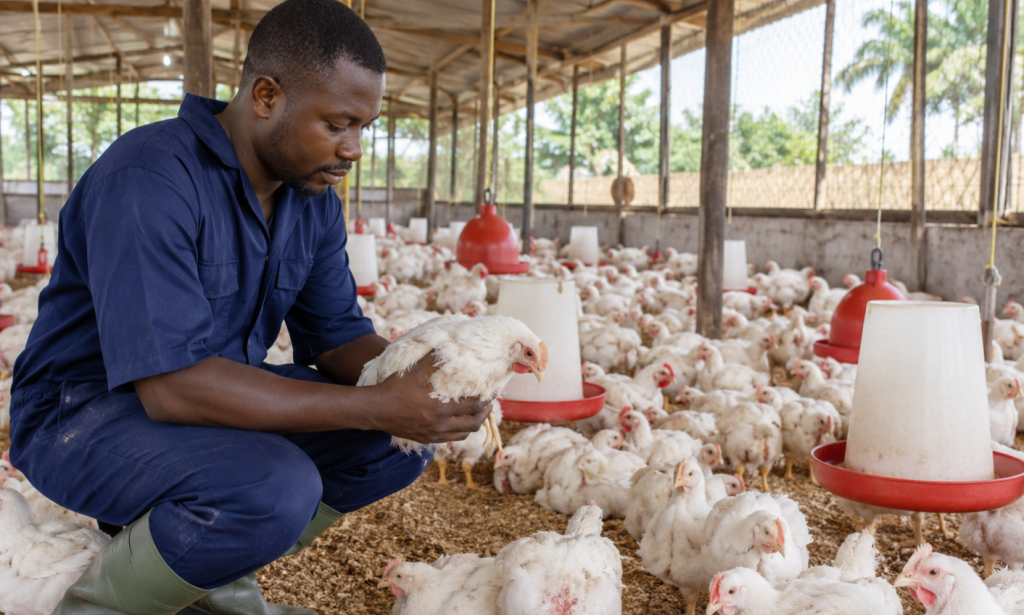
Poultry farming can be started on a small scale in Nigeria, but it is not simply a matter of buying chickens and waiting for them to grow. Your results depend on the type of birds you choose, feed costs, housing, disease prevention, mortality, labour and, most importantly, whether you already know who will buy the birds or eggs. For a beginner, starting with a manageable flock and keeping detailed records can reduce the financial risk of learning the business.
What Is Poultry Farming?
Poultry farming is the business of raising domesticated birds for meat, eggs, breeding or other commercial purposes.
In Nigeria, common poultry operations include:
- Broiler farming for chicken meat
- Layer farming for table eggs
- Cockerel production
- Noiler or dual-purpose bird production
- Turkey farming
- Breeding and hatchery operations
For someone starting for the first time, broilers and layers are usually the two models that require the most attention.
The important point is that poultry farming is both an agricultural and a business operation. You are managing living animals while also managing feed purchases, cash flow, sales, labour, transportation and customer relationships.
Is Poultry Farming Profitable in Nigeria?
Poultry farming can be profitable, but there is no guaranteed profit.
Two farmers can raise the same number of birds and end up with very different results.
For example, imagine two farmers each start with 100 broilers.
Farmer A:
- Buys healthy chicks
- Controls mortality
- Measures feed usage
- Prevents unnecessary feed wastage
- Has customers ready before sale
- Records every expense
Farmer B:
- Buys chicks without checking the supplier
- Has poor ventilation
- Loses several birds to disease
- Wastes feed
- Does not record expenses
- Waits until the birds are ready before looking for buyers
Even if both farmers sell their surviving birds at the same price, their profits can be completely different.
Current Nigerian poultry guides also show why there is no single reliable “startup cost” figure. Costs change according to bird numbers, location, housing, chick prices, feed prices, equipment and whether land and infrastructure are already available.
That is why you should build your own budget using current prices from suppliers in your area.
Broilers vs Layers: Which Should You Start With?
The first major decision is whether you want to produce meat or eggs.
Broiler farming
Broilers are chickens raised primarily for meat.
Their main attraction to beginners is the relatively short production cycle. Depending on breed, management and market target, broilers may reach sale weight in roughly 6–8 weeks.
Your revenue normally comes when you sell the birds.
This means the business has a batch-based cash-flow pattern:
Buy chicks → raise birds → sell birds → recover capital → start another cycle
Layer farming
Layers are raised primarily for egg production.
They require a much longer period before they begin laying compared with the broiler production cycle. Current poultry guides commonly place the beginning of egg production around 18–20 weeks, depending on the birds and management system.
The advantage is that once a healthy flock is laying, revenue can come from regular egg sales rather than waiting for one batch of birds to reach market weight.
However, you need to finance the flock for much longer before meaningful egg revenue begins.
A simple comparison
| Factor | Broilers | Layers |
|---|---|---|
| Main product | Chicken meat | Eggs |
| Typical production focus | Short cycles | Long-term production |
| Time before revenue | Relatively short | Longer |
| Revenue pattern | Batch sales | Regular egg sales |
| Main recurring cost | Feed | Feed |
| Main challenge | Mortality, feed cost and selling price | Long holding period, feed cost and flock management |
| Suitable for a beginner? | Can be started on a small scale | Possible, but requires longer-term planning |
There is no universal answer about which model is right. Your available capital, market, land, time and preferred cash-flow pattern should determine the choice.
How Much Does It Cost to Start Poultry Farming in Nigeria?
There is no single startup figure that applies to every poultry farm.
A person raising 50 birds in an existing backyard structure does not have the same startup cost as someone constructing a commercial 1,000-bird farm from scratch.
Your budget normally has several components:
- Day-old chicks
- Poultry housing
- Feed
- Feeders
- Drinkers
- Brooding equipment
- Vaccines and veterinary care
- Litter
- Water
- Electricity or fuel
- Labour
- Transportation
- Biosecurity and disinfectants
- Contingency money
Recent 2026 Nigerian guides give widely different figures because their assumptions are different. For example, one guide estimates a 100-bird operation at roughly ₦330,000–₦458,000 for a six-week cycle, while other estimates are substantially higher depending on infrastructure and local prices.
The lesson is more important than the exact number:
Do not copy another farmer's budget without checking current prices in your own location.
Can You Start Poultry Farming With ₦500,000?
Possibly, but the number of birds you can safely raise depends heavily on what you already have.
If you already have:
- Suitable land or backyard space
- A usable poultry house
- Water
- Some equipment
- Labour
- Electricity or another reliable brooding arrangement
your ₦500,000 can go much further.
If you need to construct the poultry house, buy equipment, arrange water and purchase the birds and feed at the same time, ₦500,000 can become inadequate very quickly.
For a beginner with limited capital, the safer approach is usually to start with the number of birds your working capital can actually support, rather than choosing a bird number first and trying to find the money afterward.
How Many Birds Should a Beginner Start With?
There is no magic number.
A beginner might consider starting with a small flock such as 50, 100 or 200 birds, depending on available space, capital and access to practical guidance.
The objective of the first cycle should not simply be to make the maximum possible profit.
You should also learn:
- How much feed your birds actually consume
- Your mortality rate
- How much labour is required
- How quickly the birds grow
- How much electricity or fuel you use
- Which suppliers are reliable
- How customers respond to your birds
- Your actual cost per surviving bird
For example, if you begin with 100 birds and 95 survive, your sales calculation should be based on the 95 birds sold, while your cost calculation must still include the money spent on the original 100 chicks.
That is one reason mortality matters financially.
Step 1: Choose Your Poultry Model
Before spending money, decide exactly what you want to produce.
For a beginner, the main choices are:
Option 1: Broilers
You raise chickens for meat and sell them after reaching your target market size.
This can provide relatively quick turnover.
Option 2: Layers
You raise birds for egg production.
This requires more patience and working capital because the flock must be maintained before and during the laying period.
Option 3: Dual-purpose birds
Some farmers choose birds that can provide both meat and eggs.
This can appeal to small-scale farmers serving local markets, but you should understand the specific breed's growth and production characteristics before investing.
Step 2: Research Your Market Before Buying Chicks
This is one of the most important steps.
Do not start with:
“I want to raise 500 chickens.”
Start with:
“Who will buy my 500 chickens?”
Potential customers include:
- Households
- Restaurants
- Hotels
- Caterers
- Food vendors
- Supermarkets
- Frozen-food retailers
- Chicken processors
- Market traders
- Event caterers
If you are producing eggs, your potential customers may include:
- Provision stores
- Bakeries
- Restaurants
- Hotels
- Food vendors
- Households
- Egg distributors
Ask potential customers:
- How many do they normally buy?
- What size do they prefer?
- Do they buy live birds or processed chicken?
- What days do they buy?
- Do they collect from the farm?
- What payment arrangement do they use?
This research can influence the type and number of birds you raise.
Step 3: Choose a Suitable Location
Your farm location matters.
Look for a place with:
- Reliable access to clean water
- Good drainage
- Adequate ventilation
- Reasonable road access
- Security
- Enough distance from major sources of contamination
- Space for expansion
- Reliable access to feed and veterinary services
You should also consider your neighbours.
A poultry farm can produce noise, odour, flies and waste. Starting in a densely populated residential area without considering local rules and neighbours can create problems later.
Step 4: Prepare the Poultry House
The poultry house should protect the birds from:
- Rain
- Excessive heat
- Cold
- Predators
- Theft
- Poor ventilation
- Excess moisture
Ventilation is particularly important.
A poultry house that is too hot, poorly ventilated or overcrowded can create conditions that negatively affect bird health and growth.
Do not simply focus on building the cheapest structure.
A cheap poultry house that causes high mortality or poor growth can become more expensive than a properly planned structure.
Step 5: Buy Good-Quality Chicks
Your production begins with the quality of the chicks.
Source birds from a reputable hatchery or supplier.
Before purchasing, ask:
- What breed are the chicks?
- How old are they?
- What vaccinations have they received?
- What is their vaccination history?
- What is the hatchery's replacement policy for weak or dead chicks?
- When were they hatched?
- What conditions were they transported under?
A 2026 Nigerian broiler guide similarly emphasizes confirming the chick source, vaccination history and health status before bringing birds onto the farm.
Step 6: Set Up Brooding Properly
The first days of a chick's life require careful management.
Before the chicks arrive, prepare:
- Heat source
- Clean water
- Feeders
- Drinkers
- Dry litter
- Appropriate brooding space
- Ventilation
- Lighting where required
- Disinfected equipment
Do not wait until the chicks arrive before preparing the brooder.
The first hours can be critical because weak chicks, inadequate temperature, poor access to water or poor brooding conditions can affect the entire batch.
Step 7: Plan Your Feed Carefully
Feed is one of the biggest financial issues in poultry farming.
Current Nigerian poultry cost guides consistently identify feed as one of the largest, and often the dominant, operating expenses.
This means you should monitor:
- Feed price
- Feed consumption
- Feed wastage
- Bird weight
- Growth rate
- Feed conversion
- Supplier reliability
Buying cheap feed is not automatically cheaper.
If poor-quality feed causes slow growth, increased feed consumption or poor final weights, the apparent saving may disappear.
Step 8: Provide Clean Water
Birds need consistent access to clean water.
Your water system should be reliable enough that a temporary water shortage does not leave the flock without water.
Check drinkers regularly for:
- Dirt
- Algae
- Leakage
- Blockage
- Contamination
Water management is easy to overlook because it does not look as expensive as feed or housing, but it directly affects daily farm operations.
Step 9: Take Disease Prevention Seriously
Disease can quickly turn a profitable-looking poultry operation into a loss.
Your prevention system should include:
- Cleaning
- Disinfection
- Controlled farm access
- Proper disposal of dead birds
- Good litter management
- Vaccination according to professional veterinary guidance
- Separation of sick birds where appropriate
- Avoiding unnecessary visitors
- Preventing contact with other poultry
Do not create your own vaccination or medication schedule from random social-media posts.
Work with a qualified veterinarian or poultry health professional who understands the diseases and vaccination requirements relevant to your area.
Step 10: Control Mortality
Mortality is one of the most important numbers to monitor.
Suppose you buy 100 chicks.
If 98 survive, you have 98 birds available for sale.
If only 85 survive, your cost has been spread across fewer saleable birds.
Your record should therefore include:
Starting birds → deaths → surviving birds → birds sold
Do not hide mortality in your records.
A farmer who records losses honestly can identify problems and improve the next production cycle.
Step 11: Keep Poultry Business Records
Your poultry farm needs financial records just like any other business.
Create a simple record showing:
| Expense | Amount |
|---|---|
| Chicks | ₦___ |
| Feed | ₦___ |
| Vaccines/medication | ₦___ |
| Litter | ₦___ |
| Labour | ₦___ |
| Electricity/fuel | ₦___ |
| Water | ₦___ |
| Transportation | ₦___ |
| Other expenses | ₦___ |
| Total cost | ₦___ |
Then record your revenue:
| Sales | Amount |
|---|---|
| Birds sold | ₦___ |
| Other poultry income | ₦___ |
| Total revenue | ₦___ |
Your basic operating result is:
Profit = Total Revenue − Total Business Cost
For more detailed business-record keeping, see our guide on How to Keep Business Records in Nigeria.
Step 12: Calculate Your Cost Per Bird
This is one of the most useful calculations you can make.
Suppose your total production cost for a batch is ₦600,000.
You started with 100 birds but 95 survive.
Your cost per surviving bird is:
₦600,000 ÷ 95 = ₦6,316 approximately
If you sell each surviving bird for ₦7,000:
₦7,000 − ₦6,316 = approximately ₦684
That is a simplified calculation, but it demonstrates why mortality matters.
If you incorrectly divide the ₦600,000 by the original 100 birds, you would calculate ₦6,000 per bird and overestimate your margin.
For a more detailed explanation of business break-even calculations, see How to Calculate the Break-Even Point for a Small Business in Nigeria.
Step 13: Know Your Selling Price Before the Birds Are Ready
One of the mistakes new farmers make is waiting until the birds are ready before searching for customers.
Instead, start marketing before the expected sale date.
Contact:
- Restaurants
- Caterers
- Retailers
- Food vendors
- Households
- Hotels
- Other farmers
- Poultry traders
Find out current market prices, preferred bird sizes and purchasing arrangements.
This gives you information before making your final production decisions.
Should You Sell Live Birds or Processed Chicken?
Both models can work, but they have different requirements.
Selling live birds
Advantages:
- Simpler operation
- Less processing equipment
- Lower processing requirements
Disadvantages:
- You may depend on traders
- Customers may negotiate heavily
- Transportation can become an issue
Selling processed chicken
Advantages:
- Potential access to retail customers
- Opportunity to package the product
- Possible additional value from cleaning and processing
Disadvantages:
- More equipment
- Hygiene requirements
- Packaging
- Cold storage
- More complex logistics
If you want to process and package poultry commercially, investigate the applicable food-safety, environmental and local regulatory requirements before starting.
How to Make More Money From a Poultry Business
Growing more birds is not the only way to increase revenue.
You can also improve the business by:
Reducing feed wastage
If feed is being spilled or contaminated, you are literally throwing money away.
Improving mortality
Healthy birds mean more saleable birds.
Buying strategically
Compare suppliers rather than automatically buying from the first person you find.
Building repeat customers
A customer who buys every week can be more valuable than someone who makes one large purchase and never returns.
Our guide on How to Get Repeat Customers for a Small Business in Nigeria explains the broader principles.
Selling directly where practical
If you can build a reliable customer base, reducing unnecessary intermediaries may improve your margins.
Keeping proper records
You cannot improve costs you do not measure.
How Much Profit Can You Make From Poultry Farming?
Avoid business plans that promise a specific profit simply because you raise a certain number of birds.
For example, a farm raising 500 broilers does not automatically make the same profit as another farm raising 500 broilers.
Your result depends on:
- Chick price
- Feed price
- Feed consumption
- Mortality
- Average final weight
- Selling price
- Labour
- Electricity
- Transport
- Medication
- Housing costs
- Market demand
One current Nigerian poultry calculator, for example, models break-even using chick cost, mortality, feed, housing, labour, vaccines and selling price rather than assuming a fixed profit percentage.
That is a better way to think about poultry economics.
A Simple 100-Bird Example
Suppose you plan to raise 100 broilers.
Before purchasing them, create a table like this:
| Item | Your Local Cost |
|---|---|
| 100 chicks | ₦___ |
| Starter feed | ₦___ |
| Finisher feed | ₦___ |
| Vaccines/medication | ₦___ |
| Litter | ₦___ |
| Electricity/fuel | ₦___ |
| Water | ₦___ |
| Labour | ₦___ |
| Transport | ₦___ |
| Contingency | ₦___ |
| Total | ₦___ |
Then estimate:
Expected surviving birds × expected selling price = expected revenue
Finally:
Expected revenue − total cost = estimated operating profit
Do not use the calculation as a guarantee.
Use it as a decision-making tool.
Should You Borrow Money to Start a Poultry Farm?
Be careful.
Poultry has biological and market risks that are different from many ordinary businesses.
A disease outbreak, unexpected feed-price increase, high mortality or sudden fall in selling price can affect your ability to repay a loan.
If you borrow, understand:
- Total amount borrowed
- Interest and fees
- Repayment schedule
- Minimum monthly payment
- What happens if the production cycle performs below expectations
Ideally, your repayment plan should not depend on achieving the most optimistic selling price.
Common Poultry Farming Mistakes Beginners Should Avoid
1. Starting too large
A first-time farmer may see large farms online and immediately want 1,000 or 5,000 birds.
Scale should come after competence.
2. Underestimating feed costs
Feed can consume a large portion of your operating budget.
3. Buying cheap chicks from an unreliable source
Saving a little on chicks can become expensive if quality is poor.
4. Poor ventilation
Overcrowded or poorly ventilated housing can create serious problems.
5. Ignoring water
Water shortages can disrupt the flock quickly.
6. Mixing business and personal money
Do not take money from the poultry account whenever you need household cash.
7. Selling without calculating cost
A farmer can sell everything and still lose money.
8. Waiting until the birds are ready before finding buyers
Start developing your customer network early.
9. Keeping no records
Without records, you cannot know which part of the operation is making or losing money.
10. Believing guaranteed-profit claims
If someone tells you poultry farming will definitely double your money in a specific period, treat the claim cautiously.
Actual results depend on the farm's numbers.
How to Start Small and Scale
A practical growth strategy can look like this:
Cycle 1: Learn the basics with a manageable flock.
Cycle 2: Correct the problems identified in the first cycle.
Cycle 3: Increase the flock only if your records support expansion.
Later: Build a stronger customer network and consider additional products or larger production.
This approach is more controlled than borrowing a large amount of money and immediately building a commercial farm without practical experience.
If you are starting with limited money, our guide on How to Start a Small Business in Nigeria With Little Money may also help you think through the broader startup decision.
A Simple Poultry Business Plan
Before you spend money, write down these ten things:
- Type of birds
- Number of birds
- Location
- Housing arrangement
- Cost of chicks
- Feed budget
- Health and vaccination plan
- Expected mortality
- Target customers
- Expected selling price
Then calculate your expected total cost and break-even point.
If the numbers do not make sense on paper, do not assume they will magically work after you buy the birds.
30-Day Preparation Plan
Week 1: Research
- Visit poultry farms
- Speak with experienced farmers
- Check local chick prices
- Check current feed prices
- Research your local market
- Identify potential buyers
Week 2: Budget
- Choose bird type
- Decide flock size
- Calculate housing costs
- Calculate feed requirements
- Add health and utility costs
- Add contingency money
Week 3: Setup
- Prepare the poultry house
- Install feeders and drinkers
- Arrange water
- Prepare brooding equipment
- Clean and disinfect the area
- Establish record sheets
Week 4: Start
- Purchase chicks from a reputable source
- Begin your health and feeding programme
- Record daily observations
- Monitor mortality
- Monitor feed usage
- Begin communicating with potential buyers
When Should You Expand?
Do not expand simply because your first batch sold out.
Expand when your records show that the business is under control.
Look for evidence such as:
- Consistent mortality performance
- Reliable feed supply
- Predictable production costs
- Repeat customers
- Positive operating results
- Sufficient working capital
- Reliable labour
- Adequate housing
Expansion should increase the size of a system that already works, not hide a system that does not.
Bottom Line
Poultry farming can become a viable business in Nigeria, but the opportunity should not be confused with guaranteed profit. Your success depends on controlling the numbers that matter: chick cost, feed cost, mortality, production time, labour, selling price and customer demand.
If you are new to poultry farming, starting with a manageable flock, learning the operation, keeping detailed records and expanding gradually can give you a much clearer understanding of the business before you commit larger amounts of money.
The goal is not simply to raise more chickens.
The goal is to build a poultry business where you know what each bird costs, what each bird earns and where your money is going.
Related Articles
- How to Start a Small Business in Nigeria With Little Money
- How to Keep Business Records in Nigeria: A Simple System for Small Businesses
- How to Calculate the Break-Even Point for a Small Business in Nigeria
- How to Manage Cash Flow in a Small Business in Nigeria
- How to Get Repeat Customers for a Small Business in Nigeria
- How to Start a Barbing Salon Business in Nigeria: A Practical Beginner’s Guide

You must be logged in to post a comment.