
A barbing salon can be started on a relatively small scale in Nigeria, but the real cost depends on the location, rent, equipment, power supply, barbering skill and whether you will operate the salon yourself or employ barbers. You do not necessarily need an expensive shop to begin. A better approach is to start with the equipment and services your target customers will pay for, keep operating costs under control and build repeat customers.
What Is a Barbing Salon Business?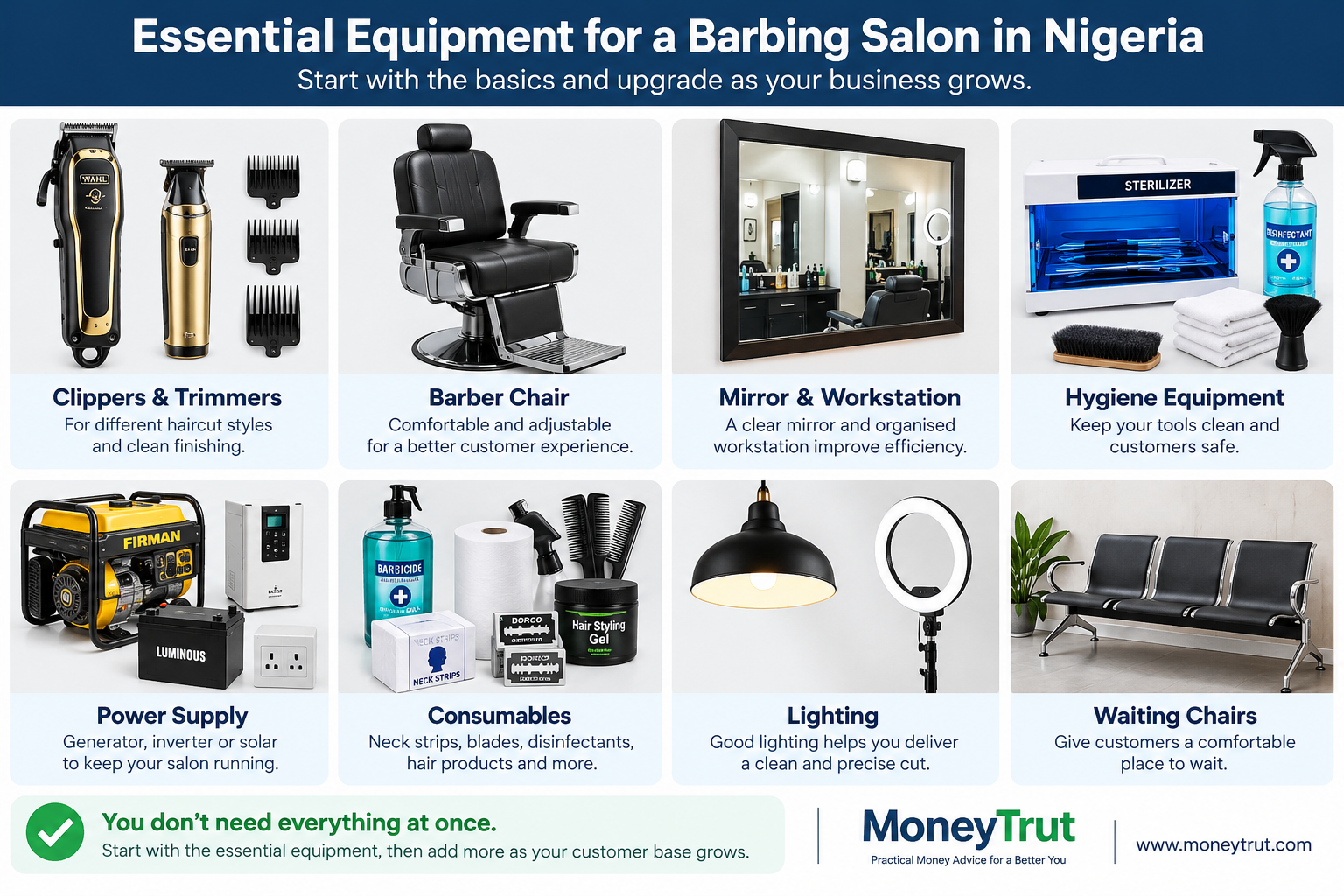
A barbing salon is a business that provides hair-cutting and men's grooming services for a fee.
Depending on the salon, services can include:
- Haircuts
- Low cuts
- Fades
- Hairline shaping
- Beard trimming
- Beard shaping
- Hair designs
- Children's haircuts
- Hair colouring
- Shaving
- Grooming treatments
Some barbers also offer home services, allowing customers to book a barber to visit their home, office or another location.
A small salon does not need to provide every service.
You can begin with the services you are skilled at delivering and expand later.
Is a Barbing Salon Profitable in Nigeria?
A barbing salon can generate profit, but the number of customers alone does not tell you how profitable it is.
Suppose you charge:
₦3,000 per haircut
and serve:
10 customers per day
Your daily revenue would be:
₦3,000 × 10 = ₦30,000
If you operate 26 days per month:
₦30,000 × 26 = ₦780,000
That is revenue, not profit.
You still have expenses such as:
- Barber wages or commissions
- Electricity
- Generator fuel
- Rent
- Water
- Disinfectants
- Blades
- Neck strips
- Hair products
- Equipment maintenance
- Internet or phone expenses
- Cleaning
- Other operating costs
If your total monthly expenses were ₦500,000:
₦780,000 − ₦500,000 = ₦280,000
That would be the simplified amount remaining before considering other factors not included in the example.
The important lesson is:
A busy barbing salon is not automatically a profitable barbing salon.
How Much Does It Cost to Start a Barbing Salon in Nigeria?
There is no single startup amount that applies everywhere.
A small salon in a low-rent area can require significantly less capital than a premium salon in Lagos, Abuja or another expensive urban location.
Your startup budget may include:
- Shop rent
- Renovation
- Barber chairs
- Clippers
- Trimmers
- Mirrors
- Hair dryers where needed
- Sterilisation or disinfection equipment
- Generator or alternative power
- Inverter or rechargeable equipment
- Lighting
- Waiting chairs
- Signage
- Water supply
- Hair products
- Working capital
Recent Nigerian 2026 guides give widely different startup ranges because they describe different salon sizes and standards. One recent guide puts a small side-hustle setup around the lower hundreds of thousands of naira, while a more developed salon can require substantially more.
That is why you should not treat an online startup figure as a universal price.
Build your budget around the actual shop, equipment and service level you intend to operate.
Can You Start a Barbing Salon With ₦300,000?
It may be possible for a very small operation if you already have some of the required equipment, have access to affordable space or operate from home/mobile appointments.
But ₦300,000 may not be enough for a fully equipped rented salon after accounting for:
- Rent
- Shop setup
- Chair
- Clippers
- Power
- Signage
- Equipment
- Consumables
- Working capital
The lower your startup capital, the more important it becomes to control fixed costs.
You may choose to:
- Start from home
- Offer home services
- Rent a small shop
- Share a space
- Start with one barbering station
- Buy only essential equipment
The objective is to get customers before committing to unnecessary overhead.
Step 1: Learn the Skill Before Opening
If you intend to cut hair yourself, barbering skill should come before the shop.
You need to understand:
- Clipper handling
- Different haircut styles
- Hairline shaping
- Beard trimming
- Hygiene
- Customer consultation
- Finishing techniques
- Equipment maintenance
A beautiful shop cannot compensate for poor haircuts.
If you are not a barber, you can employ a skilled barber, but then you must understand that your business becomes more dependent on staff.
Recent guides similarly identify barbering skill and tool hygiene as core requirements for the business.
Step 2: Decide How You Will Operate
There are several possible models.
Owner-Barber Model
You own the shop and do the barbering yourself.
Advantages include:
- Lower initial staffing costs
- Direct control over service quality
- Direct relationship with customers
The limitation is that your personal time becomes part of the business capacity.
Employee-Barber Model
You own the salon and employ one or more barbers.
This allows the business to serve customers even when you are not cutting hair.
However, you have additional responsibilities such as:
- Wages or commissions
- Staff management
- Quality control
- Scheduling
- Cash control
Home-Service Model
You travel to customers.
This can reduce shop-rent costs, but transportation becomes an important expense.
Hybrid Model
You operate a shop while also offering premium home appointments.
This can create an additional revenue stream if customers are willing to pay a higher price for convenience.
Step 3: Research Your Target Area
Before renting a shop, study the neighbourhood.
Look at:
- Population
- Number of men and boys nearby
- Existing barbing salons
- Prices
- Customer traffic
- Residential estates
- Student population
- Offices
- Schools
- Transport routes
- Security
- Power availability
Do not assume that an area with many barbing salons is automatically a bad location.
Several salons may exist because there are enough customers.
The important question is whether there is room for another business with a clear value proposition.
Step 4: Choose the Right Location
Customers generally want a barbing salon that is convenient.
A good location may be:
- Near residential areas
- Near student accommodation
- Near offices
- Inside or close to an estate
- Along a visible road
- Near other complementary businesses
But rent matters.
Suppose Shop A costs:
₦400,000 per year
and Shop B costs:
₦1,000,000 per year
If Shop B does not generate enough additional customer revenue to justify the extra ₦600,000, the more expensive location may put unnecessary pressure on the business.
Location should therefore be evaluated as an investment rather than simply a status symbol.
Step 5: Check Power Supply
Power is particularly important in a barbing salon.
Clippers, trimmers, lighting, fans, television and other equipment may depend on electricity.
Your options can include:
- Public electricity
- Generator
- Inverter
- Rechargeable clippers
- Solar/inverter systems
Do not calculate your monthly profit without including the cost of keeping the salon operational.
A salon that charges ₦3,000 per haircut but spends heavily on fuel can have a very different profit margin from a salon with reliable lower-cost power.
Step 6: Buy the Essential Equipment
Basic equipment can include:
- Professional clippers
- Trimmers
- Clippers' guards
- Barber scissors
- Combs
- Brushes
- Barber chair
- Mirror
- Workstation
- Towels
- Neck strips
- Disinfectant
- Spray bottles
- Cleaning brushes
- Hair dryer where needed
- Waste bin
- Good lighting
Depending on your services, you may also need:
- Beard tools
- Hair colouring supplies
- Styling products
- Sterilisation equipment
- Waiting chairs
- Television or entertainment equipment
Do not buy equipment simply because another salon has it.
Ask:
Will this equipment help me deliver a service customers will pay for?
Step 7: Take Hygiene Seriously
Hygiene is not optional.
Barbers use equipment that comes into contact with customers' hair and skin.
Your salon should have clear procedures for cleaning and disinfecting reusable tools between customers, along with appropriate handling of single-use items.
Keep:
- Clippers
- Trimmers
- Combs
- Brushes
- Scissors
- Work surfaces
clean and properly maintained.
A professional salon should also keep the floor, chair and surrounding area clean.
Customers notice hygiene.
Poor hygiene can damage trust even if the haircut itself is good.
Step 8: Create a Simple Service Menu
Do not make customers guess what you offer.
For example:
Basic Haircut
A standard haircut.
Haircut + Beard
Haircut combined with beard trimming or shaping.
Premium Cut
A more detailed haircut with additional grooming.
Children's Cut
A service designed for younger customers.
Home Service
A barber visits the customer at an agreed location.
The actual services and prices should reflect your skill, location and market.
Step 9: Set Your Prices Properly
Your price needs to cover the cost of delivering the service.
Suppose you charge:
₦3,000
Your average direct costs per haircut might include:
- Barber commission: ₦1,000
- Electricity/fuel allocation: ₦200
- Consumables: ₦150
Direct cost:
₦1,350
Contribution:
₦3,000 − ₦1,350 = ₦1,650
That ₦1,650 still needs to contribute toward rent and other fixed expenses.
If your rent, utilities, maintenance and other fixed expenses total ₦150,000 per month:
₦150,000 ÷ ₦1,650 ≈ 91 haircuts
You would need approximately 91 haircuts per month just to cover those assumed fixed expenses after direct costs.
That is roughly:
91 ÷ 26 ≈ 3.5 haircuts per day
Again, this is only an example.
Your actual numbers may be completely different.
For more guidance on pricing, see How to Price Your Products and Services in Nigeria Without Losing Money.
Step 10: Decide How to Pay Your Barber
If you employ another barber, decide how compensation works before opening.
Possible arrangements include:
- Fixed salary
- Commission
- Salary plus commission
- Chair rental arrangement
Each model has different implications.
For example, if a barber earns a percentage of each haircut, your labour cost rises with customer volume.
A fixed salary gives you a more predictable labour expense but means you must pay the salary even during slow periods.
Whatever arrangement you choose, put the agreement in writing and make the terms clear.
Step 11: Build a Customer Experience
Customers do not return only because of the haircut.
They also remember:
- How they were welcomed
- Waiting time
- Cleanliness
- Barber attitude
- Music
- Temperature
- Pricing
- Communication
- Consistency
If a customer gets an excellent haircut one week and a poor haircut the next, they may look for another barber.
Consistency is therefore valuable.
Step 12: Make It Easy for Customers to Return
A barbing salon has an advantage over many businesses:
Hair grows.
Customers often need another haircut.
Use that repeat behaviour.
Keep customer records where appropriate.
You can remember:
- Preferred haircut
- Preferred barber
- Last visit
- Typical visit interval
You can also use WhatsApp to send simple reminders or announcements.
For example:
“Hi David, it's been about three weeks since your last cut. We have appointments available this weekend.”
Do not spam customers.
The purpose is to make returning convenient.
Step 13: Offer Home Services Carefully
Home service can be useful for customers who value convenience.
You could charge:
Regular haircut: ₦3,000
Home service: ₦5,000
The difference should cover the additional time and transportation.
Suppose the home appointment requires ₦1,000 of transportation and an additional hour of your time.
You should not price the service as though the customer is coming to your shop.
The customer is paying for convenience.
Step 14: Market the Salon
A barbing salon can use simple digital marketing.
Post:
- Finished haircuts
- Available appointments
- New styles
- Promotions
- Customer reviews
Good-quality haircut photographs can demonstrate your skill.
TikTok
Short videos showing transformations can attract attention.
Google Business Profile
This can help local customers discover the salon when searching for barbers nearby.
Referral Marketing
Give existing customers a reason to recommend you.
For example, you could create a referral reward that does not destroy your margins.
Step 15: Take Before-and-After Photos
With the customer's permission, photographs can become powerful marketing material.
A simple:
Before → After
can show potential customers exactly what you can do.
You do not need expensive photography equipment.
A smartphone with good lighting can be enough.
Always respect customer privacy and obtain appropriate permission before publishing identifiable images.
Step 16: Keep Business Records
At minimum, record:
- Date
- Number of customers
- Service
- Amount charged
- Barber responsible
- Payment method
- Discounts
- Expenses
- Product sales
- Customer complaints
At the end of the day, you should know:
How many customers came in?
How much money came in?
How much went to barbers?
How much was spent?
How much remains?
Without records, it is easy to mistake cash movement for profit.
For more guidance, see How to Keep Business Records in Nigeria: A Simple System for Small Businesses.
Step 17: Sell Relevant Grooming Products
Once the salon has regular customers, you may consider selling products related to the services you provide.
Examples include:
- Hair brushes
- Combs
- Hair styling products
- Beard products
- Hair moisturisers
- Shaving products
But do not fill your salon with products simply because they are available.
Stock products customers actually ask for.
Keep separate records for product inventory so you know whether the retail side is profitable.
Step 18: Register the Business
If you intend to operate the salon as a serious business, you can consider registering the business name with the Corporate Affairs Commission.
CAC's current business-name process involves name availability, pre-registration information, document submission and payment of the applicable filing fee through the Company Registration Portal.
Registration gives the business a formal identity, but it does not automatically create customers or make the salon profitable.
You should also check any local requirements that apply to your premises or business activities.
Step 19: Calculate Your Break-Even Point
Suppose your monthly fixed costs are:
₦180,000
and your average contribution after barber commissions and other direct costs is:
₦1,500 per haircut
Your simplified break-even volume is:
₦180,000 ÷ ₦1,500 = 120 haircuts
If you operate 26 days per month:
120 ÷ 26 ≈ 4.6 haircuts per day
So you would need approximately five haircuts per day under these assumptions to cover the stated fixed costs.
If you average 10 haircuts per day:
10 × 26 = 260 haircuts
Contribution:
260 × ₦1,500 = ₦390,000
After ₦180,000 fixed costs:
₦390,000 − ₦180,000 = ₦210,000
This is an illustrative calculation, not a promise of earnings.
Your actual result depends on your price, barber compensation, customer volume, rent, power and other costs.
For a broader explanation of break-even calculations, see How to Calculate the Break-Even Point for a Small Business in Nigeria.
Common Barbing Salon Mistakes
1. Opening before learning the skill
A shop cannot compensate for poor barbering.
2. Choosing a location based only on cheap rent
Low rent is not useful if customers cannot easily find or reach you.
3. Ignoring hygiene
Poor tool hygiene can damage customer trust and create avoidable risks.
4. Buying too much equipment
Buy according to the services you actually provide.
5. Underpricing haircuts
A low price can leave you busy but unprofitable.
6. Ignoring power costs
Fuel and electricity can become significant expenses.
7. Depending entirely on one barber
If the entire business depends on one person, their absence can disrupt revenue.
8. Mixing business and personal money
This makes your actual profit difficult to measure.
9. Not tracking customers
You should know how many customers you serve and how often they return.
10. Expanding too early
More chairs do not automatically mean more profit.
How to Grow a Barbing Salon
Once the business has consistent demand, you can consider:
- Adding another barber
- Adding another chair
- Extending opening hours
- Introducing premium grooming
- Offering home services
- Selling grooming products
- Creating membership packages
- Building corporate or estate relationships
- Opening another branch
But expansion should follow evidence.
If your existing barber has more customers than they can serve, adding another barber may make sense.
If your salon has empty chairs most of the day, buying more chairs will not solve the problem.
The issue may instead be location, pricing, marketing, service quality or customer demand.
A Simple 30-Day Launch Plan
Week 1: Learn and Research
Improve your barbering skills if necessary.
Study competitors.
Check local prices.
Identify your target customers.
Choose the services you will offer.
Week 2: Budget
Calculate:
- Rent
- Equipment
- Power
- Consumables
- Labour
- Signage
- Working capital
Get actual quotations before spending.
Week 3: Setup
Prepare the shop or service area.
Install equipment.
Create your price list.
Set hygiene procedures.
Create your WhatsApp Business profile.
Take sample photographs.
Week 4: Launch and Measure
Start serving customers.
Record every haircut.
Track revenue.
Track barber costs.
Track power and consumables.
Ask customers for feedback.
Measure how many customers return.
Then adjust your business based on the numbers.
Bottom Line
A barbing salon can be a practical small business in Nigeria because haircuts and grooming are recurring services.
But the business is not simply about buying clippers and renting a shop.
Your location, barbering skill, hygiene, power costs, pricing, staff arrangement and ability to retain customers all affect the result.
Start with a model you can afford.
If you are the barber, focus on skill and customer experience. If you are employing barbers, focus on quality control, compensation and cash management.
Keep your startup costs under control and track every haircut and expense.
As the customer base grows, you can add services, products, staff and additional locations.
The goal is not simply to have a busy barbing salon.
The goal is to build a grooming business where customers return regularly and the numbers remain profitable after all costs are paid.
Related Articles
- How to Start a Small Business in Nigeria With Little Money
- How to Price Your Products and Services in Nigeria Without Losing Money
- How to Keep Business Records in Nigeria: A Simple System for Small Businesses
- How to Calculate the Break-Even Point for a Small Business in Nigeria
- How to Manage Cash Flow in a Small Business in Nigeria
- How to Get Repeat Customers for a Small Business in Nigeria

You must be logged in to post a comment.