
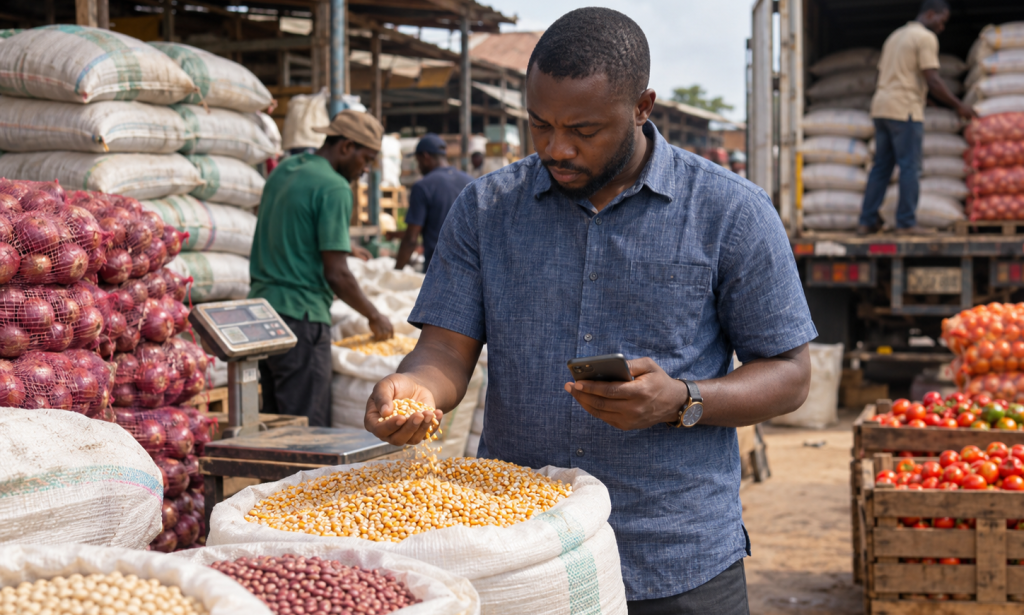
Agricultural produce trading is one of the ways to participate in Nigeria's agricultural economy without owning a farm. Instead of producing crops yourself, you buy agricultural products from farmers or rural markets and sell them to wholesalers, retailers, food businesses, processors or consumers.
The business can involve products such as maize, rice, beans, cassava, yam, onions, pepper, tomatoes, plantain, palm produce and other agricultural commodities. But the opportunity is not simply about buying cheaply and selling at a higher price. Your real challenge is managing quality, transportation, storage, market timing, price changes and working capital.
If you want to start an agricultural produce trading business in Nigeria, you need to understand both sides of the market: where the produce comes from and who is willing to buy it.
1. What Is Agricultural Produce Trading?
Agricultural produce trading involves buying agricultural products and reselling them at another stage of the supply chain.
A simplified chain may look like:
Farmer → Local Buyer/Aggregator → Trader → Wholesaler/Processor → Retailer → Consumer
You may operate at one or several points in this chain.
For example, you could buy bags of maize from farmers during harvest and sell them to poultry-feed businesses, grain wholesalers or food processors.
Another trader might buy tomatoes from producing areas and supply urban markets.
The business therefore depends heavily on connecting supply with demand.
You do not necessarily need to produce the commodity yourself.
2. Choose One Commodity Before Trying to Trade Everything
A beginner may be tempted to trade:
- Maize
- Rice
- Beans
- Yam
- Cassava
- Tomatoes
- Pepper
- Onions
- Plantain
- Palm oil
- Groundnuts
- Soybeans
at the same time.
That can make the business difficult to control.
Each commodity has different:
- Seasons
- Prices
- Storage requirements
- Quality standards
- Spoilage rates
- Buyers
- Transportation requirements
- Market cycles
It is often easier to learn one commodity properly before expanding.
For example, someone may specialise in grains first, while another trader focuses on vegetables.
The objective is to understand the economics of the commodity deeply enough to make informed buying decisions.
3. Choose the Market Before You Buy
One of the biggest mistakes in agricultural trading is buying produce first and looking for customers afterward.
Reverse the process.
Ask:
Who will buy this from me?
Potential buyers include:
- Wholesalers
- Retailers
- Food processors
- Restaurants
- Hotels
- Schools
- Supermarkets
- Food manufacturers
- Exporters
- Other traders
- Animal-feed businesses
For example, if you plan to trade maize, your potential market could include grain dealers and businesses that use maize as an input.
If you trade tomatoes, your customers may include market traders, restaurants, food businesses and processors.
Knowing the buyer determines what quality, quantity and packaging you need.
4. Understand the Difference Between Farm-Gate and Market Price
Agricultural produce can have different prices at different points in the supply chain.
You may encounter:
Farm-gate price
The price at which a farmer sells the produce.
Rural market price
The price at a nearby aggregation or local market.
Wholesale market price
The price in a larger trading market.
Retail price
The price paid by the final consumer.
The difference between these prices is not automatically your profit.
Transportation, losses, labour and other costs occur between each stage.
Suppose you buy produce for ₦500,000.
You then spend:
- ₦40,000 transportation
- ₦15,000 loading and handling
- ₦10,000 storage
- ₦10,000 sorting and packaging
Your effective cost is:
₦500,000 + ₦40,000 + ₦15,000 + ₦10,000 + ₦10,000 = ₦575,000
If you sell for ₦650,000, your gross trading surplus is:
₦650,000 − ₦575,000 = ₦75,000
That is before other business expenses.
This is why you should never calculate agricultural-trading profit using only the buying and selling prices.
5. Study Seasonal Supply
Agricultural commodities are strongly influenced by seasons.
During periods of high supply, prices can fall.
Later, when supply becomes tighter, prices may increase.
But this does not mean every trader should simply buy large quantities during harvest and wait for prices to rise.
Storage has costs and risks.
You need to consider:
- How long the commodity can be stored
- Storage conditions
- Pest risks
- Moisture
- Spoilage
- Market demand
- Cost of financing the inventory
- Expected future selling price
A price increase does not automatically mean a profitable trade if your storage and financing costs consume the difference.
6. Understand the Commodity's Shelf Life
This is one of the most important differences between agricultural trading and ordinary merchandise.
Some products can be stored for relatively long periods under appropriate conditions.
Others deteriorate quickly.
For example, fresh tomatoes and peppers require much more careful handling than properly dried grains.
NAERLS' agricultural information resources cover harvesting, storage and post-harvest handling across different crops.
Before trading a commodity, understand:
- How quickly it deteriorates
- Appropriate storage conditions
- Moisture requirements
- Pest risks
- Packaging requirements
- How transportation affects quality
Never buy a commodity in large quantities simply because the price looks attractive.
7. Post-Harvest Loss Is a Business Cost
Produce that gets damaged, spoils or loses quality is money lost.
NAERLS' 2024 Agricultural Performance Survey documented post-harvest losses across Nigerian crops and identified handling, harvesting, processing, transportation and storage among the stages where losses occur.
For a trader, this means that reducing losses can be as important as negotiating a lower purchase price.
Suppose you buy 100 bags.
If five bags become unsellable, you cannot calculate your margin as though all 100 bags were sold normally.
Your effective cost per saleable bag has increased.
This is why proper handling matters.
8. Start With a Small Trading Cycle
You do not need to begin by buying a truckload of produce.
Start with a volume you can monitor.
A simple cycle might be:
Research → Buy → Transport → Store/Sort → Sell → Record → Review
After completing several cycles, you will have actual information about:
- Average buying price
- Transportation cost
- Selling price
- Loss rate
- Average selling time
- Customer demand
- Profit per transaction
That information is more valuable than an estimated profit figure from someone else's business.
9. Find Reliable Farmers and Aggregators
Your supplier network is one of your most important assets.
Potential sources include:
- Individual farmers
- Farmer cooperatives
- Local aggregators
- Rural markets
- Farm clusters
- Processors
- Other traders
Do not depend on one supplier.
A farmer may have less produce than expected.
Weather can affect supply.
Another buyer may offer a higher price.
A local market may change quickly.
Build several relationships so you can compare supply and quality.
10. Build Relationships With Buyers Before Buying
The other side of the business is just as important.
Speak with potential buyers before you purchase significant quantities.
Ask:
- What quantity do you normally buy?
- What quality do you require?
- How often do you buy?
- What packaging do you prefer?
- Do you pay immediately?
- Do you buy on credit?
- Where should goods be delivered?
- What causes you to reject produce?
This can prevent you from buying a commodity that you later discover your target customers do not want.
11. Learn How to Grade Quality
Agricultural produce is not always equal.
Two bags of the same commodity can have different values depending on:
- Moisture
- Size
- Colour
- Cleanliness
- Variety
- Damage
- Maturity
- Foreign material
- Pest infestation
If you cannot distinguish good produce from poor-quality produce, you can easily overpay.
Learn the quality characteristics that matter for your commodity.
If necessary, work with someone experienced before making larger purchases.
12. Inspect Produce Before Paying
Do not rely only on what is visible from the top of a bag.
Where practical, inspect samples from different parts of the lot.
Check for:
- Moisture
- Rot
- Insects
- Mould
- Broken grains
- Foreign materials
- Physical damage
- Unusual odour
- Inconsistent quality
A trader who learns how to inspect produce can avoid many costly mistakes.
13. Understand Transportation Costs
Agricultural produce often moves significant distances.
Your transportation cost may depend on:
- Distance
- Commodity weight
- Vehicle size
- Fuel costs
- Road conditions
- Loading
- Offloading
- Driver charges
- Waiting time
- Market congestion
Do not negotiate a purchase price without understanding how much it will cost to move the product to your intended market.
A cheap commodity can become expensive after transportation.
14. Consider Aggregation
Aggregation means collecting smaller quantities from multiple producers or sources and combining them into a larger marketable quantity.
For example:
Farmer A → 10 bags
Farmer B → 15 bags
Farmer C → 20 bags
Farmer D → 15 bags
You now have:
60 bags
This can allow a trader to supply a larger buyer who may not want to deal with multiple individual farmers.
NAERLS describes agricultural value chains as involving multiple actors, including farmers, traders, processors, transporters, wholesalers, retailers and consumers.
Aggregation can therefore be a legitimate business function rather than simply "buying from farmers and reselling."
15. Know Your Market Prices
Do not depend on one person's quoted price.
Compare:
- Farm-gate prices
- Rural market prices
- Wholesale prices
- Urban market prices
- Prices offered by processors
- Prices from potential buyers
NAERLS' National Farmers' Helpline provides market and price information and has a market-statistics platform where users can select agricultural products and markets.
You should still verify actual transaction prices directly because market conditions can change quickly.
16. Keep a Price Record
Create a simple price log.
For each market or supplier, record:
| Date | Commodity | Location | Buying Price | Selling Price | Transport Cost |
|---|---|---|---|---|---|
| Week 1 | Commodity A | Market 1 | ₦X | ₦X | ₦X |
| Week 2 | Commodity A | Market 1 | ₦X | ₦X | ₦X |
| Week 3 | Commodity A | Market 2 | ₦X | ₦X | ₦X |
After several weeks, you will start seeing patterns.
The objective is not to predict prices perfectly.
It is to make decisions using records rather than rumours.
17. Don't Assume Every Price Difference Is an Opportunity
Suppose you hear:
"Commodity X is ₦50,000 in one market and ₦65,000 in another."
That sounds like a ₦15,000 opportunity.
But ask:
- How much is transportation?
- Are the products the same quality?
- Are the units the same?
- Are there market fees?
- How much will be lost?
- How quickly can you sell?
- Will the price still be ₦65,000 when you arrive?
A genuine trading opportunity exists only after you account for the costs and risks.
18. Decide Where You Will Store the Produce
Storage requirements depend on the commodity.
Potential options include:
- Rented warehouse
- Small store
- Cooperative storage
- Shared storage facility
- Cold storage for appropriate products
- Short-term holding space
Before renting storage, calculate whether the expected trading margin can support it.
If your commodity is highly perishable, long-term storage may not even be the correct strategy.
You may need a faster buying-and-selling cycle instead.
19. Control Moisture and Pests
For grains and other storable agricultural commodities, moisture and pests can destroy inventory.
Your storage system should therefore be appropriate for the commodity.
Depending on the product, you may need:
- Dry storage
- Proper ventilation
- Pallets
- Pest-control measures
- Appropriate packaging
- Regular inspection
- Stock rotation
Do not apply chemicals or storage treatments without understanding the appropriate product, dosage, safety requirements and intended use.
20. Decide Whether You Need a Warehouse
A beginner may not need a large warehouse.
You might initially use:
- Short-term rented storage
- Supplier storage until dispatch
- Buyer-arranged pickup
- A shared facility
- Small-scale aggregation
Your objective is to avoid paying for capacity you do not yet need.
As your trading volume becomes predictable, you can reassess storage.
21. Understand Cash Flow
Agricultural trading can require significant working capital.
Suppose you spend ₦1 million buying produce.
You then have to pay:
- Transportation
- Storage
- Labour
- Market fees
- Packaging
If your buyer pays you 30 days later, your capital remains tied up.
This can prevent you from making your next purchase.
Therefore, ask:
When does cash leave my business?
and:
When does cash return?
The shorter and more predictable the cycle, the easier it is generally to manage working capital.
22. Be Careful With Buyer Credit
Selling on credit can increase sales but expose you to collection risk.
Suppose you sell ₦500,000 worth of produce to a customer and expect payment after 30 days.
If you need that ₦500,000 to buy your next stock, your business may slow down.
For new customers, consider starting with:
- Immediate payment
- Partial deposit
- Smaller orders
- Shorter credit periods
Increase credit only when you have evidence that the customer pays reliably.
23. Calculate Your Real Trading Profit
Use a complete calculation.
Example
Purchase cost:
₦800,000
Transportation:
₦60,000
Loading and offloading:
₦20,000
Storage:
₦15,000
Sorting and packaging:
₦15,000
Total direct cost:
₦910,000
Suppose you sell the produce for:
₦1,050,000
Gross trading surplus:
₦1,050,000 − ₦910,000 = ₦140,000
That ₦140,000 is not necessarily your final business profit.
You may still have:
- Communication
- Staff
- Rent
- Financing
- Administrative expenses
- Taxes where applicable
- Losses
- Other overhead
The more accurately you record these costs, the more useful your profit calculation becomes.
24. Understand Gross Margin
Using the previous example:
Sales = ₦1,050,000
Direct cost = ₦910,000
Gross profit = ₦140,000
Gross margin:
₦140,000 ÷ ₦1,050,000 × 100 ≈ 13.3%
That gives you a clearer picture of the economics than simply saying:
"I made ₦140,000."
If your operating expenses consume ₦80,000, your final business profit would be much lower.
25. Choose Between Fast Turnover and Longer Holding
There are broadly two approaches.
Fast-turnover trading
Buy and sell quickly.
Advantages can include:
- Lower storage exposure
- Faster return of capital
- Lower spoilage risk for perishables
The challenge is that you may have less opportunity to benefit from price changes.
Holding inventory
Buy when prices are favourable and store for later sale.
Potential advantages include:
- More flexibility in timing
- Potential access to different markets
But the risks include:
- Storage costs
- Price declines
- Spoilage
- Pest damage
- Capital being tied up
Do not hold produce simply because you hope the price will rise.
Have a clear reason and exit plan.
26. Consider Value Addition
You do not always have to sell agricultural products exactly as you bought them.
Value addition can include:
- Cleaning
- Sorting
- Grading
- Packaging
- Processing
- Milling
- Drying
For example, a trader may buy an agricultural product in bulk and sell a cleaned and properly packaged version to another buyer.
The additional value can create a different business model.
NAERLS has highlighted value addition and agricultural value chains as important areas for reducing post-harvest losses and improving market opportunities.
27. Start With Products You Understand
If you grew up around a particular agricultural commodity, that knowledge can be valuable.
You may already understand:
- Seasons
- Quality
- Local suppliers
- Markets
- Buyers
- Transportation
- Common problems
That knowledge can reduce your learning curve.
You can also learn a new commodity, but do not commit large capital before understanding it.
28. Common Agricultural Produce Trading Mistakes
Buying because the price looks cheap
Cheap produce can still be difficult to sell.
Buying without a buyer
You may end up holding inventory longer than expected.
Ignoring quality
Poor-quality produce can destroy your margin.
Underestimating transport
Transportation can consume a large part of your trading margin.
Holding perishables too long
Spoilage can turn a potential profit into a loss.
Giving too much credit
Unpaid customers can trap your working capital.
Depending on one buyer
Losing a major buyer can leave you with unsold inventory.
Depending on one supplier
Supply problems can interrupt your business.
Mixing personal and business money
You may no longer know how profitable the business really is.
Trading too many commodities
You may spread your capital and attention too thinly.
29. How Much Money Do You Need to Start?
There is no universal startup amount.
You can trade at different scales depending on the commodity and market.
Your capital requirement depends on:
- Minimum purchase quantity
- Commodity price
- Transportation
- Storage
- Buyer payment terms
- Expected trading cycle
- Loss risk
- Working-capital requirements
For example, a trader dealing in a highly perishable commodity may prefer a smaller, faster cycle.
A grain trader may require more capital because larger quantities can be stored and traded over a longer period.
Calculate your own capital requirement instead of copying another trader's figure.
30. Example of a Small Trading Budget
Suppose an entrepreneur has ₦1 million available for a trial agricultural trading operation.
A hypothetical allocation might be:
| Use | Amount |
|---|---|
| Initial produce purchase | ₦650,000 |
| Transportation | ₦100,000 |
| Sorting/loading/handling | ₦50,000 |
| Short-term storage | ₦50,000 |
| Packaging/market expenses | ₦30,000 |
| Working-capital reserve | ₦70,000 |
| Contingency | ₦50,000 |
| Total | ₦1,000,000 |
These figures are illustrative and should not be treated as current market prices.
The important lesson is that the entire ₦1 million should not automatically be spent on produce.
Keep enough liquidity to deal with unexpected costs and the next trading opportunity.
31. Build a Simple Trading Record
For every transaction, record:
Commodity
Supplier
Location
Quantity purchased
Purchase price
Transportation
Other direct costs
Total cost
Buyer
Quantity sold
Selling price
Amount received
Amount outstanding
Profit or loss
After several transactions, you will have your own data.
You can then determine which commodities, suppliers, markets and buyers are actually working for you.
32. How to Scale the Business
Do not scale simply by buying more produce.
Scale by improving the system.
You might eventually:
- Work with more farmers
- Add reliable buyers
- Increase trading volume
- Rent better storage
- Add transportation capacity
- Introduce grading and packaging
- Supply processors
- Supply supermarkets
- Add another commodity
- Expand to another market
But each step increases the amount of money and risk involved.
Your records should support the decision.
33. Government and Business Support
Agricultural trading sits within the broader agricultural value chain, and there are programmes aimed at supporting agribusinesses.
SMEDAN's Agri-business Development and Empowerment Programme (ADEP), for example, is designed for people and organisations involved in agricultural production, processing and marketing and lists financial assistance, technical training and capacity building among its potential forms of support.
Support programmes can change over time, so verify eligibility, application requirements and current availability directly with the relevant organisation.
Do not build your business plan around receiving a grant.
Your business should make sense without assuming that funding will arrive.
34. A Practical 30-Day Starting Plan
If you are serious about agricultural produce trading, use your first month for research rather than immediately buying large quantities.
Week 1: Choose the commodity
Select one commodity and learn its market.
Research:
- Suppliers
- Buyers
- Seasons
- Quality
- Storage
- Transportation
Week 2: Visit the market
Speak with:
- Farmers
- Aggregators
- Traders
- Wholesalers
- Processors
- Potential customers
Record actual prices.
Week 3: Build the numbers
Calculate:
- Purchase cost
- Transportation
- Storage
- Handling
- Expected selling price
- Potential loss
- Gross margin
- Working-capital requirement
Week 4: Test
Make a small transaction that you can afford to lose money on if your assumptions prove wrong.
Record everything.
Then decide whether to repeat, change the commodity or stop.
Ready to Start Agricultural Produce Trading?
Don't start by asking, "How much can I make?"
Start by asking:
"Where can I buy this commodity reliably, who will buy it from me, and what will remain after every cost?"
Choose one commodity. Identify your suppliers. Identify your buyers. Compare actual market prices. Calculate transportation and handling costs. Then test the business with a manageable quantity.
Your next step: speak with at least five potential buyers and three potential suppliers before purchasing your first major quantity.
If this guide helped you, share it with someone considering agricultural trading in Nigeria. You can also explore MoneyTrut's guides on poultry, snail, fish and goat farming if you are considering entering agriculture through production rather than trading.
Bottom Line
Agricultural produce trading is not simply buying cheap and selling expensive.
It is a business of information, relationships, timing, quality, logistics and cash flow.
The trader who understands where supply is available, what buyers actually want, how much transportation costs and how quickly the produce can be sold has a much better basis for making decisions than someone buying purely on rumours of rising prices.
Start small. Learn one commodity. Keep accurate records. Protect your working capital. Reduce post-harvest losses. Build both supplier and buyer relationships.
Then scale when your own trading history shows that the model works.
Related Articles
- How to Start a Fish Farming Business in Nigeria: A Practical Beginner's Guide
- How to Start Poultry Farming in Nigeria: A Beginner's Guide
- How to Start a Snail Farming Business in Nigeria: A Practical Beginner's Guide
- How to Start Goat Farming in Nigeria: A Practical Beginner's Guide
- How to Start a Wholesale Distribution Business in Nigeria
Sources & References
- National Agricultural Extension and Research Liaison Services (NAERLS) — National Farmers' Helpline
- NAERLS — Agricultural Performance Survey of 2024 Wet Season in Nigeria
- NAERLS — Agricultural Market and Price Information
- NAERLS — Agricultural Value Chain Resources
- SMEDAN — Agri-business Development and Empowerment Programme
- Federal Ministry of Agriculture/related agricultural institutions — agricultural value-chain and market-development resources

You must be logged in to post a comment.