
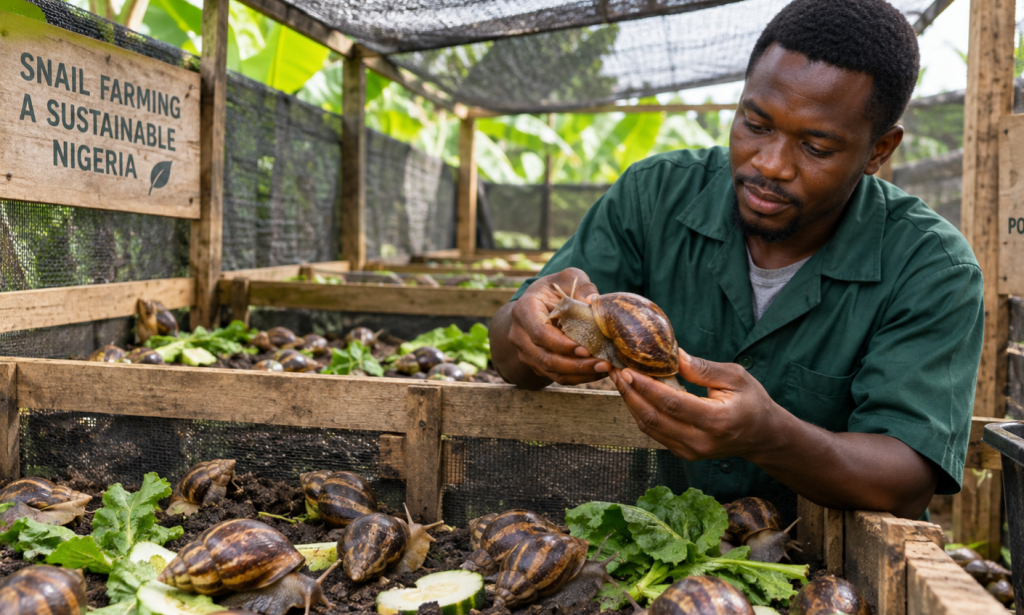
Snail farming is one of the agricultural businesses Nigerians can start on a relatively small scale, including from a suitable backyard or small piece of land. However, it is not a quick-money business: snails take time to grow, and your results depend on housing, moisture, feeding, breeding, mortality, market access and how well you control your costs. If you want to start, the safest approach is to begin with a manageable number of healthy snails, learn the production cycle and expand after you understand your actual costs.
What Is Snail Farming?
Snail farming, also called heliciculture, is the controlled rearing of land snails for commercial purposes.
A farmer provides an environment where the snails can:
- Feed
- Grow
- Reproduce
- Lay eggs
- Hatch young
- Reach marketable size
The business can generate income from selling mature snails, juvenile snails for other farmers, breeding stock and, depending on the operation, processed snail products.
In Nigeria, snail farming is particularly interesting for small-scale entrepreneurs because the physical space required can be considerably smaller than what is needed for some other livestock operations.
But small space does not mean no management.
You still need to understand the animal, its environment and your market.
Is Snail Farming Profitable in Nigeria?
It can be, but profitability depends on the economics of your particular farm.
Several Nigerian guides published in 2026 describe snail farming as a low-entry agricultural business, with some small-scale setups operating from backyards or relatively small spaces.
However, you should be careful with claims that snail farming automatically produces large profits.
The business has some characteristics that can work in its favour:
- Relatively small space requirements
- Potential to start on a small scale
- Breeding can increase your stock
- Snails can be sold to households, restaurants and traders
- Some feed materials can be sourced locally
There are also challenges:
- Slow growth
- Longer waiting periods before some snails reach market size
- Predator control
- Moisture management
- Seasonal conditions
- Finding consistent buyers
- Limited working-capital turnover compared with some short-cycle businesses
The important question is therefore not simply:
“Is snail farming profitable?”
It is:
“Can I raise snails at a cost that allows me to sell them profitably in my market?”
How Much Does It Cost to Start Snail Farming in Nigeria?
There is no single startup figure.
Your cost depends on whether you already have suitable space and materials.
A small backyard operation may require:
- Snail pen
- Healthy breeding stock
- Suitable soil
- Feed
- Water
- Netting
- Protection against predators
- Basic tools
A larger operation may additionally require:
- Multiple pens
- More breeding stock
- Larger feeding systems
- Improved irrigation or water supply
- Labour
- Storage
- Packaging
- Transport
- Security
Current Nigerian 2026 estimates vary significantly. For example, recent guides have placed small-scale startup budgets anywhere from roughly ₦50,000 to ₦150,000, while other guides give higher ranges depending on the size and construction of the farm.
Do not treat these figures as fixed prices.
The cost of wood, mesh, snails, labour and other materials can vary considerably between Lagos, Benin City, Port Harcourt, Abuja, Ibadan and smaller communities.
Build your own budget using prices from your location.
Can You Start Snail Farming With ₦100,000?
Possibly, especially if you already have suitable space and can construct a simple enclosure using affordable materials.
But ₦100,000 should not automatically be interpreted as enough to start any particular number of snails.
Consider this example.
You have ₦100,000 available.
Instead of spending all of it on breeding stock, you might need to divide it between:
- Housing
- Snails
- Feed
- Water
- Protection
- Transport
- Contingency
If you spend everything buying snails and have no money left to maintain them properly, you have not actually solved the startup problem.
The size of your initial stock should therefore be determined by your total available working capital, not by the amount you see someone else using online.
Step 1: Learn the Snail Production Cycle
Before buying anything, understand that snail farming is a patient business.
Some snails can reproduce relatively quickly under suitable conditions, but reaching a commercially desirable size can take months.
One recent Nigerian guide estimates that snails may take around 7–12 months to reach market size depending on starting age and management.
This is very different from a business where you buy inventory today and sell it tomorrow.
Your money may remain tied up in the stock for a considerable period.
That means you should not invest money that you will urgently need for rent, school fees, household expenses or debt repayment.
Step 2: Choose the Right Snail Species
Do not buy random snails simply because they are large.
Find out which species is commonly raised and sold commercially in your area and learn its:
- Growth characteristics
- Breeding characteristics
- Housing requirements
- Feeding requirements
- Market size
- Availability
Giant African land snails are commonly discussed in Nigerian snail-farming guides, including species such as Archachatina marginata.
However, the important point for a beginner is to obtain healthy stock from a reliable source and understand exactly what you are buying.
Step 3: Choose Your Farm Location
You do not necessarily need a large farm.
A suitable location should provide:
- Shade
- Protection from excessive heat
- Suitable moisture
- Good drainage
- Protection from flooding
- Security
- Access to water
- Protection from predators
Avoid placing your snail farm where heavy rain can flood the enclosure.
At the same time, avoid an exposed location that becomes excessively dry and hot.
The goal is to create a stable environment.
Step 4: Build a Suitable Snail Pen
Your snail pen is one of the most important investments.
The enclosure should:
- Keep snails inside
- Keep predators outside
- Maintain suitable moisture
- Provide enough room
- Allow easy cleaning
- Allow you to inspect the snails
Possible systems include:
- Hutch boxes
- Wooden pens
- Concrete pens
- Trench systems
- Covered outdoor pens
For a beginner, a simple well-designed pen can be enough to learn the business.
You do not need to build an expensive commercial farm before proving that you can manage a smaller operation.
Recent Nigerian guidance describes hutch-style systems using wood, mesh and suitable soil as one practical option for small-scale operations.
Step 5: Protect the Snails From Predators
Predators can quietly destroy your investment.
Potential threats include:
- Rats
- Ants
- Lizards
- Birds
- Frogs
- Some insects
- Other animals
Your enclosure should therefore be designed to reduce access.
Check the farm regularly for holes, damaged mesh and other entry points.
Do not assume that because the snails are enclosed today, they will remain protected tomorrow.
Step 6: Prepare the Soil
Snails need an appropriate environment for movement, hiding and reproduction.
The soil should be suitable for the species and free from harmful chemicals or contaminants.
Avoid using soil that may contain:
- Pesticide residues
- Industrial chemicals
- Sharp materials
- Excessive waste
- Contaminated organic material
The enclosure should also be kept appropriately moist rather than permanently waterlogged.
Step 7: Buy Healthy Snails
Your starting stock is the foundation of the farm.
When buying snails, look for healthy, active animals without obvious damage.
Ask the supplier:
- What species are they?
- How old are they?
- Where were they raised?
- Are they breeding stock or market-size snails?
- What mortality have they experienced?
- What conditions have they been kept under?
Avoid buying simply because someone is offering a large number of snails cheaply.
Quality matters.
Step 8: Feed the Snails Properly
Snails can consume a range of plant-based materials, but feeding should still be deliberate.
Depending on the farming system and locally available materials, farmers may use:
- Vegetables
- Fruits
- Leafy materials
- Certain agricultural by-products
- Formulated supplements where appropriate
Some Nigerian guides emphasize locally available feed materials as one reason small-scale snail farming can be relatively accessible.
However, “cheap feed” does not mean giving the snails anything available.
Avoid materials that may be contaminated with:
- Pesticides
- Chemicals
- Rot
- Mould
- Excess salt
- Harmful substances
Feed should also be managed to prevent excessive waste and contamination of the enclosure.
Step 9: Provide Calcium
Calcium is important for shell development.
Farmers commonly use appropriate calcium sources such as cleaned and crushed eggshells or other suitable calcium supplements.
The exact feeding programme should depend on the species, age and production system.
Do not assume that more calcium automatically means better growth.
Step 10: Manage Moisture
Moisture is one of the most important parts of snail management.
If the environment becomes excessively dry, the snails can become less active.
If it becomes constantly waterlogged, you create another set of problems.
Your goal is a controlled, moist environment with good drainage.
During dry periods, monitoring becomes particularly important.
Do not simply flood the enclosure.
Use controlled watering and observe how the soil and snails respond.
Step 11: Keep the Farm Clean
Remove:
- Uneaten food
- Rotten materials
- Dead snails
- Excess waste
- Contaminated materials
Regular cleaning reduces unpleasant odours and helps you detect problems early.
You should also avoid allowing the farm to become overcrowded.
Step 12: Manage Breeding
One of the attractive features of snail farming is the ability of mature snails to reproduce.
That means your farm can potentially expand its stock without purchasing every new snail.
However, reproduction should not be treated as free money.
You still need:
- Suitable breeding conditions
- Adequate food
- Appropriate moisture
- Protection of eggs
- Space for young snails
- Predator control
- Labour
If your farm produces more young snails than your current enclosure can support, overcrowding can become a problem.
Step 13: Separate Different Growth Stages
As your farm expands, consider managing snails according to their growth stage.
For example:
Breeding stock → eggs → juveniles → growing snails → market-size snails
This can make monitoring easier.
It also helps you understand how many snails are actually available for sale.
Step 14: Keep Detailed Records
A snail farm may look simple, but your records should be treated like those of any other business.
Record:
- Number of snails purchased
- Purchase price
- Date acquired
- Mortality
- Breeding activity
- Feed expenses
- Housing expenses
- Labour
- Water
- Transport
- Sales
- Customer information
Our guide on How to Keep Business Records in Nigeria explains a simple record-keeping system that can also be adapted to a small farm.
Step 15: Find Customers Before You Expand
Do not build a large snail farm simply because you believe demand exists.
Identify actual buyers.
Potential customers include:
- Households
- Restaurants
- Hotels
- Caterers
- Market traders
- Food vendors
- Snail sellers
- Supermarkets
- Other farmers
You can also investigate whether buyers in your area prefer:
- Live snails
- Cleaned snails
- Different sizes
- Bulk quantities
- Regular weekly supply
Your customers should influence your production strategy.
How Much Can You Sell Snails For?
There is no single national price.
The selling price can vary according to:
- Size
- Species
- Location
- Season
- Quantity
- Buyer
- Whether the snail is live or processed
- Local demand
Recent Nigerian reports have cited wide retail price ranges, illustrating why farmers should check actual prices in their own market rather than relying on one national figure.
For example, a price advertised in Lagos should not automatically become your expected selling price in Benin City.
Before starting, visit:
- Local markets
- Restaurants
- Hotels
- Food vendors
- Snail traders
Ask what they currently pay.
How to Calculate Snail Farming Profit
Suppose you have:
Total farm cost = ₦300,000
After the production period, you sell:
400 marketable snails × ₦1,500 = ₦600,000
Your simplified result would be:
₦600,000 − ₦300,000 = ₦300,000
But this is only an example.
Your actual calculation must include all relevant costs.
A better formula is:
Profit = Total Sales − Total Production Costs
Production costs may include:
- Starting stock
- Housing
- Feed
- Water
- Labour
- Transport
- Maintenance
- Mortality losses
- Packaging
- Marketing
- Other operating costs
If you already owned the land or materials, your cash expenditure may be lower, but that does not mean those resources have no economic value.
Example: Why Mortality Matters
Imagine you start with 500 juvenile snails.
If 450 eventually reach marketable size, you are selling 450 rather than 500.
Suppose your total production cost is ₦400,000.
Your cost per marketable snail becomes:
₦400,000 ÷ 450 = approximately ₦889
If you incorrectly divide by 500, you get:
₦400,000 ÷ 500 = ₦800
That difference may appear small, but it can significantly distort your profit calculation at larger scale.
This is why your records need to distinguish between:
Starting stock
and
Marketable stock
Is Snail Farming Better Than Poultry Farming?
They are different businesses.
Poultry can offer faster production cycles, particularly with broilers, but feed costs, mortality and disease management can be significant.
Snail farming can require less space and may have a lower entry barrier, but the production cycle can be much slower.
| Factor | Snail Farming | Poultry |
|---|---|---|
| Space requirement | Relatively small | Usually larger |
| Production speed | Slower | Broilers can be relatively fast |
| Feed | Plant-based/local options possible | Commercial feed is often a major expense |
| Disease management | Still important | Very important |
| Predator risk | High | High |
| Cash turnover | Slower | Potentially faster |
| Beginner learning curve | Requires patience | Requires close daily management |
| Expansion | Can be gradual | Can be gradual |
The right choice depends on your available capital, time, space, skills and market.
Can You Start Snail Farming From Your Backyard?
Yes, a suitable backyard can potentially support a small operation.
This is one reason the business attracts people who do not have large farmland.
However, check:
- Security
- Drainage
- Shade
- Water access
- Space
- Neighbouring properties
- Local environmental conditions
Do not use a backyard that floods easily.
Also consider whether domestic animals such as chickens, dogs or cats could damage the enclosure.
Common Mistakes Beginners Make
1. Buying too many snails immediately
Start with an amount you can manage.
2. Using a poor enclosure
A cheap enclosure that allows predators to enter can become expensive.
3. Allowing the farm to dry out
Moisture management is essential.
4. Overwatering
Snails need moisture, not a permanently flooded environment.
5. Ignoring predators
Rats and other predators can reduce your stock.
6. Using contaminated feed
Food safety matters even on a small farm.
7. Overcrowding
Too many snails in a small enclosure can make management more difficult.
8. Expecting quick money
Snail farming requires patience.
9. Having no market
Production without customers creates a storage and cash-flow problem.
10. Not keeping records
If you don't know what you spent, you cannot calculate your real profit.
How to Start With a Small Budget
If your capital is limited, use a staged approach.
Stage 1: Learn
Study the production process and visit an operating farm.
Stage 2: Build a small pen
Do not build a commercial structure before you understand your production model.
Stage 3: Buy a manageable breeding stock
Purchase healthy snails from a reliable source.
Stage 4: Track everything
Record feed, mortality, breeding and expenses.
Stage 5: Sell
Find buyers and learn what sizes and quantities they want.
Stage 6: Reinvest
Use part of your operating surplus to increase production.
This is much safer than spending all your available capital on a large farm immediately.
How to Grow a Snail Farming Business
Once your first operation is stable, you can consider:
- Increasing breeding stock
- Adding more pens
- Producing juvenile snails
- Selling breeding stock
- Supplying restaurants
- Supplying hotels
- Building direct household customers
- Improving packaging
- Developing regular delivery
- Adding processed products where legally and practically appropriate
Growth should follow evidence.
If you are losing money at 100 snails, increasing to 1,000 will not automatically solve the problem.
You need to identify why the first model is not working before increasing its size.
Should You Borrow Money to Start Snail Farming?
For a first-time farmer, borrowing heavily can add unnecessary pressure.
The production cycle can be long, and unexpected mortality, poor breeding performance or weak market demand can delay your expected cash flow.
If you are considering a loan, calculate:
- Total amount borrowed
- Interest
- Repayment schedule
- Expected production period
- Expected sales
- Emergency reserve
Do not base repayment on the highest price you have seen advertised online.
A Simple Snail Farming Business Plan
Before starting, write down:
- Species
- Starting stock
- Farm location
- Housing type
- Housing cost
- Feed system
- Water system
- Breeding plan
- Expected production period
- Mortality assumption
- Target customers
- Expected selling price
- Total startup cost
- Working capital
- Expansion plan
Then calculate your expected cost per marketable snail.
This gives you a much clearer picture than simply asking:
“How much money can I make from snail farming?”
30-Day Preparation Plan
Week 1: Research
- Visit at least one operating snail farm
- Learn the production cycle
- Research species
- Speak to potential buyers
- Check local selling prices
Week 2: Budget
- Price construction materials
- Price breeding stock
- Price feed
- Estimate water requirements
- Add contingency funds
Week 3: Setup
- Build the enclosure
- Prepare the soil
- Install protection
- Arrange water
- Prepare feeding areas
- Clean the farm
Week 4: Start
- Purchase healthy stock
- Record every snail purchased
- Begin feeding
- Monitor moisture
- Monitor mortality
- Start building your customer list
When Should You Expand?
Consider expansion only after you understand your first production cycle.
Useful signs include:
- Low and controlled mortality
- Healthy reproduction
- Reliable feeding routine
- Stable housing
- Known production costs
- Existing buyers
- Consistent sales
- Positive operating results
Your second stage should be based on your records, not excitement.
Bottom Line
Snail farming can be a practical small-scale agribusiness in Nigeria, particularly for someone with limited space who is willing to wait for the production cycle. But the low entry barrier should not be confused with easy money.
The fundamentals are straightforward: build a suitable enclosure, obtain healthy stock, maintain the right environment, protect the snails from predators, manage feeding carefully, keep records and develop a market before expanding.
If you start small, understand your actual cost per marketable snail and reinvest based on evidence, you give yourself a better chance of building a sustainable business instead of simply buying snails and hoping their value increases.
Related Articles
- How to Start a Small Business in Nigeria With Little Money
- How to Start a Poultry Farming Business in Nigeria: A Beginner's Guide
- How to Keep Business Records in Nigeria: A Simple System for Small Businesses
- How to Calculate the Break-Even Point for a Small Business in Nigeria
- How to Manage Cash Flow in a Small Business in Nigeria
- How to Get Repeat Customers for a Small Business in Nigeria

You must be logged in to post a comment.