
To start a provision store business in Nigeria, you need a suitable location, enough capital for initial stock and working expenses, reliable suppliers, basic shop equipment, proper record-keeping and a clear idea of what customers in your area actually buy.
You can start on a small scale and expand gradually. The important thing is not simply having a large amount of stock. It is buying products that move quickly, controlling expenses, pricing correctly and keeping enough cash available to restock.
A small provision store may require a few hundred thousand naira, while a larger, better-stocked shop can require ₦1 million or considerably more. Your actual requirement will depend heavily on rent, location, shop size, product range and how much working capital you keep aside.
Walk through almost any Nigerian neighbourhood and you will probably find a provision store.
It may be a small shop attached to someone's house, a kiosk beside a busy road or a larger neighbourhood mini-mart with shelves filled with groceries, drinks, toiletries, snacks and household products.
The business looks simple.
Buy products from suppliers and wholesalers, put them on the shelves and sell them to customers at a higher price.
But the difference between a provision store that survives and one that eventually closes is rarely just the products on the shelves.
The real business is managing stock, cash flow, pricing, customer demand and operating costs.
You can sell every day and still struggle financially if too much money is tied up in slow-moving products, customers take goods on credit, expenses are not recorded or you cannot tell which products are actually profitable.
That is why starting a provision store should be approached as a business rather than simply opening a shop.
- A provision store sells everyday consumer goods and household essentials.
- You do not need to stock everything when starting.
- Location should be selected based on customer demand, competition and affordability.
- Fast-moving products should normally receive priority over products that may sit on the shelf for months.
- Your startup budget should include stock, rent, shop fittings and working capital.
- Profit is not the same as sales revenue.
- Customer credit can seriously damage cash flow if it is poorly controlled.
- Good stock records help you know what to reorder and what to stop buying.
- Registering the business with CAC can formalize the operation and make it easier to build a recognizable business.
- Starting small and learning what sells can be safer than spending all your money on a large inventory.
What Is a Provision Store?
A provision store is a retail business that sells everyday products people regularly need.
Depending on the location and size of the shop, these can include:
- Rice
- Spaghetti
- Noodles
- Garri
- Sugar
- Salt
- Seasoning
- Tomato products
- Vegetable oil
- Biscuits
- Bread
- Bottled and sachet drinks
- Toiletries
- Soap
- Detergent
- Toothpaste
- Tissue paper
- Sanitary products
- Baby products
- Snacks
- Household cleaning products
- Other fast-moving consumer goods
A provision store is different from a specialist foodstuff business because its product range can extend beyond food.
For example, a small neighbourhood provision store might sell a customer a packet of noodles, toothpaste, detergent and a soft drink in the same transaction.
That convenience is part of what makes the model attractive.
Is a Provision Store Business Profitable in Nigeria?
It can be profitable, but profitability should not be assumed simply because people buy the products every day.
Your profit depends on several factors:
Profit = Sales Revenue − Cost of Goods − Operating Expenses
Suppose a shop sells ₦600,000 worth of products in one month.
That does not mean the owner made ₦600,000.
If the products sold cost ₦500,000, the gross profit is ₦100,000.
Then consider expenses such as:
- Rent allocation
- Electricity
- Transportation
- Generator fuel
- Staff wages
- Packaging
- Damaged goods
- Spoilage
- Bank or payment charges
- Other operating expenses
If those expenses total ₦50,000, the remaining profit is ₦50,000.
This is why judging a provision store by how busy it looks can be misleading.
A shop can have many customers and still produce disappointing profits if its margins and expenses are poorly controlled.
How Much Money Do You Need to Start a Provision Store?
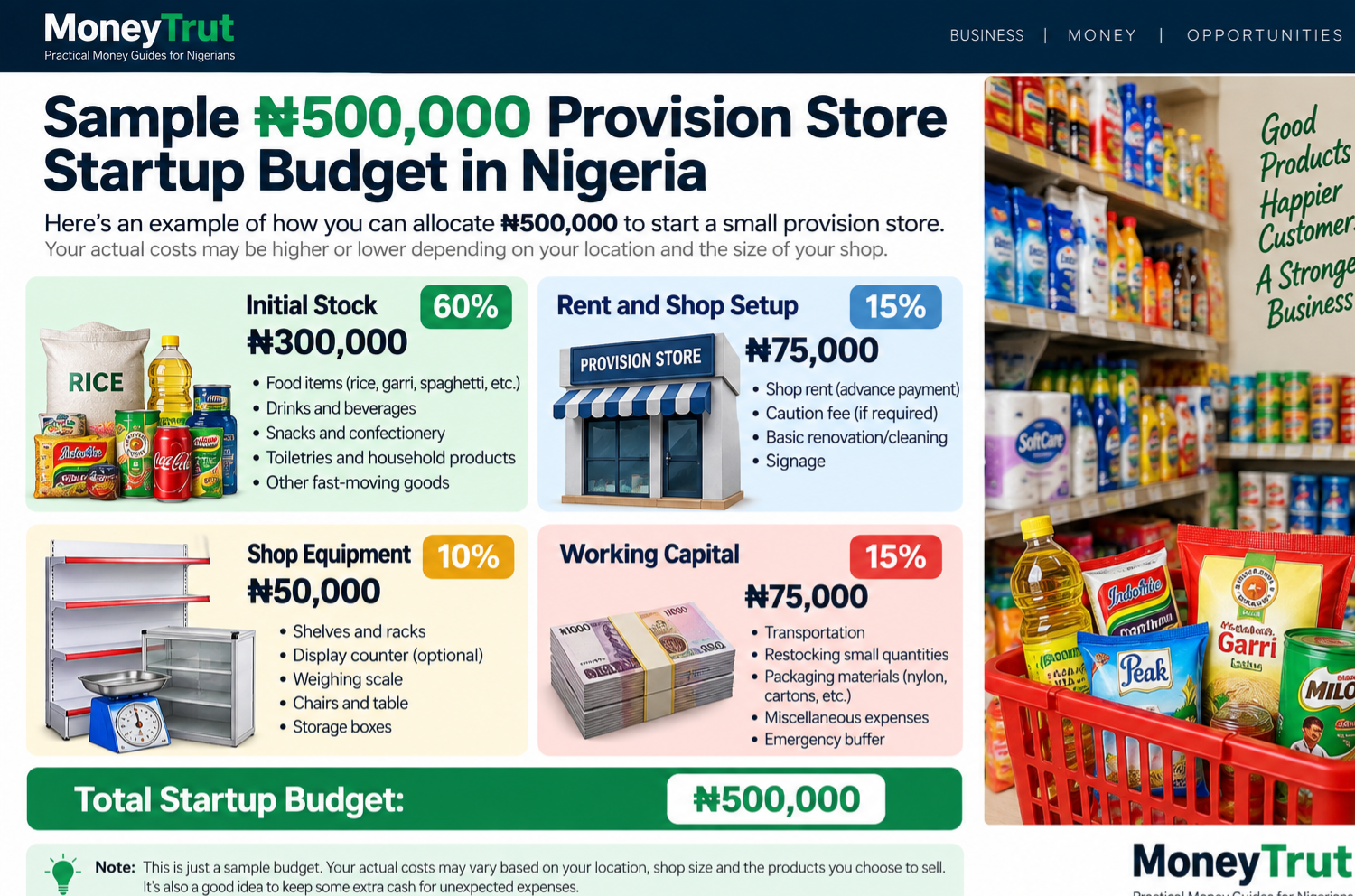
There is no single amount that applies to every Nigerian provision store.
A shop in a small town with a modest product range will require a very different budget from a mini-mart in a major city.
As a planning exercise, you could think about three broad levels.
Small Starter Store: Around ₦300,000–₦500,000+
This could suit someone starting with a limited range of fast-moving products.
Your money might be divided between:
- Initial stock
- Basic shelves
- Small shop or kiosk costs
- Transportation
- Signage
- Working capital
The exact amount can be higher depending on rent and local prices.
Medium Store: Around ₦500,000–₦1.5 million+
With more capital, you can carry a wider range of products and potentially operate from a better-equipped shop.
You may be able to add:
- More shelves
- A display counter
- More groceries
- Drinks and beverages
- Toiletries
- Household products
- Snacks
- Basic refrigeration
Larger Store: ₦1.5 million+
A larger shop or mini-mart can require substantially more capital.
You may need more inventory, better fittings, refrigeration, security equipment, staff and a larger working-capital reserve.
These figures are planning ranges, not fixed market prices. Rent, equipment and wholesale prices vary considerably between locations.
The most important principle is this:
Do not spend your entire startup capital on inventory.
If you spend everything filling the shelves, you may have no money left to restock the products that customers actually buy.
For more on starting a business with limited capital, see How to Start a Small Business in Nigeria With Little Money.
Step 1: Study Your Location Before Renting a Shop
One of the biggest mistakes you can make is renting a shop simply because the rent is cheap.
A cheap shop with very little customer traffic may be more expensive in the long run than a slightly more expensive shop in the right location.
Before committing, observe the area.
Ask:
- How many households are nearby?
- How many provision stores already operate there?
- What products do existing shops sell?
- Are the shops busy?
- What times are customers most active?
- Are there schools, hostels, offices or estates nearby?
- Is the area mainly residential?
- Are there major supermarkets nearby?
- Can customers easily stop and buy from your shop?
- Is the area secure?
- Can suppliers easily reach the location?
Spend several days observing the area if possible.
A provision store depends heavily on convenience.
People often do not want to travel far simply to buy toothpaste, noodles, detergent, bread or a bottle of drink.
Step 2: Identify Your Target Customers
Do not try to sell to everybody.
Your customer profile should influence what you stock.
For example:
Near a university or student area
You may see stronger demand for:
- Noodles
- Bread
- Biscuits
- Drinks
- Snacks
- Toiletries
- Detergent
- Affordable food products
In a family residential area
Demand may be broader:
- Rice
- Cooking ingredients
- Beverages
- Cleaning products
- Baby products
- Toiletries
- Snacks
- Household essentials
Near offices
Convenience products may be more important:
- Bottled drinks
- Water
- Snacks
- Biscuits
- Ready-to-eat products
- Toiletries
Your goal is to stock what your customers repeatedly ask for, not what you personally think looks good on a shelf.
Step 3: Decide What to Sell
Do not make the mistake of buying too many different products simply because you want the shop to look full.
Start with products that have a reasonable chance of moving.
You can divide your inventory into categories.
Food and Cooking Essentials
Examples include:
- Rice
- Garri
- Spaghetti
- Noodles
- Sugar
- Salt
- Seasoning
- Tomato products
- Cooking oil
- Flour
Snacks and Drinks
Examples include:
- Biscuits
- Sweets
- Bottled drinks
- Sachet water
- Energy drinks
- Fruit drinks
- Other locally popular beverages
Toiletries
Examples include:
- Soap
- Toothpaste
- Toothbrushes
- Deodorants
- Tissue
- Sanitary products
Household Products
Examples include:
- Detergent
- Washing soap
- Cleaning products
- Air fresheners
- Insect-control products
- Sponges
The exact product mix should be based on what people around your shop actually buy.
Step 4: Find Reliable Suppliers
Your supplier can have a major effect on your profit.
Two shops may sell the same product at almost the same price, but one may make more money because the owner buys at a better wholesale price.
Look for suppliers whose offer:
- Competitive prices
- Consistent product availability
- Genuine products
- Reliable delivery
- Clear invoices
- Reasonable payment terms where appropriate
Do not automatically choose the supplier with the lowest price.
If a supplier repeatedly gives you damaged, expired or questionable products, the apparent saving can become expensive.
Where possible, compare several wholesalers before committing large amounts of money.
Step 5: Learn the Difference Between Fast-Moving and Slow-Moving Stock
This is one of the most important lessons in retail.
A product can be profitable on paper and still be bad for your business if it takes too long to sell.
Suppose you buy 50 units of a product for ₦1,000 each.
You have ₦50,000 tied up in that stock.
If customers buy only two units every month, your money remains locked up for a long time.
Now imagine another product where you invest ₦50,000 and sell most of the stock within days.
The second product may have a lower margin per unit but produce better cash turnover.
This is why stock turnover matters alongside profit margin.
Your objective is not simply to find products with the highest markup.
You want products that give you a reasonable margin and sell consistently.
Step 6: Set Your Prices Carefully
Do not price products by guessing.
Start with the actual cost of acquiring the product.
Your cost may include:
- Purchase price
- Transportation
- Loading and unloading
- Packaging
- Other direct costs
For example:
You buy a product for ₦8,000.
Transportation and other directly related costs add ₦500.
Your effective cost is therefore:
₦8,000 + ₦500 = ₦8,500
If you sell it for ₦10,000:
₦10,000 − ₦8,500 = ₦1,500 gross profit
That is very different from simply calculating ₦10,000 minus ₦8,000.
Your pricing decisions should also consider what competing shops charge and what customers are willing to pay.
For more detail on pricing, see How to Price Your Products and Services in Nigeria Without Losing Money.
Step 7: Keep Business Money Separate From Personal Money
This sounds simple, but it is one of the easiest ways to destroy a small retail business.
Imagine you make ₦30,000 in sales today.
That ₦30,000 is not automatically your income.
Most of it may need to go back into replacing stock.
If you remove money from the cash drawer every day for food, transport, personal shopping and other expenses, eventually you may discover that you cannot afford to restock.
Create a clear separation between:
Business money
and
Personal money.
Pay yourself an amount the business can realistically support instead of treating the cash register as your personal wallet.
This is also why proper business records matter. MoneyTrut's guide on how to keep business records in Nigeria explains a simple system small-business owners can use.
Step 8: Control Customer Credit
Customer credit can be especially dangerous for small provision stores.
A customer may say:
“Give me the goods. I will pay tomorrow.”
Then tomorrow becomes next week.
Then next week becomes next month.
Meanwhile, you need cash to buy new stock.
If you decide to offer credit, establish clear rules.
Record:
- Customer's name
- Date
- Products taken
- Amount owed
- Expected repayment date
- Amount paid
- Outstanding balance
More importantly, decide who qualifies for credit.
You do not have to give credit simply because someone asks.
A shop with ₦500,000 worth of stock but ₦150,000 stuck with customers may have a serious cash-flow problem.
Step 9: Keep Track of Your Stock
You should know what is entering the shop and what is leaving.
At minimum, record:
- Product
- Quantity purchased
- Purchase price
- Selling price
- Quantity sold
- Quantity remaining
- Supplier
- Date purchased
You do not necessarily need expensive software when starting.
A properly maintained notebook or spreadsheet can be enough for a very small shop.
As the business grows, you can move to more sophisticated inventory and point-of-sale systems.
The important thing is having a system.
Step 10: Watch Expiry Dates
This is particularly important when selling food, drinks, cosmetics and other products with expiry or best-before dates.
When new stock arrives, do not simply put it in front of the old stock.
Use a system that helps older stock move first.
For suitable products, a simple first-in, first-out (FIFO) approach can help:
Older stock → sold first
This reduces the risk of products sitting at the back of the shelf until they become unsellable.
Inspect your shelves regularly.
Do not assume that because something is packaged, it will remain saleable forever.
Step 11: Register the Business
Depending on your circumstances and business plans, you may decide to register the provision store as a business name with the Corporate Affairs Commission.
CAC's current business-name process involves checking name availability, completing the relevant pre-registration information, uploading required documents and paying the applicable filing fee through its Company Registration Portal. CAC also states that individual proprietors can register business names without using a lawyer, chartered accountant or chartered secretary.
CAC currently publishes a 24-working-hour timeline for new business-name registrations once the relevant documents or compliance requirements have been satisfied, although applicants should always check the current portal and requirements before relying on a processing time.
Registration is not what makes a provision store profitable.
Your customers, location, pricing, stock management and cash flow still matter.
But formalizing the business can be useful as the business grows and you begin dealing with suppliers, banks, institutions or other business partners.
Step 12: Start With the Products Customers Actually Want
One of the smartest ways to reduce risk is to let customer behaviour guide your inventory.
Suppose after one month you discover:
- Noodles sell quickly.
- Detergent sells consistently.
- Biscuits sell well.
- A particular drink barely moves.
- An expensive imported snack has not sold.
Your next stock purchase should reflect that information.
Do not keep buying a slow-moving product simply because you like it.
Your shelves should tell you where your money is working.
How to Calculate Whether Your Provision Store Is Making Money
At the end of each period, calculate more than your total sales.
For example:
Total sales: ₦800,000
Cost of products sold: ₦650,000
Gross profit: ₦150,000
Then subtract operating expenses.
Suppose:
- Rent allocation: ₦25,000
- Transport: ₦20,000
- Electricity/fuel: ₦15,000
- Other expenses: ₦10,000
Total operating expenses:
₦70,000
Estimated operating profit:
₦150,000 − ₦70,000 = ₦80,000
This is a simplified example, but it shows why sales alone cannot tell you whether the business is healthy.
For a deeper understanding of break-even calculations, see How to Calculate the Break-Even Point for a Small Business in Nigeria.
Common Mistakes to Avoid
1. Renting a shop before studying the area
A beautiful shop in the wrong location can still fail.
2. Spending all your money on stock
Keep a working-capital reserve.
3. Stocking too many products
More products do not automatically mean more profit.
4. Ignoring small expenses
Transport, fuel, packaging and small daily withdrawals can add up.
5. Giving everybody credit
Uncontrolled credit can destroy your cash flow.
6. Mixing business and personal money
This makes it difficult to know whether the shop is actually profitable.
7. Failing to record sales
Without records, you are largely guessing.
8. Ignoring slow-moving products
Capital trapped in unsold stock cannot easily be used elsewhere.
9. Competing only by lowering prices
You may attract customers while destroying your margin.
10. Assuming high sales means high profit
Revenue and profit are not the same thing.
How to Grow a Provision Store
Once the business becomes stable, you can consider expansion.
Possible options include:
- Adding fast-moving products
- Introducing cold drinks
- Adding household products
- Offering delivery within the neighbourhood
- Accepting digital payments
- Selling through WhatsApp
- Supplying nearby offices or small businesses
- Increasing wholesale purchases for better pricing
- Opening another location
But expansion should come after the first store demonstrates that its numbers work.
Do not open a second branch simply because the first shop looks busy.
First understand:
- Monthly sales
- Gross margin
- Operating expenses
- Stock turnover
- Cash flow
- Customer retention
- Actual profit
Can You Start a Provision Store With ₦100,000?
It is possible to start a very small retail operation with limited money, but ₦100,000 is unlikely to provide the same setup as a properly stocked neighbourhood shop.
If your capital is only ₦100,000, a better approach may be to start with a very narrow product range or consider a smaller home-based or micro-retail model where your overhead is low.
The mistake would be trying to make ₦100,000 look like ₦1 million by buying too many different products in tiny quantities.
Start with what your capital can support.
As sales generate cash, reinvest into inventory.
The principle is:
Start small → sell → learn → reinvest → expand.
Bottom Line
A provision store can be a practical business to start in Nigeria because it serves everyday consumer needs.
But the business is not automatically profitable simply because people need provisions.
Your results will depend on the decisions you make before and after opening the shop.
Choose the location carefully. Start with products people actually buy. Compare suppliers. Price with your real costs in mind. Keep business money separate from personal money. Control customer credit. Track inventory. Watch expiry dates. And keep enough working capital to restock.
You do not need the biggest shop on the street.
You need a shop where your money moves efficiently and where customers have a reason to return.
Related Articles
- How to Start a Small Business in Nigeria With Little Money
- How to Price Your Products and Services in Nigeria Without Losing Money
- How to Keep Business Records in Nigeria: A Simple System for Small Businesses
- How to Calculate the Break-Even Point for a Small Business in Nigeria
- How to Manage Cash Flow in a Small Business in Nigeria
- How to Get Repeat Customers for a Small Business in Nigeria

You must be logged in to post a comment.