
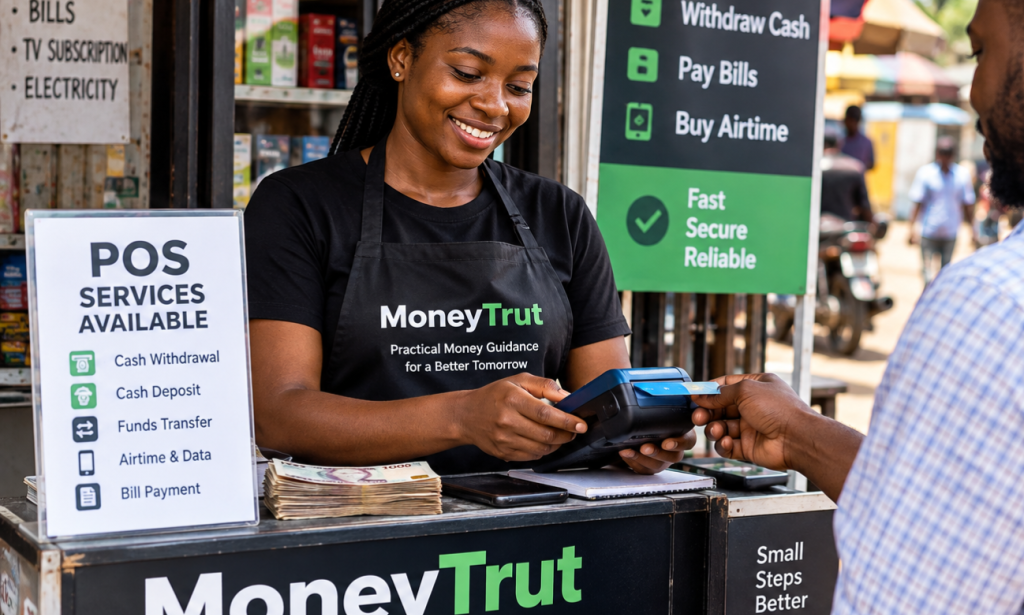
Starting a POS business in Nigeria involves more than getting a POS terminal and finding a busy location.
You need enough working capital to handle customer withdrawals, a reliable agent-banking provider, a suitable location, proper transaction records and a clear understanding of your costs and commissions.
The Central Bank of Nigeria (CBN) issued revised Guidelines for the Operations of Agent Banking in October 2025, with provisions covering agent operations, consumer protection, security, due diligence and other requirements. Some provisions, including agent-location and exclusivity requirements, took effect from April 1, 2026.
This guide explains how to start a POS business in Nigeria, the money you need to consider, how POS agents make money, how to calculate profit, how to choose a location, how to manage cash and how to reduce the risks involved.
What Is a POS Business?
A POS business allows an agent to provide certain financial services to customers through a payment terminal on behalf of an authorised financial institution or payment provider.
Depending on the provider and services available to the agent, customers may be able to use a POS location for services such as:
- Cash withdrawals
- Cash deposits
- Fund transfers
- Bill payments
- Airtime purchases
- Other permitted financial services
The exact services available depend on the provider and the agent's authorisation.
The CBN describes agent banking as the provision of financial services by a third party to customers on behalf of a licensed financial institution.
How Does a POS Agent Make Money?
A POS agent generally earns income from the fees or commissions associated with transactions and other permitted services.
For example, customers may pay a service charge for a cash withdrawal or another transaction, depending on the provider's pricing structure.
The agent does not simply keep all the money received from customers.
You need to understand:
Customer charge
Provider's share, where applicable
Agent commission
Operating expenses
Your actual profit is what remains after the relevant costs.
This is why a POS business can have many transactions but still produce disappointing profits if its costs are poorly controlled.
How Much Money Do You Need to Start a POS Business?
There is no single startup amount that applies to every POS business in Nigeria.
Your capital requirement depends heavily on your location and expected transaction volume.
You may need money for:
- Working cash
- POS terminal or provider-related costs
- Business registration where applicable
- Shop or kiosk
- Rent
- Signage
- Electricity
- Internet or data
- Security
- Transportation
- Emergency cash reserves
The most important part is often the working cash.
If customers come to your location to withdraw money, you need enough cash available to serve them.
A person may have a POS terminal but still be unable to operate effectively because there is not enough cash to meet customer withdrawals.
Why Working Capital Matters More Than the Terminal
Imagine you have a POS terminal but only ₦30,000 in cash.
A customer wants to withdraw ₦50,000.
You cannot complete the transaction unless you have sufficient cash or another appropriate way to fulfil it.
Now imagine several customers arrive at the same time.
This is why a POS business should be viewed as a cash-management business, not simply a terminal business.
Your terminal is the tool.
Your cash and account balances are part of the operating capital.
Example of a Small POS Setup
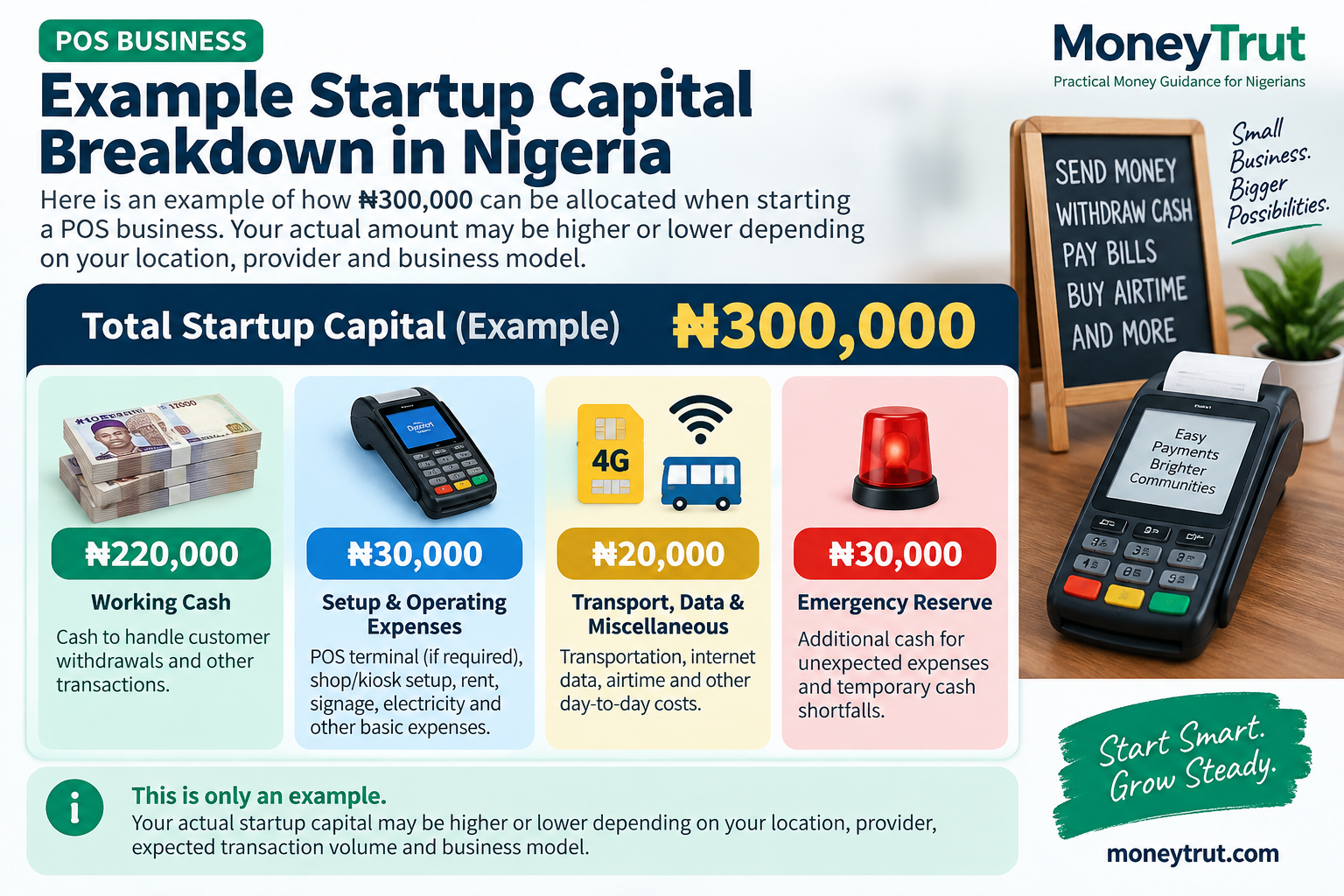
Suppose you have ₦300,000 available.
You could create a simple starting plan such as:
₦220,000 — working cash
₦30,000 — operating and setup expenses
₦20,000 — transportation/data/miscellaneous costs
₦30,000 — emergency reserve
This is only an illustration.
It does not mean ₦300,000 is the required amount to start a POS business.
Your actual requirement depends on the location, provider, transaction demand and other costs.
Choose Your Location Carefully
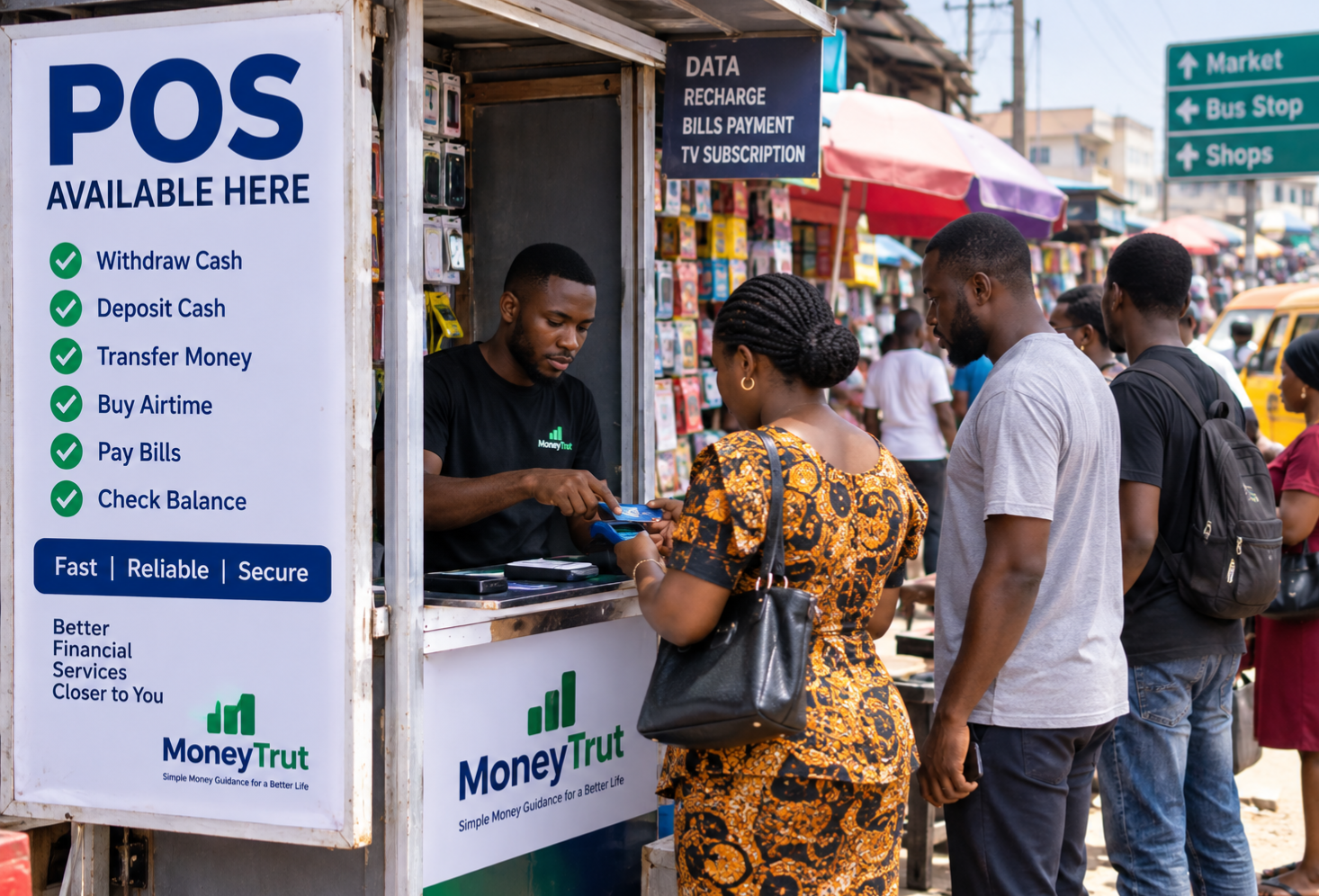
Location can make a major difference.
A POS business needs people who regularly need financial transactions.
Potential locations could include areas near:
- Markets
- Busy residential communities
- Transport areas
- Student communities
- Small business clusters
- Areas with limited access to nearby banking facilities
- High-footfall neighbourhoods
But high foot traffic alone is not enough.
You also need to consider competition.
If ten POS agents are already operating within a few metres of each other, simply opening an eleventh terminal may not produce the results you expect.
Study the Location Before Paying Rent
Spend time observing the area before committing money.
Visit at different times of the day.
Look at:
How many people pass through?
How many POS agents operate nearby?
Do customers queue?
Are agents frequently out of cash?
Are there nearby ATMs or bank branches?
What services do existing agents offer?
What charges are customers already paying?
You are trying to identify a gap.
For example, if customers regularly leave a nearby POS location because the agent runs out of cash, reliable cash availability could become part of your competitive advantage.
Don't Choose a Location Only Because It Is Busy
A busy road does not automatically mean a profitable POS location.
Suppose 5,000 people pass through a location every day but most are simply commuting and do not need your service.
Another location may have fewer people but a much higher percentage of people who regularly need cash withdrawals and transfers.
What matters is not simply traffic.
It is relevant demand.
Understand the Current Agent Banking Rules
This is one area where new POS business owners should avoid relying on old blog posts.
The CBN issued revised Guidelines for the Operations of Agent Banking on October 6, 2025. The guidelines set minimum standards for agent banking operations and cover areas including agent relationships, consumer protection, security, risk management and operational requirements.
The CBN also stated that implementation of agent-location and agent-exclusivity provisions would take effect from April 1, 2026.
Because regulations and provider requirements can change, check the current requirements with your bank, payment service provider and the CBN before setting up or expanding an agent location.
Choose a Reliable POS Provider
You may encounter several banks, fintechs and payment providers offering POS or agent services.
Do not choose one simply because someone says:
"Their POS is the best."
Compare the provider based on factors such as:
- Transaction reliability
- Network performance
- Settlement process
- Agent support
- Charges
- Commission structure
- Availability of services
- Dispute resolution
- Security features
- Provider requirements
A provider with slightly different charges may still be better for your location if transactions are more reliable.
Don't Ignore Network Reliability
A POS business can lose customers when transactions repeatedly fail.
Imagine a customer needs ₦100,000 urgently.
You try the transaction.
It fails.
You try again.
It fails again.
The customer may go to another agent.
If this happens repeatedly, customers may stop seeing your location as reliable.
This is why network and transaction reliability should be considered when selecting a provider.
The CBN has also introduced measures aimed at strengthening the resilience of POS and electronic payment infrastructure.
How Much Can a POS Agent Make?
There is no fixed monthly profit for a POS business.
Anyone promising that every POS agent will automatically make a particular amount each month is oversimplifying the business.
Your income depends on:
- Number of transactions
- Transaction size
- Commission or permitted charges
- Service mix
- Location
- Competition
- Operating expenses
- Network reliability
- Cash availability
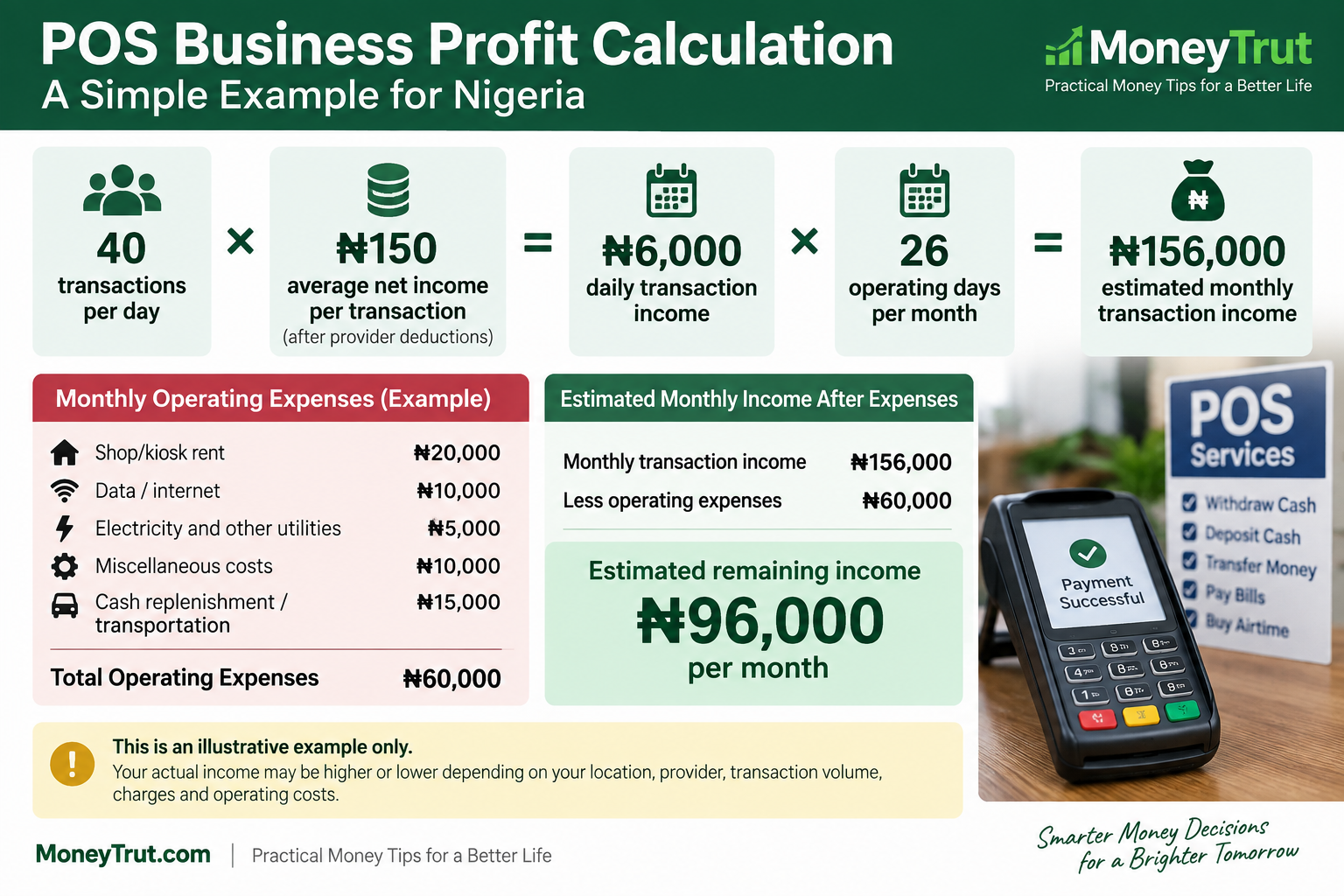
Consider a simple example.
Suppose your average net income per transaction after applicable provider deductions is ₦150.
If you complete 40 transactions per day:
40 × ₦150 = ₦6,000
Over 26 operating days:
₦6,000 × 26 = ₦156,000
That is an illustrative transaction-income calculation, not a guaranteed POS profit.
If your monthly operating costs are ₦50,000:
₦156,000 − ₦50,000 = ₦106,000
Your actual result could be much higher or lower depending on your transaction mix and real costs.
Transaction Volume Matters
Suppose another agent earns only ₦100 per transaction but processes 80 transactions per day.
That agent's daily transaction income would be:
80 × ₦100 = ₦8,000
At 26 operating days:
₦8,000 × 26 = ₦208,000
This illustrates why you should not look at the fee on one transaction in isolation.
The important question is:
How many profitable transactions can this location realistically generate?
Cash Withdrawal Is Not the Only Service
Depending on your provider and authorisation, you may be able to offer multiple services.
These can include:
- Withdrawals
- Deposits
- Transfers
- Airtime
- Bill payments
- Other permitted agent-banking services
Having several useful services can increase the number of reasons customers visit your location.
However, do not add a service simply because it exists.
Understand how it works and what income, costs and risks are associated with it.
Cash Management Is One of Your Biggest Challenges
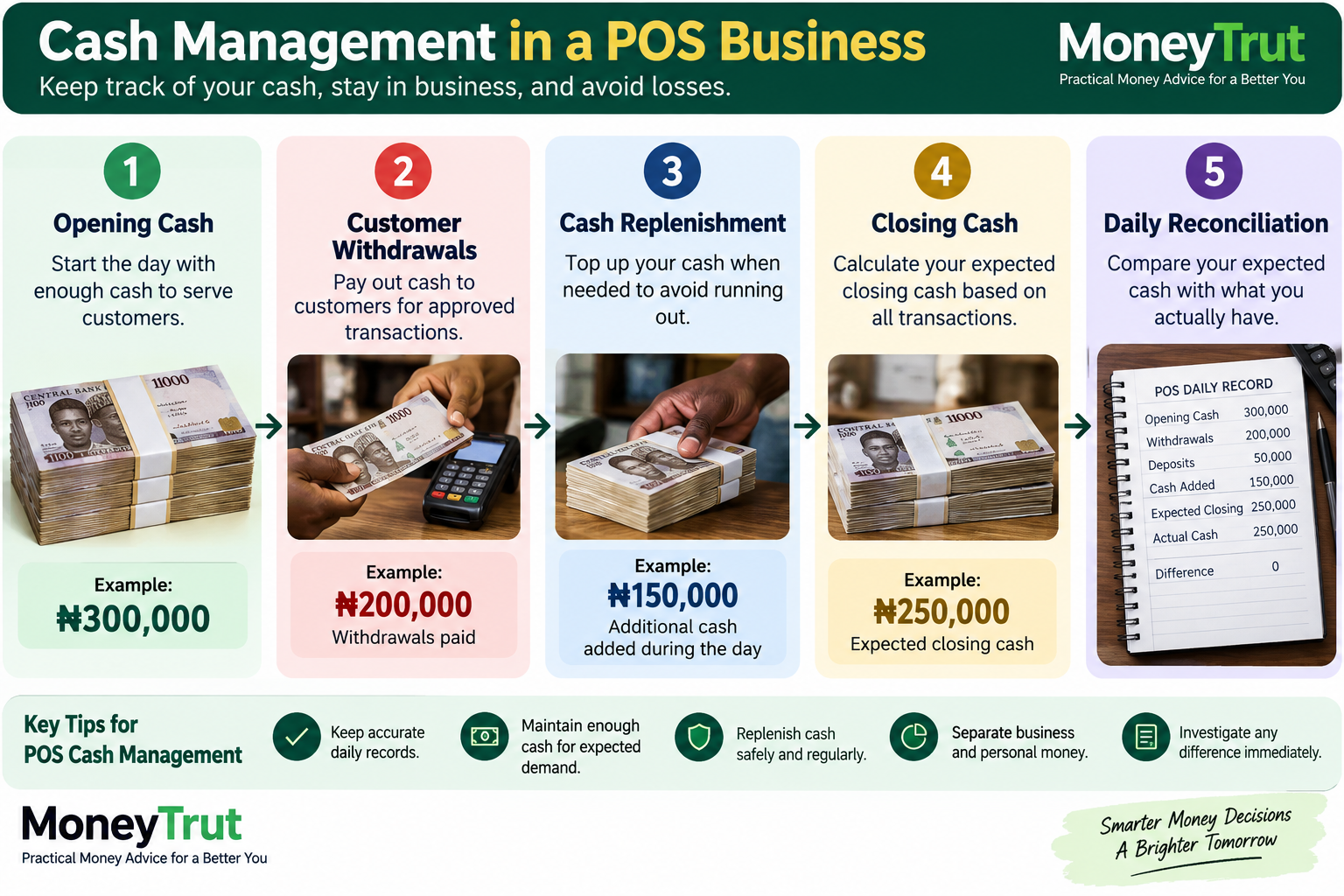
A POS agent can have a profitable location and still experience problems because of poor cash management.
Suppose you start the day with:
₦300,000 cash
Customers withdraw:
₦220,000
You may now have only:
₦80,000
available for further withdrawals.
If you do not plan how to replenish your cash, you could lose customers later in the day.
You therefore need to understand:
Where will I get additional cash?
How often can I rebalance?
What is the safest way to transport cash?
How much cash should I keep on-site?
Avoid keeping unnecessarily large amounts of physical cash where possible.
Keep Your POS Account and Cash Records
At the end of each day, you should be able to reconcile your business.
For example:
Opening cash: ₦300,000
Cash withdrawals paid: ₦200,000
Cash deposits received: ₦50,000
Other cash movements: ₦10,000
Expected closing cash: Calculate based on the actual transactions.
Then compare the expected figure with what you physically have.
If the numbers do not match, investigate.
A small unexplained difference every day can become a significant loss over a month.
Keep Business Money Separate
One of the easiest ways to lose track of a POS business is to treat the cash as personal money.
Suppose your POS business has ₦500,000 available.
You take ₦50,000 to pay a personal bill.
Now your business may not have enough cash to handle customers.
You need to separate:
Business working capital
from
Personal spending
If you need to take money from the business, record it properly.
This is the same principle that applies to other small businesses.
Our guide on How to Keep Business Records in Nigeria explains why proper records matter.
What Happens When a POS Transaction Fails?
A failed transaction can create a serious customer-service problem.
For example:
A customer requests a ₦50,000 withdrawal.
The customer's account is debited.
But you do not receive the cash confirmation you expect.
The customer is understandably worried.
Do not simply tell the customer:
"It will reverse."
Check the transaction status through the appropriate provider channel.
Keep the transaction reference.
Document the issue.
Follow the provider's dispute process.
The CBN maintains consumer-protection and complaint mechanisms, and customers are expected to first lodge complaints with their financial institution before escalating through the CBN complaint process where appropriate.
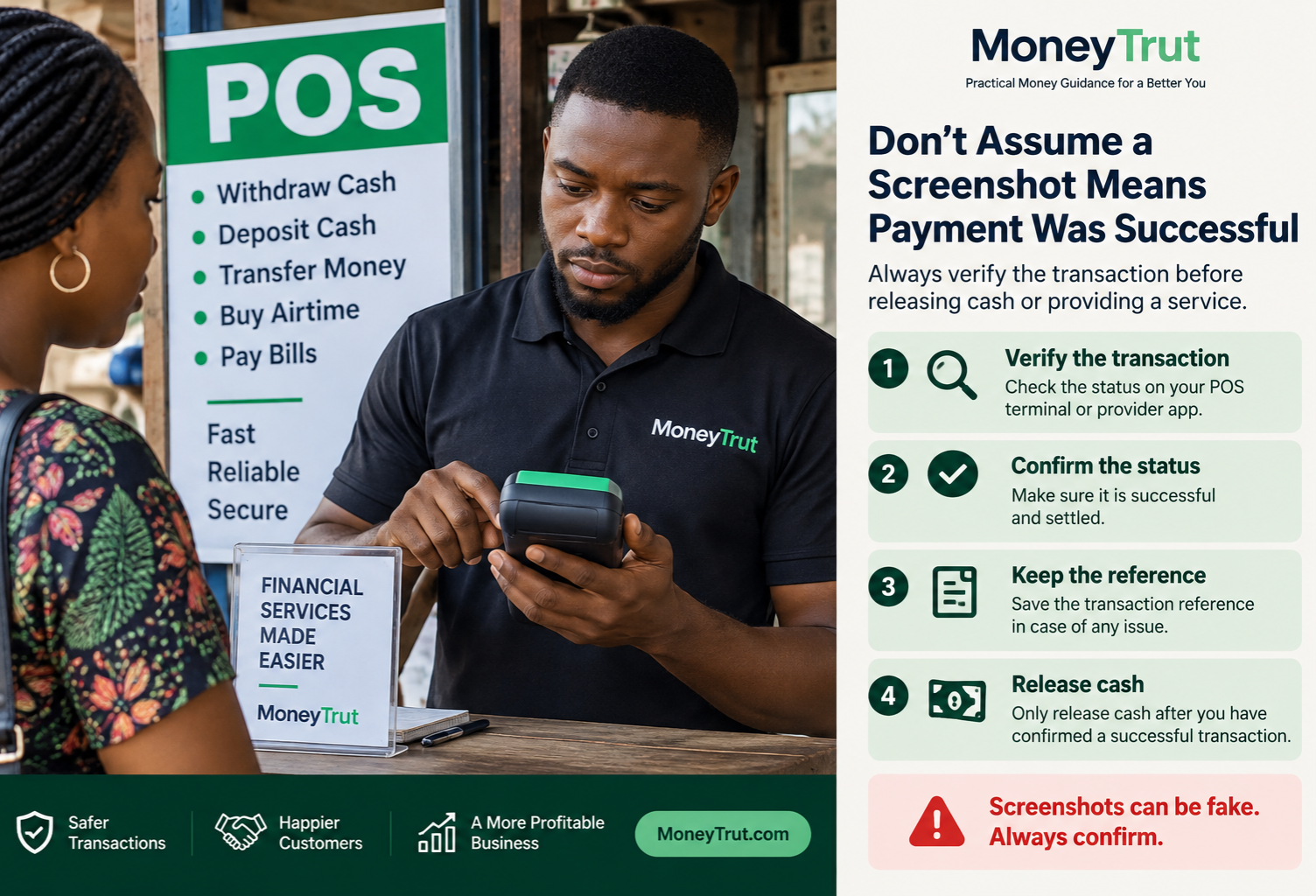
Never Assume a Screenshot Means Payment Was Successful
This is an important rule for POS agents.
A customer may show you:
- A screenshot
- An SMS
- A transfer notification
- A transaction reference
But your business should confirm the transaction through the appropriate system before releasing cash or goods.
Screenshots can be manipulated.
Messages can be delayed.
Transactions can fail.
Your records and the provider's confirmation should determine whether a transaction was successfully completed.
Protect Customer Information
POS agents handle sensitive financial information.
Do not casually record or share:
- Customer PINs
- Card details
- Account information
- Transaction information
- Identification documents
The CBN emphasises privacy and confidentiality as important rights for bank customers.
You should also avoid asking customers to reveal their PIN to you.
The customer should enter sensitive authentication information themselves.
Be Careful About Fraud
POS businesses can be attractive targets for fraud because they handle cash and financial transactions.
Fraudsters may use:
- Fake payment screenshots
- Social engineering
- Stolen cards
- Fake reversal claims
- False transaction confirmations
- Attempts to distract agents during transactions
The CBN advises consumers and financial-service users to verify suspicious requests and report suspected fraud promptly to their financial institution and relevant authorities.
Your staff should receive basic fraud-awareness training if you employ other people.
Don't Allow Customers to Rush You
A common fraud technique can involve creating pressure.
A customer may say:
"Please hurry. I am late."
That should not cause you to skip verification.
For every transaction:
Confirm the amount.
Confirm the transaction status.
Confirm the customer's request.
Complete the transaction properly.
Speed is useful.
Accuracy is more important.
Consider Security Before Opening
Think about physical security.
Your location should ideally have:
- Good visibility
- Adequate lighting
- Secure cash handling
- A safe way to close the business
- Appropriate security arrangements
- Limited unnecessary exposure of cash
The more cash you handle, the more seriously you should take security.
Avoid publicly displaying large amounts of cash.
Should You Rent a Shop?
Not necessarily.
Some agents operate from small kiosks or other permitted locations.
The right setup depends on:
- Provider requirements
- Local conditions
- Security
- Customer demand
- Rent
- Space
- Expected transaction volume
If you are testing a new location, avoid committing to an expensive lease before you understand the economics.
A POS Business Can Work Alongside Another Business
Some entrepreneurs combine POS services with another business.
For example:
POS + phone accessories
POS + mini-mart
POS + provisions
POS + recharge/accessories
This can help because the POS service may bring additional foot traffic while the other business generates its own sales.
However, do not allow the POS operation to interfere with the primary business.
Both should have proper records.
Calculate Your Break-Even Point
Suppose your monthly fixed operating costs are:
₦60,000
and your average net income per transaction is:
₦150
You need:
₦60,000 ÷ ₦150 = 400 transactions
to cover those fixed costs.
If you operate 26 days per month:
400 ÷ 26 ≈ 15.4 transactions per day
So you would need roughly 16 transactions per day just to cover those assumed fixed costs.
That is a simplified break-even calculation.
Your actual calculation should use your real costs and average contribution per transaction.
For more information, see How to Calculate the Break-Even Point for a Small Business in Nigeria.
What If Your Location Is Not Making Enough Money?
Do not immediately buy another terminal.
First investigate the problem.
Ask:
Is there enough customer demand?
Are transaction charges competitive?
Are customers experiencing failed transactions?
Do I have enough cash?
Is the location secure and convenient?
Is competition too strong?
Are my operating costs too high?
You may discover that the problem is the location rather than the terminal.
Common Mistakes New POS Agents Make
Starting without enough working cash
A terminal cannot serve customers if you cannot fund withdrawals.
Choosing a location without researching demand
A busy area is not necessarily a profitable area.
Choosing a provider only because of a cheap terminal
Reliability and support matter.
Spending business cash personally
This can quickly reduce your ability to serve customers.
Failing to reconcile transactions
Small discrepancies can accumulate.
Releasing cash based on screenshots
Always verify transactions through the appropriate system.
Ignoring security
POS businesses handle both cash and sensitive financial transactions.
Assuming every transaction is profitable
Some transactions may have low margins after costs.
Relying on outdated regulatory information
Agent-banking rules can change. Check current CBN and provider requirements.
A Simple POS Business Startup Checklist
Before starting, ask:
Have I researched the location?
Have I compared providers?
Do I understand the provider's requirements?
Do I have enough working capital?
Do I have a plan for replenishing cash?
Do I understand the current agent-banking rules?
Do I have proper transaction records?
Do I understand how failed transactions are resolved?
Do I have a security plan?
Have I calculated my expected break-even point?
If you cannot answer these questions, spend more time planning before committing your money.
A Simple Example
Suppose you have ₦500,000 available.
You decide to allocate:
₦350,000 — working cash
₦50,000 — setup and operating expenses
₦50,000 — emergency reserve
₦50,000 — other working requirements
Now suppose your business processes an average of 50 transactions per day and your average net income per transaction is ₦150.
Daily transaction income:
50 × ₦150 = ₦7,500
At 26 operating days:
₦7,500 × 26 = ₦195,000
If operating expenses are ₦70,000:
₦195,000 − ₦70,000 = ₦125,000
Again, this is only an example.
Actual POS income depends on your provider, transaction mix, charges, commissions, operating costs and customer volume.
How to Grow a POS Business
Once the basic operation is stable, growth could involve:
- Increasing transaction volume
- Improving customer service
- Adding permitted services
- Serving nearby businesses
- Extending operating hours where safe and worthwhile
- Combining POS with another business
- Opening another location only after proving demand
Do not expand simply because the first month looks good.
First determine whether the result is consistent.
A profitable month does not automatically mean you have a sustainable business.
Bottom Line
A POS business in Nigeria can generate income, but it is not simply a matter of buying a terminal and standing beside a busy road.
The real business is managing cash, transactions, customers, security and operating costs.
Before starting, research your location, compare providers, understand the current CBN agent-banking requirements and make sure you have enough working capital.
Then track every transaction.
Know how much money comes in.
Know how much goes out.
Know how much you earn per transaction.
Know your monthly expenses.
And most importantly, know whether the location is producing enough transaction volume to justify the capital and risk involved.
A POS business can become a useful standalone business or an additional service alongside another small business, but it should be treated as a real financial-services operation rather than an easy-money shortcut.
Related Articles
- How to Choose the Right Bank Account in Nigeria
- How Bank Transfers Work in Nigeria: NIP, USSD, Mobile Banking and What Happens When a Transfer Fails
- How to Keep Business Records in Nigeria: A Simple System for Small Businesses
- How to Calculate the Break-Even Point for a Small Business in Nigeria
- How to Manage Cash Flow in a Small Business in Nigeria

You must be logged in to post a comment.