
Starting a cleaning business in Nigeria does not necessarily require a shop, large office or expensive equipment. You can begin with basic cleaning supplies, a focused service, a small customer base and a system for delivering consistent results. The key is to understand your target customers, calculate your real costs, price each job properly and build enough trust for customers to call you again.
What Is a Cleaning Business?
A cleaning business provides paid cleaning services to individuals, households, businesses or property owners. Depending on the model, you could clean:
- Homes
- Offices
- Shops
- Restaurants
- Short-let apartments
- Move-in and move-out properties
- Newly renovated buildings
- Schools
- Churches and other facilities
- Upholstery and carpets You do not have to offer every service when you start. A beginner may choose one specific service, build experience and then expand. For example, you could start with residential cleaning and later add office cleaning, post-construction cleaning or short-let turnover services.
Is a Cleaning Business Profitable in Nigeria?
A cleaning business can generate profit, but profitability depends on how you structure and price the service. A customer may pay you ₦25,000 for a cleaning job, but that does not mean you made ₦25,000. You may have to pay for:
- Cleaning chemicals
- Transportation
- Labour
- Water
- Equipment maintenance
- Packaging or consumables
- Marketing
- Phone and communication costs Suppose you charge: ₦25,000 Your direct costs are:
- Cleaning supplies: ₦3,000
- Transport: ₦3,000
- Assistant: ₦6,000 Your contribution before other overheads is: ₦25,000 − ₦12,000 = ₦13,000 That is very different from saying the business made ₦25,000. Your calculations should always separate sales revenue, direct costs and profit.
Step 1: Choose the Type of Cleaning Business You Want to Start
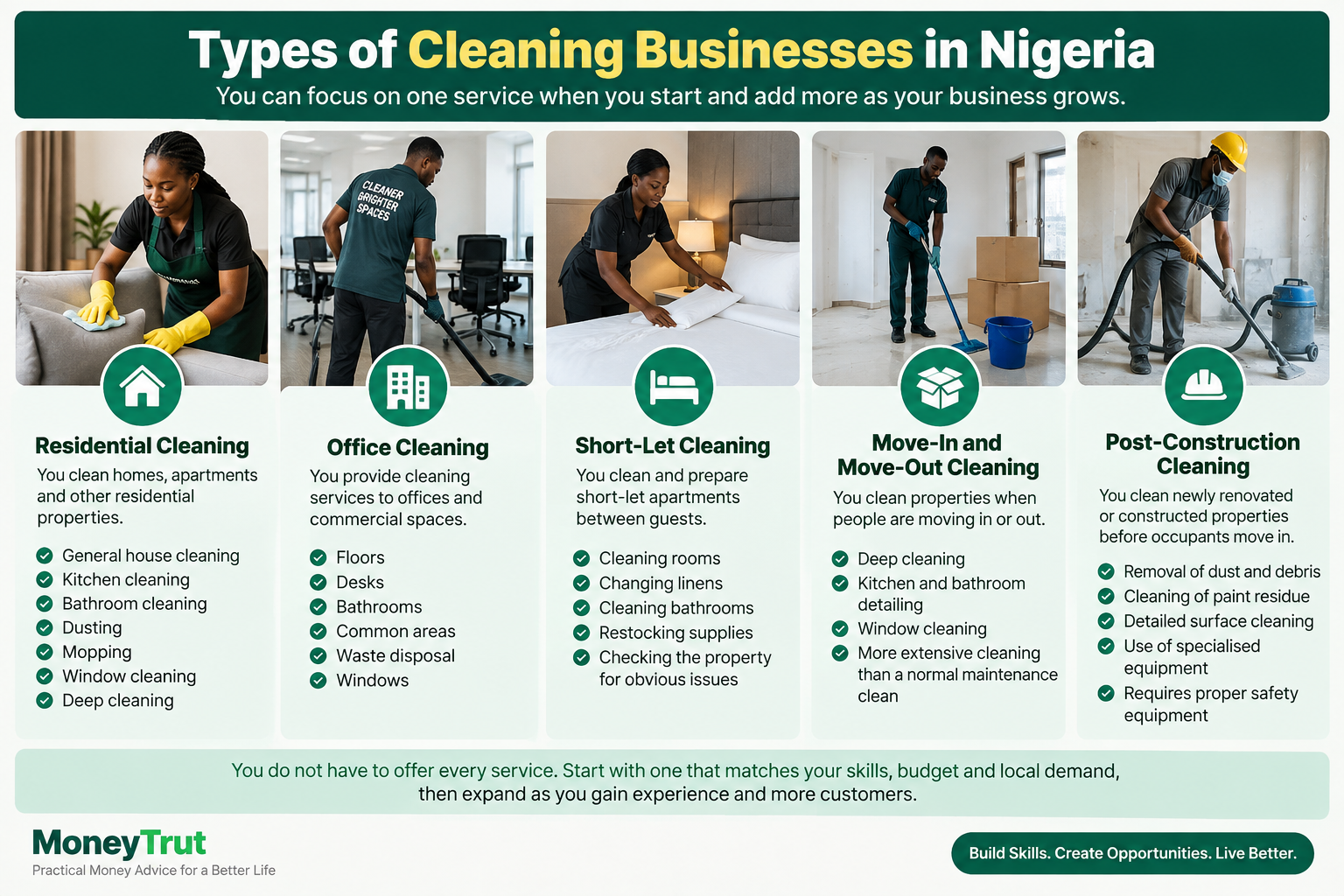
One of the first decisions is deciding what type of cleaning service you will provide.
Residential Cleaning
You clean homes, apartments and other residential properties. Services may include:
- General house cleaning
- Kitchen cleaning
- Bathroom cleaning
- Dusting
- Mopping
- Window cleaning
- Deep cleaning This can be a practical starting point because you can begin with relatively basic equipment.
Office Cleaning
You provide cleaning services to offices and commercial spaces. This may involve:
- Floors
- Desks
- Bathrooms
- Common areas
- Waste disposal
- Windows Office contracts can potentially provide recurring work, but clients may expect consistent schedules and professional standards.
Short-Let Cleaning
Short-let apartments require cleaning between guests. The work can include:
- Cleaning rooms
- Changing linens
- Cleaning bathrooms
- Restocking supplies
- Checking the property for obvious issues This type of service can work particularly well where short-let properties are concentrated.
Move-In and Move-Out Cleaning
People moving into or out of a property may need more extensive cleaning. These jobs can require more time and stronger cleaning products than a normal maintenance clean.
Post-Construction Cleaning
Newly renovated or constructed properties may need substantial cleaning before occupants move in. This can involve dust, debris, paint residue and other construction-related mess. It may require more specialised equipment and protective equipment, so it is not necessarily the best first service for someone with very limited capital.
Step 2: Start With a Specific Customer
Do not simply say: “I clean everything for everybody.” Be more specific. For example: “I provide weekly home cleaning for busy professionals in my area.” Or: “I provide cleaning and turnover services for short-let apartments.” Or: “I provide after-hours office cleaning for small businesses.” A clear target customer makes it easier to decide:
- What equipment to buy
- How to price
- Where to advertise
- What service package to create
- What customers to approach
Step 3: Research Your Local Market
Before buying equipment, research your area. Look at existing cleaning businesses and find out:
- What services they offer
- How they price
- What areas they cover
- Whether they offer recurring services
- Whether they provide supplies
- Whether transportation is included
- What customers say in their reviews You should also speak with potential customers. Ask:
- What cleaning service do you currently use?
- What do you pay?
- How often do you need cleaning?
- What do you dislike about your current service?
- Would you prefer a one-time or recurring service?
- Would you pay extra for supplies or transport? The goal is not to copy another cleaner. It is to understand the market you are entering.
Step 4: Decide Whether You Need a Shop
In many cases, you do not. A cleaning business can operate from home while the cleaner travels to customers. This can eliminate or reduce:
- Shop rent
- Shop renovation
- Signage
- Some utility costs Your home can serve as the base where you store supplies and equipment, provided the arrangement is suitable. You can then travel to customers with the equipment required for each job. This can be especially useful when starting with limited capital. Instead of spending ₦300,000 or ₦500,000 setting up a shop, you could direct more of your money toward equipment, transportation and customer acquisition.
Step 5: Buy the Equipment You Actually Need
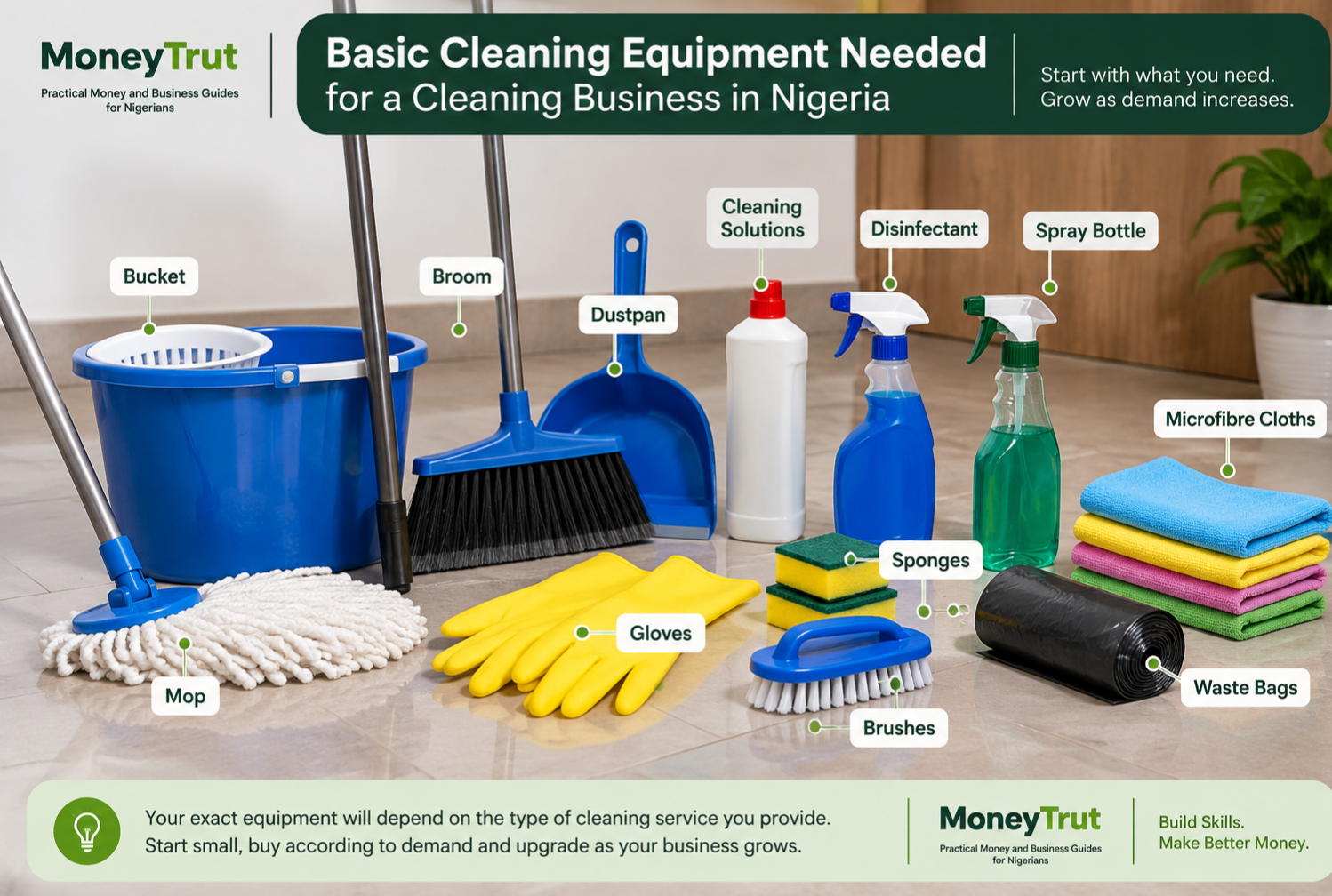
Your equipment depends on the services you provide. Basic supplies may include:
- Mop
- Buckets
- Brooms
- Dustpans
- Brushes
- Microfibre cloths
- Sponges
- Gloves
- Cleaning solutions
- Disinfectants
- Waste bags
- Spray bottles For larger jobs, you may eventually need:
- Vacuum cleaner
- Pressure washer
- Wet and dry vacuum
- Extension cables
- Ladders
- Floor-cleaning equipment
- Carpet-cleaning equipment Do not buy every machine you see advertised. If your first customers only need basic home cleaning, expensive specialised equipment may sit unused. Buy according to the services you have evidence people will pay for.
Step 6: Understand Cleaning Products and Safety
Cleaning chemicals should be handled carefully. Read product labels and follow the manufacturer's instructions. Do not mix cleaning chemicals simply because someone online says the combination is stronger. Some combinations can create dangerous fumes or chemical reactions. Use appropriate protective equipment, particularly gloves and other protection required for the product or task. If you are working with stronger chemicals or specialised cleaning processes, make sure you understand the relevant safety requirements before offering the service. A professional cleaner should protect both the customer's property and their own health and safety.
Step 7: Decide What Your Service Includes
Customers should know exactly what they are paying for. For example, a basic home-cleaning package might include:
- Sweeping
- Mopping
- Dusting
- Bathroom cleaning
- Kitchen surface cleaning A deep-cleaning package could include additional work such as:
- Detailed bathroom cleaning
- Kitchen degreasing
- Interior window cleaning
- Hard-to-reach areas
- More detailed surface cleaning The exact package should depend on the property. Avoid vague promises such as: “We clean everything.” Define the scope of work.
Step 8: Calculate Your Cost Per Job
Before setting a price, calculate what the job actually costs you. Suppose a job takes: 5 hours You may have:
- Cleaning supplies: ₦2,500
- Transport: ₦3,000
- Assistant: ₦5,000
- Miscellaneous costs: ₦1,500 Total direct cost: ₦12,000 If you charge ₦20,000: ₦20,000 − ₦12,000 = ₦8,000 That ₦8,000 is not necessarily your final profit because the business may also have recurring overheads. But you now have a much better basis for pricing. This is why pricing should come after understanding your costs. For more on pricing, see How to Price Your Products and Services in Nigeria Without Losing Money.
Step 9: Create a Simple Pricing System
You can price cleaning services in several ways.
Price Per Job
You give the customer a fixed price for the entire property. This can be simple for customers.
Price Per Room
You charge based on the number or type of rooms.
Price By Property Size
Larger properties generally require more time and labour.
Hourly Pricing
You charge according to the amount of time spent. This can work for some services but requires clear expectations about what can be completed during the booked period.
Recurring Service Pricing
You offer weekly, biweekly or monthly cleaning arrangements. Recurring customers can make revenue more predictable, but the price still needs to cover your actual costs. Do not choose a pricing model simply because another cleaner uses it. Choose one that makes your own numbers work.
Step 10: Charge for Distance When Necessary
Transportation can quietly destroy a cleaning business's margin. Suppose you charge ₦20,000 for a job. If transportation costs you ₦5,000, you have already lost 25% of the revenue to transport before paying for cleaning materials or labour. You can manage this by:
- Setting a service area
- Charging a location fee
- Including transport in your price
- Grouping customers in nearby areas
- Scheduling jobs efficiently A customer who lives 2 kilometres away and one who lives 30 kilometres away should not necessarily cost you the same amount to serve.
Step 11: Get Your First Customers
You do not need hundreds of customers to start. You need your first few customers who are willing to pay and give you an opportunity to demonstrate your service. Possible approaches include:
Create a simple business profile and post:
- Before-and-after photos
- Services
- Prices or starting prices
- Customer feedback
- Availability
Social Media
Instagram, TikTok and Facebook can help showcase visual results. Cleaning is particularly suited to before-and-after content because the improvement can be easy to see.
Referrals
Ask satisfied customers to recommend you. A simple referral can be more valuable than a large number of people who have never used your service.
Local Businesses
Approach:
- Offices
- Salons
- Restaurants
- Shops
- Short-let operators
- Small hotels You can offer a clear service proposal instead of simply asking: “Do you need a cleaner?”
Step 12: Build Trust
Cleaning is a trust-based business. A customer may give you access to:
- Their home
- Bedroom
- Office
- Personal belongings
- Business premises Professionalism matters. Build trust through:
- Clear communication
- Punctuality
- Proper identification
- Respect for property
- Consistent cleaning quality
- Transparent pricing
- Professional appearance
- Reliable customer service
- Proper handling of keys or access codes Do not underestimate this. A customer who trusts your business may use your service repeatedly and recommend you to others.
Step 13: Keep Customer Records
Record:
- Customer name
- Phone number
- Address or service location
- Service requested
- Date
- Price
- Payment status
- Special instructions
- Cleaning products required
- Feedback This makes the business easier to manage as the customer base grows. For a simple record-keeping approach, see How to Keep Business Records in Nigeria: A Simple System for Small Businesses.
Step 14: Turn One-Time Customers Into Recurring Customers
A one-time cleaning job is useful. A customer who books every week is potentially much more valuable to the business. After completing a job, ask whether the customer would like:
- Weekly cleaning
- Biweekly cleaning
- Monthly cleaning You can also create recurring packages. For example: Weekly Home Cleaning Four visits per month. Biweekly Home Cleaning Two visits per month. Monthly Deep Cleaning One more extensive cleaning visit. Recurring arrangements can make planning easier because you have a clearer idea of upcoming work.
Step 15: Calculate Your Break-Even Point
Suppose your monthly fixed business costs are: ₦60,000 After paying the direct costs associated with each cleaning job, your average contribution is: ₦5,000 per job Your simplified break-even point is: ₦60,000 ÷ ₦5,000 = 12 jobs You therefore need approximately 12 jobs per month to cover those assumed fixed costs. If you work 24 days per month: 12 ÷ 24 = 0.5 jobs per day This is only an example. Your actual break-even point depends on your fixed costs and the contribution from each job. For a more detailed explanation, see How to Calculate the Break-Even Point for a Small Business in Nigeria.
How Much Money Do You Need to Start a Cleaning Business?
There is no universal startup figure. A person starting a basic home-cleaning service could require considerably less capital than someone setting up a specialised commercial cleaning company. Your initial spending may include:
- Basic cleaning tools
- Cleaning chemicals
- Protective equipment
- Transportation
- Branding
- Marketing
- Phone/data
- Equipment
- Working capital If you already own some equipment, your starting cost can be lower. If you need specialised machines, your capital requirement will be much higher. A sensible approach is to create your own startup budget before spending money. For example: Basic equipment: ₦80,000
Cleaning supplies: ₦30,000
Protective equipment: ₦15,000
Marketing: ₦20,000
Transportation reserve: ₦25,000
Working capital: ₦80,000
Total: ₦250,000 This is an illustrative example, not a fixed market price. Actual equipment and supply prices vary by location, quality and supplier.
Can You Start a Cleaning Business With ₦100,000?
You may be able to start a very small cleaning service with ₦100,000 if you already have access to some basic equipment and operate with a narrow service range. You would need to keep your overhead extremely low. For example, you might start with:
- Basic cleaning tools
- Small quantities of supplies
- Protective equipment
- Transportation
- Simple marketing You would probably not want to spend the entire ₦100,000 immediately. The objective at this stage is to get paying customers, learn the service and reinvest some of the earnings. If you need expensive machines, a shop and employees immediately, ₦100,000 will not be enough for that model.
Should You Register a Cleaning Business?
If you plan to operate the business seriously, you may choose to register it with the Corporate Affairs Commission. CAC's current process allows business-name registration through its Company Registration Portal. The Commission says applicants should check name availability, complete the pre-registration information, upload the required documents and pay the applicable filing fee. Individual proprietors can register business names without using a lawyer, chartered accountant or chartered secretary. CAC currently publishes a 24-working-hour timeline for new business-name registrations once the relevant documents have been received and any compliance issues have been resolved. The Commission's iCRP FAQ also says business-name registrations are currently AI-approved and processed instantly under the new system, so applicants should check the live portal for the current process and status. Registration does not guarantee customers or profit. It is simply one part of formalising the business.
Common Cleaning Business Mistakes
1. Buying expensive equipment too early
Do not buy equipment before you know what customers are willing to pay for.
2. Underpricing jobs
Cheap prices may attract customers but leave you unable to cover your costs.
3. Forgetting transportation
A job can appear profitable until transport is included.
4. Offering every service
Start with services you can deliver consistently.
5. Ignoring customer trust
Professionalism is part of the product.
6. Taking too many jobs
If you cannot maintain quality, more customers can create more problems.
7. Failing to record expenses
Small expenses accumulate.
8. Mixing personal and business money
This makes it difficult to know whether the business is actually profitable.
9. Not following up
A satisfied customer may become a recurring customer if you make it easy for them to book again.
10. Promising what you cannot deliver
Do not advertise specialised cleaning if you do not have the equipment, knowledge or experience to perform it safely.
How to Grow a Cleaning Business
Once the business has consistent customers, you can expand carefully. You could:
- Add another cleaner
- Offer pickup and delivery of cleaning equipment where relevant
- Add office cleaning
- Add short-let cleaning
- Add carpet and upholstery cleaning
- Buy specialised equipment
- Create recurring contracts
- Serve businesses instead of only individuals
- Expand into another neighbourhood Growth should follow demand. If you are consistently turning away customers because you lack capacity, adding equipment or staff may make sense. If you have very few customers, buying more equipment may simply increase your costs.
A Simple 30-Day Launch Plan
Week 1: Choose Your Market
Select your target customer and service. Research competitors. Calculate your basic startup cost.
Week 2: Prepare
Buy only the equipment and supplies you need. Create your service packages. Set your prices. Create a WhatsApp Business profile and basic social media presence.
Week 3: Find Customers
Contact people in your network. Approach local businesses. Post useful before-and-after content where you have permission. Ask satisfied customers for referrals.
Week 4: Review the Numbers
Calculate:
- Total sales
- Number of jobs
- Average revenue per job
- Direct cost per job
- Transportation costs
- Marketing costs
- Repeat customers
- Complaints
- Actual profit Then adjust your pricing or service model based on the numbers.
Bottom Line
A cleaning business can be started on a relatively small scale in Nigeria without immediately renting a shop or buying expensive machinery. The most important investment at the beginning is not necessarily equipment. It is understanding what customers want, delivering consistent results and making sure each job is priced above its real cost. Start with a service you can perform well. Keep your initial overhead under control. Track transportation, supplies and labour. Build trust with customers and focus on turning satisfied customers into recurring clients. As demand grows, you can add equipment, staff and more specialised services. The goal is not simply to clean more houses. The goal is to build a cleaning business that delivers reliable service and produces measurable profit.
Related Articles
- How to Start a Small Business in Nigeria With Little Money
- How to Price Your Products and Services in Nigeria Without Losing Money
- How to Keep Business Records in Nigeria: A Simple System for Small Businesses
- How to Calculate the Break-Even Point for a Small Business in Nigeria
- How to Manage Cash Flow in a Small Business in Nigeria
- How to Get Repeat Customers for a Small Business in Nigeria

You must be logged in to post a comment.