
Choosing a bank account may seem simple. You walk into a bank, open an account and start using it.
But not every account is designed for the same purpose.
A salary earner may need a different account from a small business owner. Someone saving for an emergency fund may have different priorities from someone receiving payments from abroad.
The right account can make managing your money easier. The wrong one can leave you paying unnecessary charges, dealing with inconvenient restrictions or keeping your money in an account that does not match your needs.
In Nigeria, common account types include savings, current, fixed deposit and domiciliary accounts. The Central Bank of Nigeria (CBN) describes savings accounts as accounts intended for saving and withdrawals, while current accounts are designed for transactions and can be used by individuals and businesses. Domiciliary accounts are denominated in foreign currencies.
This guide explains how to choose a bank account in Nigeria based on how you actually use your money.
Before opening an account, compare the charges, accessibility, digital banking features, withdrawal conditions, customer service, security and any minimum balance requirements.
For many people, a regular savings account may be sufficient for everyday personal banking. A current account may make more sense for certain business or transaction-heavy activities, while fixed deposits and domiciliary accounts serve different purposes.
1. Start With What You Need the Account For
The first question should not be:
"Which bank is the best?"
Start with:
"What do I want this account to do?"
You might need an account to:
- receive your salary;
- receive payments from customers;
- save for emergencies;
- pay household bills;
- receive money from abroad;
- make frequent business transactions;
- keep money separate from your everyday spending;
- save towards a specific goal.
Your answer will immediately narrow down the type of account you should consider.
For example, someone earning ₦150,000 monthly and mainly using the account for salary, bills and savings may have very different requirements from a business owner receiving ₦2 million or more in customer payments.
2. Understand the Main Types of Bank Accounts
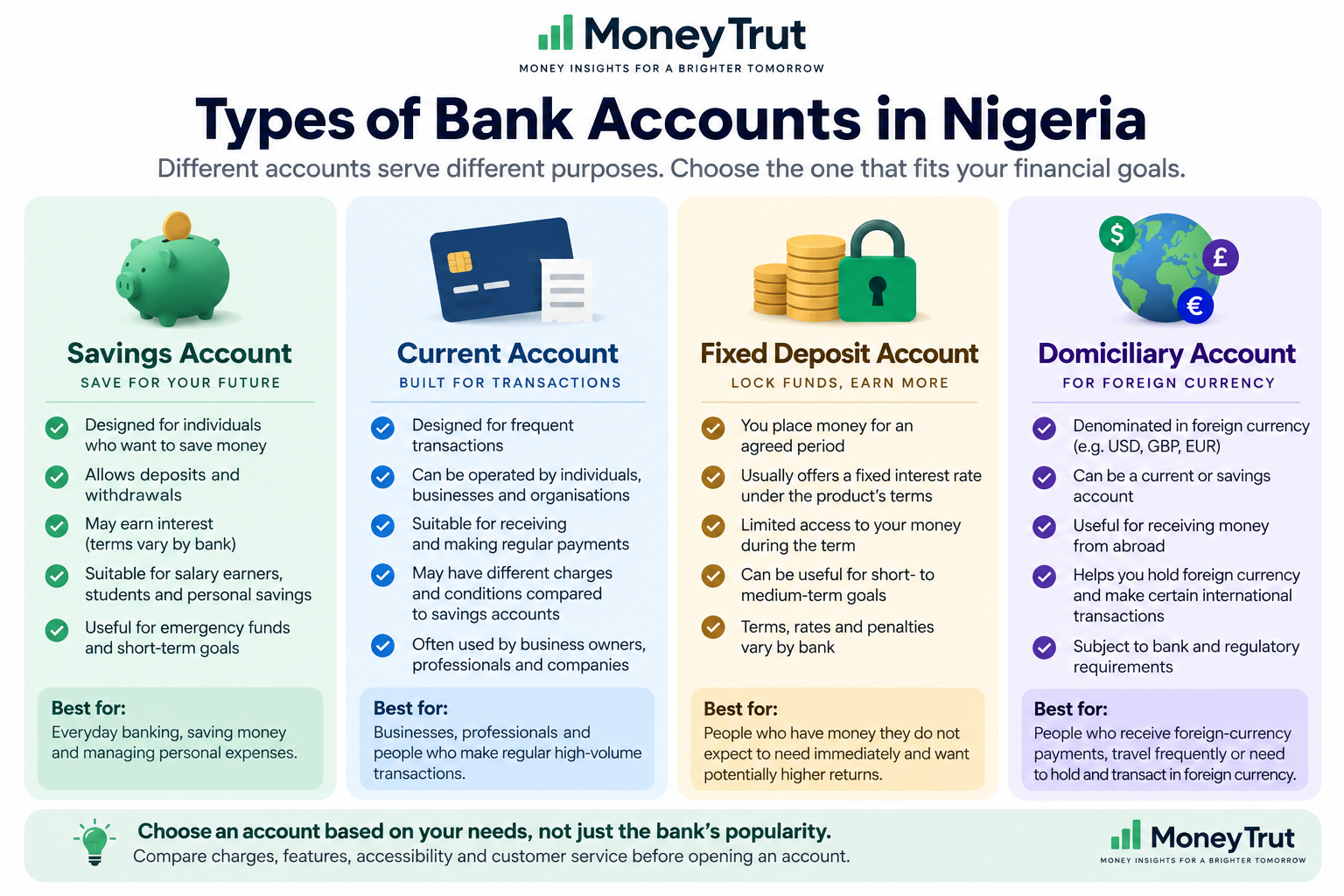
Before comparing banks, understand what the different account types are designed for.
Savings Account
A savings account is generally designed for individuals who want to keep money in a bank while retaining relatively easy access to it.
It can be useful for:
- salary earners;
- students;
- emergency savings;
- personal expenses;
- general savings.
Savings accounts typically allow deposits and withdrawals, although individual products may have different conditions and features.
If you simply want a place to receive your salary, save money and make normal payments, a savings account may be enough.
Current Account
A current account is designed for more transaction-oriented banking.
It can be useful for:
- businesses;
- professionals;
- organisations;
- people who make frequent transactions.
CBN describes current accounts as accounts that can be operated by individuals, companies and corporate organisations.
However, don't assume that a current account is automatically better than a savings account. It depends on how you use your account and the specific bank's terms.
Fixed Deposit Account
A fixed deposit is different from an ordinary transaction account.
You place money with the financial institution for an agreed period and receive an agreed return under the product's terms.
This can be useful when you have money you do not expect to need immediately.
For example, if you have ₦500,000 that you know you will not need for several months, a fixed deposit may be worth considering.
But don't put your entire emergency fund into a product that makes accessing your money difficult or costly.
MoneyTrut explains the differences in more detail here:
What Is a Fixed Deposit and How Does It Work in Nigeria?
Domiciliary Account
A domiciliary account is denominated in a foreign currency rather than naira.
It may be relevant if you:
- receive legitimate foreign-currency payments;
- receive money from abroad;
- need to hold foreign currency;
- make certain international transactions.
The CBN defines a domiciliary account as a bank account denominated in foreign currency, which can be structured as a current or savings account.
The important point is that you should not open one simply because you think having a foreign-currency account is automatically better.
Choose it because you have a genuine need for the functionality.
3. Compare Bank Charges Before Opening the Account
One of the biggest mistakes people make is looking only at the bank's brand.
A bank can have a good reputation and still offer an account that is unsuitable for your particular needs.
Look carefully at the charges associated with:
- transfers;
- cards;
- ATM withdrawals;
- SMS alerts;
- account maintenance;
- cash deposits;
- cash withdrawals;
- international transactions;
- foreign-currency transactions;
- other services you expect to use regularly.
The CBN says customers have a right to clear information about the terms and conditions of their accounts, including applicable interest rates, charges and penalties.
Don't just ask:
"How much does it cost to open the account?"
Ask:
"How much is this account likely to cost me over a year?"
That is a much more useful comparison.
4. Don't Choose a Bank Based Only on the Interest Rate
Interest matters, but it should not be your only consideration.
Suppose Bank A offers slightly better interest on a savings product but has features you rarely use.
Bank B may offer a lower rate but provide:
- better access to branches;
- a more convenient mobile app;
- easier customer support;
- better ATM availability;
- more suitable transaction options.
The better choice depends on your priorities.
Also remember that an advertised interest rate does not tell you the entire story.
Check the conditions attached to the rate.
Ask:
- Is there a minimum balance?
- Are there withdrawal restrictions?
- Is the rate guaranteed?
- How often is interest paid?
- Are there fees that reduce the benefit?
- Does the rate apply to the entire balance or only part of it?
5. Check the Mobile Banking App
For many Nigerians, banking now happens primarily through a phone.
Before choosing an account, consider whether the bank's digital services are reliable enough for your needs.
Look for features such as:
- transfers;
- bill payments;
- card management;
- transaction history;
- account statements;
- beneficiary management;
- spending notifications;
- customer support;
- security controls.
Convenience matters.
If you regularly send money to family, pay bills or receive business payments, having reliable digital banking can save significant time.
However, convenience should not come at the expense of security.
The CBN has continued to strengthen requirements around digital banking security, fraud monitoring and customer authentication.
6. Check ATM and Branch Accessibility
A bank may have an excellent app but still be inconvenient if you regularly need physical banking services.
Think about where you live and work.
Ask yourself:
- Is there an ATM near my home?
- Is there an ATM near my workplace?
- Are there branches in places I frequently visit?
- What happens if my card stops working?
- Can I resolve problems without visiting a branch?
You don't necessarily need a branch close to your house if you rarely visit one.
But if you frequently deposit cash or require physical banking services, location becomes much more important.
7. Consider How Much Cash You Handle
Your banking needs can change significantly depending on how you receive and spend money.
Someone who earns ₦100,000 monthly through salary and pays most expenses electronically may have relatively simple banking needs.
A trader receiving large amounts of cash from customers may need to think much more carefully about:
- cash deposit facilities;
- transaction limits;
- account type;
- documentation;
- branch accessibility;
- transaction costs.
Don't choose an account based on someone else's banking habits.
Choose it based on your own.
8. Think About Your Income
Your income level can influence which account features matter most.
If you earn ₦50,000–₦100,000 monthly
Your priorities may be:
- low charges;
- easy access;
- reliable transfers;
- salary payments;
- savings;
- good mobile banking.
You may not need a complicated banking setup.
If you earn ₦150,000–₦300,000 monthly
You may want to separate your money into different purposes.
For example:
Account 1: salary and regular spending
Account 2: emergency savings
This can make it easier to avoid spending money intended for savings.
If you are building an emergency fund, see:
How Much Should You Have in an Emergency Fund?
If you earn ₦500,000 or more monthly
You may have additional needs involving:
- larger transfers;
- investments;
- business transactions;
- multiple savings goals;
- foreign-currency transactions;
- more sophisticated financial planning.
At this stage, having more than one account can be useful if each account has a clear purpose.
9. Consider Having More Than One Bank Account
You don't have to keep all your money with one bank.
For example, you could have:
Account A — Everyday spending
Used for:
- salary;
- food;
- transport;
- bills;
- regular transfers.
Account B — Emergency savings
Used only for genuine emergencies.
Account C — Business
Used for business income and expenses.
This separation can make your finances easier to understand.
MoneyTrut discusses the importance of separating business and personal money in:
How to Start a Small Business in Nigeria With Little Money
However, having multiple accounts only makes sense if each one has a purpose.
Opening five accounts and barely using them may create unnecessary complexity.
10. Check Deposit Protection
When keeping substantial savings in a bank, it is important to understand deposit protection.
The CBN advises customers to use licensed financial institutions and notes that deposits in covered institutions are protected under the NDIC deposit insurance system, subject to applicable limits.
This is another reason to avoid putting your savings into an institution simply because someone advertised it online.
Before depositing significant money, confirm that you are dealing with a properly licensed institution.
11. Pay Attention to Security
Your bank account is only as secure as your banking habits and the security systems protecting it.
Never casually share:
- your PIN;
- one-time passwords;
- authentication codes;
- card details;
- passwords;
- banking login information.
Be particularly careful with messages claiming that your account has been blocked or that you must click a link to prevent it from being closed.
The CBN specifically warns about fraudulent communications impersonating the Bank and advises people not to disclose personal information or access suspicious links.
If something looks suspicious, contact your bank through an official channel.
12. Check Customer Service Before You Need It
Customer service is easy to ignore when everything is working.
You may think:
"I don't care about customer service. I just want an account."
Until your account has a problem.
A failed transfer, blocked card, disputed transaction or account restriction can become extremely frustrating if you cannot get help.
Before choosing a bank, consider:
- how easy it is to contact support;
- whether support is available through multiple channels;
- how quickly complaints are handled;
- whether you can resolve common issues without visiting a branch.
The CBN says customers have the right to file complaints with their financial institution and escalate unresolved issues to its Consumer Protection Department.
13. Read the Account Terms
Don't open an account simply because someone says:
"This bank is good."
Your friend may have completely different needs from you.
Read the actual account terms.
Look for:
- charges;
- transaction limits;
- withdrawal conditions;
- interest rules;
- minimum balance requirements;
- card charges;
- account inactivity rules;
- restrictions;
- conditions for promotional rates.
This becomes particularly important when opening specialised savings products.
14. Don't Ignore Dormant Account Rules
A bank account that you stop using indefinitely should not simply be forgotten.
The CBN's current framework distinguishes inactive accounts from dormant accounts. An account can become inactive after a period without customer-initiated transactions and may subsequently become dormant if inactivity continues.
If you have several bank accounts, keep track of them.
You don't want to discover years later that an account you forgot about has become dormant.
If you have an old account you no longer use, contact the bank and find out its current status rather than assuming everything is unchanged.
15. Think About Your Future Needs
The best account is not only one that works today.
Think about what you may need in the next few years.
For example, a university student may start with a simple savings account.
Later, they may:
- receive a salary;
- start a business;
- invest;
- receive foreign payments;
- take a loan;
- need additional banking services.
You don't need to predict everything.
But choosing a bank with services that can grow with you can reduce the need to change your entire banking setup later.
16. Don't Open an Account Just Because of a Promotion
Banks sometimes offer promotions, bonuses or special rates to attract new customers.
These can be useful, but don't allow a temporary promotion to determine a long-term financial decision.
Ask:
"What happens after the promotion ends?"
If the underlying account has high charges or poor features for your needs, the temporary benefit may not be worth it.
Look at the normal terms, not just the advertisement.
17. Compare Banks Using a Simple Scorecard
Instead of choosing emotionally, create a simple comparison.
For example:
| Feature | Bank A | Bank B | Bank C |
|---|---|---|---|
| Transfer convenience | |||
| Mobile app | |||
| ATM access | |||
| Branch access | |||
| Account charges | |||
| Customer support | |||
| Savings features | |||
| International services |
Give each bank a score from 1 to 5.
You may discover that the bank you initially preferred is not actually the best match for your needs.
18. Your Bank Account Is Not Your Investment Strategy
This distinction is important.
A bank account is primarily a tool for storing, accessing and managing money.
It does not automatically mean that your money is being invested efficiently.
For example, you might keep your emergency fund in an accessible savings account while investing long-term money separately.
Depending on your goals, investments could include instruments such as Treasury bills, bonds or mutual funds.
MoneyTrut explains some of these options here:
What Is a Treasury Bill and How Does It Work in Nigeria?
What Is a Money Market Fund and How Does It Work in Nigeria?
The important point is to match the financial product to the purpose of the money.
19. A Simple Setup for Someone Earning ₦300,000
Suppose you earn ₦300,000 per month.
You could potentially structure your banking like this:
Everyday account
Used for:
- food;
- transport;
- bills;
- regular spending.
Savings account
Used for:
- emergency fund;
- short-term goals.
Investment account or platform
Used for:
- long-term investments.
The exact structure depends on your circumstances.
The purpose is simply to prevent every naira from sitting in one place where it is easy to spend.
20. A Simple Checklist Before Opening an Account
Before you open an account, ask:
1. What will I use this account for?
2. How often will I receive money?
3. How often will I make transfers?
4. Will I need cash frequently?
5. Do I need a physical branch?
6. How important is mobile banking to me?
7. What charges will I pay?
8. Does the account have restrictions I need to know about?
9. Do I need foreign-currency services?
10. Is the institution properly licensed and covered by the applicable deposit protection scheme?
If you can answer these questions, choosing an account becomes much easier.
Common Mistakes to Avoid
Choosing a bank because everyone uses it
Popularity does not automatically mean the account fits your needs.
Looking only at interest rates
A higher rate can be outweighed by fees, restrictions or poor accessibility.
Ignoring charges
Small recurring charges can become significant over time.
Keeping all your money in one account
Separating money by purpose can make financial management easier.
Opening accounts you never use
Too many unused accounts can make your finances harder to track.
Sharing banking information
Never give your PIN, OTP or authentication credentials to someone simply because they claim to be a bank employee.
Ignoring account statements
Regularly checking transactions helps you identify errors, unexpected charges and unauthorised activity.
The Bottom Line
Choosing the right bank account in Nigeria starts with understanding what you actually need from your banking relationship.
A simple savings account may be enough for everyday personal banking. A current account may be more suitable for certain transaction-heavy or business activities. Fixed deposits and domiciliary accounts serve different purposes and should be considered based on your specific financial needs.
Before opening an account, compare charges, accessibility, digital banking, customer service, security and account conditions.
Most importantly, don't choose an account simply because someone else recommends it. Choose the account that fits the way you earn, save, spend and manage your money..

You must be logged in to post a comment.