
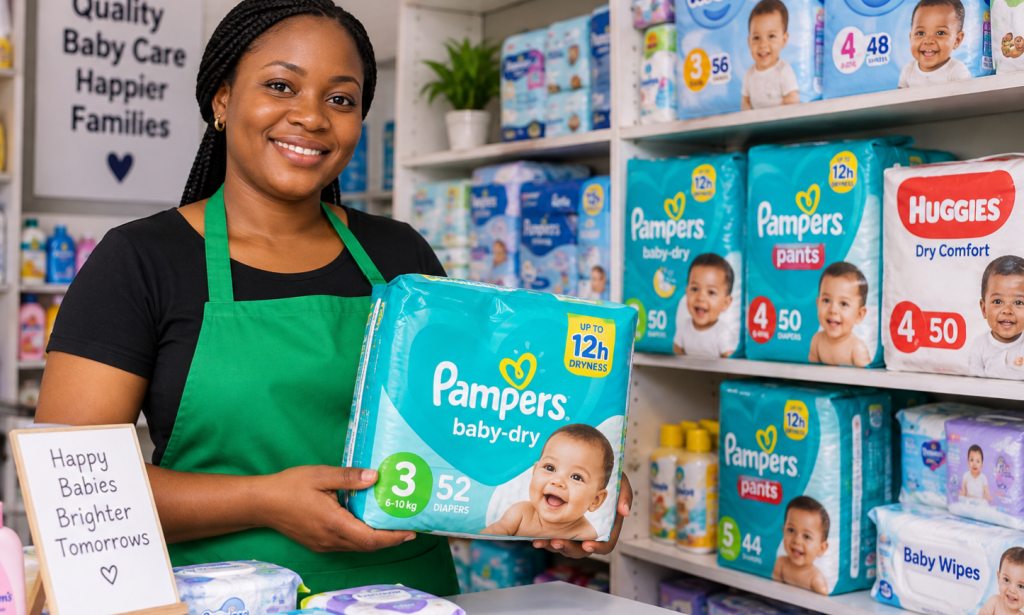
The important decisions are choosing the right business model, understanding your customers, finding reliable suppliers, calculating your real costs, pricing correctly and managing your stock and cash flow.
This guide explains how to start a pampers business in Nigeria, how much money you may need, where to buy diapers, what products to sell alongside pampers, how to calculate your profit and how to avoid common mistakes.
What Is a Pampers Business?
A pampers business involves buying diapers and related baby-care products and reselling them to customers at a price that leaves you with a margin after your costs.
You can operate the business in several ways.
Retail
You buy diapers in smaller quantities and sell directly to parents and other consumers.
Online Reselling
You advertise products through WhatsApp, Instagram, Facebook or other channels and arrange delivery after customers place orders.
Wholesale
You buy larger quantities at better prices and supply smaller retailers.
Distribution
You operate further up the supply chain and supply retailers or other businesses.
For a beginner, retail or small-scale reselling is usually easier to understand than jumping directly into full distribution.
How Much Money Do You Need to Start a Pampers Business?

There is no single amount that everyone needs.
Your startup capital depends on:
- The quantity of stock you want
- The brands and sizes you sell
- Whether you rent a shop
- Your location
- Transportation costs
- Packaging
- Delivery
- Registration
- Marketing
- Working capital
Someone starting from home with online sales may need considerably less capital than someone opening a physical baby-products shop.
For example, suppose you decide to start with:
₦150,000 for inventory
₦20,000 for transportation and delivery
₦10,000 for packaging and other small expenses
Your initial working requirement would be approximately:
₦180,000
That is only an example.
Do not treat ₦180,000 as the required amount to start a pampers business. Your actual figure should come from the prices and operating costs available to you.
The important thing is to calculate your startup requirement before spending the money.
Start With the Business Model, Not the Shop
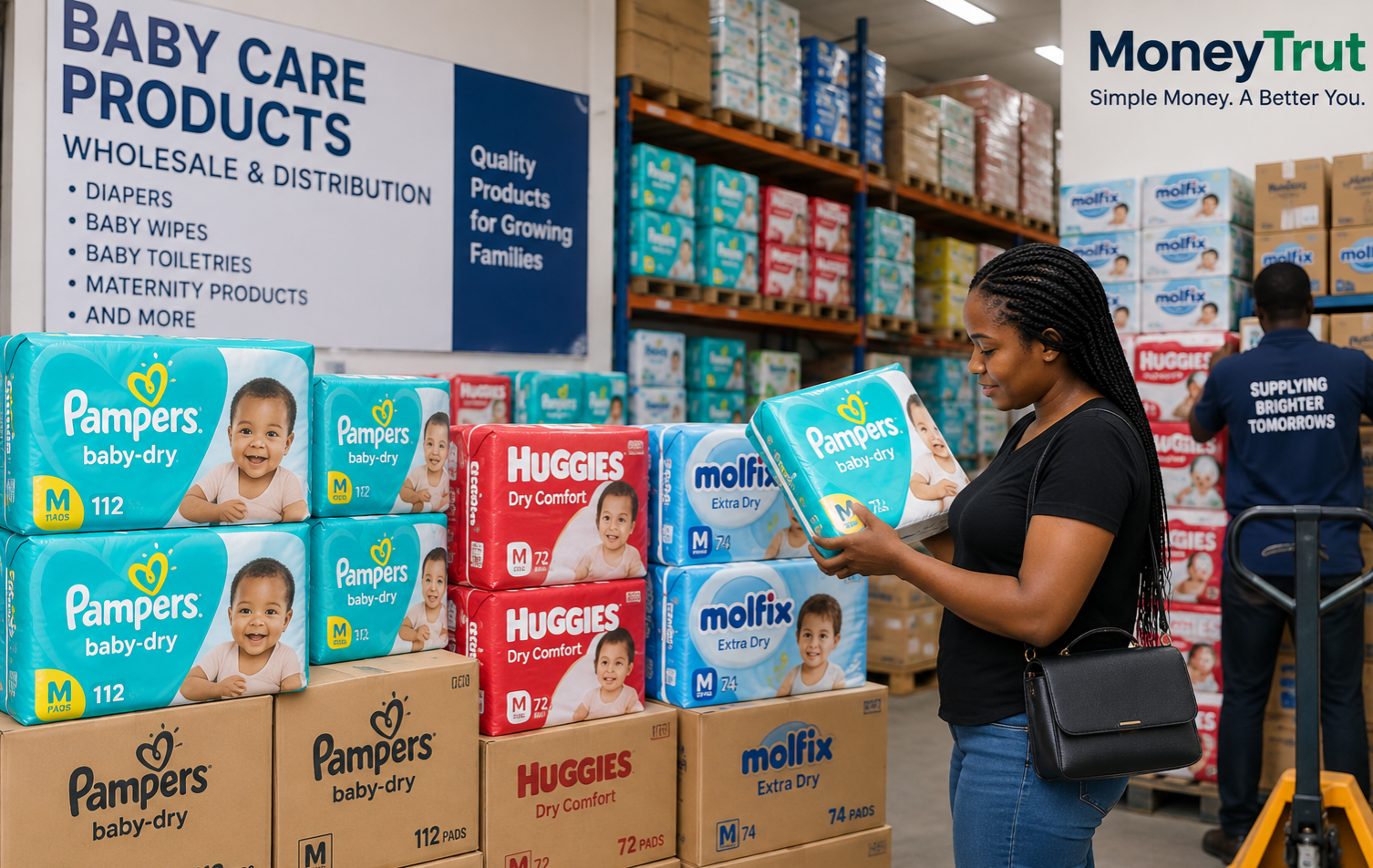
One common mistake is renting a shop before knowing how the business will work.
You may spend money on:
- Rent
- Shelving
- Signage
- Renovation
- Electricity
- Security
- Other operating expenses
before you have sold your first pack.
Instead, decide how you want to sell first.
You could begin with:
Home-based retail
Online sales
Small physical shop
Wholesale supply
Combination of online and physical sales
If you already have access to customers, a smaller starting setup may allow you to test demand before taking on larger fixed costs.
Research Your Local Market
Before buying large quantities, find out what people around you actually buy.
Visit shops and markets in your area.
Ask retailers:
- Which diaper sizes sell fastest?
- Which brands do customers request?
- Which products are frequently out of stock?
- What price ranges are customers comfortable with?
- Which products have slow turnover?
- Where do retailers source their stock?
You can also speak with potential customers.
For example, if most parents in your target area regularly ask for certain sizes but you spend most of your money stocking slow-moving sizes, your capital may remain trapped in inventory.
Market research can save you from making an expensive purchasing decision.
Choose the Right Diaper Products
Do not assume that stocking every available diaper product is a good idea.
You can start with a smaller range.
Depending on your market, this could include:
- Different diaper sizes
- Different pack sizes
- Different brands
- Baby wipes
- Baby toiletries
- Diaper pants
- Related baby-care products
Your objective is to understand what sells quickly.
A product that gives you a ₦2,000 margin but takes three months to sell may be less useful to a small business than a product with a smaller margin that sells repeatedly.
This is where stock turnover becomes important.
Pampers Is a Brand, Not the Entire Business
The word "pampers" is commonly used by consumers when talking about disposable baby diapers, but a business selling diapers does not necessarily have to sell only the Pampers brand.
You can stock products according to what your customers actually demand.
However, be careful when advertising.
Do not present another brand as Pampers or make customers believe a product is an official Pampers product when it is not.
If you sell several brands, clearly identify each one.
Where Can You Buy Pampers and Other Diapers?
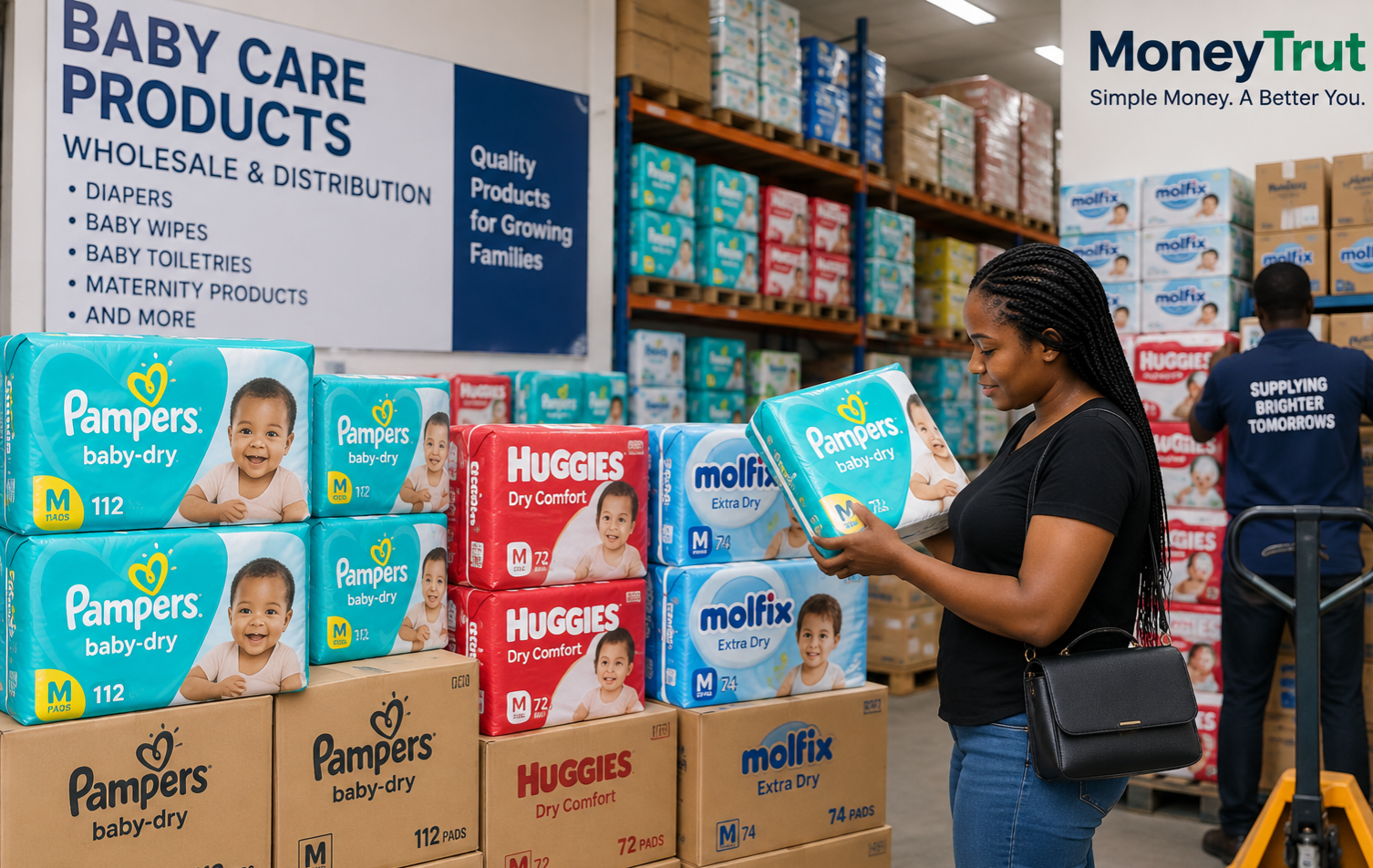
Your sourcing options may include:
- Authorised distributors
- Wholesalers
- Established baby-product suppliers
- Large distributors
- Direct business-to-business suppliers
The best source depends on your location, quantity and the terms available to you.
Do not choose a supplier simply because their price is the lowest.
Check:
- Product authenticity
- Supplier reputation
- Minimum order quantity
- Delivery arrangements
- Payment terms
- Return policy where applicable
- Consistency of supply
- Invoice or transaction records
Some established distributors operate regionally. For example, Sharubutu Investment publicly identifies itself as a Procter & Gamble regional distributor and lists Pampers among its brands, illustrating why supplier coverage can vary by location.
Before sending a large payment to any supplier, independently verify the supplier and the transaction.
How to Know If a Supplier Is Reliable
Do not judge a supplier from WhatsApp pictures alone.
A supplier may appear legitimate online and still create problems when you place a large order.
Start with a smaller transaction if possible.
Check:
Are the products genuine?
Does the supplier consistently deliver what was ordered?
Are prices clearly communicated?
Can you verify the business?
Are transaction records available?
Do other retailers have experience with the supplier?
A reliable supplier is important because your reputation depends partly on the products you sell.
Calculate Your Real Cost Per Pack
Do not calculate profit using only the supplier's selling price.
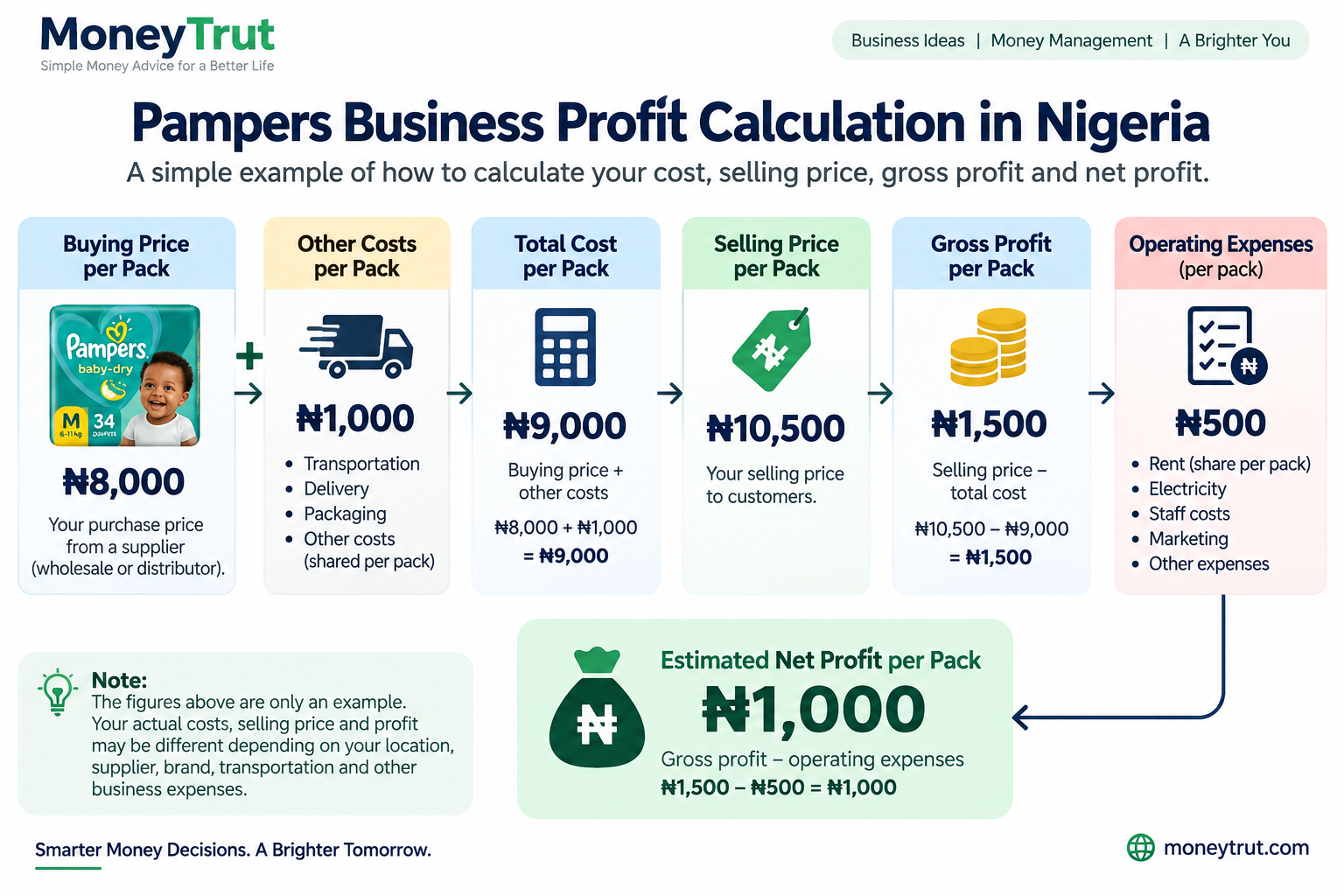
Suppose you buy a pack for:
₦8,000
You spend:
₦20,000 on transportation
and bring back:
20 packs
Transportation cost per pack is:
₦20,000 ÷ 20 = ₦1,000
Your effective cost per pack becomes:
₦8,000 + ₦1,000 = ₦9,000
If you sell the pack for ₦10,500, your gross margin before other relevant expenses is:
₦10,500 − ₦9,000 = ₦1,500
That is very different from assuming your cost was simply ₦8,000.
Your calculation should consider the costs that actually belong to the stock.
Don't Confuse Markup With Profit Margin
Suppose your total cost for a pack is ₦9,000 and you sell it for ₦10,500.
Your gross profit is:
₦10,500 − ₦9,000 = ₦1,500
Your markup on cost is:
₦1,500 ÷ ₦9,000 × 100 = 16.7%
Your gross profit margin on sales is:
₦1,500 ÷ ₦10,500 × 100 = 14.3%
These are different calculations.
Understanding the difference becomes important when you are comparing suppliers and setting prices.
How to Set Your Pampers Selling Price
Your price should reflect your actual cost and the market you are serving.
Consider:
- Purchase price
- Transportation
- Delivery
- Packaging
- Payment-related costs
- Shop expenses
- Losses or damaged stock
- Other operating expenses
- Desired profit
Then compare your resulting price with what customers are currently paying in your market.
If your calculated price is significantly higher than the market price, do not immediately conclude that you need to sell at a loss.
Investigate why.
Maybe:
- Your supplier is expensive.
- Your order quantity is too small.
- Your transportation cost is high.
- Your rent is too expensive.
- Your business model needs adjustment.
Pricing is a business decision, not simply a guess.
For more on this, see How to Price Your Products and Services in Nigeria Without Losing Money.
How Much Profit Can You Make?
There is no honest single figure that applies to every pampers business.
Your profit depends on:
- Purchase price
- Selling price
- Sales volume
- Product mix
- Location
- Supplier terms
- Transportation
- Rent
- Delivery costs
- Other operating expenses
Suppose you make an average gross profit of ₦1,500 per pack.
If you sell:
10 packs × ₦1,500 = ₦15,000 gross profit
If you sell:
50 packs × ₦1,500 = ₦75,000 gross profit
But that is gross profit, not money you can automatically take home.
If your monthly operating expenses are ₦40,000, then:
₦75,000 − ₦40,000 = ₦35,000
Your actual net profit would depend on all relevant expenses and accounting treatment.
This is why articles promising a fixed daily profit from a business idea should be treated carefully.
Stock Turnover May Matter More Than a Big Margin
Imagine two products.
Product A
Profit per pack: ₦2,000
You sell 10 packs per month.
Gross profit:
₦2,000 × 10 = ₦20,000
Product B
Profit per pack: ₦1,000
You sell 60 packs per month.
Gross profit:
₦1,000 × 60 = ₦60,000
Product B has a smaller profit per unit but generates more gross profit because it sells faster.
For a small retail business, the combination of margin and turnover matters.
Keep Enough Working Capital
Do not spend all your money on initial stock.
Suppose you have ₦300,000.
You could spend the entire ₦300,000 on inventory.
But what happens when:
- Transportation costs increase?
- A customer orders for delivery?
- A supplier requires a minimum order?
- Your best-selling product suddenly becomes unavailable?
- You need to restock before your previous customers have paid you?
A better approach may be to keep part of your capital available as working capital.
For example:
₦220,000 inventory
₦80,000 working capital
The exact split depends on your circumstances.
The important principle is:
Do not confuse money invested in stock with money available to operate the business.
Start Small and Learn What Sells
You do not need to stock every diaper size and every baby product immediately.
Start with a manageable selection.
Track:
- What sells quickly
- What sells slowly
- Which sizes customers request
- Which brands customers prefer
- Average order size
- Repeat customers
- Products customers frequently buy together
After a few weeks or months, your own sales data can become more useful than assumptions.
Consider Selling Related Baby Products
Once you understand your customers, you may be able to increase the average order value by selling complementary products.
Depending on your business model, these might include:
- Baby wipes
- Baby toiletries
- Diaper pants
- Baby tissue
- Feeding accessories
- Baby-care products
Suppose a customer comes to buy diapers for ₦15,000.
If they also need wipes worth ₦3,000 and another baby-care item worth ₦2,000, the total order becomes:
₦15,000 + ₦3,000 + ₦2,000 = ₦20,000
You are not forcing the customer to buy unnecessary products.
You are simply making relevant products available in one place.
Sell From Home Before Renting a Shop
A physical shop can help visibility, but it also creates fixed costs.
Depending on your location, you may have to pay for:
- Rent
- Shop setup
- Electricity
- Security
- Signage
- Furniture
- Other operating costs
If your business can work through home-based sales and delivery, you could test the model first.
For example:
WhatsApp + small inventory + local delivery
can allow you to learn about demand before committing to a larger physical setup.
This does not mean a shop is unnecessary.
It means you should understand the business before taking on significant fixed costs.
Use WhatsApp to Find Customers
A simple online sales system can start with WhatsApp.
You can:
- Post available products
- Show prices clearly
- Share product sizes
- Take orders
- Confirm payments
- Arrange delivery
- Follow up with customers
Your WhatsApp status can function as a simple storefront.
But avoid posting random products without prices or useful information.
A customer should quickly understand:
What are you selling?
How much is it?
Where do you deliver?
How can I order?
Target Customers Who Actually Need the Product
Your marketing should reach people who are likely to buy.
Potential customer groups can include:
- Parents
- Expectant parents
- Baby-product retailers
- Maternity-related businesses
- Daycare operators
- Small baby-product shops
- Other resellers
You can also build relationships with businesses that regularly serve parents, provided your marketing approach is appropriate and compliant with their policies.
Build Repeat Customers
A pampers business has one major advantage over some businesses:
Diapers are consumable.
A customer who buys them today may need another pack later.
That creates an opportunity for repeat sales.
Keep appropriate customer records and, where customers have agreed to receive communication, remind them about restocking when it makes sense.
You can also offer:
- Convenient delivery
- Multi-pack purchases
- Relevant bundles
- Loyalty benefits
- Reliable availability
Our guide on How to Get Repeat Customers for a Small Business in Nigeria explains how customer retention can turn one-time buyers into repeat customers.
Delivery Can Become Your Competitive Advantage
Suppose two sellers offer the same product at similar prices.
One says:
"Come and collect it."
The other offers convenient delivery at a clearly communicated cost.
For a busy parent, convenience can matter.
You do not necessarily need to offer free delivery.
Instead, understand your delivery costs and price them properly.
For example, if delivery costs you ₦2,000, you could:
- Charge the customer ₦2,000
- Absorb part of the cost where the margin allows
- Offer free delivery above a minimum order
- Bundle delivery into a larger purchase
The right approach depends on your margins and customer expectations.
Keep Business and Personal Money Separate
Suppose you start the business with ₦300,000.
After several sales, your account contains ₦420,000.
It is tempting to think:
"I have made ₦120,000."
But that may be wrong.
Some of the ₦420,000 may represent money needed to replace your inventory.
You need to know:
How much is capital?
How much is revenue?
How much is cost?
How much is profit?
How much can I safely withdraw?
This is why proper business records matter.
See How to Keep Business Records in Nigeria: A Simple System for Small Businesses.
Should You Register the Business?
If you are building a serious business, consider formal registration and other requirements that apply to your specific operation.
The Corporate Affairs Commission is Nigeria's official corporate registry and provides business-name registration through its online Company Registration Portal.
CAC's current published process includes checking name availability, completing the relevant registration information and paying the applicable filing fees.
Do not rely on an old article for current registration fees.
Check the official CAC portal before making payment because fees and procedures can change.
If you are operating beyond simple retail and become an importer, manufacturer or otherwise handle regulated products, check whether additional regulatory requirements apply to your particular activities.
Do You Need a Physical Shop?
No.
You can potentially start with:
Home-based stock + WhatsApp + delivery
You could later move to:
Small shop + WhatsApp + delivery
And eventually:
Retail shop + online sales + wholesale supply
Your business does not have to begin at its largest possible size.
Common Mistakes to Avoid
Buying too much stock too early
Large inventory does not automatically mean a profitable business.
Choosing a supplier only because the price is cheap
A cheap supplier is not useful if the products are unreliable or delivery is inconsistent.
Renting an expensive shop immediately
High fixed costs can put pressure on a new business before demand is proven.
Ignoring transportation costs
Transportation can significantly affect your real cost per pack.
Selling without calculating margins
Revenue is not profit.
Mixing business money with personal spending
This makes it difficult to know whether the business is actually growing.
Stocking what you like instead of what customers buy
Customer demand should influence your inventory decisions.
Promising products you don't have
Always confirm stock before taking an order.
A Simple Example of Starting Small
Suppose you have ₦250,000 available.
Instead of putting everything into stock, you could create a simple plan:
₦170,000 — initial inventory
₦30,000 — transportation and delivery
₦50,000 — working capital
You then track what sells over the first few weeks.
Suppose your first stock generates ₦210,000 in sales.
That does not mean you made ₦40,000 profit.
You need to deduct the cost of the goods sold and relevant expenses.
If your cost of those goods was ₦170,000:
₦210,000 − ₦170,000 = ₦40,000 gross profit
Then consider other expenses.
This is the difference between looking at sales and actually understanding the business.
A Simple 30-Day Plan
Week 1: Research
Visit wholesalers, retailers and potential customers.
Find out:
- Popular brands
- Popular sizes
- Prices
- Supplier options
- Delivery costs
Week 2: Test your suppliers
Compare several suppliers.
Start with manageable quantities where possible.
Week 3: Start selling
Use your existing network, WhatsApp and local marketing to find your first customers.
Track every transaction.
Week 4: Review
Calculate:
- Total sales
- Cost of goods
- Gross profit
- Operating expenses
- Best-selling products
- Slow-moving products
- Repeat customers
Then decide what to restock.
Is a Pampers Business Profitable?
It can be profitable, but profitability is not guaranteed.
The business works when you can consistently:
Buy at a competitive price
Sell at a sustainable price
Move stock quickly enough
Control operating costs
Avoid excessive losses
Keep customers returning
The biggest mistake is assuming that because diapers are essential products, every seller automatically makes good money.
Demand does not remove competition.
Your supplier price, location, stock management and customer service still matter.
Bottom Line
Starting a pampers business in Nigeria does not require you to begin with a large shop or enormous inventory.
You can start small, test demand and expand as you understand your customers and sales patterns.
Before spending your money, answer five questions:
Who will I sell to?
Where will I buy my products?
What products and sizes actually sell in my area?
What is my real cost per pack?
How much profit remains after all relevant expenses?
If you can answer those questions clearly, you are already in a much stronger position than someone who simply buys a large quantity of diapers because they believe the business is profitable.
Start with controlled inventory, keep proper records, protect your working capital and focus on building repeat customers.
That is how a small pampers-selling business can develop into a larger baby-products retail or wholesale business over time.
Related Articles
- How to Start a Small Business in Nigeria With Little Money
- How to Price Your Products and Services in Nigeria Without Losing Money
- How to Keep Business Records in Nigeria: A Simple System for Small Businesses
- How to Get Customers for a Small Business in Nigeria: Practical Ways That Work
- How to Get Repeat Customers for a Small Business in Nigeria

You must be logged in to post a comment.