
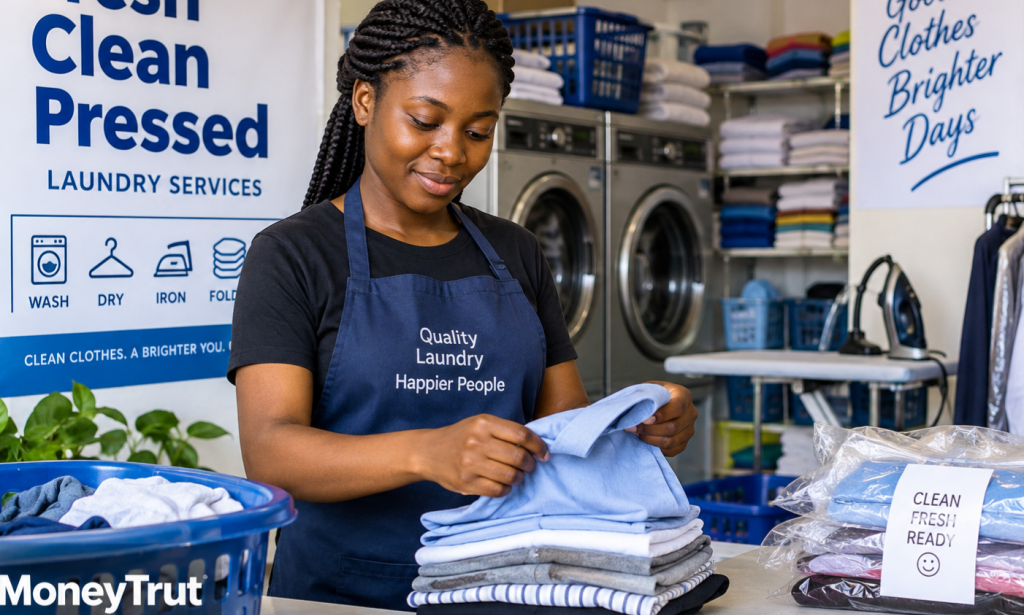
To start a laundry business in Nigeria, choose a business model, research your target customers and location, calculate your startup and operating costs, get the necessary equipment, set profitable prices and create a reliable system for handling customers' clothes. You can start from home with a small setup or invest in a physical laundry shop with pickup and delivery as the business grows.
There is no fixed amount required to start because your capital depends on whether you already have equipment and space, the type of laundry services you offer, your location and the scale of the business.
Starting a laundry business in Nigeria can be a practical way to build a service business because people and businesses regularly need clothes, bedding and other fabrics washed, dried, ironed or properly cared for. But owning a washing machine and putting up a sign is not enough to make the business profitable.
You need to understand how much it costs to process each order, how much customers are willing to pay, how you will manage water and electricity, how you will track customers' clothes and how you will get people to use your service repeatedly.
You can start a laundry business from home with limited equipment, operate a small shop or build a pickup-and-delivery service. The best option depends on your available capital, location and target customers.
A laundry business can be started on a small scale from home or built into a larger shop with washing machines, staff and pickup-and-delivery services.
The important thing is not to start by buying expensive equipment. Start by understanding your customers, choosing the right service model, calculating your costs, setting prices that leave a profit and creating a system for handling customers' clothes properly.
This guide explains how to start a laundry business in Nigeria, what you need, how much money you may need, what equipment to consider, how to price your services, how to find customers and how to avoid common mistakes.
What Is a Laundry Business?
A laundry business provides services such as washing, drying, ironing, folding and, depending on the business, dry cleaning or pickup and delivery.
Customers pay because they want to save time, handle clothes that require special care or avoid doing the work themselves.
A laundry business can operate in several ways:
- Home-based laundry
- Small walk-in laundry shop
- Pickup-and-delivery laundry
- Full-service laundry and dry cleaning
- Commercial laundry for businesses and institutions
You do not have to start with the largest model.
A person with limited capital could begin from home, learn what customers want and expand as demand grows.
How Much Does It Cost to Start a Laundry Business in Nigeria?
There is no single amount that everyone needs.
Your startup cost depends on the model you choose.
A home-based operation may require much less capital than a fully equipped shop because you may already have access to space, water or some household equipment.
Your main expenses may include:
- Washing machine
- Pressing iron
- Ironing board
- Water storage
- Generator, inverter or another power solution
- Detergent and cleaning supplies
- Packaging
- Clothes tags
- Rent
- Shop setup
- Branding
- Transportation
- Delivery
- Business registration
- Working capital
For example, someone who already has a suitable washing machine and operates from home could start with a smaller budget.
Someone renting a shop and buying several machines would need considerably more.
The key is to calculate your own setup cost rather than relying on a fixed amount advertised online.
Three Ways to Start a Laundry Business
1. Home-Based Laundry
You operate from your home or another suitable private space.
This can reduce:
- Rent
- Shop renovation
- Signage costs
- Some overhead expenses
It can be a practical way to test the business before committing to a shop.
2. Small Laundry Shop
You rent a visible location and serve customers who bring their clothes to you.
This can make the business easier to find, but you take on additional fixed costs.
3. Pickup-and-Delivery Laundry
You collect clothes from customers, process them and return them after completion.
This can work well in areas with busy professionals, families and customers who value convenience.
You do not necessarily need a large storefront if your operations are organised properly.
Which Model Is Best for a Beginner?
There is no universal answer.
If your capital is limited, a home-based or pickup-and-delivery model may allow you to test demand with lower fixed costs.
If you already have a good location and sufficient capital, a small shop may make sense.
The important question is:
Which model can you operate profitably with the money and resources you currently have?
Do not rent an expensive shop simply because a laundry business is traditionally associated with a storefront.
Research Your Area Before Spending Money
Before buying equipment, study the area where you want to operate.
Look at:
- Number of existing laundry businesses
- Their prices
- Their turnaround times
- Services they offer
- Customer reviews
- Pickup and delivery options
- Their opening hours
- The type of customers they serve
Then speak to potential customers.
Ask questions such as:
What do you normally pay for laundry?
What do you dislike about your current laundry service?
Would you pay for pickup and delivery?
How quickly do you expect your clothes back?
Which clothes do you prefer to wash yourself?
This research can reveal opportunities that are not obvious from simply looking at competitors.
Choose Your Target Customers
You do not need to serve everybody.
Potential customers include:
- Busy professionals
- Families
- Students
- People living in estates
- Short-let operators
- Small hotels
- Restaurants
- Salons
- Offices
- Schools
- Medical facilities
- Other businesses with uniforms or reusable fabrics
Each group has different needs.
For example, a student may care primarily about price.
A busy professional may care more about convenience and turnaround time.
A hotel may care about consistency, volume and reliability.
Understanding this helps you build the right service.
What Equipment Do You Need?
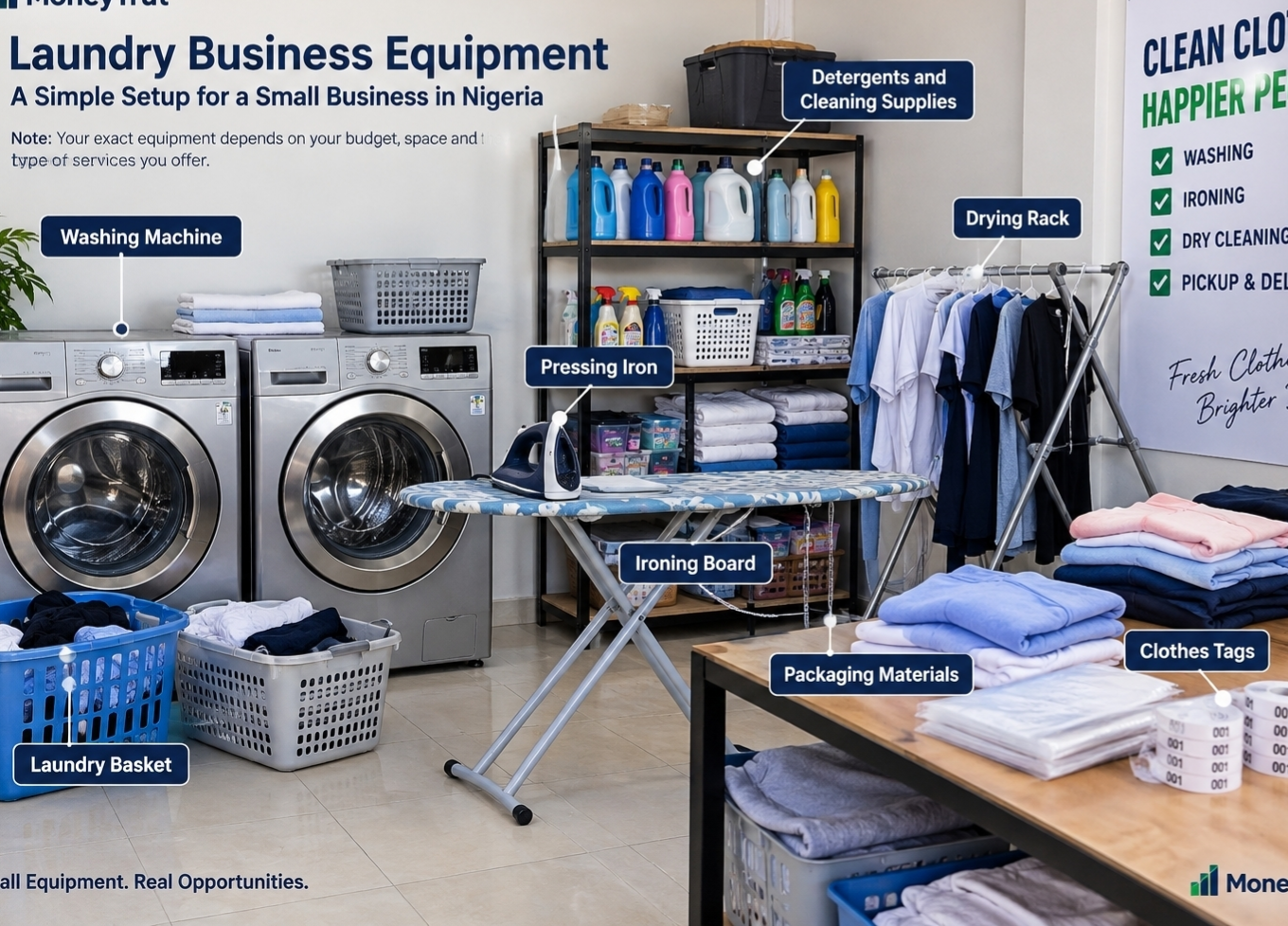
The equipment depends on your business model.
A small laundry operation may need:
- Washing machine
- Pressing iron
- Ironing board
- Drying racks or suitable drying space
- Water storage
- Laundry baskets
- Clothes tags
- Detergent
- Stain removers
- Packaging materials
- Measuring containers
- Hangers
A larger operation may require:
- Multiple washing machines
- Dryers
- Industrial irons
- Steam equipment
- Larger water storage
- Backup power
- More sorting and storage equipment
Do not buy the largest equipment you can afford simply because you have the money.
Buy equipment based on the amount of work you can realistically generate.
Don't Buy Equipment Before Testing Demand
Suppose you have ₦800,000.
You could spend most of it immediately on equipment.
But what if you discover that you only have five customers in your first month?
Your money is now tied up in equipment while your business is still searching for customers.
A better approach may be to determine:
How many customers can I realistically serve?
How many clothes can my current setup handle?
At what point will additional equipment become necessary?
Then expand when demand justifies it.
Water and Power Are Major Operating Issues
Laundry requires water and power.
This is particularly important in Nigeria, where availability and cost can vary significantly by location.
Before opening, determine:
Where will your water come from?
How reliable is the supply?
How much water do your machines require?
What happens when public power is unavailable?
How much will your alternative power source cost to operate?
These are not minor details.
If your machine cannot run because there is no water or power, your customer is still waiting for their clothes.
Calculate the Cost of Washing Clothes
Do not price laundry based only on what competitors charge.
Calculate your costs.
Suppose a particular order costs you:
₦1,500 — detergent and supplies
₦500 — estimated water cost
₦1,000 — power/fuel
₦500 — packaging and other variable costs
Total variable cost:
₦3,500
If you charge ₦6,000:
₦6,000 − ₦3,500 = ₦2,500
That ₦2,500 is not automatically your final profit.
You still need to consider other costs such as:
- Rent
- Staff
- Equipment maintenance
- Transportation
- Marketing
- Phone/data
- Business registration
- Repairs
- Your own time
This is why pricing needs to be based on the entire business.
For more guidance, see How to Price Your Products and Services in Nigeria Without Losing Money.
Don't Copy a Competitor's Price
Suppose another laundry charges ₦5,000 for a particular service.
You may be tempted to charge ₦4,500.
But what if their:
- Rent is lower
- Equipment is already paid for
- Electricity costs are lower
- Customer volume is higher
- Staff costs are lower
Your business could lose money at ₦4,500 even though the competitor is profitable at ₦5,000.
Instead:
Calculate your cost first.
Then compare your price with the market.
Consider Different Pricing Models
You can structure your laundry pricing in several ways.
Per Item
For example:
- Shirt
- Trousers
- Dress
- Suit
- Bedsheet
This can work well when individual garments require different levels of care.
By Weight
You charge based on kilograms.
This can simplify pricing for regular wash-and-fold services.
By Service
You may have different prices for:
- Washing
- Washing and ironing
- Dry cleaning
- Express service
- Pickup and delivery
The best model depends on your customers and the type of laundry you handle.
Charge More for Express Service
A customer who wants clothes returned urgently is asking for more than the standard service.
You could offer:
Standard service
and
Express service
with different prices.
This allows customers who need speed to pay for the additional pressure placed on your operation.
But only offer turnaround times you can actually meet.
A promise of same-day service means little if you repeatedly return clothes late.
Pickup and Delivery Can Be a Strong Selling Point
Convenience can help differentiate a laundry business.
Instead of asking customers to bring clothes to you, you can offer collection and delivery.
But calculate the cost properly.
Suppose a pickup and delivery trip costs you ₦2,000.
If the customer gives you a ₦3,000 order, absorbing the entire transportation cost may leave little or no profit.
You could instead:
- Charge a delivery fee
- Set a minimum order
- Offer free delivery above a certain order value
- Combine multiple nearby pickups into one route
The best approach depends on your numbers.
Focus on Customer Density
One of the easiest ways to make pickup and delivery expensive is to serve customers who are far apart.
Imagine you have 10 customers:
Customer A is in your neighbourhood.
Customer B is 2 km away.
Customer C is 10 km away.
Customer D is 15 km away.
Even if they all place orders, your transportation costs can quickly rise.
A better strategy can be to build a concentrated customer base.
Ten customers within a small area may be more profitable than 30 customers spread across an entire city.
Create a Clothes-Tracking System
This is one of the most important systems in a laundry business.
Every item should be traceable from:
Customer → Intake → Sorting → Washing → Drying → Ironing → Packaging → Delivery
Use tags, numbers, labels or another system that works for your operation.
Record:
- Customer name
- Phone number
- Date received
- Number of items
- Type of items
- Condition of clothes
- Special instructions
- Amount paid
- Expected completion date
- Delivery status
This is where proper business records become especially important.
See How to Keep Business Records in Nigeria.
Check Clothes Before Washing
Do not accept every item without checking its condition.
Look for:
- Existing stains
- Tears
- Missing buttons
- Loose stitching
- Fading
- Delicate materials
- Items in pockets
If necessary, document the condition before processing.
This can help prevent disputes later.
A customer may say:
"This shirt was not damaged when I brought it."
If your intake process recorded the condition, you have something to refer to.
Keep Customer Clothes Separate
Mixing clothes carelessly can create serious problems.
You need a clear system for separating:
- Different customers
- White and coloured items
- Delicate clothes
- Items requiring special treatment
- Clothes ready for delivery
A laundry business is trusted with people's personal property.
Losing or damaging items can cost more than the value of the garment because you can also lose the customer's trust.
Don't Promise What You Cannot Deliver
If your normal turnaround is three days, do not tell every customer:
"Come tomorrow."
A reliable three-day service is better than an unreliable one-day promise.
Set realistic turnaround times.
If an order will be delayed, inform the customer before they start asking where their clothes are.
Communication can prevent a small delay from becoming a major customer-service problem.
How to Get Your First Laundry Customers
You do not need thousands of customers.
Start with your immediate market.
Potential sources include:
- Neighbours
- Estate residents
- Friends and colleagues
- Students
- Offices
- Local businesses
- WhatsApp contacts
- Community groups
You can also offer a simple introductory promotion, but be careful not to build the business around permanent discounts.
Your first goal is to prove:
People will pay for this service.
Use WhatsApp to Market Your Laundry Business
WhatsApp can be useful for a local laundry service.
Use it to show:
- Services
- Prices
- Pickup areas
- Delivery areas
- Turnaround times
- Customer reviews where appropriate
- Before-and-after results where suitable
- Contact information
Make it easy for someone to place an order.
A simple message can be:
"Laundry pickup available in [area]. Same-day and standard services available. Send a message for pricing and pickup."
The message should be clear rather than overloaded with information.
Build Repeat Customers
Laundry has an important advantage:
Customers may need the service repeatedly.
A customer who gives you clothes this week may need the service again next week.
That means customer retention can become a major part of the business.
Focus on:
- Consistent quality
- Reliable turnaround
- Accurate clothes tracking
- Good communication
- Convenient pickup
- Professional packaging
- Fair pricing
Our article How to Get Repeat Customers for a Small Business in Nigeria explains how businesses can turn first-time buyers into repeat customers.
Don't Compete Only on Price
Suppose three laundry businesses operate in the same neighbourhood.
Business A is the cheapest.
Business B is slightly more expensive but returns clothes on time.
Business C charges more but offers pickup and delivery, communicates well and handles clothes carefully.
Many customers will not automatically choose Business A.
Your competitive advantage could be:
Reliability
Convenience
Quality
Speed
Customer service
Specialised garment care
Price is only one part of the decision.
Consider Monthly Laundry Packages
A subscription or package can make revenue more predictable.
For example, you could create a package for a customer who normally gives you laundry every week.
Instead of paying separately every time, the customer pays for an agreed package.
The exact pricing must be based on your actual costs and expected workload.
Do not offer unlimited laundry for a fixed price unless you have carefully calculated the risks.
Build Relationships With Businesses
Household customers are not your only market.
You could approach:
- Small hotels
- Short-let operators
- Restaurants
- Salons
- Spas
- Offices
- Schools
- Clinics
- Gyms
These businesses may have recurring laundry needs.
For example, a small hotel may need towels, bedsheets and other fabrics processed regularly.
The advantage is volume.
The disadvantage is that business customers may demand:
- Consistent quality
- Reliable turnaround
- Invoices
- Formal records
- Specific collection schedules
- Competitive pricing
Make sure you can meet those expectations before accepting a large contract.
Keep Track of Your Daily Numbers
At the end of each day, record:
Number of orders
Number of items
Total sales
Cost of supplies
Delivery costs
Amount collected
Outstanding payments
Complaints
Damaged or missing items
This helps you understand whether the business is improving.
For example, if your sales increase from ₦150,000 to ₦250,000 but your costs increase from ₦100,000 to ₦230,000, the higher revenue has not necessarily made the business healthier.
Revenue alone does not tell the whole story.
Calculate Your Break-Even Point
Suppose your monthly fixed costs are:
₦80,000
Your average contribution per customer order after variable costs is:
₦2,000
Your simplified break-even point is:
₦80,000 ÷ ₦2,000 = 40 orders
You therefore need approximately 40 orders per month to cover those assumed fixed costs.
At 26 operating days:
40 ÷ 26 ≈ 1.5 orders per day
This is only an example.
Your actual break-even point depends on your fixed costs and the contribution generated by your average order.
For a deeper explanation, see How to Calculate the Break-Even Point for a Small Business in Nigeria.
Don't Forget Maintenance
Laundry equipment works under repeated stress.
Washing machines, irons, generators, pumps and other equipment can develop problems.
If you wait until something breaks completely, the repair may cost more and your customers may experience delays.
Set aside money for:
- Routine maintenance
- Repairs
- Replacement parts
- Cleaning
- Equipment replacement
Maintenance is a business expense, not an optional luxury.
Keep a Reserve for Power and Water Problems
Suppose your business normally spends ₦30,000 per month on power.
One month, your alternative power costs increase and you spend ₦50,000.
If your pricing did not account for these changes, your profit could fall sharply.
This is why you should regularly review your costs.
Do not assume that today's operating cost will remain unchanged indefinitely.
Should You Register the Laundry Business?
If you are building a serious business, consider formal registration.
The Corporate Affairs Commission is Nigeria's official corporate registry and provides business-name registration through its online Company Registration Portal. CAC states that individuals and proprietors can register business names through the portal without necessarily using a lawyer, chartered accountant or chartered secretary.
The current CAC process includes checking business-name availability, completing the relevant pre-registration information and paying the applicable filing fee through the official system.
Do not rely on old articles for current CAC fees or procedures.
Check the official CAC portal before paying because fees and processes can change.
Depending on your location and the services you provide, there may also be other local requirements you need to check.
Open a Separate Business Account
Once the business starts receiving regular payments, separating business money from personal money can make your finances easier to understand.
Suppose your laundry business receives:
₦300,000
during a month.
You should know:
How much went to detergent?
How much went to power?
How much went to transport?
How much went to staff?
How much was left?
A separate business account can make this easier to track.
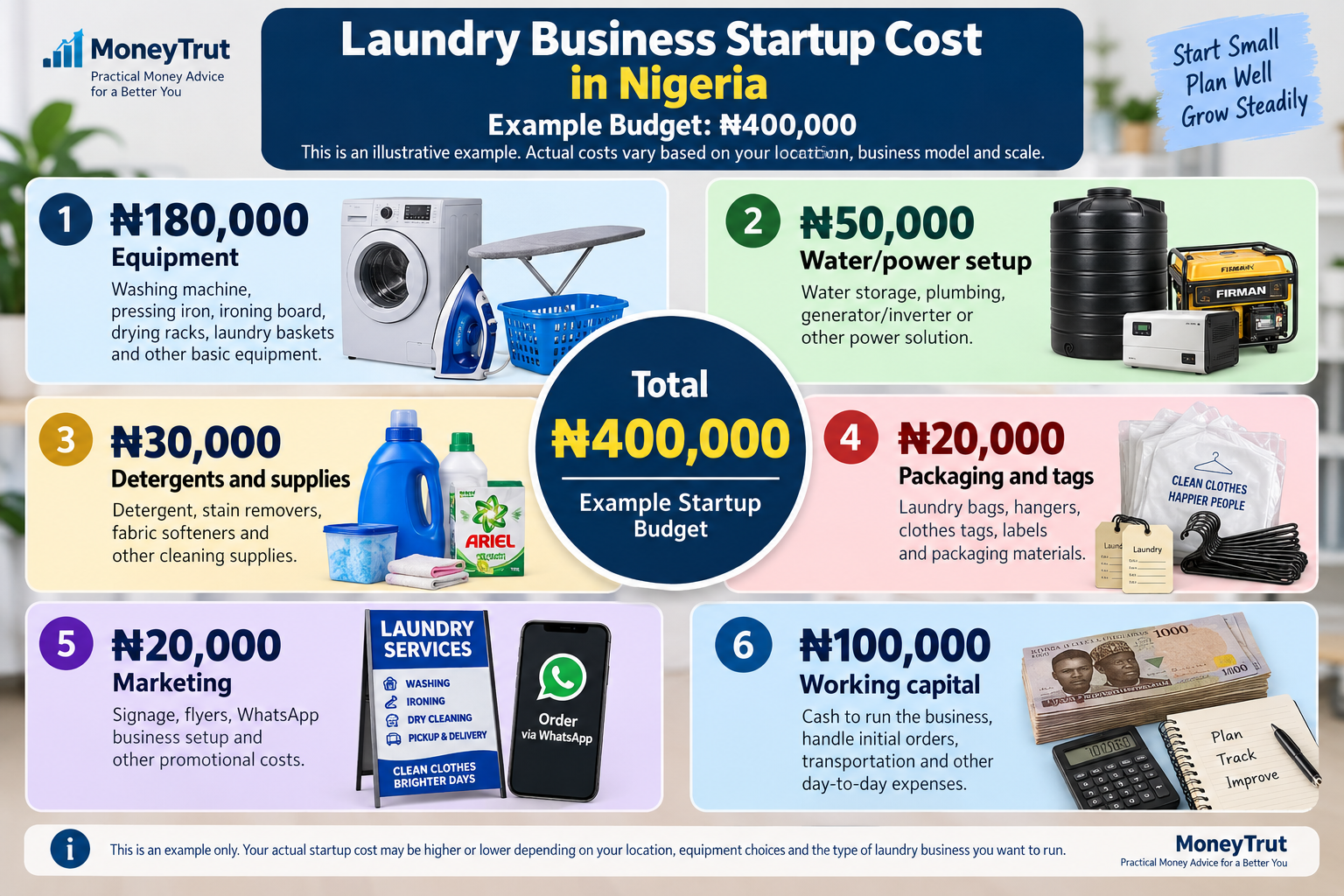
A Simple Example of Starting Small
Suppose you have ₦400,000 available.
You might plan your initial setup like this:
₦180,000 — equipment
₦50,000 — water/power setup
₦30,000 — detergents and supplies
₦20,000 — packaging and tags
₦20,000 — marketing
₦100,000 — working capital
This is an example, not a recommended fixed budget.
If you already own some equipment, your startup cost could be lower.
If you need to rent a shop and buy more equipment, it could be much higher.
The principle is to avoid spending your entire capital on equipment and rent while leaving nothing to operate the business.
A Simple 30-Day Launch Plan
Week 1: Research
Study your area.
Identify competitors.
Speak to potential customers.
Find out what services people want and what they currently pay.
Week 2: Plan Your Costs
List:
- Equipment
- Water
- Power
- Detergent
- Packaging
- Transport
- Registration
- Marketing
- Working capital
Calculate your expected cost per order.
Week 3: Start Small
Begin serving a manageable number of customers.
Track every order.
Test your turnaround time.
Identify problems.
Week 4: Review
Calculate:
- Total sales
- Total costs
- Gross profit
- Number of customers
- Repeat customers
- Average order value
- Complaints
- Damaged items
- Delivery costs
Then decide what needs to change.
Common Laundry Business Mistakes
Buying expensive equipment too early
Equipment should match your current demand.
Renting an expensive shop before testing the market
High fixed costs can put pressure on a new business.
Underpricing
Low prices do not help if every order loses money.
Ignoring power and water costs
These can significantly affect your operating expenses.
Failing to tag clothes
A poor tracking system increases the risk of lost or mixed-up items.
Mixing customer clothes carelessly
Different materials and colours may require different treatment.
Promising unrealistic turnaround times
Late delivery can damage customer trust.
Focusing only on new customers
Repeat customers can become a major source of revenue.
Mixing personal and business money
This makes it difficult to know whether the business is actually profitable.
Is a Laundry Business Profitable in Nigeria?
A laundry business can be profitable, but profitability is not automatic.
It depends on:
- Customer demand
- Pricing
- Operating costs
- Equipment efficiency
- Power and water costs
- Staff costs
- Location
- Customer retention
- Delivery costs
- How efficiently you process orders
The business becomes more attractive when you can process more orders without allowing quality and customer service to deteriorate.
For example, increasing your number of customers from 20 to 50 is useful only if your costs do not increase so much that the additional sales disappear as profit.
What Makes a Laundry Business Successful?
The strongest laundry businesses are not necessarily the ones with the most expensive equipment.
They are often the ones that can consistently deliver:
Clean clothes
Good ironing
Reliable turnaround
Proper clothes tracking
Clear communication
Fair pricing
Convenient service
Good customer care
Customers are trusting you with their clothes.
That trust is part of what you are selling.
Bottom Line
You do not need to start a laundry business with a large shop and several expensive machines.
You can start small, test demand and increase your capacity as the business grows.
Before spending your money, understand your target customers, study your competition, calculate your costs and decide whether a home-based, shop-based or pickup-and-delivery model makes the most sense.
Then build the systems that protect the business:
Track every garment.
Calculate your real costs.
Price for profit.
Control water and power costs.
Communicate clearly.
Deliver on time.
Keep business records.
Build repeat customers.
A laundry business is ultimately a service business. The customer is not only paying you to wash clothes.
They are paying you to take responsibility for their clothes and return them properly, on time and in good condition.
If you can consistently deliver that experience while keeping your numbers under control, you have the foundation for a business that can start small and grow.
Related Articles
- How to Start a Small Business in Nigeria With Little Money
- How to Price Your Products and Services in Nigeria Without Losing Money
- How to Keep Business Records in Nigeria: A Simple System for Small Businesses
- How to Calculate the Break-Even Point for a Small Business in Nigeria
- How to Get Repeat Customers for a Small Business in Nigeria

You must be logged in to post a comment.