
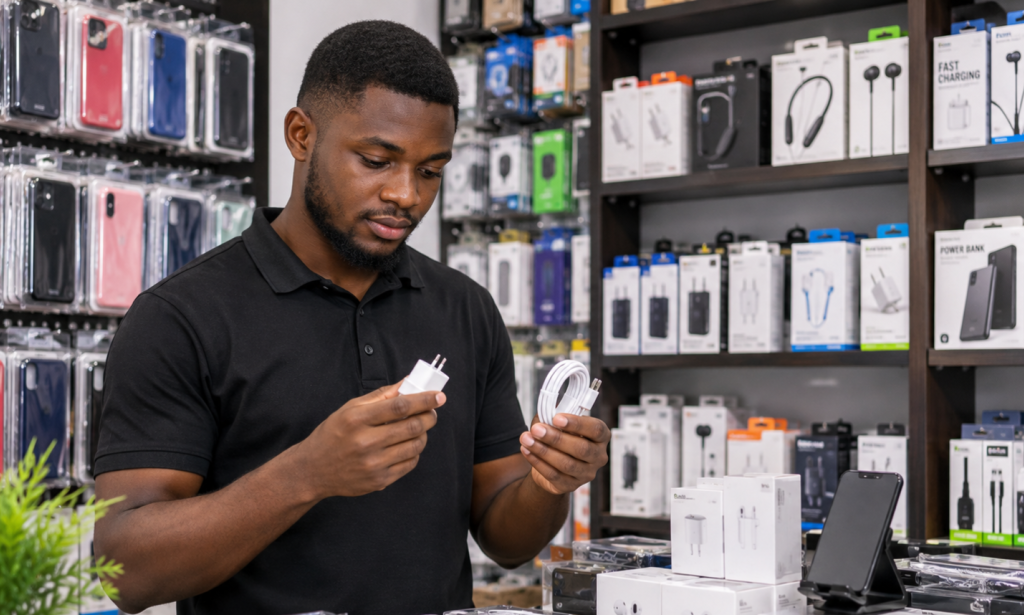
Starting a phone accesories business in Nigeria can be done on a small scale, but buying a few chargers and phone cases is not enough to make the business work. You need to know which products customers actually need, where to source them, how to identify quality products, how to price them and how much money to keep available for restocking.
Nigeria has a large and active mobile market. The Nigerian Communications Commission reported about 194.9 million active telephony connections in July 2026, while mobile GSM internet subscriptions were about 157.3 million. That does not mean every connection belongs to a unique person, but it shows the size of the market surrounding mobile devices and the services and accessories used with them.
If you are considering starting this business, the real question is not simply, “Is phone accessories business profitable?”
It is:
Can you buy the right products at a cost that allows you to sell competitively while still making enough margin to cover your operating expenses and restock?
What Is a Phone Accessories Business?
A phone accessories business involves selling products that support, protect, charge or improve the use of mobile phones and related devices.
Common products include:
- USB charging cables
- Phone chargers
- Screen protectors
- Phone cases
- Earphones and earbuds
- Power banks
- Car phone holders
- Phone stands
- Wireless chargers
- OTG adapters
- Memory cards
- SIM-related accessories
- Cleaning kits
- Charging adapters
- Small Bluetooth accessories
You do not need to sell all of these products when starting.
In fact, carrying too many products too early can tie up your capital in stock that may take months to sell.
Your objective should be to identify the products with reliable demand in your particular market.
Why People Buy Phone Accessories
Phone accessories are different from many other retail products because some purchases are planned while others are caused by an immediate problem.
A customer may need a new cable because the old one stopped working.
Someone may need a screen protector immediately after buying a new phone.
Another customer may have lost a charger.
Someone may want a phone case because they bought a new device.
A driver may need a car phone holder.
A student may need inexpensive earphones.
These situations create different types of demand.
The opportunity for the business owner is to understand which problems occur frequently in the area being served.
How Much Money Do You Need to Start?
There is no single amount required to start a phone accessories business.
Your capital depends on whether you want to sell from home, online, from a small table, a kiosk or a full shop.
It also depends on whether you are buying from local wholesalers or importing your stock.
For example, someone starting with ₦100,000 may need to focus on a very small selection of lightweight, fast-moving products.
Someone with ₦300,000 may have more flexibility to carry several product categories.
Someone with ₦1 million may be able to build a broader inventory and operate from a more structured retail location.
But having more capital does not mean you should spend all of it on stock.
Suppose you have ₦500,000 available.
You could decide to use:
- ₦250,000 for initial inventory
- ₦50,000 for display, packaging and basic setup
- ₦50,000 for transportation and marketing
- ₦150,000 as working-capital reserve
These numbers are only an illustration.
Your actual allocation should depend on your location, product prices, rent, expected sales and business model.
The important principle is:
Do not confuse available money with money you should spend immediately.
Decide Where You Will Sell
There are several ways to operate a phone accessories business.
1. Physical shop
You rent a shop where customers can walk in and purchase products.
The advantage is visibility.
Customers can see the products, compare options and make immediate purchases.
The disadvantage is that rent, electricity, security, furniture and other expenses increase your monthly operating costs.
2. Kiosk or small retail space
A smaller location can reduce some startup expenses.
This can work particularly well in areas with regular pedestrian traffic.
The challenge is that you have less display and storage space.
3. Home-based business
You can keep inventory at home and sell through WhatsApp, social media, referrals and direct delivery.
This can reduce fixed costs, but you need a reliable way to reach customers.
4. Online-first business
You can sell through WhatsApp Business, Instagram, TikTok, Facebook Marketplace, Jiji or your own website.
This can allow you to test demand before paying for a physical shop.
5. Combination model
You can combine a physical location with online sales.
For example, a customer may discover your product on social media and then visit your shop to collect it.
There is no universally correct model.
Choose the one that fits your capital, location, customers and operating ability.
Choose Your Target Customers
Do not try to sell to everyone at the beginning.
Your target customers could include:
- Students
- Office workers
- Drivers
- Small business owners
- Smartphone users in residential areas
- Corporate employees
- Retail shops
- Other phone-accessories sellers
Your location should influence your product selection.
For example, an area dominated by students may have stronger demand for affordable cables, screen protectors, earphones and phone cases.
An area with many drivers may create opportunities for car chargers and phone holders.
A business district may have customers looking for reliable charging products, power banks and premium accessories.
Study the people around you before buying inventory.
Which Phone Accessories Should You Sell?
This is one of the most important decisions you will make.
Do not start by asking:
“Which accessory has the highest profit?”
Ask:
“Which accessories do people in my target market regularly need and replace?”
Charging cables
Cables can be frequent replacement products.
However, quality varies significantly.
A cable that fails after a few days may produce complaints and damage your reputation.
Chargers
Customers often care about charging speed, compatibility and reliability.
Avoid making technical claims about charging performance unless you understand the specifications of the product.
Screen protectors
These can be attractive because they are relatively small and easy to store.
However, you need to understand the phone models common in your area.
Stocking protectors for unpopular models can leave your money tied up.
Phone cases
Cases can sell well, but demand is highly model-dependent.
You may have a beautiful case that nobody in your area needs.
This is why you should study the phones people actually use before buying large quantities.
Earphones and earbuds
These products can have strong demand, but quality differences can be significant.
Test products before buying large quantities where possible.
Power banks
Power banks can represent a larger sale than basic cables or cases.
They also require more careful product selection because customers expect the product to perform as advertised.
Car accessories
Car phone holders and charging accessories can provide another customer segment.
They can work particularly well when sold near transport-heavy areas or alongside other mobile accessories.
Start With Fewer Products
One of the easiest mistakes to make is buying too many different products.
Imagine you have ₦300,000.
You could buy:
- 20 types of cables
- 15 types of cases
- 10 types of chargers
- 10 types of earbuds
- several power banks
- several phone holders
- screen protectors for dozens of phone models
You may end up with a shop that looks full but a cash position that is weak.
Instead, start with a smaller selection.
For example:
- a few common cable types
- selected chargers
- popular screen protectors
- selected phone cases
- a small number of earphones
- a few phone holders
Then monitor sales.
If one product sells quickly, increase the quantity.
If another product remains untouched for months, stop buying it.
Local Sourcing vs Importing
You can source phone accessories locally or import them.
Buying from Nigerian wholesalers
The major advantage is speed.
You can inspect the goods before purchasing and restock quickly.
You also avoid some of the complexity associated with international shipping.
The disadvantage is that your purchase price may be higher than the supplier price available directly from an overseas manufacturer or wholesaler.
Importing
Importing can potentially reduce the unit cost when you buy in larger quantities.
But the supplier price is not your final cost.
You need to consider:
- Product cost
- International shipping
- Freight charges
- Applicable customs or import-related costs
- Local delivery
- Payment costs
- Damaged goods
- Exchange-rate changes
- Packaging
- Marketing
- Returns
MoneyTrut's guide on mini importation explains why calculating landed cost is important before placing an overseas order.
For a beginner, local sourcing can sometimes be a useful way to understand what sells before taking on additional importation risk.
How to Check Product Quality
Price should not be your only consideration.
Two chargers may look almost identical but perform very differently.
Two cables may have similar packaging but different durability.
Two power banks may have completely different performance.
Before buying significant quantities, examine:
- Build quality
- Packaging
- Product specifications
- Connector quality
- Cable flexibility
- Charging performance
- Warranty or return terms
- Supplier reputation
- Customer feedback
Where practical, buy samples first.
Testing ten units before committing to 100 can save you from a much larger inventory problem.
Be Careful With Counterfeit Products
A low price can be attractive, but counterfeit or falsely branded products can create problems.
If a product carries a brand name, make sure you understand what you are actually buying.
Do not present an unbranded product as an original branded product.
Customers who believe they bought an original product but receive a counterfeit may demand refunds, leave negative reviews or stop buying from you.
Trust is part of your inventory.
A business that makes a little less margin but develops a reputation for selling products honestly may have a stronger foundation than one that maximizes margin through questionable products.
Calculate Your Real Cost Before Pricing
This is where many small retailers make mistakes.
Suppose you buy 50 charging cables.
Product cost:
₦2,500 × 50 = ₦125,000
Transportation and other direct costs:
₦10,000
Your total direct cost is:
₦135,000
Your cost per cable is:
₦135,000 ÷ 50 = ₦2,700
If you sell each cable for ₦4,000:
Revenue:
₦4,000 × 50 = ₦200,000
Gross margin before other operating expenses:
₦200,000 − ₦135,000 = ₦65,000
But that ₦65,000 is not automatically your final business profit.
You may still have:
- Rent
- Electricity
- Staff costs
- Advertising
- Delivery
- Packaging
- Damaged products
- Returns
- Transaction costs
- Other operating expenses
This is why pricing based only on the supplier's purchase price can make a business appear more profitable than it really is.
For a deeper explanation of pricing, see MoneyTrut's guide on how to price products and services in Nigeria.
Don't Confuse Markup With Profit
Suppose you buy an item for ₦3,000 and sell it for ₦5,000.
You made ₦2,000 before other costs.
But saying “I made ₦2,000 profit” may be inaccurate if you spent money transporting the product, advertising it or delivering it.
There is an important difference between:
Selling price − purchase price
and:
Revenue − all relevant business costs
The second calculation gives you a much better picture of profitability.
Manage Your Inventory Carefully
Inventory is money.
If you spend ₦500,000 on stock, you have not simply “spent” ₦500,000.
You have converted cash into products that must eventually be sold.
That creates an important question:
How quickly can you turn your inventory back into cash?
A product that gives you a large margin but takes six months to sell may be less useful to a small business than a product with a smaller margin that sells every week.
This is why inventory turnover matters.
Track:
- Quantity purchased
- Purchase price
- Quantity sold
- Selling price
- Remaining stock
- Damaged items
- Returned items
- Date purchased
- Date sold
You will gradually discover which products deserve more of your capital.
Keep Popular Phone Models in Mind
Phone accessories are particularly sensitive to device models.
If you stock phone cases and screen protectors, you need to understand what devices are common in your market.
Do not assume that a product will sell simply because it is popular somewhere else.
Before buying a large quantity, visit local phone shops and markets.
Ask:
- Which phone models do customers commonly request?
- Which accessories sell fastest?
- Which products are difficult to find?
- Which products have many complaints?
- Which accessories do customers frequently replace?
Your local market can give you better information than a generic list of “best-selling accessories” online.
Where Can You Find Suppliers?
Depending on your business model, you can research:
- Local wholesale markets
- Nigerian distributors
- Importers
- Manufacturer representatives
- Online B2B marketplaces
- Overseas suppliers
- Established electronics wholesalers
Do not choose a supplier simply because the price is lowest.
Compare:
- Unit price
- Minimum order quantity
- Product quality
- Delivery time
- Return policy
- Communication
- Consistency
- Payment terms
A supplier who is slightly more expensive but consistently delivers acceptable products may be more valuable than one who offers the lowest price but unreliable quality.
How to Get Your First Customers
You do not need thousands of followers to sell phone accessories.
Start with the people around your target market.
Possible channels include:
Create a proper WhatsApp Business catalogue.
Use clear product photographs and prices.
Social media
Show the actual products you have.
Short videos can demonstrate:
- Cable quality
- Charging performance
- Phone cases
- Screen protectors
- Power banks
- New stock
Physical visibility
If you operate from a shop or kiosk, make the products easy to see.
Referrals
A satisfied customer can introduce another customer.
Partnerships
You could build relationships with:
- Phone repairers
- Phone sellers
- Cybercafés
- Small electronics shops
- Corporate offices
- Student communities
A phone repairer, for example, may encounter customers who need a cable, charger, screen protector or phone case immediately.
Consider Selling to Other Businesses
You do not necessarily have to sell only to individual consumers.
You can also supply smaller retailers.
For example, suppose you import 100 cables.
You might sell 60 directly to consumers and supply 40 to smaller retailers at a wholesale price.
Your margin per unit may be lower on wholesale sales, but the transaction can move more inventory at once.
This connects the phone-accessories business with the broader wholesale-distribution model.
MoneyTrut's guide on starting a wholesale distribution business explains some of the principles involved in buying in volume and supplying other businesses.
How to Start With ₦200,000
Suppose you have ₦200,000 available.
You could create an illustrative starting structure such as:
₦100,000 — initial inventory
₦20,000 — transportation and sourcing
₦15,000 — packaging and basic display
₦15,000 — marketing
₦50,000 — reserve and working capital
This is not a recommended fixed budget.
The actual allocation depends on the products, location and sourcing arrangement.
The key idea is to avoid putting the entire ₦200,000 into inventory on day one.
If your first products sell quickly, you can reinvest.
If they do not sell, you still have money available to change direction.
What If You Have ₦500,000?
With ₦500,000, you could potentially carry a wider range of products.
But resist the temptation to buy everything.
A more disciplined approach might be:
Phase 1: Test a small number of product categories.
Phase 2: Track sales for several weeks.
Phase 3: Identify fast-moving products.
Phase 4: Reduce slow-moving stock.
Phase 5: Increase orders for products with proven demand.
This is much safer than trying to create a large inventory simply because you have the money.
Should You Rent a Shop?
Not necessarily.
A shop can improve visibility, but it also creates fixed costs.
Before renting, calculate:
Monthly shop expenses + electricity + staff + transport + other overheads
Then ask:
How many products must I sell each month just to cover those costs?
For example, if your average contribution after product cost is ₦1,500 per item and your monthly fixed operating expenses are ₦150,000, you would need:
₦150,000 ÷ ₦1,500 = 100 items
That means you need to sell approximately 100 items just to cover those assumed fixed costs.
This does not mean 100 items guarantees profitability. It simply illustrates how break-even thinking can change a business decision.
Before renting a shop, calculate your own break-even point.
Common Mistakes to Avoid
Buying too much stock
More inventory does not automatically mean more profit.
Chasing the highest markup
A high markup is useless if customers refuse to buy at that price.
Selling poor-quality products
Complaints and returns can destroy customer trust.
Stocking too many phone models
Slow-moving cases and screen protectors can tie up your capital.
Renting an expensive shop too early
Your business may not yet generate enough cash to support the rent.
Mixing personal and business money
You may think the business is making money when you are actually consuming its working capital.
Giving customers too much credit
A sale on paper is not the same as cash in your account.
Ignoring small expenses
Transport, packaging, delivery and small losses can reduce your actual margin.
Buying because a product is trending
A product that is popular on social media may not have sustained demand in your local market.
Expanding before understanding your numbers
Do not increase inventory simply because one week was good.
Look for consistent sales.
Keep Simple Business Records
You should be able to answer these questions at any time:
- How much stock do I have?
- How much did I pay for it?
- How much have I sold?
- How much cash have I collected?
- How much do customers owe me?
- How much do I owe suppliers?
- What are my monthly expenses?
- Which products sell fastest?
- Which products are barely moving?
- How much profit did I actually make?
You do not need complicated accounting software to begin.
A spreadsheet or simple record system can be enough for a small operation.
As the business grows, your record-keeping system should grow with it.
How to Scale the Business
Once you understand your best-selling products, you can gradually increase your purchasing volume.
You could move from:
Small stock → repeat orders → larger wholesale purchases → direct importing → business-to-business supply
But scaling should be based on evidence.
Before increasing your inventory, ask:
- Are sales consistent?
- Are customers returning?
- Is the product quality stable?
- Is the supplier reliable?
- Is the margin still attractive at higher volume?
- Can I sell the larger quantity quickly?
- Will the extra inventory put pressure on my cash flow?
If the answer to several of these questions is no, increasing your stock may simply increase your risk.
Can Phone Accessories Be a Side Hustle?
Yes, depending on the business model.
You could operate a small inventory business alongside a full-time job by selling through WhatsApp, social media and your existing network.
You could also supply products to other retailers rather than spending every day behind a shop counter.
However, a side business still requires proper record keeping.
If you cannot monitor your inventory, customer payments and cash flow, the business can become difficult to control.
MoneyTrut's guide on starting a side hustle while working full-time covers the broader issues involved in managing a business alongside employment.
A Practical 30-Day Starting Plan
Week 1: Research
Visit local phone shops and markets.
Identify common phone models and frequently requested accessories.
Record competitor prices.
Talk to potential customers.
Week 2: Supplier research
Identify several suppliers.
Compare prices and quality.
Buy samples where practical.
Calculate your complete cost.
Week 3: Test sales
Start with a small inventory.
Create your WhatsApp catalogue.
Post products online.
Tell people around your target market.
Record every sale.
Week 4: Review
Calculate:
- Total sales
- Product costs
- Operating expenses
- Gross margin
- Actual profit
- Remaining inventory
Then decide what to reorder.
Do not automatically reorder everything.
Reorder the products that have demonstrated demand.
Final Checklist Before Starting
Before putting your money into a phone accessories business, make sure you can answer:
Products
- Which accessories will I sell?
- Which phone models am I targeting?
- Why will customers buy these products?
Suppliers
- Who will supply me?
- Have I tested the product quality?
- Can the supplier maintain consistent quality?
Money
- How much capital can I safely invest?
- How much working capital will remain?
- What is my true cost per product?
- What is my break-even point?
Sales
- Where will I find customers?
- Will I sell online, offline or both?
- How will customers pay?
- How will I handle delivery?
Inventory
- Which products are fast-moving?
- How much stock should I keep?
- How will I record purchases and sales?
If you cannot answer these questions, spend more time researching before committing significant capital.
Bottom Line
A phone accessories business can be started on a small scale in Nigeria, but success is not simply about buying cheap products and selling them at a higher price.
The real business is choosing products people actually need, sourcing reliable stock, protecting your reputation, pricing correctly and keeping your capital moving.
Start with a focused inventory.
Test demand before buying heavily.
Calculate your real cost rather than looking only at the supplier's price.
Keep enough working capital to restock.
Track which products sell and which ones remain on the shelf.
And do not rent an expensive shop or import a large shipment simply because you have enough money to do so.
The goal is not to have the biggest collection of accessories.
The goal is to build a business that can repeatedly turn inventory into sales, sales into cash and cash into sustainable profit.
Related Articles
- How to Start a Small Business in Nigeria With Little Money
- How to Start a Mini Importation Business in Nigeria: A Practical Beginner's Guide
- How to Price Your Products and Services in Nigeria Without Losing Money
- How to Get Customers for a Small Business in Nigeria: Practical Ways That Work
- How to Manage Cash Flow in a Small Business in Nigeria

You must be logged in to post a comment.